Tree profile
Ash trees (Fraxinus): how to identify them
Opposite, pinnately compound leaves are the first check. Then the bark, the leaf scars and the seeds tell white, green and black ash apart.
In short
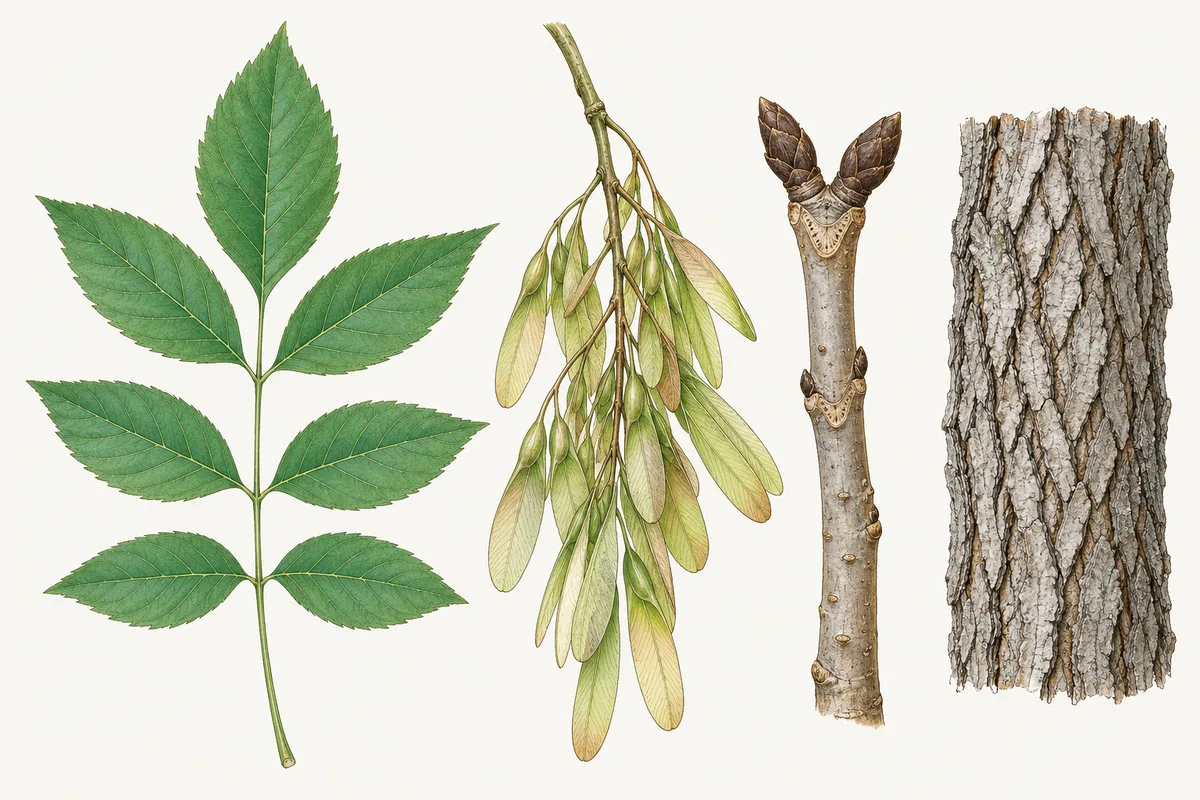
Ash tree identification starts with branching: ash leaves and twigs grow in opposite pairs, and each leaf is pinnately compound, usually with 7 to 11 leaflets. Confirm with the bark, ashy gray with interlacing ridges that form diamonds, and with the seed, a single-winged paddle-shaped samara hanging in clusters. Hickories and walnuts also have compound leaves, but theirs alternate; boxelder is opposite but has only 3 to 5 leaflets.
- Opposite plus compound narrows a large tree to ash or boxelder; hickories, walnuts and sumacs are all alternate.
- White ash: lateral buds sit in a notch of a U-shaped leaf scar. Green ash: buds sit on top of a flat-topped scar.
- Emerald ash borer leaves D-shaped exit holes and kills branches from the top of the crown down.
Field marks at a glance
- Scientific name
- Fraxinus
- Family
- Oleaceae (olive family)
- Type
- Broadleaf, deciduous
- Leaves
- Opposite, pinnately compound: white ash 8 to 12 inches with about 7 leaflets; green ash 6 to 9 inches with 7 to 9; black ash 10 to 14 inches with 7 to 11 stalkless leaflets.
- Twigs and buds
- Stout, opposite twigs. Buds brown on white and green ash, nearly black on black ash. The leaf scar shape separates white ash (notched) from green ash (flat-topped).
- Bark
- Ashy gray to brown with interlacing corky ridges that form obvious diamonds on white and green ash; black ash bark is scaly to corky, gray-brown.
- Seeds
- A single-winged, flattened samara (paddle) in hanging clusters, maturing in fall and often hanging on into winter. Most ash trees are either male or female, so only some trees carry seeds.
- Flowers
- Small, without petals, light green to purplish, in clusters that open with or just before the leaves in spring.
- Size
- White ash up to about 80 ft; green ash 50 to 60 ft in the north and up to 120 ft on good southern sites; black ash commonly 60 to 70 ft.
- Range
- White ash from Nova Scotia to northern Florida, west to eastern Minnesota and eastern Texas. Green ash, the most widespread, reaches west to Alberta and Montana. Black ash is northern.
- Habitat
- White ash on rich, moist, well-drained slopes; green ash on bottomlands and stream banks and widely planted in towns; black ash in northern swamps.
Ash trees (Fraxinus) are among the most common large trees in eastern and central North America, and one of the easiest groups to name once you know where to look. Two checks put a tree in the genus: opposite branching and pinnately compound leaves. Three more (leaf scar, seed and habitat) separate white, green and black ash.
The two-step check: opposite branching, then compound leaves
1. Look at how the leaves and twigs pair up. On an ash, every leaf and every side twig has a partner directly across the stem. The trees most often mistaken for ash (hickories, walnuts, sumacs, tree of heaven) are all alternate: their leaves step up the twig one at a time.
2. Look at the leaf. An ash leaf is pinnately compound: a central stalk carries pairs of leaflets and ends in a single leaflet. The Virginia Tech white ash fact sheet gives about 7 leaflets on a leaf 8 to 12 inches long; green ash has 7 to 9 leaflets on a 6- to 9-inch leaf; black ash has 7 to 11 on a leaf 10 to 14 inches long. Opposite plus pinnately compound points to ash, or to boxelder, a maple with compound leaves that Virginia Tech lists as an ash look-alike (see the look-alike box).
3. Confirm with bark and seeds. On a mature white or green ash the bark is ashy gray to brown with interlacing corky ridges that form obvious diamonds. The fruit is a single-winged samara, like a small canoe paddle, hanging in clusters from fall into winter. Ash trees are mostly male or female, so a tree with no seeds can still be an ash.
When the leaves are out of reach, a photo of a leaf from a low branch, or of the bark at chest height, is enough for Tree Identifier to suggest a name. The app shows no confidence score and no list of look-alikes, so confirm its answer with the opposite-branching check above. The European ash (Fraxinus excelsior) is in the app's Collection; the North American ashes on this page are not listed there, though a photo can still return their names.
White ash vs green ash vs black ash
These are the three ashes most people meet in the eastern United States. The table draws on the Virginia Tech fact sheets for white ash, green ash and black ash, and on the USDA Forest Service's Silvics of North America.
| Feature | White ash (F. americana) | Green ash (F. pennsylvanica) | Black ash (F. nigra) |
|---|---|---|---|
| Leaf | 8–12 in, about 7 leaflets | 6–9 in, 7–9 leaflets | 10–14 in, 7–11 leaflets |
| Leaflets | Stalked, slightly paler below | Stalked, smooth to silky below | Stalkless (sessile), tufts of brown hair below |
| Leaf scar and bud | Scar notched at the top, side bud sits in the notch | Scar flat-topped or semicircular, bud sits on top | Scar nearly circular, buds nearly black |
| Seed | Seed cavity full and rounded | Seed cavity slender and thin | Wide wing, indistinct seed cavity |
| Bark | Diamond ridges, scaly when old | Diamond ridges, somewhat scaly when old | Scaly to corky, gray-brown |
| Typical place | Rich, moist, well-drained slopes | Bottomlands and stream banks; widely planted | Northern swamps and wet woods |
The leaf-scar test is the one to learn. Pull a leaf off in late summer, or look at last year's scars in winter. If the scar is shaped like a U or a smile with the bud tucked inside, it is white ash. If the top of the scar is flat and the bud sits on it like a ball on a tee, it is green ash.
Range helps too. The Forest Service maps white ash from Cape Breton Island, Nova Scotia, to northern Florida, and west to eastern Minnesota and eastern Texas. Green ash is the most widely distributed American ash, reaching from Nova Scotia west to southeastern Alberta and south to southeastern Texas. Black ash ranges from western Newfoundland to southeastern Manitoba and eastern North Dakota, south only to Iowa, southern Indiana and West Virginia. A wet northern woodland with a slender ash in it points to black ash; the Forest Service records it as the only ash native to Newfoundland, also called basket ash because its wood splits easily into strips.
Ash look-alikes: hickory, walnut, boxelder and elm
People most often confuse ash with trees that share one of its traits, compound leaves or diamond-patterned bark. The quickest separations:
- Hickory and walnut have compound leaves too, but they are alternate: look along the twig and the leaves step up one at a time. Both bear nuts in husks, never winged seeds. See hickory and walnut for their own field marks.
- Boxelder is the one that catches careful people, because it is opposite and compound. Count the leaflets: boxelder has 3 to 5, coarsely toothed and often lobed like a maple leaf, on green to purplish twigs dusted with a whitish bloom. Its seeds come in V-shaped pairs.
- Elm shares the gray, diamond-furrowed bark, which is why "elm vs ash" is a common question in winter. Elm leaves are simple and alternate with a lopsided base, and elm buds sit slightly to one side of a slender, zigzag twig. Ash twigs are stout and opposite. A thin chip of elm bark shows alternating buff and reddish-brown layers, a test Virginia Tech gives for American elm.
Ash in winter
With the leaves gone, the opposite arrangement is still there in the twigs and buds. On a white or green ash, look for:
- Stout twigs with a large brown end bud flanked by two side buds.
- Leaf scars in opposite pairs, shaped as in the table above.
- Seed clusters still hanging on female trees: the Forest Service notes that white ash seeds fall between September and December, and Virginia Tech that green ash samaras disperse over winter.
Black ash is easy in winter if you see its buds: nearly black, with the first pair of side buds set some distance below the end bud. The winter tree identification guide covers bud and leaf-scar reading for other genera.
Emerald ash borer: what you will see on the tree
Emerald ash borer (Agrilus planipennis) is an invasive wood-boring beetle from Asia. USDA APHIS reports that it was first detected in North America in 2002 in southeast Michigan and had been found in 38 states and the District of Columbia when we read the page on October 21, 2026. A Forest Service pest alert states that in North America it infests all species of ash.
What a passer-by can see, according to those two USDA sources:
- D-shaped exit holes in the bark, where adults emerge in May and early June. The native redheaded ash borer, by contrast, leaves a round hole.
- S-shaped galleries under the bark, visible where bark has split or been peeled.
- Dead branches near the top of the crown, the crown thinning from the top down.
- Vertical splits in the bark.
- Sprouts on the trunk (epicormic branching).
- Woodpecker damage: woodpeckers strip the outer bark to reach the larvae, leaving pale patches.
The Forest Service warns that damage may not be apparent for up to three years after a tree is infested, and that drought, ash yellows and native borers can also stress ash. It also notes that the six-spotted green tiger beetle, often seen on hiking trails, is frequently mistaken for the borer. If you think you have found emerald ash borer, APHIS asks for a report through its website or at 1-866-322-4512, and both agencies ask people to buy firewood locally rather than move it. Treatment decisions belong with a certified arborist or your state forestry agency.
Tree Identifier's Diagnose tool can describe what it sees in a photo of a declining tree, but a report to APHIS or your state agency is what confirms the borer. If you are tracking particular ash trees, the app's Tree Map keeps each located identification so you can return to the same tree next season.
European ash (UK and Ireland)
In Britain and Ireland the ash is European ash, Fraxinus excelsior, which the Woodland Trust calls the third most common tree in Britain. It passes the same two checks as the American ashes: opposite branching and pinnately compound leaves, here with 3 to 6 opposite pairs of oval leaflets plus one at the tip. It grows to about 35 m (115 ft), its bark is pale brown to gray and fissures with age, and its winged seeds, called keys, appear in late summer and autumn.
The tell is the bud. European ash has black, velvety buds in opposite pairs, unlike the brown buds of white and green ash. Black ash in North America also has nearly black buds, but it grows in northern swamps on the other side of the Atlantic and has stalkless leaflets, so place settles that one.
European ash is also the tree behind the "ash dieback" in British news. Forest Research describes it as a disease caused by the fungus Hymenoscyphus fraxineus, of eastern Asian origin, first confirmed in the UK in February 2012 and now present in most of the UK and in Ireland. It notes blackened, wilting leaves and shoots, typically July to September, and dark diamond-shaped lesions on branches and trunks. For identification, that means a European ash in summer may have a thin crown and dead shoots; diagnosis and management belong with Forest Research guidance and a qualified arborist.
Why ash matters
White ash is the most common and useful native ash, according to the Forest Service: its wood is tough, strong and resistant to shock, and it has long been used for tool handles, oars and baseball bats. Wood duck, bobwhite, purple finch, pine grosbeak and fox squirrel eat its seeds. Green ash, hardy to climatic extremes, has been planted widely across the Plains and in towns, which is why so many street and yard trees are ashes. For the general method that works on any tree, see how to identify trees.
Look-alikes and how to tell them apart
Hickories (Carya)
Hickory leaves and buds alternate along the twig, never in pairs. Hickories bear a nut in a husk instead of winged seeds, and shagbark hickory's bark peels in long strips, unlike ash's tight diamond ridges.
Black walnut (Juglans nigra)
Walnut leaves alternate and carry 10 to 24 leaflets, far more than an ash. Slice a walnut twig lengthwise and its pith shows a ladder of small chambers. Walnut drops a round green husked nut, not samaras.
Boxelder (Acer negundo)
Boxelder is also opposite and compound, but has only 3 to 5 (sometimes 7) coarsely toothed, often lobed leaflets, green to purplish twigs with a whitish bloom, and paired V-shaped maple seeds instead of single paddles.
American elm (Ulmus americana)
Elm bark also shows diamond-shaped fissures, but elm leaves are simple, alternate and lopsided at the base. Cut a small chip of elm bark: Virginia Tech notes alternating buff and reddish-brown layers.
What a photo can't settle
- White ash and green ash overlap in leaflet count and bark; the leaf scar and seed cavity are the dependable differences, and both need a close look at a twig or seed in hand. A photo of a whole tree can name the genus but rarely the species.
- Pumpkin ash, which the USDA Forest Service describes as a likely cross of green and white ash, has larger leaves, twigs and fruit that resemble one parent or the other, so some trees will not fit any of the three profiles here.
- A thinning crown is not proof of emerald ash borer: the Forest Service notes drought, ash yellows and native borers also stress ash. Only the D-shaped holes and S-shaped galleries are specific signs.
Questions people ask
How do you identify an ash tree by its bark?
On mature white and green ash the bark is ashy gray to brown, with interlacing corky ridges that form an obvious diamond pattern. Black ash bark is scalier and more corky. Bark alone can mislead, because elm shows diamond fissures too, so confirm with opposite branching and compound leaves.
How do you identify an ash tree in winter?
Look for stout twigs with buds and leaf scars in opposite pairs, plus bunches of paddle-shaped seeds left on female trees. Then read the leaf scar: white ash scars are notched with the bud sitting in the notch, green ash scars are flat-topped with the bud on top, and black ash buds are nearly black.
What is the difference between hickory and ash trees?
Branching settles it. Ash leaves and buds come in opposite pairs; hickory leaves and buds alternate. Hickories also bear husked nuts instead of winged seeds, and their leaf scars are three-lobed. Shagbark hickory's peeling bark is nothing like an ash's tight diamonds.
How do you tell a young ash tree from other saplings?
A sapling shows the same opposite, pinnately compound leaves as a mature ash, while its bark is still smooth. Count leaflets and check the arrangement: boxelder saplings are also opposite but have only 3 to 5 coarsely toothed leaflets and green, often bloomy twigs.
What are the signs of emerald ash borer on an ash tree?
USDA APHIS and the Forest Service list D-shaped exit holes in the bark, S-shaped tunnels under it, dead branches at the top of the crown, vertical bark splits, sprouts on the trunk and more woodpecker activity. Damage may not show for up to three years. Report suspected cases to APHIS or your state agency.
Sources
- White ash fact sheet — Virginia Tech Dendrology
- Green ash fact sheet — Virginia Tech Dendrology
- Black ash fact sheet — Virginia Tech Dendrology
- White Ash (Fraxinus americana), Silvics of North America — USDA Forest Service
- Green Ash (Fraxinus pennsylvanica), Silvics of North America — USDA Forest Service
- Black Ash (Fraxinus nigra), Silvics of North America — USDA Forest Service
- Emerald Ash Borer — USDA Animal and Plant Health Inspection Service (APHIS)
- What is the Emerald Ash Borer? (Pest alert NA-PR-05-04, reprinted May 2015) — USDA Forest Service, Northeastern Area State and Private Forestry