Winter field guide
Winter tree identification, from buds to bark
How to name a bare tree from its twigs, buds, leaf scars, bark and whatever fruit or dead leaves it kept, with a twig key for 12 common eastern US trees.
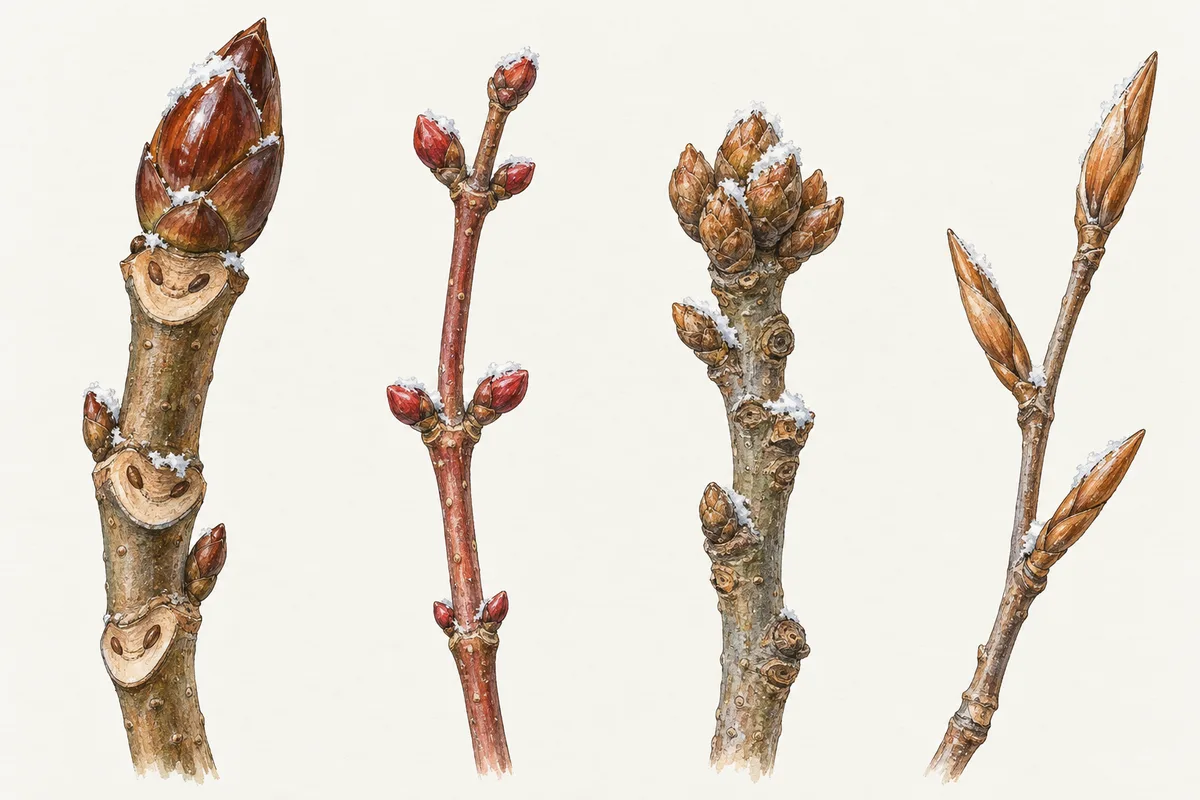
In short
Winter tree identification starts with the branching: opposite twigs and buds point to a maple, ash, dogwood or buckeye. Then read the buds (shape, color, scales, clustered at the tip as on oaks), the leaf scars, the bark and any fruit or dead leaves still on the tree. Some trees settle it with one test: a black walnut twig has a chambered pith, a black birch twig smells of wintergreen.
- Opposite twigs and buds in eastern North America mean maple, ash, dogwood or buckeye (or a shrub such as viburnum or elderberry).
- American beech has long, slender, cigar-shaped buds about 3/4 inch long that stand off the twig like thorns.
- Oaks carry several buds clustered at the twig tip: small and rounded on white oak, larger and conical on northern red oak.
- Cut a black walnut twig lengthwise to see its chambered pith; scratch a black birch twig to smell wintergreen.
A bare tree in January still carries most of what you need to name it. The leaves are gone, but the buds sit exactly where the leaves did, the leaf scars show their outline, and the bark, fallen fruit and the odd clinging dead leaf fill in the rest. University of New Hampshire Extension calls this the three B's: branching, buds and bark. This guide takes them in that order, adds fruit and dead leaves, and ends with a twig key for 12 common trees of the eastern United States.
Start with the branching: the opposite shortcut
Look at where side twigs and buds leave a branch. If they come off in pairs, facing each other, the tree is opposite. If they are staggered, one per point, it is alternate. Check three or four twigs, because a lost bud or a broken twig can make an opposite tree look alternate.
Opposite trees are few, which makes this the fastest check in winter. UNH Extension lists the native groups with opposite branching: maples, ashes, horse chestnut (which includes the buckeyes), dogwoods, viburnums and elderberry. Viburnums and elderberry are mostly shrubs, so for a tree, opposite branching almost always means one of four:
- Maple: slender twigs, buds with several scales, paired winged seeds on the ground in fall. See the maple guide.
- Ash: stout, gray-green twigs; the leaf scar is notched at the top with a bud sitting in the notch. See the ash guide.
- Dogwood: slender twigs that are green or purple, with clove-shaped flower buds at the tips.
- Buckeye: stout twigs, large pointed buds and big shield-shaped leaf scars.
Students learn the list as MADCap Horse (Maple, Ash, Dogwood, Caprifoliaceae, Horse chestnut). If the twig is alternate, set all four aside and go to the buds.
Read the buds
Buds come in all shapes and sizes, and UNH Extension suggests four questions: are they pointed or rounded, long or short, pressed close to the twig or angled away from it, and are there any at all? Add two of your own:
- How many scales, and what color? Sugar maple buds are brown, very sharp-pointed and tightly scaled, according to Virginia Tech Dendrology. Red maple buds are blunt, green or reddish, with several loose scales.
- Are several buds clustered at the tip? Oaks carry multiple buds bunched at the end of each twig. White oak's are small, rounded and red-brown, per the Virginia Tech white oak fact sheet; northern red oak's are larger, conical and red-brown.
Some buds are distinctive enough to name the tree alone. American beech buds are long (about 3/4 inch), slender and light brown, covered with overlapping scales and best described as "cigar-shaped"; they stand out from the very slender, zigzag twig "almost looking like long thorns", according to the Virginia Tech beech fact sheet. Yellow-poplar (tuliptree) buds are flattened and valvate, shaped like a duck's bill. American sycamore has no end bud at all: its side buds are covered by a single cap-like scale, and the leaf scar wraps right around each bud.
Leaf scars, pith and smell
A leaf scar is the mark left where last year's leaf stalk joined the twig. Inside it you can see small dots, the bundle scars, where the veins passed through. Its shape is often a clue:
- White ash: round at the bottom and notched at the top, with the side bud sitting in the notch (Virginia Tech).
- Red maple: V-shaped, with 3 bundle scars.
- Black walnut and shagbark hickory: 3-lobed, the pattern Virginia Tech compares to a "monkey face".
Two tests use a pocketknife. Cut a black walnut twig lengthwise and you'll see a buff-colored chambered pith, a row of small hollow chambers separated by thin plates (Virginia Tech black walnut fact sheet); see the walnut guide for its look-alikes. Break or cut a black birch twig and it gives off a wintergreen smell; both UNH Extension and the Virginia Tech sweet birch fact sheet note it. Black cherry twigs have a bitter almond odor instead.
Bark, persistent fruit and marcescent leaves
Bark is the one feature you can read from the ground on a tall tree, but UNH Extension warns that it changes with age: a young shagbark hickory is smooth and gray and only develops its peeling plates as it matures. Use bark to confirm, not to start. Smooth gray bark that stays smooth even on big trunks points to beech; patchy brown, green, tan and white "camouflage" bark to sycamore; interlacing ridges that form diamonds to white ash.
Persistent fruit often hangs on well into winter. Yellow-poplar keeps the base whorls of its cone-like fruit into the following spring, where they look like wooden flowers high in the tree. Sycamore's round seed balls mature in November and release their seeds in late winter. White ash samaras disperse over winter, so some are still on the twigs. Look on the ground too, for acorns, hickory and walnut husks, and sweetgum's spiny "gumballs".
Marcescent leaves are dead leaves that stay attached all winter. University of Illinois Extension names oaks and beech as the familiar examples, with young trees more likely to hold them than mature ones; a forest understory of young beech full of pale leaves under a bare canopy is a classic winter sight. Some oaks, such as shingle oak and pin oak, keep their leaves even when mature. A marcescent leaf is a gift: it gives you the leaf shape in midwinter.
A twig key to 12 eastern US trees
Use the key after you've checked several twigs from the outer crown. Features are from the Virginia Tech Dendrology fact sheets for each species, except where noted.
| Tree | Branching | Twig and buds | Confirm with |
|---|---|---|---|
| Sugar maple | Opposite | Slender, brown, shiny; end buds brown, very sharp-pointed, tight scales | Furrowed bark with curling ridges on older trees |
| Red maple | Opposite | Reddish, shiny; buds blunt, green or red, loose scales; V-shaped leaf scars | Smooth light gray bark on young trees |
| White ash | Opposite | Stout, gray-olive-green; leaf scar notched at top with bud in the notch | Diamond pattern of corky bark ridges |
| Flowering dogwood | Opposite | Slender, green or purple; clove-shaped flower buds, "cat claw" leaf buds | Scaly to finely blocky bark |
| Yellow buckeye | Opposite | Stout; large shield-shaped leaf scars; end buds orange-brown, 1/2 to 3/4 inch, sharp | Smooth husks with shiny brown seeds |
| American beech | Alternate | Very slender, zigzag; buds about 3/4 inch, cigar-shaped, sharp, angled out | Smooth gray bark; dead leaves on young trees |
| White oak | Alternate | Several small, rounded red-brown buds clustered at the tip | Acorns with a warty bowl cap; pale, scaly bark |
| Northern red oak | Alternate | Stout; several large conical red-brown buds clustered at the tip | Flat-topped bark ridges like ski tracks |
| Black walnut | Alternate | Stout, light brown; buff chambered pith; 3-lobed leaf scars | Round husked nuts 2 to 2½ inches |
| Shagbark hickory | Alternate | Stout; large brown end bud with 3 to 4 scales; 3-lobed leaf scars | Long bark plates curling away at the ends |
| Black (sweet) birch | Alternate | Slender, reddish brown; no end bud; wintergreen smell when cut | Dark bark breaking into scaly plates |
| American sycamore | Alternate | Zigzag, orange-brown; no end bud; one cap-like scale; leaf scar circles the bud | Peeling camouflage bark; hanging seed balls |
Look-alikes worth a second check: American elm also has a slightly zigzag twig, but its buds are reddish brown with darker-edged scales and often sit a little to one side of the twig (Virginia Tech). Black cherry is alternate with very small buds (about 1/5 inch) and the bitter almond smell.
Where a photo helps in winter
A photo is most useful in winter for the parts you can't reach or bring home: a dead leaf high in the crown, the bark, a seed ball on a high branch. Tree Identifier, an iPhone app, names a tree from one photo and shows the common and scientific names and key traits; it needs an internet connection. A bare twig carries less information than a summer leaf, so photograph the fruit or a marcescent leaf if there is one, and use the key above to check the answer. If you allow location, the Tree Map in Tree Identifier pins the tree so you can come back in May for the leaves. For the full year-round method, see the hub guide to identifying trees; for a pocket twig key to carry on winter walks, see the tree identification books compared.
What a photo can't settle
- A photo can't record a twig's smell or the inside of its pith, so the black birch and black walnut tests need you at the tree.
- Bark changes with age, so a young tree's bark may not match a description written for mature trunks; a photo of bark alone is a weak clue in winter.
- A bare twig shows fewer features than a leaf, flower or fruit, so a twig photo gives any app, Tree Identifier included, less to work with; check the answer with the key.
Questions people ask
How do you identify trees in winter without leaves?
Check the branching first: opposite twigs point to maple, ash, dogwood or buckeye. Then look at the buds (shape, color, scales, clusters at the tip), the leaf scars, the bark, and any fruit or dead leaves on the tree or the ground. A few trees have a one-step test, such as walnut's chambered pith.
How do you identify maple trees in winter?
Maples have opposite twigs and buds. Sugar maple buds are brown and very sharp-pointed with tight scales. Red maple twigs are reddish and shiny, with blunt green or red buds, loose scales and V-shaped leaf scars. Paired winged seeds under the tree confirm a maple.
How do you identify an elm tree without leaves?
American elm twigs are slender, slightly zigzag and reddish brown, with buds over 1/4 inch long whose scales have darker edges, often set a little to one side of the twig. The bark has flat-topped ridges, and a cut piece of outer bark shows alternating buff and reddish brown layers.
Is there a winter tree identification key?
Yes. Printed twig keys such as May and Tom Watts's Winter Tree Finder and William Harlow's Fruit Key and Twig Key, both recommended by UNH Extension, work from bud and twig features. The short key on this page covers 12 common eastern US trees.
How do you identify a dead tree in winter?
Use the same clues as for a living tree: branching, leaf scars, bark and any fruit on the ground. Whether a tree is dead or only dormant is a different question, and for a large tree near a house or path it is one for an ISA Certified Arborist to answer on site.
Sources
- Mind Your B's to Identify Winter Trees — University of New Hampshire Extension
- Why do some trees retain leaves over winter? — University of Illinois Extension, The Garden Scoop
- American beech fact sheet — Virginia Tech Dendrology
- Black walnut fact sheet — Virginia Tech Dendrology
- Sweet birch fact sheet — Virginia Tech Dendrology
- White oak fact sheet — Virginia Tech Dendrology
- White ash fact sheet — Virginia Tech Dendrology
- Sugar maple fact sheet — Virginia Tech Dendrology