Tree profile
Beech (Fagus): how to identify a beech tree
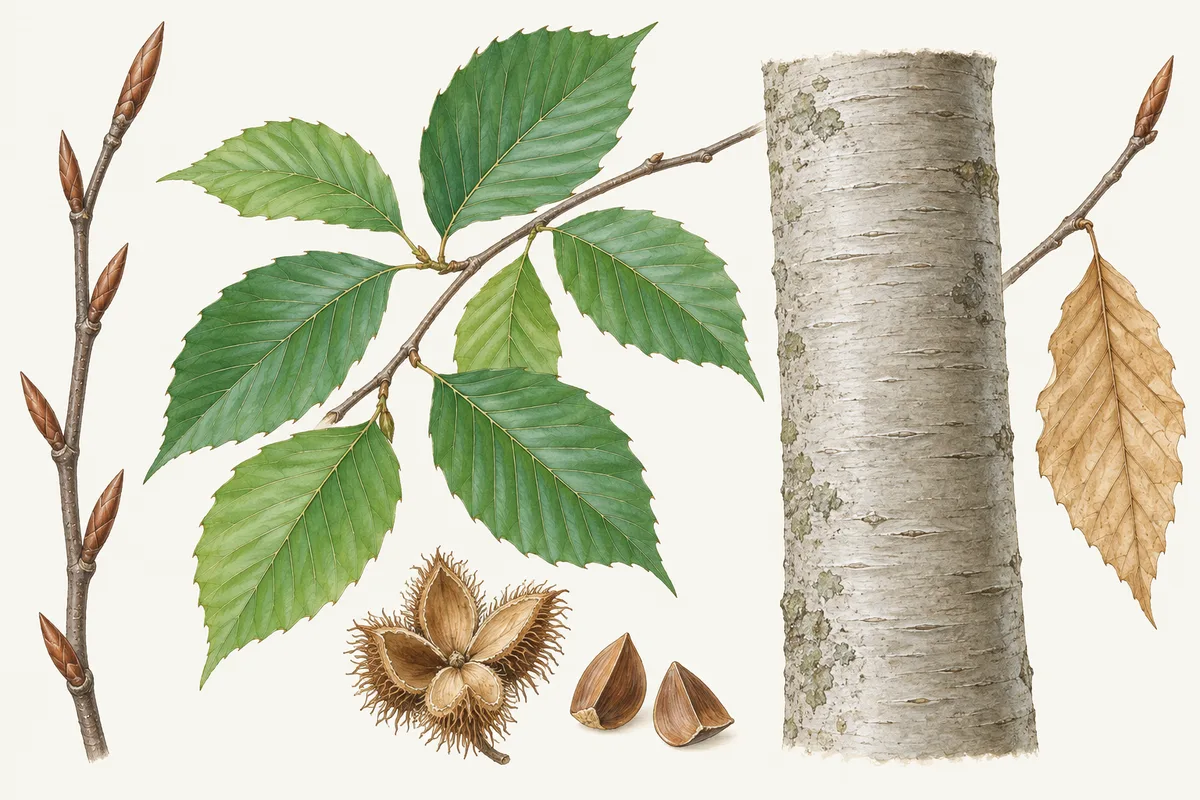
Smooth gray bark on even the biggest trunks, buds like thin cigars and a straight vein running into every tooth. Here is the order to check them in.
In short
Beech tree identification starts with the bark: smooth, thin and gray even on trunks several feet thick. Confirm with the buds, slender, pointed and about 3/4 to 1 inch long, and with the leaf, 2 1/2 to 5 1/2 inches long on American beech with 11 to 14 straight vein pairs, each ending in a sharp tooth. Many beeches also keep dry, pale leaves on their branches well into winter.
- Smooth gray bark on a big trunk plus cigar-shaped buds: beech, summer or winter.
- American hornbeam also has smooth gray bark, but its trunk is fluted like muscle and its buds are 1/4 inch or less.
- Beech leaf disease shows as dark bands between the leaf veins; beech bark disease as pocked, cankered bark.
Field marks at a glance
- Scientific name
- Fagus
- Family
- Fagaceae (beech family)
- Type
- Broadleaf, deciduous
- Bark
- Smooth, thin and gray even on the largest trunks (Virginia Tech Dendrology); The Morton Arboretum calls it silvery gray. European beech is darker gray-blue, with an elephant-hide look.
- Buds
- Long, slender, sharply pointed and cigar-shaped, covered in overlapping scales and held out from the twig almost like thorns: about 3/4 inch (Virginia Tech) to over 1 inch (Morton) on American beech.
- Leaves
- Alternate, simple, 2 1/2 to 5 1/2 inches on American beech, with 11 to 14 pairs of straight veins, each ending in a sharp tooth; shiny and smooth. European beech: 2 to 4 inches, 7 to 9 vein pairs, nearly smooth or wavy edge.
- Nuts
- Triangular, shiny brown nuts, usually two in a woody husk covered with spines, 1/2 to 3/4 inch long on American beech (Virginia Tech); they ripen in one season, September to November.
- Winter leaves
- Dried leaves often hang on the branches well into winter (marcescence), per The Morton Arboretum.
- Form and size
- American beech generally 60 to 80 feet, up to 120 feet in the best conditions (USDA Forest Service). Often surrounded by a thicket of root suckers.
- Native range
- American beech: eastern North America from Cape Breton Island, Nova Scotia, west to eastern Wisconsin, south to eastern Texas and northern Florida. European beech is planted in yards and parks.
- Fall color
- Golden-bronze on American beech (Morton); reddish-brown to bronze on European beech, often lasting into winter.
Beech (Fagus) is the tree with bark like smooth gray concrete. American beech is the only species of the genus native to North America, according to the USDA Forest Service, and European beech is the one planted in yards, often with purple or weeping foliage. Check the bark, then the buds, then the leaf veins.
Bark, buds, leaves: the three checks
1. The bark. The Virginia Tech Dendrology fact sheet describes American beech bark as smooth, thin and gray even on the largest stems. If the trunk is pocked, cankered or deformed, see the disease section below: beech bark disease changes that smooth surface.
2. The buds. Look at a twig tip. Beech buds are long, light brown and slender, covered with overlapping scales and "best described as cigar-shaped" in Virginia Tech's words, held out from the twig almost like thorns. Virginia Tech gives about 3/4 inch; The Morton Arboretum says over 1 inch, sharply pointed and smooth, and calls them a good identification characteristic.
3. The leaf. American beech leaves are 2 1/2 to 5 1/2 inches long, shiny, waxy and smooth, with 11 to 14 pairs of straight veins. Each vein ends in a sharp, distinct tooth. That one-tooth-per-vein pattern is the quickest leaf test against birch and hornbeam, whose leaves carry small teeth between the big ones.
The nuts. In fall, look under the tree for woody husks covered in spines, usually holding two triangular, shiny brown nuts. The Forest Service reports that the nuts mature in one season and ripen between September and November, and that good crops come at 2 to 8 year intervals. Never eat a berry, nut or seed on the strength of a web page or an app; check with a local expert.
If the branches are out of reach, a photo of the bark or of a fallen husk is enough to get a name from Tree Identifier. The app shows no confidence score and no list of look-alikes, so check the buds and the leaf veins before you trust it. American and European beech are both in the app's 138-species Collection.
Beech in winter: buds and marcescence
Beech is one of the easiest trees to identify without leaves, and often it isn't even without leaves. Many beeches hold dry, pale leaves on their branches into the winter, a habit called marcescence. Morton notes that American beech leaves "typically hang on well into the winter months".
Then check the cigar-shaped buds, which stand out on a bare twig, and the smooth gray bark. Look on the ground for last fall's empty husks. Beech also spreads by root suckers: the Forest Service describes reproduction almost entirely by suckering in some northern areas, and Virginia Tech notes old trees may be surrounded by a ring of young beech. A thicket of small, smooth-barked stems around one big tree is a strong clue. For buds, twigs and leaf scars of other trees, use the winter tree identification guide.
American beech vs European beech
| Feature | American beech | European beech |
|---|---|---|
| Leaf | 2 1/2–5 1/2 in, 11–14 vein pairs, sharp teeth | 2–4 in, 7–9 vein pairs, nearly smooth or wavy edge, fine hairs on the margin |
| Bud | About 3/4 in (Virginia Tech) to over 1 in (Morton) | About 1 in, scales tinged with fine hairs |
| Bark | Smooth, silvery gray | Smooth, darker gray-blue, sometimes mottled; "elephant-hide" |
| Size | Generally 60–80 ft, up to 120 ft | Up to 90 ft (Virginia Tech); 50–60 ft in landscapes (Morton) |
| Where | Native, eastern North America | Planted in yards and parks |
Sources: Virginia Tech's American and European beech fact sheets, Morton's European beech page and the Forest Service.
The vein count is the reliable test. Beyond that, a beech with purple, copper or pink-edged leaves, a weeping crown, deeply cut fern-like leaves or a narrow columnar shape is a European beech cultivar: Morton lists 'Riversii' (River's Copper), 'Purpurea Tricolor', 'Pendula' (weeping), 'Asplenifolia' (fern-leaved) and 'Dawyck Purple' among them.
American beech grows from Cape Breton Island, Nova Scotia, west to Maine, southern Quebec, southern Ontario, northern Michigan and eastern Wisconsin, then south to southern Illinois, southeastern Missouri, eastern Texas and northern Florida, according to the Forest Service's Silvics of North America. It reaches its largest size in the Ohio and Mississippi river valleys and may live 300 to 400 years.
Beech vs American hornbeam (musclewood)
American hornbeam is the tree most often mistaken for a young beech, because both have smooth, gray to blue-gray bark. The hornbeam fact sheet gives the differences:
- Trunk: hornbeam's is heavily fluted, with long ridges that make it look muscular, hence musclewood. Beech trunks are round.
- Buds: hornbeam buds are brown, angled and 1/4 inch or less; beech buds are three or four times longer.
- Leaves: hornbeam leaves are 3 to 5 inches and doubly toothed; beech has one tooth per vein.
- Fruit: hornbeam's small ribbed nutlets ride on 3-lobed leafy bracts hanging in clusters; beech has spiny husks.
- Size: hornbeam is small, up to about 25 feet, often with a twisted trunk.
In Britain and Europe the look-alike is European hornbeam (Carpinus betulus), a common hedge tree; beech vs hornbeam compares it with European beech, including how to tell a beech hedge from a hornbeam hedge in winter. Birch is the other common mix-up; the birch identification page has a beech-vs-birch box.
Beech bark disease and beech leaf disease
Two diseases change what a beech looks like, so they matter for identification.
Beech bark disease starts with a non-native scale insect. UConn Extension explains that the felted beech scale feeds through the bark and opens the way for Neonectria fungi. Heavily infested trunks look whitewashed from the scale's waxy covering, then develop cankers and pockmarked bark, sometimes with masses of small red fungal fruiting bodies. The Forest Service calls it the most serious problem of American beech; the scale was introduced to Nova Scotia from Europe around 1890.
Beech leaf disease is newer. UMass Amherst reports it was first found in northeastern Ohio in 2012 and is caused by a foliar nematode, Litylenchus crenatae. Look up into the canopy for dark green bands between the leaf veins, along with cupped, curled, thickened or leathery leaves. American and European beech are both known hosts.
If you see either, contact an ISA Certified Arborist or your extension office. For the general method that works on any tree, see how to identify trees.
Look-alikes and how to tell them apart
American hornbeam, musclewood (Carpinus caroliniana)
Hornbeam bark is also smooth and blue-gray, but the trunk is fluted and ridged like flexed muscle. Its buds are 1/4 inch or less, its leaves are doubly toothed, and it rarely passes 25 feet. Beech trunks are round and its buds about three times longer.
Birches (Betula)
Young birch bark can look smooth and pale, but it carries horizontal lenticel lines and often peels; beech bark does neither. Birch buds are short, and black and yellow birch twigs smell of wintergreen when scratched.
What a photo can't settle
- Hornbeam, young birch and beech can all show smooth gray bark in a photo; the buds, the fluted trunk and the leaf teeth settle it, so get close.
- European beech cultivars planted in yards (purple, copper, weeping, fern-leaf, tricolor) look very different from the wild tree, and a photo of foliage alone may not show that it is a beech.
- Beech bark disease and beech leaf disease call for an ISA Certified Arborist or your extension office; a photo can suggest them but can't confirm them.
Questions people ask
How do you identify a beech tree?
Check the bark first: smooth, thin and gray even on a big trunk. Then look at a twig tip for a long, slender, pointed bud shaped like a thin cigar. Finally count the leaf veins: American beech has 11 to 14 straight pairs, each running into a sharp tooth at the edge.
How do you identify a beech tree in winter?
Beech is one of the easiest trees to name in winter. The bark stays smooth and gray, the buds are long cigar-shaped spikes about 3/4 to 1 inch, and many beeches still hold dry, pale leaves. Look on the ground for last fall's empty, spiny husks.
What does a beech nut look like?
Beech nuts are triangular, shiny brown and small, usually two to a woody husk covered in spines; Virginia Tech gives 1/2 to 3/4 inch for American beech. Never eat a berry, nut or seed on the strength of a web page or an app; check with a local expert.
What is the difference between beech and hornbeam?
Both have smooth gray bark. American hornbeam's trunk is fluted like muscle, its buds are 1/4 inch or less, its leaves are doubly toothed and its seeds hang on 3-lobed leafy bracts. Beech has a round trunk, buds about 3/4 to 1 inch, one tooth per vein and spiny nut husks.
Why do beech trees keep their leaves in winter?
Many beeches hold their dead leaves into winter, a habit called marcescence. The Morton Arboretum notes that American beech leaves typically hang on well into the winter months, and that European beech fall color often lasts into winter.
Sources
- American beech fact sheet — Virginia Tech Dendrology
- European beech fact sheet — Virginia Tech Dendrology
- Hornbeam fact sheet — Virginia Tech Dendrology
- American Beech (Fagus grandifolia), Silvics of North America — USDA Forest Service
- American beech (Fagus grandifolia) — The Morton Arboretum
- European beech (Fagus sylvatica) — The Morton Arboretum
- Beech Bark Disease — UConn Extension
- Beech Leaf Disease — UMass Amherst Center for Agriculture, Food, and the Environment