Field guide
Tree seed identification: from acorn, pod or samara to the tree
Eight fruit and seed types cover most of what you will find under a North American tree. Each one points to a short list of genera, and size and season do the rest.
In short
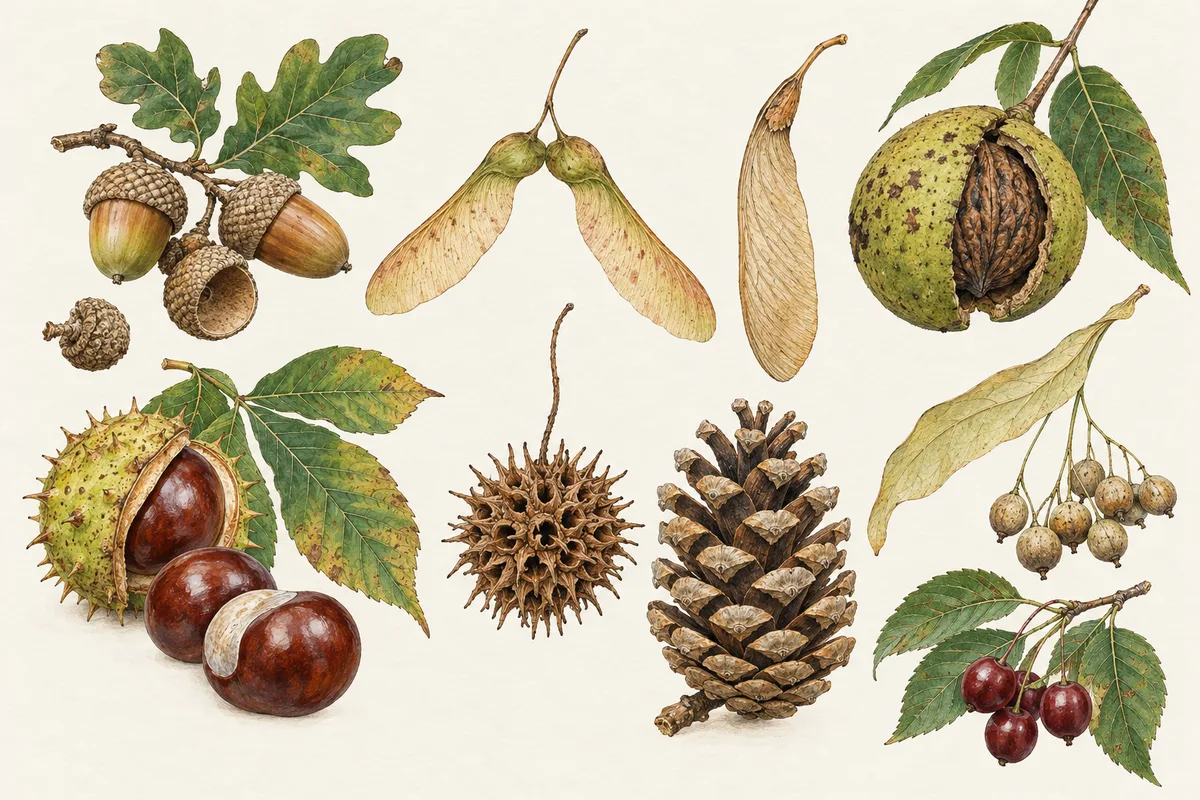
Tree seed identification starts with the fruit type, because each type points to a short list of genera. An acorn in a scaly cap means an oak. Paired winged seeds mean a maple; single wings point to an ash, elm or tree of heaven. A nut in a thick husk means a walnut or hickory, a flat pod a locust or redbud, a spiky woody ball a sweetgum. Then measure it and note the season.
- Season helps: red and silver maples drop their samaras in late spring, sugar maple in fall.
- Paired wings joined at the seed mean a maple; a single wing means an ash, elm, tulip tree or tree of heaven.
- Black walnut's thick green husk never splits open; shagbark hickory's very thick husk holds a distinctly 4-ribbed nut.
What lies under a tree is often the fastest way to name it. Seeds, nuts, pods and cones last for weeks or months on the ground, they are within reach when the leaves are not, and most of them belong to one of eight types. Each type narrows the tree to a short list of genera.
Never eat a berry, nut or seed on the strength of a web page or an app; check with a local expert. This guide is about naming trees, not about food.
The seed and fruit chart: from type to genus
The fruit types follow the University of Vermont Forestry 21 course appendix, Basis of Woody Plant Identification. Sizes and descriptions come from Virginia Tech Dendrology fact sheets.
| What you found | Fruit type | Genus (common trees) | Field marks |
|---|---|---|---|
| Nut in a scaly cap | Acorn (a nut) | Quercus (oaks) | White oak: about 1 in, warty bowl-shaped cap over 1/4 of the nut. Northern red oak: 3/4 to 1 in, flat, thick, beret-like cap |
| Two wings joined at the seeds | Paired samara | Acer (maples, boxelder) | Sugar maple: horseshoe-shaped pairs about 1 in. Boxelder: V-shaped pairs 1 to 1 1/2 in, hanging on through winter |
| One wing per seed | Single samara | Fraxinus (ashes), Ulmus (elms), Ailanthus (tree of heaven), Liriodendron (tulip tree) | White ash: one flat wing, full rounded seed cavity. Elm: round, flat, papery wafer 3/8 to 1/2 in, notched at the tip. Tree of heaven: twisted, 1 to 1 1/2 in, seed in the center |
| Nut inside a thick husk | Nut in husk | Juglans (walnuts), Carya (hickories, pecan) | Black walnut: round, 2 to 2 1/2 in, thick green husk that stays closed. Shagbark hickory: 1 1/2 to 2 in, very thick husk, 4-ribbed nut |
| Flat or bean-like pod | Legume (pod) | Robinia (black locust), Gleditsia (honeylocust), Cercis (redbud), Gymnocladus (Kentucky coffeetree) | Black locust: flat, 2 to 4 in, 4 to 8 seeds. Honeylocust: 6 to 8 in, leathery, dries and twists. Redbud: flat, 2 to 4 in |
| Woody scales around an axis | Cone | Pinus, Picea, Abies, Tsuga and other conifers | See the cone table in the conifer identification guide |
| Soft, fleshy fruit | Berry, drupe or pome | Prunus (cherries), Cornus (dogwoods), Nyssa (blackgum), Crataegus (hawthorns), Malus, Pyrus | Black cherry: dark purple to black, about 1/3 in. Flowering dogwood: shiny red, 1/4 to 1/2 in, clusters of 3 to 5 |
| Spiky or bumpy woody ball | Ball of capsules or spiny husk | Liquidambar (sweetgum), Aesculus (horse chestnut), Castanea (chestnuts), Platanus (sycamore) | Sweetgum: spiny "gumball" 1 to 1 1/2 in. Sycamore: smooth ball of tiny seeds on a 3 to 6 in stalk |
| Pod or capsule that splits open | Capsule | Catalpa, Populus (cottonwoods, aspens), Salix (willows), Paulownia | Catalpa: stiff, round "beans" 10 to 18 in. Cottonwood and willow: small capsules releasing cottony seeds |
The UVM appendix gives the botanical definitions behind the table. A samara is a winged, achene-like fruit (ash, maple, elm). A nut is usually one-seeded, with a hard wall, and usually partly or completely enclosed in a husk (oak, birch). A legume is a pod that splits along two lines (black locust). A capsule may open in one of several ways (catalpa, aspen, horse chestnut). A drupe has a fleshy layer around a stony pit (cherry, plum); a pome has a papery core with several seeds (apple, pear, hawthorn); and a cone is made of scales arranged around a central axis (pine).
Acorns and winged seeds
Acorns always mean an oak. The white oak acorn is ovoid to oblong, with a warty, bowl-shaped cap covering a quarter of the nut; it matures in one growing season and the cap always detaches (Virginia Tech). Northern red oak's acorn is 3/4 to 1 inch, nearly round, with a flat, thick cap like a beret, and takes two growing seasons. In summer, a red oak group tree carries two sizes of acorns on its twigs, a white oak only one. The oak page has the full acorn comparison.
Paired samaras are the maples' "helicopters". Sugar maple pairs are horseshoe-shaped, about 1 inch long, brown when mature in fall. Red maple samaras are 1/2 to 3/4 inch with slightly spread wings, ripening in late spring and early summer. Silver maple has the largest samara of any native maple, wings 1 1/2 to 2 1/2 inches. The season helps: a red or silver maple drops its seeds in spring, a sugar maple in fall.
Single samaras belong to several genera. White ash: one wing on a seed with a full, rounded seed cavity, maturing in fall and dispersing over winter. Elms: round, flat, papery wafers, notched at the tip; American elm's ripen in spring. Tree of heaven: twisted samaras 1 to 1 1/2 inches with the seed in the middle, in long hanging clusters. Tulip tree (yellow-poplar): a cone-like cluster of one-winged samaras, about 2 inches, whose base stays on the tree like a wooden flower.
Nuts in husks
Black walnut fruit is round, 2 to 2 1/2 inches across, with a thick green husk that does not split open, around an irregularly furrowed hard nut (Virginia Tech). The USDA Forest Service's Silvics of North America says the nut ripens in September or October and drops shortly after the leaves fall. Butternut's fruit is lemon-shaped, with a sticky husk. The same Forest Service page describes juglone, a substance in walnut leaves, bark, nut husks and roots, reported toxic to some plants (tomatoes especially) by the USDA Forest Service. See the walnut page.
Hickories differ by husk and nut. Shagbark hickory fruit is nearly round, 1 1/2 to 2 inches, with a very thick husk and a distinctly 4-ribbed nut (Virginia Tech). Bitternut hickory's is smaller, about 1 inch, with a thin husk that is 4-winged above the middle, often dusty yellow, and splits partway from the middle to the pointed tip. Pecan's nuts are oblong, 1 1/2 to 2 inches, brown splotched with black, with thin husks. The hickory page compares the hickories by husk and leaflet count.
Other husked nuts: American beech holds two irregularly triangular, shiny brown nuts in a woody husk covered with spines. American chestnut's husk is large, round and very sharply spiny, 2 to 2 1/2 inches, around 2 or 3 nuts. Yellow buckeye has a smooth, leathery husk around 1 to 3 shiny brown seeds with a pale spot; horse chestnut's husk is very spiny. The chestnut vs buckeye page sets the leaves and husks of American chestnut, Chinese chestnut and Ohio buckeye side by side.
Pods, cones, berries, spiky balls and capsules
Pods. Black locust has flat, light brown pods 2 to 4 inches long holding 4 to 8 kidney-shaped seeds. Honeylocust's pods are 6 to 8 inches, flat, red-brown and leathery, drying and twisting. Eastern redbud's are flat, dry and 2 to 4 inches. Kentucky coffeetree's are thick, 3 to 8 inches long and 1 1/2 to 2 inches wide, with dark seeds in a sticky pulp. The locust page separates black locust from honeylocust.
Cones and cone-like fruit. Conifer cones are covered in the conifer guide. Some broadleaf trees make cone-like fruit too: birch's cylindrical, cone-like fruit breaks apart into tiny winged nutlets, and hophornbeam carries hop-like clusters of papery sacs, each around a small nutlet.
Berries, drupes and pomes. Black cherry: round, dark purple to almost black, about 1/3 inch. Flowering dogwood: shiny, oval, red, 1/4 to 1/2 inch, in clusters of 3 to 5. Blackgum: dark purplish blue, about 1/2 inch. Sassafras: dark blue, held upright in a red cup on a red stalk. Hawthorns carry small yellow to red pomes about 1/4 inch across; Callery pear has small, round, brown pomes about 1/2 inch.
Spiky balls. Sweetgum drops woody, spiny "gumballs" 1 to 1 1/2 inches across, each a cluster of capsules that release two seeds apiece (Virginia Tech). Sycamore's ball is a cluster of tiny seeds on a 3- to 6-inch stalk that hangs on through winter. Osage-orange's fruit is far bigger, 4 to 5 inches, with a brain-like surface. The spiky balls guide separates all of them.
Capsules. Northern catalpa's long, stiff "beans", 10 to 18 inches, are capsules full of flat, papery-winged seeds and may stay on the tree over winter. Cottonwoods, aspens and willows release tiny seeds on cotton from small capsules in late spring and summer. Royal paulownia's oval, 1- to 1 1/2-inch capsules hold thousands of tiny seeds.
Where a photo helps with seeds and nuts
A seed on the ground is a good subject for a photo: it stays still and fills the frame. In Tree Identifier, photograph the seed or nut next to a leaf from the same tree if you can find one, since the app identifies from one photo and the leaf adds a second clue. The app returns a common and scientific name with key traits, but no confidence score and no list of look-alikes, so check the answer against the table above and the tree overhead. Use the follow-up chat to ask how that species' fruit differs from a look-alike, never whether it is safe to eat.
For the full field method, see how to identify trees.
What a photo can't settle
- Neither this page nor Tree Identifier decides whether a fruit, nut or seed is safe to eat; that takes a local expert.
- Seeds on the ground may have blown, rolled or been carried by squirrels and birds from another tree, so confirm with the leaves of the tree above.
- Many trees fruit only in some years, and young trees may not fruit at all, so the seed test is not always available.
Questions people ask
How do I identify a nut tree?
Look at the husk first. A thick, round green husk that stays closed points to black walnut; a ribbed nut or a thin husk splitting from the tip points to a hickory; a spiny husk holding two triangular nuts means American beech; a very spiny husk around two or three round nuts means a chestnut. Then check the leaves.
What tree has long seed pods?
Several. Honeylocust has flat, red-brown, leathery pods 6 to 8 inches long that dry and twist. Black locust pods are flat and 2 to 4 inches. Kentucky coffeetree pods are thick, 3 to 8 inches. Northern catalpa's 10- to 18-inch 'beans' are round in cross-section and are technically capsules.
What tree drops helicopter seeds?
Maples. Their samaras come in joined pairs, each seed with its own wing. Sugar maple pairs are horseshoe-shaped, about 1 inch long, mature in fall; silver maple has the largest of any native maple, with wings 1 1/2 to 2 1/2 inches, maturing in late spring. Ash samaras are single.
How can I tell an acorn from a white oak and a red oak?
White oak group acorns mature in one season, so a tree carries one size of acorn in summer; white oak's warty, bowl-shaped cap covers about a quarter of the nut. Red oak group acorns take two seasons; northern red oak's flat, thick cap covers about a quarter or less.
Sources
- Basis of Woody Plant Identification (Forestry 21, Appendix A) — University of Vermont
- White oak fact sheet — Virginia Tech Dendrology
- Sugar maple fact sheet — Virginia Tech Dendrology
- Black walnut fact sheet — Virginia Tech Dendrology
- Black Walnut, Silvics of North America — USDA Forest Service
- Shagbark hickory fact sheet — Virginia Tech Dendrology
- Black locust fact sheet — Virginia Tech Dendrology
- Sweetgum fact sheet — Virginia Tech Dendrology
Keep reading
- Field guideHow to identify trees, step by step
- Clue guideWhich tree has spiky balls? Six candidates and how to tell them
- Tree profileHickory trees (Carya): how to identify them
- Tree profileWalnut trees (Juglans): how to identify them
- Field guideConifer identification: three questions about the needles, then the cone