Tree comparison
Chestnut vs buckeye: chestnut tree identification
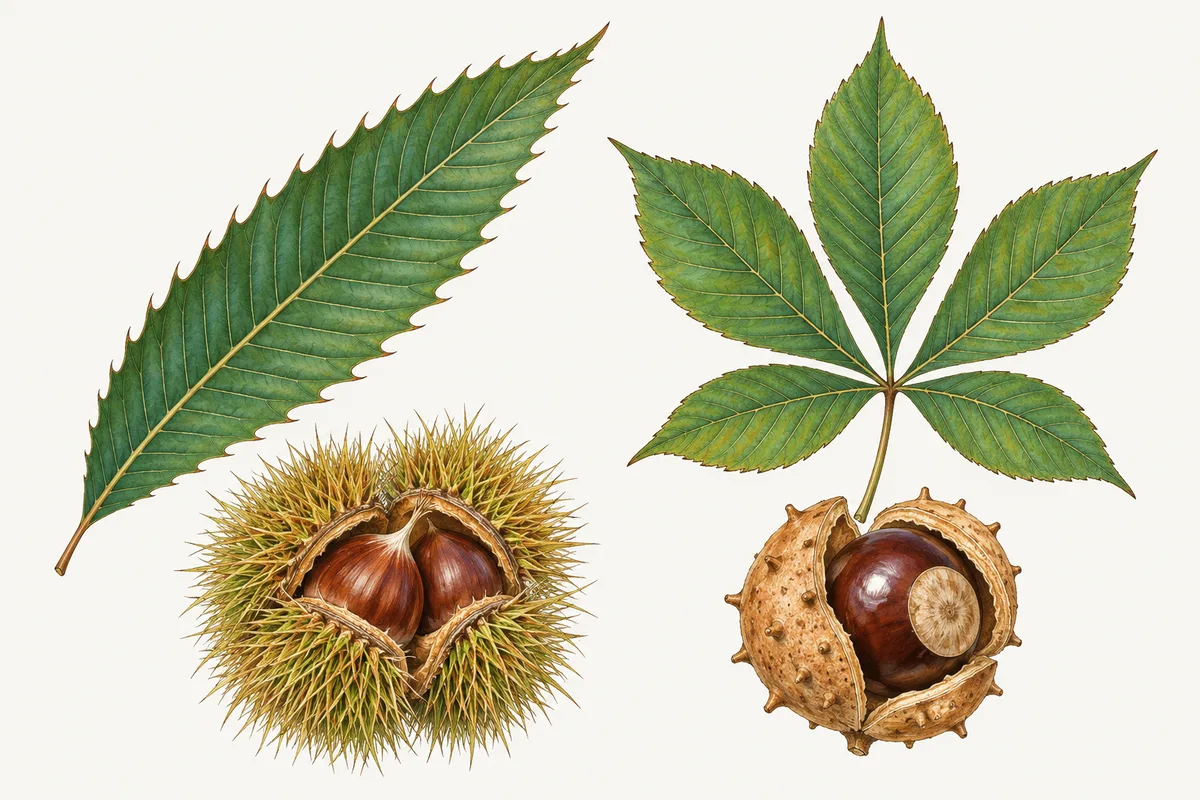
Count the leaflets and look at the twig. A chestnut has single, long, toothed leaves; a buckeye has five leaflets spread like a hand, in opposite pairs.
In short
Chestnut tree identification starts with the leaf. True chestnuts have alternate, simple leaves 5 to 8 inches long with coarse teeth that each end in a bristle, and a bur covered in sharp spines holding 2 or 3 nuts. Buckeyes have opposite, palmately compound leaves, usually five leaflets, and a leathery husk with weak prickles or none, around one glossy seed with a pale scar.
- Alternate, single leaves with bristle-tipped teeth mean a chestnut; opposite leaves with five leaflets like a hand mean a buckeye.
- A chestnut bur is a dense ball of sharp spines with 2 or 3 nuts; a buckeye husk is leathery, slightly prickly or smooth, usually with one seed.
- Most chestnuts in US yards are Chinese chestnut. American chestnut survives mostly as root sprouts under 20 feet because of chestnut blight.
Field marks at a glance
- Scientific name
- Castanea dentata, Castanea mollissima and Aesculus glabra
- Family
- Fagaceae (beech family) for the chestnuts; Sapindaceae (soapberry family) for buckeyes, listed by Virginia Tech under the older Hippocastanaceae
- Type
- Broadleaf, deciduous
- Leaf arrangement
- Chestnuts: alternate, one leaf per point on the twig. Buckeyes: opposite, two leaves facing each other.
- Leaf type
- Chestnuts: simple, oblong to lance-shaped, 5 to 8 inches. Ohio buckeye: palmately compound, usually 5 leaflets 3 to 6 inches long, spread from one point.
- Leaf edge
- American chestnut: large coarse teeth, each with a bristle that curves inward. Chinese chestnut: smaller teeth. Ohio buckeye: toothed leaflets.
- Leaf underside
- American chestnut: hairless, light green. Chinese chestnut: whitish and fuzzy on sun leaves. Ohio buckeye: paler green; foliage smells unpleasant when crushed.
- Husk
- Chestnuts: a dense ball of long, sharp spines about 2 to 3 inches across. Ohio buckeye: a leathery husk with weak prickles; yellow buckeye's is smooth.
- Inside the husk
- Chestnuts: 2 to 3 brown nuts, flattened on one or two sides. Ohio buckeye: usually one smooth, glossy chestnut-brown seed with a large pale scar, the buck's eye.
- Twig and buds
- American chestnut: hairless, chestnut to orange-brown twig, small pointed buds that angle away. Ohio buckeye: thick twig, large shield-shaped leaf scars, big orange-brown end bud, foul smell when broken.
- Size today
- American chestnut: once over 100 feet, now mostly stump and root sprouts under 20 feet. Ohio buckeye: often under 30 feet, up to 60 to 80 feet on good sites.
Chestnuts and buckeyes both drop a husk around shiny brown nuts in fall, and both have "chestnut" in their common names, but they belong to different families and are easy to tell apart once you look at a twig. This page compares American chestnut, Chinese chestnut and Ohio buckeye, with notes on the relatives and the oak that people mix them up with. Never eat a berry, nut or seed on the strength of a web page or an app; check with a local expert.
Chestnut or buckeye: the two-second test
Pull down a branch and look at where the leaves join the twig. Chestnuts are alternate, one leaf per point, and each leaf is a single blade. Buckeyes are opposite, two leaves facing each other, and each leaf is split into leaflets that spread from one point like the fingers of a hand. Only a handful of eastern trees have opposite leaves (maples, ashes, dogwoods and buckeyes), so that check alone removes the chestnuts. The step-by-step identification method starts with the same test. The rows below come from Virginia Tech Dendrology's fact sheets for American chestnut and Ohio buckeye unless noted.
| Feature | American chestnut | Chinese chestnut | Ohio buckeye |
|---|---|---|---|
| Arrangement | Alternate | Alternate | Opposite |
| Leaf | Simple, long and narrow, 5–8 in | Simple, oval, rounded base | Palmately compound, usually 5 leaflets of 3–6 in |
| Teeth | Large, bristle curving inward | Smaller | Toothed leaflets |
| Underside (sun leaf) | Light green, few hairs | Whitish, hairy | Paler green |
| Husk | Dense mass of long, slender spines | Sparse mass of short, thick spines | Leathery, weakly prickly |
| Inside | 2–3 nuts, 1/2–1 in | 2–3 nuts, 3/4–2 in | Usually 1 glossy seed with a pale scar |
| Crushed leaf or broken twig | Not a field mark | Not a field mark | Strong, unpleasant smell |
The spine and nut measurements for the two chestnuts are from The American Chestnut Foundation's comparison, Chinese and American Chestnuts. The rest of this page takes each tree in turn.
American chestnut tree identification
American chestnut (Castanea dentata) leaves are alternate, oblong to lance-shaped, 5 to 8 inches long and hairless on both sides. The American Chestnut Foundation (TACF) describes them as long relative to their width, tapering sharply at the base and thin, almost papery. The best single mark is the teeth: large and prominent, each ending in a bristle that curves inward like a breaking wave.
The twig confirms it. Virginia Tech describes a moderately stout, hairless twig, chestnut to orange-brown with many pale lenticels, and small orange-brown buds about 1/4 inch long sitting slightly off-center above a half-round leaf scar. TACF adds that American chestnut buds are pointed and angle away from the stem.
The bur is the classic chestnut tree spiky ball: about 2 to 2 1/2 inches across, very sharp, holding 2 or 3 shiny brown nuts that ripen in early fall. Young bark is smooth and chestnut-brown, later splitting into flat ridges.
What you are most likely to find, though, is not a tall tree. Virginia Tech notes that American chestnut once grew over 100 feet tall and now occurs mostly as stump sprouts under 20 feet. A USDA Forest Service article on American chestnut in Ohio's historic woodlands explains why: essentially all mature trees in Ohio were killed by chestnut blight in the 1920s and 1930s, and sprouts that grow from the root collar after the top dies resist the blight only while they stay small. Those sprouts, though uncommon, still persist in the understory of southern and eastern Ohio woodlands. Bark infected by the blight is sunken and split, sometimes with orange fungal fruiting bodies.
Chinese chestnut: the chestnut in most yards
If a chestnut is growing in a yard, a park or an orchard, compare it with Chinese chestnut (Castanea mollissima) first. TACF says Chinese chestnuts have a high tolerance to chestnut blight, which is why they are the chestnut people most often meet in the United States, and that more than half of the leaf samples sent to it for identification turn out to be Chinese chestnut.
The differences TACF lists are small but consistent:
- Leaf shape. Oval with a rounded base, thick and waxy, against American chestnut's long, narrow, papery leaf with a tapering base.
- Underside. Sun leaves look whitish from dense hairs; American chestnut's stay light green with few hairs.
- Teeth. Smaller, without the big inward-curving bristles.
- Twig and buds. Hairy, tan to pea-green stems with large lenticels, and rounded buds that hug the stem.
- Stipules. Broad, covering the buds and staying on the stem through September; American chestnut's are slender and usually fall off in June.
- Burs and nuts. Short, thick spines in a sparse mass, and larger nuts, 3/4 to 2 inches, with rounded, hairy tips.
When a tree shows a mix of these features, a sample sent to TACF, described below, is the way to settle it.
Buckeye tree identification
Ohio buckeye (Aesculus glabra) is Ohio's state tree, formally adopted by the legislature in 1953 according to the Ohio State University Herbarium. Its leaves are opposite and palmately compound. Virginia Tech counts five oval leaflets, 3 to 6 inches long with toothed edges, on a stalk about as long as the leaflets; the USDA Forest Service and the Ohio State Herbarium give five to seven. Crush a leaf or break a twig and it smells unpleasant, which is why the USDA Forest Service also lists the names fetid buckeye and stinking buckeye.
In winter, look for a thick twig with large shield-shaped leaf scars and a big orange-brown end bud with ridged scales. Young bark is smooth and ashy gray, later corky and scaly. Pale yellow flowers stand in upright clusters 4 to 7 inches long in spring, with stamens longer than the petals.
The husk is leathery and prickly, but its prickles are weak next to a chestnut bur. Inside is usually one smooth, chestnut-brown seed, 1 to 1 1/2 inches across. The USDA Forest Service describes its large, light-colored scar, which makes the seed look like an eye; that is the buck's eye. The same source reports the seeds and bark of Ohio buckeye as poisonous and its young shoots as toxic to cattle.
Ohio buckeye's native range runs from western Pennsylvania, Ohio and southern Michigan west to Illinois and central Iowa, and south to eastern Kansas, southwestern Oklahoma and central Texas, reaching east to western Arkansas, Tennessee and central Alabama (USDA Forest Service).
Yellow buckeye and the European horse chestnut
Yellow buckeye (Aesculus flava) is the buckeye most often set beside Ohio buckeye: Virginia Tech lists the two as look-alikes, and the USDA Forest Service records hybrids between them (under the older name Ae. octandra) and hybrid swarms with features of both. Virginia Tech's yellow buckeye fact sheet gives the quickest test: its husk is smooth, not prickly, thick and leathery around 1 to 3 shiny seeds with a large pale spot. Its five leaflets run 3 to 7 inches, and its bark breaks into large scaly patches with age.
The European horse chestnut (Aesculus hippocastanum), planted along streets and in yards, is the buckeyes' Old World relative, with the same opposite, hand-shaped leaves; Virginia Tech lists it as a look-alike of both buckeyes. In Europe it is paired with a different tree again, the sweet chestnut (Castanea sativa), a true chestnut with spiny burs; the horse chestnut vs sweet chestnut page compares that European pair. Both European trees are in Tree Identifier's 138-species Collection.
Chestnut tree spiky balls: reading the husk
When all you have is what fell on the ground, the husk still says a lot:
- A ball of long, sharp spines that hurts to pick up, holding 2 or 3 nuts flattened on one or two sides: a chestnut. Dense, slender spines point to American chestnut, sparse, thick ones to Chinese chestnut.
- A leathery husk with scattered prickles, far weaker than a chestnut's spines, splitting to show one large glossy seed with a pale scar: Ohio buckeye.
- A smooth leathery husk around one to three seeds with a pale spot: yellow buckeye.
- A husk around glossy seeds under a planted street or yard tree with opposite, hand-shaped leaves: consider the European horse chestnut as well as the buckeyes.
Then look up at the leaves to confirm, because a squirrel can carry a nut a long way. The guide to trees with spiky balls adds sweetgum, sycamore and Osage orange, and identifying trees by seeds and nuts covers walnuts, hickories and acorns.
Chestnut oak and other look-alikes
Chestnut oak (Quercus montana) takes its name from leaves that look like a chestnut's at a glance. Virginia Tech's chestnut oak fact sheet describes alternate, egg-shaped to elliptical leaves 4 to 6 inches long with a wavy edge of rounded teeth, and no bristles. The fruit settles it: an oval acorn 1 to 1 1/2 inches long in a thin, warty, teacup-shaped cap, not a spiny bur. Old trunks form thick, hard ridges often compared to an alligator's back. For the rest of the oak family, see the oak identification page.
Virginia Tech also lists Allegheny chinkapin, a shrubby chestnut relative, along with sawtooth oak and American beech among the American chestnut's look-alikes. Check the bur, the leaf underside and the twig before naming any of them.
Getting an American chestnut confirmed
Because a wild American chestnut is now a notable find, TACF runs a free identification service. Its instructions ask for a freshly cut twig 6 to 12 inches long with mature leaves, preferably from a sunny branch, pressed between cardboard rather than sealed in plastic, with the burs removed and a tree locator form giving latitude and longitude. Spring and summer samples work best. TACF is clear that photos can help but that a precise identification cannot be made from photos alone.
A photo app is a faster first step. Tree Identifier names a tree from one photo of a leaf, the bark, a bur or the whole tree, and the follow-up chat under the result can explain how American and Chinese chestnut differ. It does not show a confidence score or alternative species, so if the answer is American chestnut, run the TACF checks above and send a sample. With location allowed, Tree Identifier's Tree Map keeps the spot so you can return in fall for the burs.
Look-alikes and how to tell them apart
Chinese chestnut (Castanea mollissima)
Turn a sun leaf over: Chinese chestnut is whitish and hairy underneath, American chestnut light green and nearly hairless. Chinese leaves are oval with a rounded base and small teeth; its twigs are hairy, tan to pea-green, with rounded buds that hug the stem.
Yellow buckeye (Aesculus flava)
Same opposite, five-leaflet leaves as Ohio buckeye, but the husk is smooth with no prickles and the bark breaks into large scaly patches. Virginia Tech lists the two as look-alikes, and the USDA Forest Service records hybrid swarms between them.
Chestnut oak (Quercus montana)
Alternate leaves 4 to 6 inches long like a chestnut's, but the edge has rounded, wavy teeth with no bristles, and the tree drops acorns in thin warty caps instead of spiny burs. Old bark forms thick ridges like an alligator's back.
What a photo can't settle
- The American Chestnut Foundation says a precise identification cannot be made from photos alone and asks for a pressed twig with mature leaves instead.
- Ohio buckeye and yellow buckeye form hybrid swarms with intermediate features, the USDA Forest Service notes, so a husk or a single leaf may not settle which buckeye you have.
- Tree Identifier gives one name from one photo, with no confidence score and no look-alike list, so check the leaf underside and the twig yourself before you call a tree an American chestnut.
Questions people ask
How do you identify an American chestnut tree?
Look for alternate, long, narrow leaves 5 to 8 inches long, hairless and light green underneath, with large teeth whose bristles curve inward. The twigs are hairless and reddish brown, the buds pointed and angled away from the stem. Most American chestnuts today are sprouts under 20 feet growing from old roots.
How can you tell a buckeye tree from a chestnut tree?
Look at the twig. Buckeye leaves grow in opposite pairs and each is split into usually five leaflets spread like a hand. Chestnut leaves are alternate and single, with bristle-tipped teeth. The husks differ too: a chestnut bur is a dense ball of sharp spines, a buckeye husk is leathery with weak prickles or none.
What chestnut tree has spiky balls?
All true chestnuts. American and Chinese chestnut both carry burs covered in sharp spines, about 2 to 3 inches across, with up to 3 nuts inside. The American Chestnut Foundation separates them by the spines: long and slender in a dense mass on American chestnut, short and thick in a sparse mass on Chinese chestnut.
Are buckeyes poisonous?
The USDA Forest Service reports Ohio buckeye seeds and bark as poisonous and its young shoots as poisonous to cattle. For any question about a person or animal that touched or swallowed one, ask a doctor, a vet or poison control; a web page or an app cannot decide it.
Is a horse chestnut the same as a buckeye?
No. They are close relatives in the same genus, Aesculus, with the same opposite, hand-shaped leaves and glossy seeds, and Virginia Tech lists horse chestnut as a look-alike of both Ohio and yellow buckeye. Horse chestnut is a European tree planted in the US; Ohio and yellow buckeye are native to North America.
Why is Ohio called the Buckeye State?
Ohio buckeye is Ohio's state tree, formally adopted by the legislature in 1953, according to the Ohio State University Herbarium. The herbarium notes that the nickname caught on in 1840, when William Henry Harrison used the buckeye as a campaign symbol, though its exact origin is not fully known.
Sources
- Chinese and American Chestnuts — The American Chestnut Foundation
- American chestnut fact sheet — Virginia Tech Dendrology
- Ohio buckeye fact sheet — Virginia Tech Dendrology
- Yellow buckeye fact sheet — Virginia Tech Dendrology
- Chestnut oak fact sheet — Virginia Tech Dendrology
- Ohio Buckeye, Silvics of North America — USDA Forest Service
- American chestnut in Ohio's historic woodlands (Hutchinson and Dyer, 2021) — USDA Forest Service, Northern Research Station
- The Ohio Buckeye — Ohio State University Museum of Biological Diversity, Herbarium