Tree comparison
Conker tree: horse chestnut vs sweet chestnut
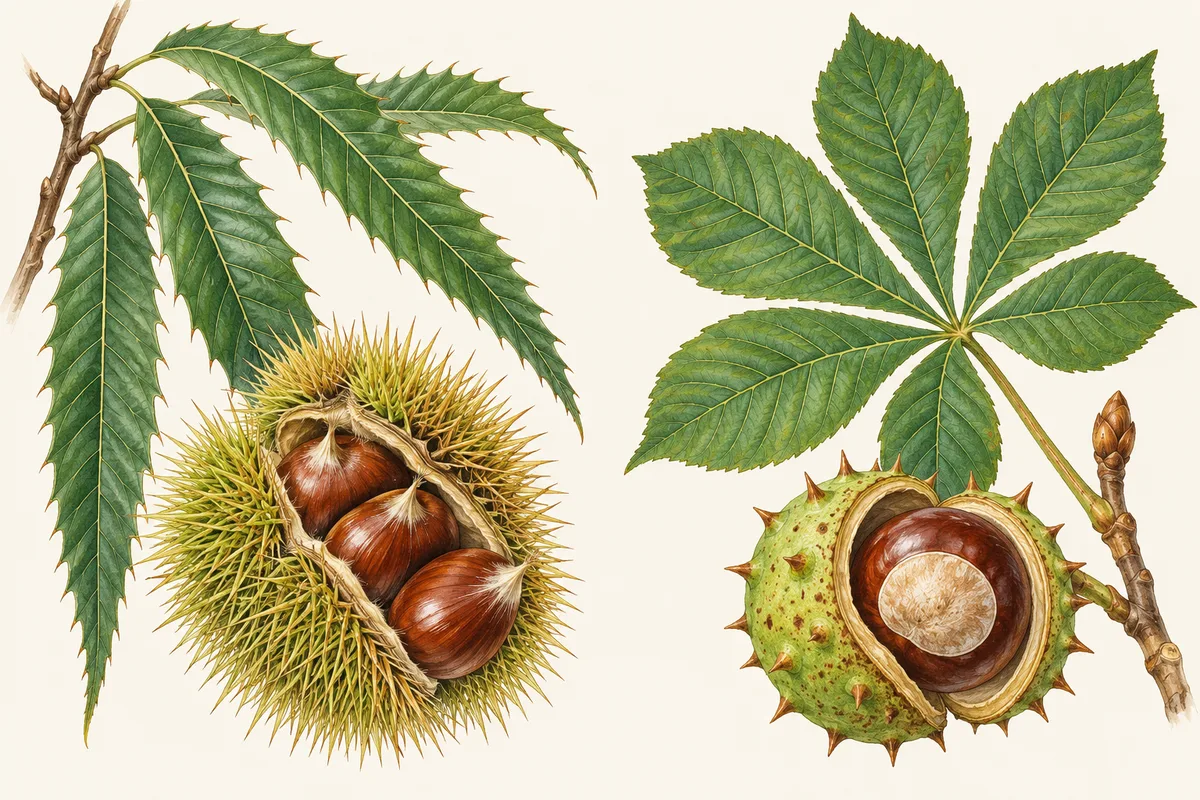
Two unrelated trees share a name and a spiky case. One leaf tells them apart: a hand of five to seven leaflets, or one long leaf with a saw edge.
In short
The conker tree is the horse chestnut (Aesculus hippocastanum). Its leaves are hand-shaped, with 5 to 7 toothed leaflets spreading from one point, its winter buds are dark red and sticky, and each conker sits in a green, spiky husk. Sweet chestnut (Castanea sativa) has single, long leaves 16 to 28 cm with widely spaced teeth, and smaller nuts clustered in a spiky green case.
- Never eat a berry, nut or seed on the strength of a web page or an app; check with a local expert.
- A hand of 5 to 7 leaflets means horse chestnut, the conker tree. One long leaf with a saw-toothed edge and about 20 pairs of parallel veins means sweet chestnut.
- The two are not related: sweet chestnut is in the beech family with oak and beech; horse chestnut belongs to the soapberry family with the maples.
Field marks at a glance
- Scientific name
- Aesculus hippocastanum and Castanea sativa
- Family
- Sapindaceae (horse chestnut; formerly Hippocastanaceae) and Fagaceae (sweet chestnut)
- Type
- Broadleaf, deciduous
- Horse chestnut leaf
- Palmate: 5 to 7 pointed, toothed leaflets spreading from the end of one stalk, like fingers on a hand. Leaves in opposite pairs.
- Sweet chestnut leaf
- Single, oblong, 16–28 cm (6–11 in) long and 5–9 cm wide, pointed tip, widely spaced teeth, about 20 pairs of parallel veins, glossy.
- Winter buds
- Horse chestnut: oval, dark red, shiny and sticky, above a leaf scar shaped like an upside-down horseshoe with nail holes.
- Husk and nut
- Horse chestnut: glossy red-brown conker in a spiky green husk, one or a few large seeds with a pale scar. Sweet chestnut: smaller shiny nuts clustered in a green case covered in spines.
- Flowers
- Horse chestnut: upright spikes of white flowers in May, each with a pink or yellow tint at the base. Sweet chestnut: long yellow catkins, mostly male, with female flowers at the base.
- Bark
- Horse chestnut: smooth pinky-grey when young, later scaly plates. Sweet chestnut: grey-purple and smooth, later deep fissures that spiral up the trunk.
- Size and age
- Horse chestnut up to 40 m (130 ft), living up to 300 years. Sweet chestnut up to 35 m (115 ft), living up to 700 years (Woodland Trust).
- Origin
- Both non-native in Britain. Horse chestnut from the Balkans, brought from Turkey in the late 16th century. Sweet chestnut from southern Europe, western Asia and North Africa.
- In the app's Collection
- Both horse chestnut and sweet chestnut are in Tree Identifier's Collection.
Never eat a berry, nut or seed on the strength of a web page or an app; check with a local expert. This page is for telling two trees apart, not for deciding what can be eaten.
The conker tree is the horse chestnut. Sweet chestnut shares half its name and a spiky case around its fruit, and nothing else: the two trees are not related, and their leaves look nothing alike. Check the leaf first, then the buds, the husk and the bark.
The leaf: a hand of leaflets, or one long toothed leaf
From April to October this is the fastest and surest test.
Horse chestnut. The Woodland Trust describes palmate leaves made of 5 to 7 pointed, toothed leaflets spreading from a central stem. All the leaflets meet at the tip of one long leaf stalk, like fingers on a hand. The leaves grow in opposite pairs on the twig, a detail the NC State Plant Toolbox lists for the species.
Sweet chestnut. The Woodland Trust's sweet chestnut page describes a single leaf about 16 to 28 cm long and 5 to 9 cm wide, oblong with a pointed tip, glossy, with widely spaced teeth around the edge and about 20 pairs of prominent parallel veins. One leaf, one stalk, and a saw edge.
| Feature | Horse chestnut (Aesculus hippocastanum) | Sweet chestnut (Castanea sativa) |
|---|---|---|
| Leaf | Palmate, 5–7 leaflets from one point | Single, oblong, 16–28 cm |
| Leaf edge | Leaflets pointed and toothed | Widely spaced pointed teeth |
| Veins | — | About 20 pairs, prominent and parallel |
| Arrangement | Opposite pairs | Single leaves along the twig |
| Winter buds | Oval, dark red, shiny, sticky | — |
| Flowers | White spikes in May | Long yellow catkins |
| Fruit case | Spiky green husk | Green case covered in spines |
| Nuts inside | Large glossy conker | Smaller nuts in a cluster |
| Bark | Pinky-grey, then scaly plates | Grey-purple, then spiral fissures |
| Family | Sapindaceae (formerly Hippocastanaceae) | Fagaceae, with oak and beech |
A dash means our sources do not state it. The Woodland Trust page gives horse chestnut's family under the older name Hippocastanaceae; NC State uses the current Sapindaceae.
The husk and the nut, in autumn
In September and October the ground under the tree tells you which it is.
Under a horse chestnut, the Woodland Trust describes a glossy red-brown conker inside a spiky green husk that falls in autumn. NC State gives the husk as a prickly, leathery capsule 1 to 2 inches (2.5 to 5 cm) across, holding large, shiny brown seeds, each with a pale scar.
Under a sweet chestnut, the fruits are shiny and red-brown too, inside a green, spiky case. The Woodland Trust points out the difference that matters: sweet chestnut's nuts are smaller and grow in clusters. The tree does not start fruiting until it is about 25 years old.
Conkers are not sweet chestnuts. The Woodland Trust's sweet chestnut page states that horse chestnut nuts are not edible, and its horse chestnut page calls conkers mildly poisonous if eaten in excessive quantities. NC State Extension goes further: it reports horse chestnut as highly toxic to people, cats, dogs and horses, and lists bark, flowers, fruits, leaves, seeds and stems. The sources disagree on how severe it is; none of them is a reason to taste anything. The rule at the top of this page applies to both trees.
Buds, flowers and bark through the year
Winter. Horse chestnut is one of the easiest trees to name without leaves. The Woodland Trust describes oval, dark red, shiny, sticky buds on stout twigs, and below each, the scar left by last year's leaf: an upside-down horseshoe complete with nail holes. That scar may be where the "horse" in the name comes from. For sweet chestnut in winter, look at the bark instead, which on older trees develops fissures that spiral up the trunk.
Spring and early summer. Horse chestnut flowers in May, in upright spikes of white flowers; the Woodland Trust describes each flower with 4 or 5 fringed petals, tinted pink at the base, and NC State describes a yellow throat and red speckles. Sweet chestnut flowers later, in long yellow catkins of mostly male flowers, with the female flowers at their base.
Bark. Horse chestnut bark is smooth and pinky-grey when young, darkening into scaly plates. Sweet chestnut bark is grey-purple and smooth at first, then deeply fissured; the spiral twist is the giveaway on a mature trunk.
Brown leaves in summer: the leaf miner
If a horse chestnut looks autumnal in July, the likely cause is horse chestnut leaf miner (Cameraria ohridella), a small moth. Forest Research reports that it was discovered in Wimbledon in 2002 and is now present in much of England and Wales. Its larvae make long patches in the leaves that start white and turn brown, from the lower canopy upwards, sometimes as early as June.
For identification, two points matter. Forest Research says sweet chestnut is not affected, so blotched leaves on a tree with hand-shaped leaves fit horse chestnut. And it describes the effect on tree health as mostly aesthetic, so browning alone does not mean the tree is dying. Health questions belong with an arborist; this page stays with naming the tree.
Where you find them, and using a photo
Both trees are introduced in Britain. The Woodland Trust says horse chestnut is native to the Balkan Peninsula and was first brought to the UK from Turkey in the late 16th century, then widely planted. Sweet chestnut comes from southern Europe, western Asia and North Africa; long thought to be a Roman introduction, it may have arrived more recently. It is common in woods and copses throughout the UK and is still coppiced over large areas of southern England. In North America horse chestnut is a planted European tree, and the native buckeyes, its relatives, are compared on the tree with spiky balls page.
A clear photo of a whole leaf or a husk on the ground is enough for Tree Identifier to suggest a name, and both trees are in the app's Collection. The app shows no confidence score and no list of look-alikes, so count the leaflets yourself. It does not say whether a nut can be eaten, and no app should. For more on reading fruit and seeds, see identify trees by seeds and nuts; the UK tree identification guide puts both chestnuts among the other common British trees.
The first recorded game of conkers, according to the Woodland Trust, was played on the Isle of Wight in 1848.
Look-alikes and how to tell them apart
Sweet chestnut (Castanea sativa)
One long leaf per stalk, not a hand of leaflets, with a saw edge of widely spaced, pointed teeth and about 20 pairs of straight parallel veins. The bark twists in spiral fissures on older trees.
Horse chestnut (Aesculus hippocastanum)
Count the leaflets: 5 to 7 spread from one point at the end of the stalk, and leaves come in opposite pairs. In winter, look for fat, sticky, dark red buds above horseshoe-shaped leaf scars.
Buckeyes (other Aesculus species)
In North America, native buckeyes have the same hand-shaped, opposite leaves and shiny seeds with a pale scar. They are horse chestnut's relatives, not chestnuts. Flower colour and the husk separate them; see the spiky balls guide.
What a photo can't settle
- No page and no app, ours included, can tell you whether a nut is safe to eat. Identifying the tree does not replace a local expert.
- In midwinter, with no leaves or husks on the ground, a bark photo alone separates these trees poorly. Look for old husks, dry leaves or the sticky buds.
- The flower and husk details here are for the common, white-flowered horse chestnut. Other Aesculus species and buckeyes planted in parks share the hand-shaped leaf, so a leaf photo names the genus more safely than the species.
Questions people ask
What is a conker tree called?
Its proper name is horse chestnut, *Aesculus hippocastanum*. Conkers are its seeds: glossy red-brown, each inside a spiky green husk that falls in autumn. The Woodland Trust suggests the 'horse' may come from the leaf scar, shaped like an upside-down horseshoe, or from conkers once being fed to horses as a cough remedy.
Are conkers sweet chestnuts?
No. Conkers come from the horse chestnut, a different tree in a different family. The Woodland Trust's sweet chestnut page sets the two apart and states that horse chestnut nuts are not edible; its horse chestnut page describes conkers as mildly poisonous in excessive quantities. Never eat a nut on the strength of a page or an app.
What do horse chestnut tree leaves look like?
Large and hand-shaped: 5 to 7 pointed, toothed leaflets spreading from the tip of one long stalk, in opposite pairs on the twig. The Woodland Trust says they turn yellow and red in autumn. Brown blotches from early summer are often leaf miner damage.
What do sweet chestnut tree leaves look like?
One long, glossy leaf per stalk, 16 to 28 cm long and 5 to 9 cm wide, oblong with a pointed tip. The edge has widely spaced, pointed teeth, and about 20 pairs of prominent parallel veins (Woodland Trust).
Are horse chestnuts poisonous?
NC State Extension reports horse chestnut as toxic to people, cats, dogs and horses, rating it highly toxic and listing every part of the tree. The Woodland Trust calls conkers mildly poisonous if eaten in excessive quantities. If a person or pet has swallowed one, contact a doctor, vet or poison service.
Why are horse chestnut leaves turning brown in summer?
Often horse chestnut leaf miner, a moth whose larvae make long patches that start white and turn brown, sometimes from June. Forest Research found it in Wimbledon in 2002; it is now in much of England and Wales. It describes the effect as mostly aesthetic. Sweet chestnut is not affected.
Sources
- Horse chestnut (Aesculus hippocastanum) — Woodland Trust
- Sweet chestnut (Castanea sativa) — Woodland Trust
- Aesculus hippocastanum (common horsechestnut) — North Carolina Extension Gardener Plant Toolbox, NC State University
- Horse chestnut leaf miner (Cameraria ohridella) — Forest Research