Field guide
Tree identification in the UK: British trees by leaf, bark and picture
Decide broadleaf or conifer, read the leaf, then confirm with buds, bark and fruit. The common British trees below are grouped by the clue that gives each one away.
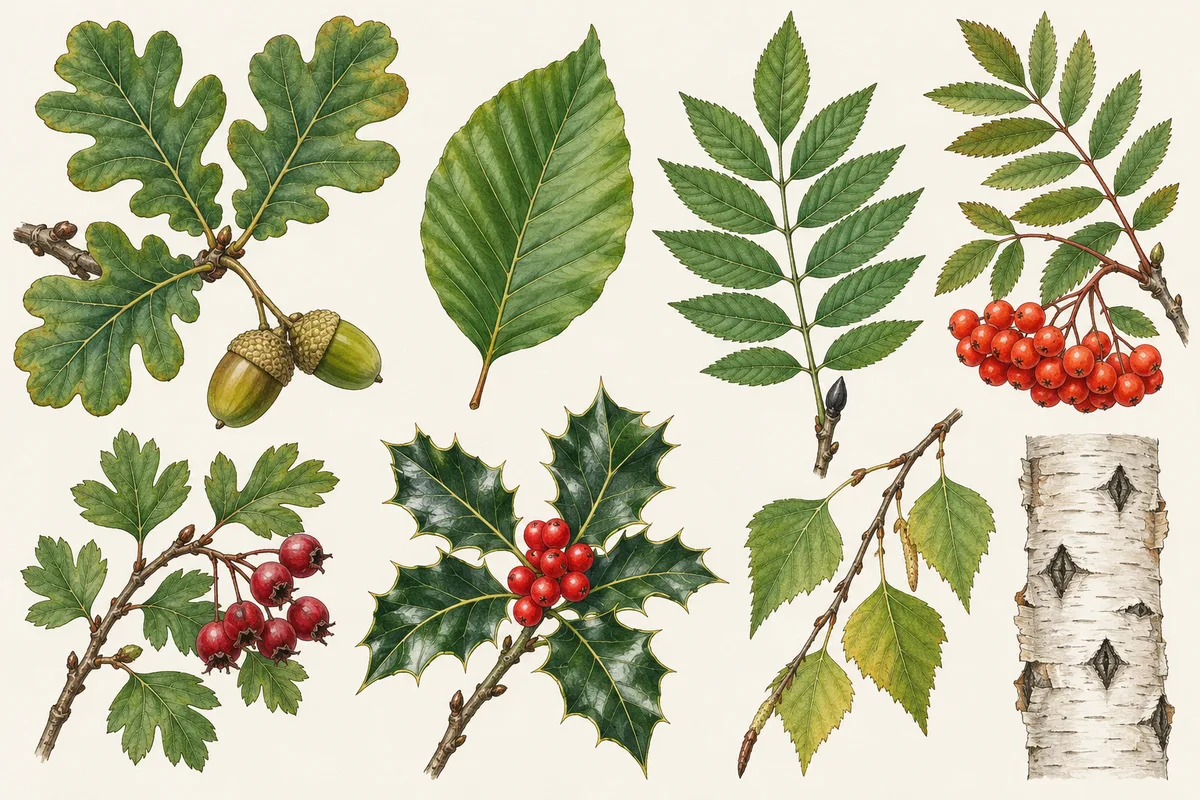
In short
Tree identification in the UK works in a fixed order. Decide whether the tree has broad leaves or needles, then read the leaf: lobed like oak, pinnate like ash and rowan, or simple like beech and lime. Confirm with the buds (opposite on ash and sycamore, alternate on rowan and hawthorn), the bark and the fruit. In winter, the Woodland Trust says to rely on twigs, buds and bark.
- Ash, sycamore and Norway maple carry their buds in opposite pairs; rowan, hawthorn, hazel, elms and limes alternate them.
- Rowan, ash and elder have pinnate leaves; horse chestnut has a hand-shaped compound leaf.
- The Woodland Trust's Tree ID app for iPhone and Android is free and works from leaves, bark, twigs, buds, flowers or fruit.
Britain has a short list of trees that make up most of its woods, hedges and streets, so a few clues go a long way. This guide gives the method in four steps, then groups about 25 common British trees by the clue that gives each one away, with a section on red berries and the free UK resources worth having.
How to identify British trees in four steps
The Woodland Trust's How to Identify Trees sets out the method most British guides follow:
- Broad leaves or needles. A broadleaf in Britain is usually deciduous; a conifer has needles or scales.
- Read the leaf. Is it simple, lobed, pinnate (leaflets paired along a central stalk) or palmate? Then look at the edge and the base.
- Check the buds and twigs. Opposite, alternate or spiral; colour, shape, and whether they are sticky or pressed against the twig.
- Confirm with bark, flowers and fruit, and with the setting: hedgerow, waterside, parkland or woodland each favour different trees.
The Trust's advice is to combine clues: overall shape, bark, leaves, flowers, fruit, buds and twigs together give the most reliable name. In winter, rely on twigs, buds and bark. Our field method for any tree covers the same steps in more depth.
British trees by leaf
All the clues in this section and the next come from the Woodland Trust's identification guide.
Lobed leaves
- Oak: lobed leaves and a broad, spreading crown. Sessile oak bark is silvery-brown and deeply fissured with age. Britain's two native oaks are compared on English oak vs sessile oak.
- Sycamore: a simple, lobed leaf on a tree with opposite buds and paired winged seeds. In North America the same name means a plane tree; see sycamore.
- Field maple: a simple, lobed leaf with vivid orange or red autumn colour and paired winged seeds.
- Hawthorn: simple but lobed leaves on a spiny twig; flowers around May.
Compound leaves
- Ash: pinnate leaves, deep purple flowers before the leaves, purple-black buds in opposite pairs and single-winged seeds. Its branches curve down, then turn up at the tips. See ash.
- Rowan: pinnate leaves, alternate buds and, from late summer, clusters of red berries. See rowan.
- Elder: pinnate leaves and berries.
- Horse chestnut: a palmate compound leaf, like a hand of leaflets, and fat, sticky buds. Conkers and sweet chestnuts are separated on horse chestnut vs sweet chestnut.
Simple leaves
- Beech: wavy leaf edges; buds that stand out from the twig at an angle.
- Hornbeam: serrated leaf edges and single-winged seeds. Beech and hornbeam hedges are compared on beech vs hornbeam.
- Lime: heart-shaped leaves with a pointed tip and alternate buds.
- Silver and downy birch: triangular leaves. Silver birch has a narrow, airy crown and white bark that peels in layers, black and rugged at the base.
- Aspen: very rounded leaves.
- Willows: long, thin, lance-shaped leaves, as on white willow; buds pressed tight against the twig.
- Elms: a lopsided leaf base, unequal on each side of the stalk.
- Hazel: long male catkins, the tiny female flowers showing pink stigmas.
- Alder: dark green male catkins, small female catkins that become woody cones and stay on all year.
- Wild cherry: deep reddish-brown bark with prominent horizontal lines.
British conifers and winter clues
Conifers. Pines, spruces, firs, cedars and larches have needles. Larch needles grow in clusters, and European larch drops them in winter. Yew has flattened needles and a densely bushy shape. Juniper's needles grow in whorls of three, and its berry-like cones are blue. Leyland cypress and its relatives have overlapping, shield-shaped scales. Scots pine stands on a tall, straight trunk, and cedar of Lebanon spreads its branches in horizontal layers. Our conifer identification guide goes needle by needle.
Buds and twigs in winter. The Woodland Trust groups the commonest trees by bud arrangement:
| Bud arrangement | Trees |
|---|---|
| Opposite pairs | Ash, dogwood, spindle, sycamore, Norway maple |
| Alternate | Rowan, hawthorn, hazel, elms, limes |
| Spiral | Oaks, aspen, blackthorn |
Then look closer. Ash buds are purple-black. Horse chestnut buds are fat and sticky. Willow buds lie pressed against the twig, where oak and beech buds stick out. Spines on the twig suggest hawthorn or blackthorn, corky ribs suggest alder, and blackthorn flowers on bare twigs in late winter or early spring. More winter marks are in winter tree identification.
British trees with red berries
Rowan, hawthorn, holly, yew and guelder rose are the red-berried trees and shrubs you are most likely to meet. Never eat a berry, nut or seed on the strength of a web page or an app; check with a local expert.
- Rowan: small orange-red berries in large clusters, which the Woodland Trust's winter berries guide lists from August to January. Pinnate leaves.
- Hawthorn: deep red fruits called haws, September to November, on a thorny tree with lobed leaves.
- Holly: small clusters of bright red berries from November to February. Holly has separate male and female trees. The Woodland Trust reports holly berries as poisonous to people and pets.
- Yew: the red "berry" is a modified cone, a fleshy red cup around a seed, on a conifer with flat needles. Yew also has separate male and female trees.
- Guelder rose: a shrub up to 4 m (13 ft) with opposite, three-lobed, coarsely toothed leaves 5–10 cm (2–4 in) long. Its round, translucent, bright red berries hang in bunches in autumn. The Woodland Trust's guelder rose profile notes it grows on damp soils at low altitudes and is rare in Scotland, and that its leaves resemble field maple's.
North American red-berried trees, from American holly to crabapples, are on trees with red berries.
Free apps and guides for UK tree identification
Woodland Trust Tree ID app. The Woodland Trust's Tree ID app page describes a free app for iPhone and Android that identifies the UK's native and common non-native trees from leaves, bark, twigs, buds, flowers or fruit, in any season. On the UK App Store it is listed as "British tree identification", by the Woodland Trust, free to download (checked 21 October 2026).
Woodland Trust A-Z of British trees. The same site has a free online A-Z of British trees covering native, naturalised and widely planted non-native species, with a profile page for each tree.
Tree Identifier. Our own iPhone app takes the other route: you photograph the tree, a leaf, the bark, a flower or a fruit, and it names it from that one picture. It needs an internet connection, shows the common and scientific name with key traits, and is free to download with optional in-app purchases. It gives no confidence score or list of alternatives, so check its answer against the clues above, especially the buds and leaf type.
What a photo can't settle
- Hybrid oaks, planted cultivars and young or shaded leaves often don't match the textbook description; a single photo of one leaf can't settle them.
- Whether a berry, nut or seed is safe to eat is never settled by a photo, an app or this page.
- Many parks and gardens hold non-native trees that aren't in British field guides, so check several clues before trusting any name.
Questions people ask
How do I identify a tree in the UK by its leaves?
Sort the leaf into a type first. Lobed: oak, sycamore, field maple, hawthorn. Pinnate: ash, rowan, elder. Hand-shaped compound: horse chestnut. Simple: beech (wavy edge), hornbeam (toothed edge), lime (heart-shaped), birch (triangular), aspen (very rounded), willow (long and narrow), elm (lopsided base).
How can I identify a UK tree in winter?
Use the twigs, buds and bark. Opposite buds point to ash, sycamore or Norway maple; purple-black buds mean ash; fat, sticky buds mean horse chestnut. Spines suggest hawthorn or blackthorn. White peeling bark with a dark base is silver birch.
Is there a free tree identification app for the UK?
Yes. The Woodland Trust's Tree ID app, listed on the App Store as British tree identification, is free for iPhone and Android and covers the UK's native and common non-native trees. Its website also has a free A-Z guide to British trees.
Which British trees have red berries?
The common ones are rowan (clusters of orange-red berries from August), hawthorn (deep red haws, September to November), holly (small clusters, November to February), yew (a red cup around a seed, on a conifer) and guelder rose (translucent red bunches on a shrub with three-lobed leaves).
How do I identify British conifers?
Look for needles or scales. Pines, spruces, firs, cedars and larches have needles; yew has flat needles; juniper's sit in threes; cypresses such as Leyland cypress have overlapping scales. European larch is a conifer that drops its needles in winter.
Sources
- How to Identify Trees: A Simple Guide — Woodland Trust
- Identify Trees With Our Tree ID app — Woodland Trust
- Winter berries: what are they and where to find them — Woodland Trust
- Guelder Rose (Viburnum opulus) — Woodland Trust
Keep reading
- Field guideHow to identify trees, step by step
- Tree profileSycamore tree: the British maple and the American plane tree
- Tree profileRowan tree (mountain ash): how to identify it
- Winter field guideWinter tree identification, from buds to bark
- Clue guideWhich tree has red berries? Sort it by leaf and season