Tree profile
Sycamore tree: the British maple and the American plane tree
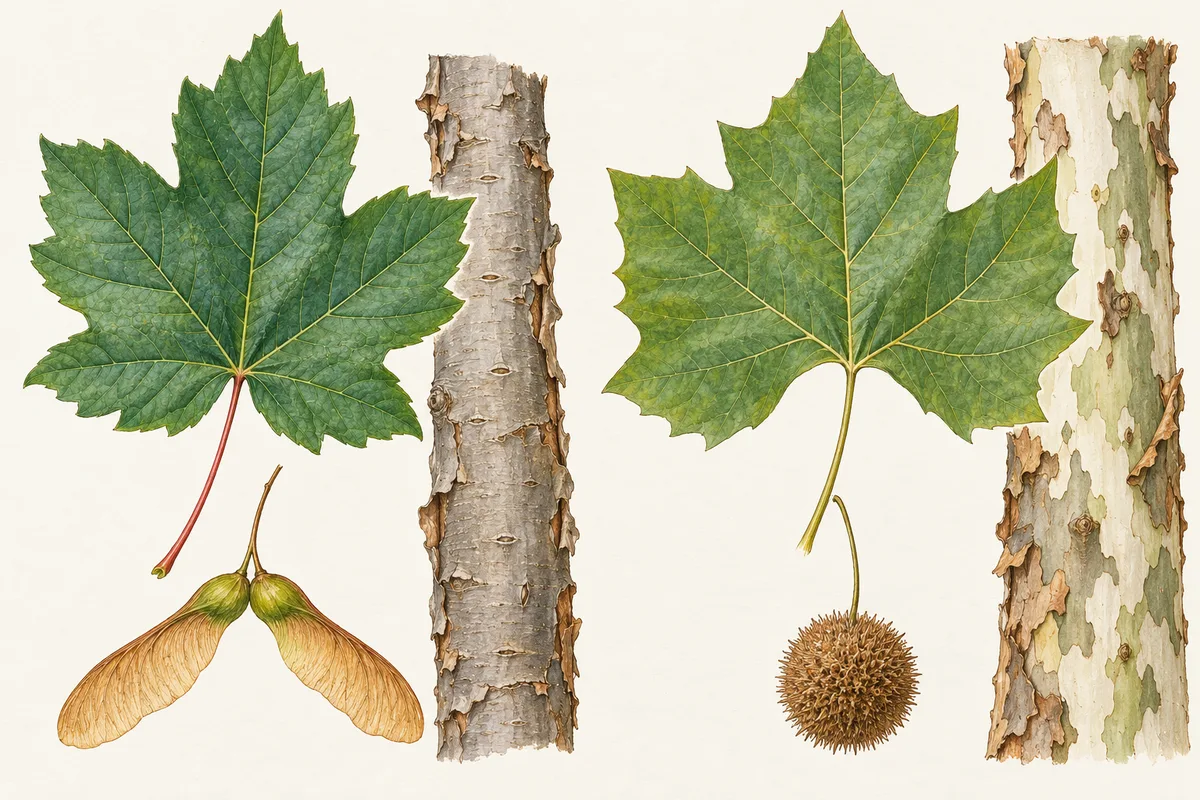
One name, two unrelated trees. Opposite buds and winged seeds make the British sycamore; alternate leaves, seed balls and peeling bark make the American one.
In short
A sycamore tree is one of two different trees. In Britain and Ireland it is Acer pseudoplatanus, a maple with five-lobed leaves 7–16 cm across, buds in opposite pairs and paired winged seeds set in a narrow V. In North America it is Platanus occidentalis, a plane tree with alternate leaves, round seed balls hanging on long stalks and mottled bark that peels in patches.
- Check the buds first: opposite pairs mean the British sycamore (a maple); one bud per node, hidden under the leaf stalk, means a plane tree.
- British sycamore seeds form a narrower V than those of field maple or Norway maple.
- London plane, the street tree of British cities, is a hybrid of the American sycamore and the Oriental plane.
Field marks at a glance
- Scientific name
- Acer pseudoplatanus (Britain and Ireland); Platanus occidentalis (North America)
- Family
- Sapindaceae (British sycamore); Platanaceae (American sycamore)
- Type
- Broadleaf, deciduous
- Which sycamore
- In the UK and Ireland, Acer pseudoplatanus, a maple. In the US and Canada, Platanus occidentalis, a plane tree. The two are not related.
- Leaves (UK)
- Palmate, 7–16 cm (3–6 in) across, with five lobes; hairy veins underneath; leaf stalks reddish on younger trees. Orange and red in autumn.
- Leaves (US)
- Alternate, 10–20 cm (4–8 in) wide, with three to five lobes and coarse teeth; the base of the leaf stalk encloses the bud.
- Seeds (UK)
- Paired winged seeds (samaras) in a narrow V; the flowers hang in green-yellow spikes.
- Fruit (US)
- A round ball of tiny winged seeds on a stalk 8–15 cm (3–6 in) long, usually one ball per stalk; ripe in November, breaking up in late winter.
- Bark
- UK: dark pinkish-grey and smooth, cracking into small plates with age. US: thin and mottled brown, green, tan and white, peeling in patches.
- Twigs and buds
- UK: pinkish-brown, hairless twigs with opposite buds. US: zigzag orange-brown twigs, no end bud, each side bud under a single cap-like scale.
- Size
- UK: up to about 35 m (115 ft), living around 400 years. US: a massive tree over 30 m (100 ft) with heavy, spreading limbs.
- Origin
- British sycamore: native to central, eastern and southern Europe, introduced to Britain. American sycamore: native to North America.
"Sycamore" names two unrelated trees. Ask in Britain or Ireland and you get a maple, Acer pseudoplatanus. Ask in the United States or Canada and you get a plane tree, Platanus occidentalis. Both have big lobed leaves, so the name travels with photos and causes confusion in both directions. One check separates them in seconds: the buds.
Which sycamore is it: buds, seeds and bark
1. The buds. Look at a twig. The Woodland Trust's How to Identify Trees lists the sycamore among the trees with opposite buds, set in pairs across the twig like ash and Norway maple. The American sycamore has one bud per node, alternating up a zigzag twig, and each bud sits hidden inside the hollow base of the leaf stalk (Virginia Tech Dendrology).
2. The seeds. The British sycamore makes paired winged seeds called samaras. The American sycamore makes a round ball of tiny seeds on a stalk 8–15 cm (3–6 in) long, usually one ball to a stalk, which ripens in November and hangs on the tree into late winter.
3. The bark. British sycamore bark is dark pinkish-grey and smooth when young, then cracks into small plates, according to the Woodland Trust's sycamore profile. The American sycamore's thin bark peels in patches and leaves a mottle of brown, green, tan and white that Virginia Tech calls camouflage bark.
If you are standing under a tall tree and can't reach a twig, a photo of the bark or of a fallen seed is often enough for Tree Identifier to suggest a name. The app shows no confidence score or list of alternatives, so confirm the answer with the bud and seed checks above.
The British sycamore (Acer pseudoplatanus)
The Woodland Trust describes a large tree reaching about 35 m (115 ft) and living around 400 years in the wild, with cultivated trees passing 500.
- Leaves: palmate, 7–16 cm (3–6 in) across, with five lobes. The leaf stalks of younger trees are reddish, and the veins on the underside are hairy. In autumn the leaves turn orange and red.
- Flowers: small and green-yellow, hanging in spikes called racemes, pollinated by wind and insects.
- Seeds: paired winged fruits whose wings meet in a narrow V.
- Twigs: pinkish-brown and hairless, the Woodland Trust's key mark in winter.
It is not native to Britain. The Woodland Trust gives its home as central, eastern and southern Europe and says it may have arrived with the Romans or, by other accounts, around the Tudor period. Planting increased in the 1700s, and the first record of it spreading in the wild dates from the mid-1800s. Its fertile seeds have since let it colonise many woodlands at the expense of native trees, and it is planted in parks, large gardens, exposed coastal sites and streets. The wood is hard and strong; it is used for furniture and kitchenware because it carves well and does not stain food.
Sycamore vs field maple vs Norway maple
These three maples share the opposite buds and the winged seeds, and all three grow in British woods, hedges and streets. The Woodland Trust's profiles of field maple and Norway maple give the marks that separate them:
| Feature | Sycamore | Field maple | Norway maple |
|---|---|---|---|
| Leaf | 7–16 cm, five toothed lobes | Small, shiny, much more rounded lobes | Five lobes ending in a few long, pointed teeth |
| Seed wings | Narrow V | In a straight line | Wider than sycamore's |
| Bark | Pinkish-grey, then small plates | Light brown, flaky | Grey with fine ridges |
| Height | About 35 m | About 20 m | About 25 m |
| Status in the UK | Introduced | Native, the UK's only native maple | Introduced in the 17th century |
Start with the leaf size and shape: a small, rounded, shiny leaf in a hedgerow points to field maple. For a large five-lobed leaf, squeeze the stalk; milky sap settles it as Norway maple. Seeds on the ground in autumn give a second check. Our maple guide covers the North American maples and the same milky-sap test.
The American sycamore (Platanus occidentalis)
In North America, sycamore means a plane tree, native to the continent. Virginia Tech describes a tree over 30 m (100 ft) tall with heavy, spreading limbs.
- Leaves: alternate, 10–20 cm (4–8 in) wide, with three to five lobes and coarse teeth. The veins may be hairy underneath.
- Fruit: a ball of tiny winged seeds, each about 1.3 cm (half an inch) long; the balls hang through winter "like Christmas tree ornaments".
- Twigs: obviously zigzag, orange-brown, with no end bud; each side bud wears a single cap-like scale, and the leaf scar circles the bud.
- Bark: thin and mottled, peeling to show pale inner bark; older stems turn grey-brown and scaly.
The palm-like lobes can suggest a maple; the alternate buds and the seed balls rule that out.
London plane: the sycamore look-alike in British streets
The plane tree most people in Britain see is the London plane (Platanus × hispanica). The Woodland Trust's London plane profile explains that it is a hybrid of the American sycamore and the Oriental plane, from a chance cross in a London nursery garden in the mid-17th century. It grows to about 35 m and has been planted along London streets since the late 18th century.
Its leaves have five triangular lobes and look so like a sycamore's that the Trust lists the two as look-alikes. Three marks tell them apart:
- Leaf texture and edge: London plane leaves are thick and leathery and their edges are not toothed.
- Bark: olive-green to grey, flaking in large plates to reveal cream patches.
- Fruit: green, spiky balls on long stalks that break up over winter, where a sycamore would carry winged seeds.
Tree Identifier's Collection, the 138-species catalogue that fills in as you identify, includes the American sycamore, the London plane (listed under its other name, Platanus × acerifolia) and Norway maple. The British sycamore is not one of its 138 species. For the other common trees of British woods and streets, see tree identification in the UK.
Look-alikes and how to tell them apart
Field maple (Acer campestre)
Field maple leaves are small, much more rounded and shiny, with blunt lobes; its seed wings sit in a straight line instead of a V. Older twigs often carry corky ridges. It is Britain's only native maple and grows to about 20 m.
Norway maple (Acer platanoides)
Squeeze a Norway maple leaf stalk and it oozes milky sap. Its five lobes end in a few long, pointed teeth, and its seed wings spread wider than a sycamore's, which the Woodland Trust calls the main difference.
London plane (Platanus × hispanica)
The leaf looks like a sycamore's, but it is thick and leathery and its edges are not toothed. Peeling olive-to-cream camouflage bark and spiky seed balls hanging through winter confirm a plane, not a maple.
American sycamore vs London plane
Both have seed balls and peeling bark. The American sycamore usually carries one ball per stalk and has coarsely toothed leaves; London plane is the hybrid planted along streets, very common in London.
What a photo can't settle
- A close-up of a single leaf can't show whether the buds are opposite or alternate, which is the quickest way to separate a maple from a plane tree; photograph a twig with at least two leaves or buds.
- Sycamore, field maple and Norway maple leaves vary with age and shade; young or shaded leaves can look atypical, so check the seeds, buds or sap as well.
- Plane trees in parks and streets may be planted hybrids or cultivars, and a photo alone can't always tell an American sycamore from a London plane.
Questions people ask
Is a sycamore tree a maple?
In Britain and Ireland, yes: the sycamore is Acer pseudoplatanus, a maple with opposite buds and paired winged seeds. In North America, no: the sycamore is Platanus occidentalis, a plane tree with alternate leaves and round seed balls. The two trees only share a name.
Is sycamore native to the UK?
No. The Woodland Trust gives it as native to central, eastern and southern Europe. It may have arrived with the Romans or, by other accounts, in Tudor times; planting increased in the 1700s and it was first recorded spreading in the wild in the mid-1800s. Today it grows across the UK.
How do you tell a field maple from a sycamore?
Field maple leaves are small, shiny and much more rounded, with blunt lobes; sycamore leaves are larger, 7–16 cm across, with five pointed, toothed lobes. Then check the seeds: field maple wings lie in a straight line, sycamore wings form a narrow V.
What are the balls on a sycamore tree?
On an American sycamore or a London plane, the hanging balls are the fruit: tight clusters of tiny seeds, each with stiff hairs or a small wing for the wind. On the American sycamore they ripen in November, usually one per stalk, and break up in late winter.
What is the sycamore tree in the Bible?
Not either of these. The Woodland Trust notes that the sycamore of the Gospels was most likely Ficus sycomorus, the sycamore fig, a different tree from both the British maple and the American plane tree.
Sources
- Sycamore (Acer pseudoplatanus) — Woodland Trust
- Field Maple (Acer campestre) — Woodland Trust
- Norway Maple (Acer platanoides) — Woodland Trust
- London Plane (Platanus x hispanica) — Woodland Trust
- How to Identify Trees: A Simple Guide — Woodland Trust
- American sycamore (Platanus occidentalis) fact sheet — Virginia Tech Dendrology