Field guide
How to identify trees by their leaves
Five checks in a fixed order, a leaf chart with the terms field guides use, and ten common US trees worked through from leaf to name.
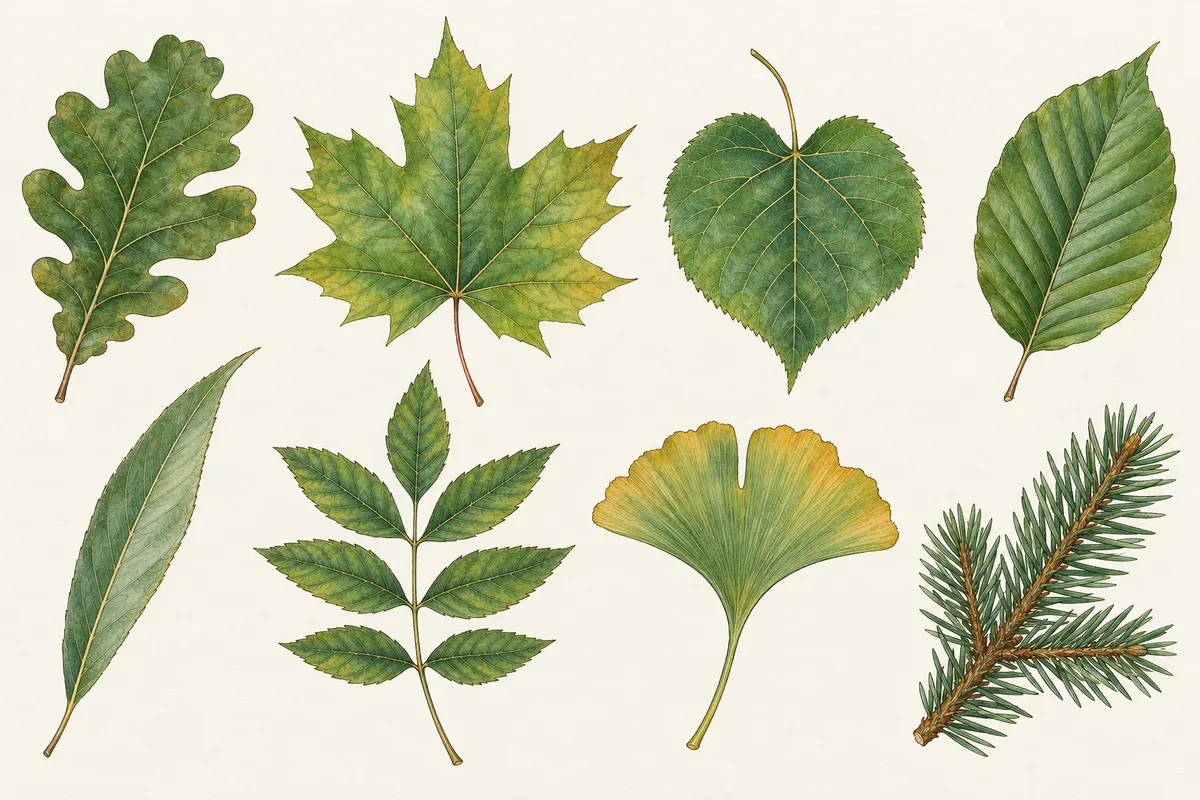
In short
To identify trees by leaves, read five features in order: leaf type (needle, scale or broad), arrangement on the twig (opposite, alternate or whorled), simple or compound, the margin and lobes, then the vein pattern. Opposite leaves with palmate lobes point to a maple; alternate leaves with bristle-tipped lobes point to the red oak group. Measure the leaf and compare several sunlit leaves before you name the tree.
- Find the bud first: it sits where a whole leaf meets the twig, never at the base of a leaflet, so it tells you whether you are holding a leaf or a leaflet.
- Opposite leaves narrow a native eastern tree to a short list: maples, ashes, dogwoods and buckeyes.
- In a 2022 study of six photo apps on 55 tree species, simple leaves without lobes were the hardest leaf type to identify.
Leaves carry more identification clues than any other part of a tree, and you can read them without any equipment. The trick is to look at them in a fixed order: first the features that split trees into big groups, then the details that separate close relatives. This guide gives that order, a chart of the terms field guides use, and ten common US trees worked through from leaf to name.
The leaf chart: five features to read in order
Read every leaf in the same five steps. The definitions below follow the University of Illinois Woody Plants Tutorial glossary; the example trees come from Virginia Tech Dendrology fact sheets.
| Feature | Options | What to look for | Example trees |
|---|---|---|---|
| 1. Leaf type | Needle, scale, broad | Needles or overlapping scales mean a conifer; a flat blade on a stalk means a broadleaf tree | Pines and spruces (needles), eastern redcedar (scales), oaks (broad) |
| 2. Arrangement | Opposite, alternate, whorled | Opposite: two leaves across from each other at the same node. Alternate: one leaf per node. Whorled: three or more per node | Maples and ashes (opposite), oaks and elms (alternate), northern catalpa (whorled) |
| 3. Simple or compound | Simple, pinnately compound, palmately compound, bipinnate | Simple: one undivided blade, which may still be lobed or toothed. Compound: leaflets along a central axis (pinnate) or radiating from one point (palmate). Bipinnate: the leaflets are divided again | Elms (simple), ashes and walnuts (pinnate), buckeyes (palmate), honeylocust (sometimes bipinnate) |
| 4. Margin and lobes | Entire, serrate, doubly serrate, crenate, dentate, lobed | Entire: smooth edge. Serrate: sharp forward-pointing teeth. Doubly serrate: teeth on the teeth. Crenate: rounded teeth. Dentate: teeth pointing outward. Lobed: rounded divisions cut less than halfway to the midvein | Redbud (entire), black cherry (serrate), American elm (doubly serrate), white oak (lobed) |
| 5. Venation | Pinnate, palmate | Pinnate: one prominent midvein with veins along both sides. Palmate: several main veins from one point at the base | Beech and cherry (pinnate), maples, sweetgum and sycamore (palmate) |
Two more details finish the description. Outline: lanceolate (longer than wide, broadest below the middle), ovate (teardrop, broad end at the stalk), obovate (the reverse), cordate (heart-shaped), deltoid (triangular), elliptic (broadest in the middle) or linear (more than four times as long as wide). Size: measure the blade, because "4 to 7 inches" separates species that look alike in a photo.
Collect several leaves from the sunlit outer crown, not one from a shaded sprout. Shade leaves and leaves on young trees are often bigger and less typically lobed. Once you can read the five features, the tree identification key asks for them one question at a time and names the tree.
Step by step: how to read a single leaf
Leaf type. Needles and scales send you to the conifer identification guide. Everything below is about broad leaves.
Arrangement. Look at where the leaves leave the twig, on three or four twigs, because a lost leaf can make an opposite tree look alternate. Opposite trees are a short list. In eastern North America the native trees with opposite leaves are mostly maples, ashes, dogwoods and buckeyes, which is why the how to identify trees hub starts here.
Simple or compound. Find the bud. It sits in the angle where a whole leaf joins the twig, never at the base of a leaflet. A single ash leaflet looks like a whole leaf until you notice it has no bud.
Margin and lobes. Run a finger along the edge. Smooth, toothed or lobed is the first split; then look closer. Teeth carrying smaller teeth (doubly serrate) point to elms, birches and hophornbeam. On lobed leaves, check the lobe tips: in oaks, bristle tips mean the red oak group and rounded tips mean the white oak group.
Venation. Hold the leaf to the light. Several main veins fanning from the base mean palmate venation, typical of maples, sweetgum and sycamore. A single midrib with side veins is pinnate. On American beech each side vein runs straight to a sharp tooth.
Base and stalk. Small details settle many cases. An elm leaf base is lopsided. Eastern cottonwood has a flattened leaf stalk with glands at the top. Eastern redbud's stalk is swollen at both ends.
Ten worked examples
Each example follows the five steps. Leaf sizes are from the Virginia Tech Dendrology fact sheets.
1. White oak. Broad, alternate, simple, lobed. The leaf is 4 to 7 inches long with 7 to 10 rounded, finger-like lobes, no bristle tips, and a whitish underside (Virginia Tech). Rounded lobes put it in the white oak group. Full profile: white oak; all oaks: oak tree identification.
2. Northern red oak. Broad, alternate, simple, lobed, like white oak, but each of its 7 to 11 lobes ends in a bristle. The leaf is 5 to 8 inches long, and the sinuses reach a third to half of the way to the midvein (Virginia Tech). The red oak vs white oak page adds the acorn and bark tests.
3. Sugar maple. Broad, opposite, simple, palmately veined. The leaf is 3 to 6 inches long with 5 rounded lobes and smooth (entire) edges between the lobe tips (Virginia Tech).
4. Red maple. Opposite, simple, palmately veined like sugar maple, but smaller (2 to 4 inches) with 3 to 5 lobes and a toothed margin, whitish beneath (Virginia Tech). Teeth or no teeth is the quickest split between the two; see red maple vs sugar maple and the maple guide.
5. White ash. Opposite and pinnately compound: 7 leaflets on a leaf 8 to 12 inches long, the leaflet edges toothed to smooth (Virginia Tech). Opposite plus compound leaves a short list of ashes, boxelder and buckeyes. More on the ash page.
6. Black walnut. Alternate and pinnately compound, 12 to 24 inches long with 10 to 24 finely toothed leaflets; the end leaflet is often missing or poorly formed (Virginia Tech). Shagbark hickory, another alternate compound leaf, has only 5 (sometimes 7) leaflets with a large end leaflet. See walnut and hickory.
7. American elm. Alternate, simple, 3 to 5 inches long, with a coarse doubly serrate margin and a conspicuously lopsided base (Virginia Tech). Double teeth plus an uneven base is the elm signature. More on the elm page.
8. Black willow. Alternate, simple, lanceolate, 3 to 6 inches long with a finely toothed margin, shiny above (Virginia Tech). A long, narrow, finely toothed leaf by water is very often a willow; see willow.
9. Black cherry. Alternate, simple, 2 to 5 inches long, oblong to lance-shaped, finely serrate, with tiny glands on the leaf stalk and often a band of yellowish-brown hairs along the midrib underneath (Virginia Tech). Those hairs are worth a hand lens. More on the cherry page.
10. American beech. Alternate, simple, 2 1/2 to 5 1/2 inches long, with 11 to 14 pairs of straight side veins, each ending in a sharp tooth (Virginia Tech). Straight, parallel side veins running into teeth separate beech from look-alikes; see beech.
Two shapes deserve a mention because people search for them. A heart-shaped (cordate) leaf with smooth edges, 3 to 5 inches long and wide, is the classic eastern redbud leaf; the heart-shaped leaves guide covers redbud, catalpa, basswood and others. A leaf that comes unlobed, mitten-shaped and three-lobed on the same branch is sassafras.
Common mix-ups and how to avoid them
- Leaflet taken for a leaf. The commonest mistake. Look for the bud before you count anything.
- Lobed taken for compound. A lobed leaf is still a simple leaf: an oak or maple blade is one piece, however deep the sinuses between the lobes, and it has one bud at its base.
- Opposite taken for alternate. Check several twigs; a broken twig or a missing leaf hides the pair.
- Shade leaves. Leaves from the lower, shaded crown are often bigger and less lobed. Describe sunlit leaves.
- Young trees and sprouts. Their leaves can be much larger or oddly lobed, so don't rely on them alone.
- Planted trees. Yards and streets hold species from other continents, such as Norway maple, which a regional field guide may leave out.
Where a photo app helps with leaves
A leaf is the part photo apps read best. In a 2022 study published in Arboriculture & Urban Forestry, Rutgers researchers tested six apps on 440 photos of leaves and bark from 55 New Jersey tree species. Leaf photos were identified far more reliably than bark photos. Among leaves, palmately lobed and compound leaves scored best, and simple leaves without lobes scored worst. The authors conclude that the apps can't replace field identification but can help narrow down the candidates.
That matches how to use Tree Identifier: photograph one typical leaf, flat, against a plain background, and you get a common and scientific name with key traits. The app shows no confidence score and no list of look-alikes, so confirm the answer with the five checks above. If the name surprises you, the follow-up chat under the result in Tree Identifier lets you ask how that species differs from the one you suspected. When the leaves are out of reach, the bark is the next clue: see how to identify trees by bark.
What a photo can't settle
- A single leaf can't settle a hybrid. Oaks in particular cross within their group, and the leaves of a hybrid fall between both parents.
- Simple, unlobed leaves look alike across many genera. In the 2022 Rutgers study, they were the hardest leaf type for photo apps to identify, so check the bark, buds or fruit as well.
- Garden cultivars (cut-leaf, purple or variegated forms) can look unlike the wild species, and neither a key nor a photo gives you the cultivar name.
Questions people ask
Can you identify a tree by its leaf?
Usually to the genus, and often to the species. A leaf gives you its arrangement, whether it is simple or compound, its margin, lobes, veins and size. That is enough to tell a maple from an oak and a red oak from a white oak. Close relatives and hybrids may also need the bark, buds or fruit.
How do I identify a tree by its leaf?
Pick a typical sunlit leaf with its stalk. Note where it joined the twig (opposite or alternate), find the bud to see whether it is simple or compound, then describe the outline, the edge (smooth, toothed or lobed) and the veins. Measure it. Run those notes through a key or field guide.
What is the difference between a leaf and a leaflet?
A leaf ends where its stalk meets the twig, and a bud sits in that angle. A leaflet is one blade of a compound leaf and has no bud at its base. A black walnut leaf, 12 to 24 inches long, carries 10 to 24 leaflets on one stalk.
What tree has leaves with three different shapes?
Sassafras. Virginia Tech's fact sheet describes leaves that are unlobed, two-lobed like a mitten or three-lobed like a trident, often all on the same branch. The leaves are fragrant when crushed, which helps confirm it.
Why do leaves on the same tree look different?
Leaves vary with light and age. Shade leaves, leaves on sprouts and leaves on young trees are often larger, thinner or less deeply lobed than sunlit leaves from a mature crown. Collect several leaves from the sunny outer crown and describe the most common form.
Sources
- Glossary, Woody Plants Tutorial — University of Illinois, Department of Natural Resources and Environmental Sciences
- White oak fact sheet — Virginia Tech Dendrology
- Northern red oak fact sheet — Virginia Tech Dendrology
- Sugar maple fact sheet — Virginia Tech Dendrology
- Red maple fact sheet — Virginia Tech Dendrology
- Black walnut fact sheet — Virginia Tech Dendrology
- American elm fact sheet — Virginia Tech Dendrology
- An Analysis of the Accuracy of Photo-Based Plant Identification Applications on Fifty-Five Tree Species (Arboriculture & Urban Forestry 48(1): 27–43) — International Society of Arboriculture (Schmidt, Casario, Zipse and Grabosky, Rutgers University)
Keep reading
- Field guideHow to identify trees, step by step
- Field guideTree bark identification: seven bark types and the trees that have them
- Clue guideTrees with heart-shaped leaves, and how to tell them apart
- Tree profileOak trees (Quercus): how to identify them
- Tree profileMaple trees (Acer): how to identify them