Field guide
Tree bark identification: seven bark types and the trees that have them
A bark chart built on seven textures, the US trees that show each one, and an honest note on why bark is harder than leaves, for people and for apps.
In short
Tree bark identification starts on the main trunk at chest height: note the color, then match the texture to one of seven types (smooth, peeling, scaly plates, ridges and furrows, shaggy strips, visible lenticels or corky ridges). Smooth gray bark on a large trunk points to American beech, chalky white bark peeling in papery strips to paper birch, and long plates curling away at both ends to shagbark hickory.
- Bark changes with age: young, mature and old bark can look like three different species, and an old tree can show all three from the base to the crown.
- Use bark to confirm a candidate from the leaves, buds or fruit, not to find one from scratch.
- In a 2022 Rutgers study, six photo apps were much more accurate on leaf photos than on bark photos; the birch family was the exception.
Bark is the one clue a tree carries all year, at eye level, and it is the clue most people try first. It is also the hardest to read, because a species' bark changes as the tree ages and many trees end up with similar ridges and furrows. Used the right way, as a check on a name you suspect, bark settles a lot of identifications. This guide sorts bark into seven types with US examples for each.
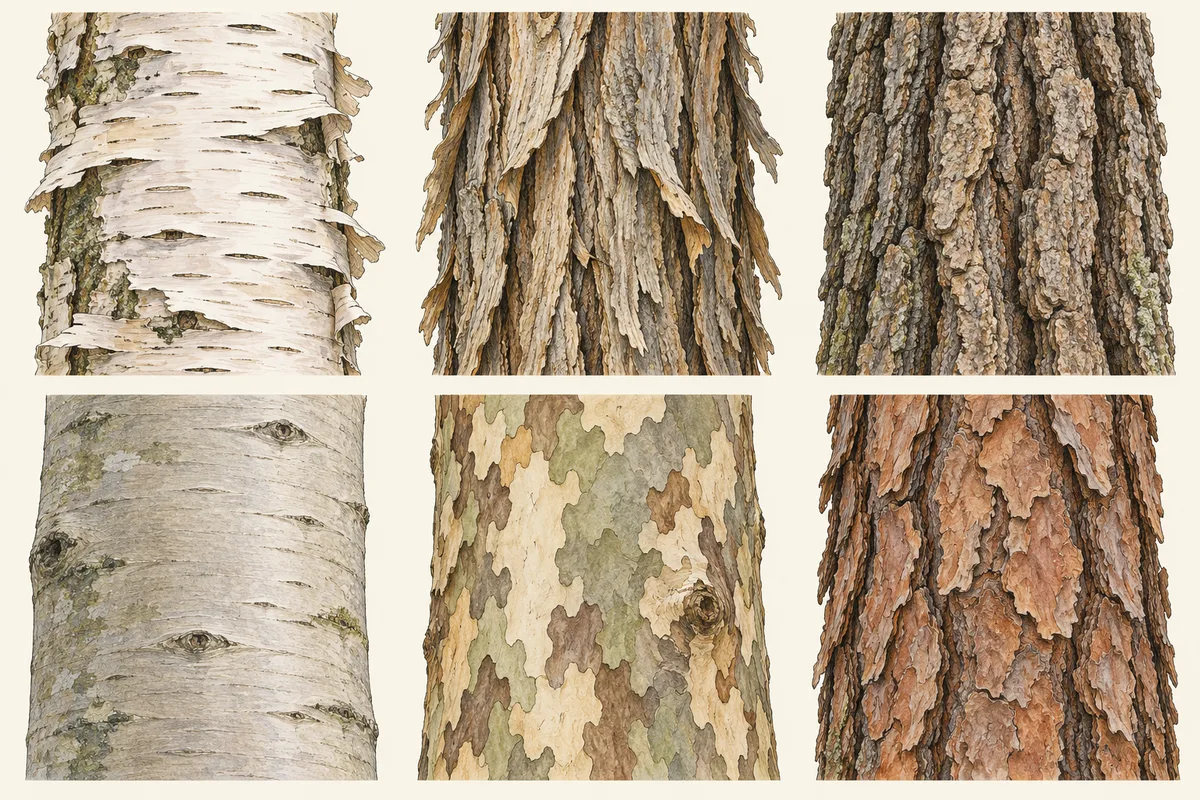
The bark chart: seven types and the trees that show them
The seven types follow the bark categories that University of New Hampshire Extension teaches from Michael Wojtech's Bark: A Field Guide to Trees of the Northeast, with corky ridges added as a separate type. Descriptions come from Virginia Tech Dendrology fact sheets.
| Bark type | What it looks like | US examples |
|---|---|---|
| Smooth | Thin, unbroken, no ridges even on big trunks | American beech, American hornbeam, young red maple |
| Peeling or papery | Thin layers coming away in strips, curls or patches | Paper birch, river birch, yellow birch, American sycamore |
| Scaly plates | Broken into flat scales or plates | Black cherry, common persimmon, red pine, blackgum |
| Ridges and furrows | Long ridges separated by grooves, often in a pattern | Northern red oak, white ash, black walnut, black locust, yellow-poplar |
| Shaggy strips | Long strips or plates loose at one or both ends | Shagbark hickory, silver maple, eastern redcedar, hophornbeam |
| Visible lenticels | Smooth bark marked with short horizontal lines or dots | Young black cherry, black (sweet) birch, bigtooth aspen, pawpaw |
| Corky ridges or warts | Raised, spongy-looking bumps or ridges | Hackberry |
Look at the main trunk at chest height, in good light, and describe the bark in three words: color, texture, pattern. Then look higher up the trunk. Michael Wojtech's point, as UNH Extension explains it, is that each tree passes through young, mature and old bark, and an old tree can show the oldest bark at its base and young bark on its upper branches.
Smooth bark
Smooth bark that stays smooth on a large trunk is rare, which makes it a strong clue. American beech bark is smooth, thin and gray even on the largest stems (Virginia Tech). American hornbeam is also thin, smooth and gray to bluish gray at any age, but it is a small tree, up to about 25 feet, and its trunk is heavily fluted, so it looks muscular.
Many trees are smooth only when young. Red maple starts smooth and light gray and later darkens and breaks into long, fine, scaly plates. UNH lists beech and red maple as its examples of smooth, unbroken bark. For more on beech, see the beech profile.
Peeling and papery bark
Paper birch is the reference: reddish brown with light lenticels on very young stems, then chalky to creamy white, peeling in horizontal papery strips, with orange inner bark and darker, sometimes furrowed bark at the base (Virginia Tech). River birch peels in papery scales of several colors, from creamy to orangish brown, and yellow birch peels horizontally in curly strips (UNH). The birch page compares the four common birches.
American sycamore sheds its thin bark in patches, leaving a mottled trunk of brown, green, tan and white that Virginia Tech calls "camouflage" bark; older trunks are gray-brown and scaly at the base. Scots pine is a conifer example: its upper crown always shows orange, peeling bark.
Plates, ridges and shaggy strips
These three types cover most mature trees, so the details matter.
Scaly plates. Black cherry bark becomes very dark, nearly black, and breaks into small, rough, upturned plates that Virginia Tech compares to burnt cornflakes. Common persimmon breaks into thick, square, scaly plates "reminiscent of charcoal briquettes". Old blackgum bark can become blocky, like alligator hide, and red pine bark becomes plated with a reddish tinge.
Ridges and furrows. Northern red oak develops wide, flat-topped ridges and shallow furrows that Virginia Tech compares to ski tracks. White ash has interlacing corky ridges forming obvious diamonds; black walnut is ridged and furrowed in a rough diamond pattern; black locust is thick and fibrous, "heavily ridged and furrowed", like woven rope. Yellow-poplar has flat-topped ridges with conspicuous white furrows. For the oaks, the red oak vs white oak page compares the two barks side by side.
Shaggy strips. Shagbark hickory starts smooth and gray, then breaks into long, wide plates attached at the middle that curve away from the trunk (Virginia Tech). UNH lists shagbark among the trees whose smooth young bark first shows vertical cracks or seams, so a young shagbark can look nothing like an old one. Silver maple bark breaks into long, thin strips loose at the ends; eastern redcedar exfoliates in long, fibrous, red-brown strips; hophornbeam turns shreddy, with small loose plates that a brush of the hand can knock off. See the hickory page for the full hickory set.
Lenticels, corky ridges and other details
Lenticels are pores in the bark, visible as short lines or dots. Young black cherry bark is smooth with numerous short, narrow, horizontal lenticels before it turns platy. UNH lists black birch and bigtooth aspen as trees whose lenticels stay visible; bigtooth aspen develops diamond-shaped lenticels as it ages. Pawpaw is smooth and brown with wart-like lenticels.
Corky ridges and warts. Hackberry is the tree to know: smooth gray-brown at first, it soon develops individual corky warts that later join into rough, irregular corky ridges (Virginia Tech). Corky wings on twigs are a different feature, seen on sweetgum twigs when they grow fast.
Other marks. Balsam and Fraser fir bark is smooth with raised resin blisters. Honeylocust can carry clusters of large, branched thorns on the trunk. The inner bark helps when a piece is already broken: orange on paper birch, cinnamon-brown and spicy-smelling on sassafras.
Bark in winter
From leaf fall to spring, bark works together with twigs and buds. Read the bark first to shortlist candidates, then confirm with the bud arrangement, bud shape and leaf scars, and with any fruit still on the tree or on the ground. The winter tree identification guide covers buds and twigs, and how to identify trees gives the whole method in order. Bark is also the main clue left on a dead or cut tree, which is why the firewood identification guide starts from it.
Bark photos and apps: what the research says
Photo apps do worse on bark than on leaves, and the research is clear about it. In a study published in 2022 in Arboriculture & Urban Forestry, the journal of the International Society of Arboriculture, Rutgers University researchers (Schmidt, Casario, Zipse and Grabosky) tested six plant identification apps on 440 photos covering 55 tree species common in New Jersey, at least four bark photos and four leaf photos per species. Their abstract states that the apps "are much more accurate in identifying leaf photos as compared to bark photos." The birch family was the exception, with one of the highest identification rates from bark. The authors conclude that the apps cannot replace traditional field identification but can help narrow down the likely species. The app accuracy guide summarizes the study in more detail.
What this means in practice: when you photograph bark in Tree Identifier, take the photo straight on, at chest height, filling the frame with the bark of a mature trunk, and add a photo of a leaf, a twig or fruit whenever you can. The app returns a name with key traits but no confidence score and no list of look-alikes, so treat a name from bark alone as a lead. Ask the follow-up chat in Tree Identifier how that species' bark changes with age, then check the tree against the chart above. For the leaves, use how to identify trees by leaves.
What a photo can't settle
- Bark changes with age, and young trees of many species have smooth bark that gives little away, so a bark photo of a sapling rarely settles the species.
- In the 2022 Rutgers study, all six photo apps were much more accurate on leaf photos than on bark photos. Treat any name from a bark photo as a lead to confirm with leaves, buds or fruit.
- Disease, sunscald, lichens and moss change how bark looks; beech bark disease, for example, severely deforms beech's smooth bark.
Questions people ask
Can you identify a tree by its bark?
Often, for trees with distinctive bark: beech, paper birch, sycamore, shagbark hickory, black cherry and hackberry are hard to mistake once mature. Many other trees have ridged and furrowed bark that looks alike, so use bark to confirm a candidate from the leaves, buds or fruit rather than as the only clue.
What tree has smooth gray bark?
American beech is the classic example: Virginia Tech describes its bark as smooth, thin and gray even on the largest trunks. American hornbeam is also smooth and gray but much smaller, with a fluted, muscular-looking trunk. Young red maples are smooth and light gray before the bark breaks into plates.
What tree has bark that peels off?
Paper birch peels in horizontal papery strips of chalky white bark. River birch shows salmon to orange-brown papery scales. Sycamore sheds patches that leave a mottled brown, green, tan and white trunk. Shagbark hickory's long plates curl away from the trunk, and eastern redcedar peels in long fibrous strips.
What tree has bark with bumps or warts?
Hackberry. Virginia Tech describes smooth gray-brown bark that soon develops corky, individual warts, which later merge into rough, irregular corky ridges. Pawpaw bark is smooth and brown with wart-like lenticels, and balsam and Fraser firs carry raised resin blisters on otherwise smooth bark.
Sources
- An Analysis of the Accuracy of Photo-Based Plant Identification Applications on Fifty-Five Tree Species (Arboriculture & Urban Forestry 48(1): 27–43) — International Society of Arboriculture (Schmidt, Casario, Zipse and Grabosky, Rutgers University)
- Bark! A Great Way to Identify Trees in the Winter — University of New Hampshire Extension
- Paper birch fact sheet — Virginia Tech Dendrology
- American sycamore fact sheet — Virginia Tech Dendrology
- Shagbark hickory fact sheet — Virginia Tech Dendrology
- American beech fact sheet — Virginia Tech Dendrology
- Black cherry fact sheet — Virginia Tech Dendrology
- Hackberry fact sheet — Virginia Tech Dendrology