Tree profile
Cedar trees: how to identify red, white and true cedars
Most American "cedars" are not true cedars. Look at the foliage, the cone and the bark, and you can name the one in front of you in a few minutes.
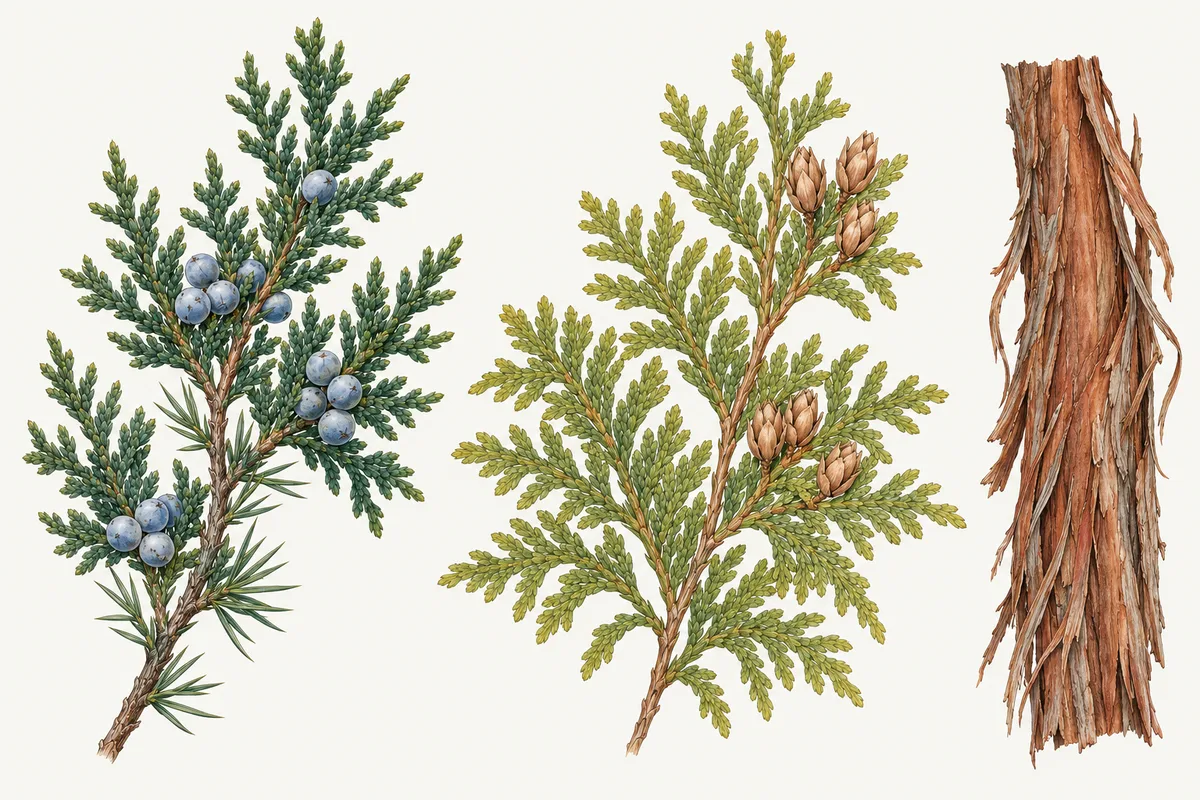
In short
Cedar tree identification starts with the foliage. Tiny overlapping scales mean a native "cedar" from the cypress family: berry-like blue cones point to eastern red cedar, a juniper; flat fan-like sprays with small upright cones point to white cedar (arborvitae) or western redcedar. Needles in tufts of 10 to 20 on short spurs, with upright barrel-shaped cones, mean a true cedar (Cedrus), an Old World tree planted in the US.
- Eastern red cedar (Juniperus virginiana) is a juniper, not a true cedar: its cones look like small dusty-blue berries.
- True cedars (Atlas, Lebanon and deodar cedar) have needles in tufts on spur shoots and come from North Africa, the Mediterranean and the Himalayas.
- Northern white cedar, eastern white cedar and eastern arborvitae are three names for one tree, Thuja occidentalis.
Field marks at a glance
- Scientific name
- Juniperus, Thuja, Chamaecyparis and Cedrus
- Family
- Cupressaceae (cypress family) for the native "cedars"; Pinaceae (pine family) for the true cedars
- Type
- Conifer, evergreen
- Foliage
- Native "cedars": tiny scale-like leaves pressed against the twig. True cedars (Cedrus): needles in tufts of 10 to 20 on short spur shoots, single on new growth.
- Eastern red cedar
- A juniper. Scales about 1/16 inch plus sharp needle-like leaves about 1/4 inch on young trees and fast shoots; berry-like cones about 1/4 inch, dark blue with a whitish bloom.
- Northern white cedar
- Arborvitae. Flat, fan-like sprays, usually horizontal and stiff, dull yellowish green turning bronze in winter; cones 1/3 to 1/2 inch, upright on a short curved stalk.
- Western redcedar
- Flat sprays with a butterfly-shaped white pattern under the scales; 1/2-inch woody cones turned up on the branches; trunk base often swollen and fluted.
- True cedars
- Upright, barrel-shaped cones 2 to 3 inches long on top of the branches, taking two years to mature; needles about 3/4 inch, green to blue-green.
- Bark
- Eastern red cedar: red-brown, peeling in long fibrous strips, ashy gray where weathered. White cedars and western redcedar: thin, fibrous, peeling in long narrow strips.
- Range
- Eastern red cedar: every state east of the 100th meridian. Northern white cedar: Nova Scotia and Maine to Manitoba and Minnesota. Western redcedar: northern California to southeastern Alaska, inland to Montana and Idaho.
- In the app's Collection
- Northern white cedar, western redcedar, cedar of Lebanon, Atlas cedar, deodar cedar and common juniper.
The word "cedar" covers at least four groups of trees in North America, and only one of them is a true cedar. Eastern red cedar is a juniper. White cedar is an arborvitae. Western redcedar is a giant arborvitae of the Pacific Northwest. True cedars, the genus Cedrus, are Old World trees that Americans plant in parks and yards. Here is how to tell them apart.
Trees called cedar: foliage, cone, bark and range
Start with the foliage, then confirm with the cone. The rows below come from Virginia Tech Dendrology's fact sheets for eastern redcedar, western redcedar and Atlantic white-cedar, Natural Resources Canada's eastern white-cedar factsheet, Oregon State University's Atlas cedar page and the USDA Forest Service's Silvics of North America for the ranges.
| Tree | Foliage | Cone | Bark | Native range |
|---|---|---|---|---|
| Eastern red cedar (Juniperus virginiana) | Scales 1/16 in, four-sided, tight to the twig; sharp needle-like leaves 1/4 in on young growth | Berry-like, about 1/4 in, green turning dark blue with a whitish bloom | Red-brown, peeling in long fibrous strips | Every state east of the 100th meridian |
| Northern white cedar, arborvitae (Thuja occidentalis) | Flat, fan-like sprays, usually horizontal and stiff; bronze in winter | Upright, egg-shaped, 7 to 15 mm (1/3 to 1/2 in), green to light brown | Thin, in long narrow flat strips, reddish brown turning gray | Nova Scotia and Maine to Manitoba and Minnesota |
| Western redcedar (Thuja plicata) | Flat sprays, yellow-green, butterfly-shaped white bloom underneath | Woody, 1/2 in, 5 to 6 pairs of thin scales, turned up | Thin, fibrous, stringy, reddish brown, in long strips | Pacific coast from Humboldt County, California, to southeastern Alaska; inland to western Montana and northern Idaho |
| Atlantic white cedar (Chamaecyparis thyoides) | Scales 1/16 to 1/8 in, blue-green with white margins, on irregular branchlets (not flat sprays) | Round, 1/4 in, blue or purple with a bloom, 4 or 5 scales | Thin, fibrous, somewhat peeling, ashy gray to red-brown | Native to North America; Virginia Tech gives no range text |
| True cedars: Atlas, Lebanon, deodar (Cedrus) | Needles about 3/4 in, 10 to 20 in tufts on spur shoots | Upright, barrel-shaped, 2 to 3 in, two years to mature | Not used here to separate them | Atlas Mountains of Algeria and Morocco; the Mediterranean (Lebanon); the Himalayas (deodar) |
The table settles most trees. If your tree has single needles along the twig, it is not a cedar of any kind: try the conifer identification key instead.
Eastern red cedar is a juniper, not a cedar
The tree most Americans call red cedar is Juniperus virginiana. The USDA Forest Service's Silvics of North America lists it under the names red juniper and savin and says it grows in every state east of the 100th meridian, often on dry, exposed sites and in abandoned fields. Mature trees usually stand 40 to 50 feet tall and 12 to 24 inches in diameter at breast height.
To recognize it, check three things:
- Two kinds of leaves. Virginia Tech describes tiny four-sided scales about 1/16 inch long, dark green and held tightly to the twig, and longer dark blue-green needle-like leaves about 1/4 inch, more common on young trees and fast-growing shoots. Run your hand up a young tree and it feels prickly.
- Berry-like cones. Only female trees carry them, since the species is dioecious. They are about 1/4 inch across, light green in spring and dark blue with a whitish bloom by fall. The Forest Service traces the color from green through greenish white and whitish blue to bluish over the season.
- Stringy bark. Red-brown, peeling in long, fibrous strips, often ashy gray where exposed (Virginia Tech).
The form helps from a distance: a small tree with a dense egg-shaped or columnar crown, up to about 60 feet. The Forest Service also ranks it among the top five Christmas trees and notes that its wood supplies cedarwood oil.
How to identify red cedar trees: eastern or western
"Red cedar" means two different trees depending on the coast. In the East it is the juniper above. In the Pacific Northwest it is western redcedar (Thuja plicata), which the Forest Service calls the only Thuja native to western North America, also known as Pacific redcedar, giant-cedar and canoe-cedar. It grows from Humboldt County, California, north to southeastern Alaska, and inland from British Columbia into western Montana and northern Idaho. Trees often live 800 to 1,000 years.
Western redcedar has no berries. Look for flat, drooping sprays of yellow-green scales; turn one over and the underside shows a white, butterfly-shaped pattern. Its cones are woody, about 1/2 inch long and turned up on the branches. The bark is thin, fibrous and reddish brown and comes off in long strips, and the base of an old trunk is often swollen and fluted. Virginia Tech gives it up to 200 feet tall and 10 feet in diameter.
White cedar and arborvitae
Northern white cedar, eastern white cedar and eastern arborvitae are one species, Thuja occidentalis. Readers in Canada know it as eastern white cedar, the name Natural Resources Canada uses (see the Canada tree identification guide), and its French name is thuya occidental. In the United States the Forest Service places it in the northern states and southern Canada, from Nova Scotia and Maine to Manitoba and Minnesota, abundant in swamps and seeps and on cliffs and old pastures. It grows fastest on calcium-rich soils of limestone origin, and trees on cliffs can pass 900 years.
Its foliage is the giveaway: flattened shoots arranged in fans, usually horizontal and stiff, dull yellowish green and turning bronze in winter, with conspicuous resin glands on the scales (Natural Resources Canada). The cones are small, 7 to 12 mm by NRCan's measure and 8 to 15 mm by the Forest Service's, egg-shaped and held upright on a short, curved stalk. The bark peels in long, narrow, flat strips, shiny reddish brown when young and gray with age.
Atlantic white cedar (Chamaecyparis thyoides) is the look-alike. Virginia Tech lists northern white cedar among the trees it resembles. Its branchlets are slender and irregular rather than flattened sprays, its blue-green scales have white margins and smell strongly when crushed, and its round cones are about 1/4 inch, blue or purple with a bloom. The trunk grows as a slender column that becomes spire-like.
True cedars: Atlas, Lebanon and deodar
True cedars belong to the pine family, not the cypress family. Oregon State University's Landscape Plants database now treats the genus Cedrus as two species: deodar cedar (C. deodara) of the Himalayas and cedar of Lebanon (C. libani) of the Mediterranean. Atlas cedar, from the Atlas Mountains of Algeria and Morocco and the one most used in landscaping, is now considered a subspecies of cedar of Lebanon, although nurseries still sell it as C. atlantica. Blue forms sold as 'Glauca' are common, and OSU notes Atlas cedar is not hardy for much of the US (it is hardy to USDA Zone 6).
You will meet them planted, not wild. Look for:
- Needles in tufts. About 2 cm (3/4 inch), clustered 10 to 20 on short spur shoots, single along the leading twigs.
- Upright barrel cones. Female cones stand on the branches, 5 to 7.5 cm (2 to 3 inches) long, and take two years to mature.
- Shape. Pyramidal when young, flat-topped with age.
OSU describes Atlas cedar's branch tips as tending not to droop. Separating the three true cedars from a single branch is hard enough that botanists have merged two of them into one species.
Cedar vs pine tree identification
Cedar vs pine is the easiest split. Pines grow their needles in bundles of 2, 3 or 5 held together at the base by a papery sheath; the pine page has a needles-per-bundle chart. A true cedar's tufts hold 10 to 20 needles on a stubby, woody spur shoot, with no sheath. A true cedar's cones stand upright on top of the branch like small barrels. The native "cedars" are even easier to separate from pines, because they have flat or four-sided scales instead of needles.
Cedar vs cypress tree identification
Here the names get in the way: eastern red cedar, white cedar, Atlantic white cedar and western redcedar all belong to the cypress family, Cupressaceae, in Virginia Tech's fact sheets. Telling a "cedar" from a "cypress" really means telling genera apart, and the foliage and cone do it:
- Fleshy, berry-like blue cones: a juniper, such as eastern red cedar.
- Flat, fan-like sprays and small upright woody cones: Thuja, northern white cedar or western redcedar.
- Irregular, slender branchlets and tiny round cones with 4 or 5 scales: Atlantic white cedar, a false cypress (Chamaecyparis). Virginia Tech lists Sawara-cedar, Hinoki falsecypress and Leyland cypress among its look-alikes.
- Needles in tufts on spur shoots: a true cedar, pine family.
Baldcypress and the other cypresses are in the conifer identification guide. Bark helps less than foliage here, since most of these trees have thin, stringy bark; the bark identification guide covers the textures. If the tree has single needles spaced along the twig, compare spruce and fir next.
When you can't reach the branches, a photo still helps. Tree Identifier names a tree from one photo of the foliage spray, a cone or the bark, and its Collection includes northern white cedar, western redcedar and the three true cedars. Take the picture close enough to show the scales or the needle tufts, and include a cone if you can find one.
Look-alikes and how to tell them apart
Atlantic white cedar (Chamaecyparis thyoides)
Its branchlets are slender and irregularly arranged, not held in the flat sprays of northern white cedar, and its scales are blue-green with white margins. The cones are about 1/4 inch, round, blue or purple with a bloom, with 4 or 5 scales: no fleshy berry like a juniper.
Pines (Pinus)
Pine needles grow in bundles of 2, 3 or 5 held by a papery sheath at the base. A true cedar's needles grow 10 to 20 together on a stubby spur shoot with no sheath, and its cones stand upright like barrels instead of hanging.
Spruces and firs (Picea and Abies)
Spruce and fir needles grow one at a time along the twig, never in tufts on spurs and never as scales. A fir's cones also stand upright, so check the twig: a fir has no spur shoots.
What a photo can't settle
- Eastern red cedar carries two kinds of leaves, sometimes on one tree: prickly needle-like leaves on young growth and tiny scales on older growth. A photo of a juvenile shoot can look like a different conifer.
- Garden arborvitae, junipers and false cypresses come in hundreds of cultivars, dwarf, golden or blue. A photo app may name the species but won't give the cultivar.
- Tree Identifier gives one name from one photo, with no confidence score and no look-alike list. For scale-leaved conifers, photograph a cone next to the foliage spray to give it the best chance.
Questions people ask
What kind of tree is a cedar?
It depends on the tree. True cedars (Cedrus) are pine-family conifers from North Africa, the Mediterranean and the Himalayas, planted in the US as ornamentals. The native American trees called cedar, such as eastern red cedar, northern white cedar and western redcedar, belong to the cypress family and have scale leaves instead of needles.
Is eastern red cedar a real cedar?
No. Eastern red cedar is Juniperus virginiana, a juniper; the USDA Forest Service also lists the names red juniper and savin. Its fleshy, berry-like cones, dark blue with a whitish bloom when ripe, give it away: no true cedar or white cedar has a cone like that.
Is eastern white cedar the same as arborvitae?
Yes. Eastern white cedar, northern white cedar, eastern arborvitae and eastern thuja are all names for Thuja occidentalis, according to Natural Resources Canada and the USDA Forest Service. The Forest Service lists arborvitae first among its other names.
How do you tell eastern white cedar from western redcedar?
Mostly by where you are: northern white cedar grows from Nova Scotia to Minnesota, western redcedar from California to Alaska. Up close, western redcedar has a butterfly-shaped white pattern under its scales and grows far larger, up to 200 feet. Both have flat sprays and small upright cones.
What does a young cedar tree look like?
A young eastern red cedar is often prickly: Virginia Tech notes that its sharp, needle-like leaves about 1/4 inch long are more common on young trees and fast-growing shoots, while older growth carries tiny scales. A young true cedar already shows tufts of needles on short spur shoots.
How do you tell a cedar from a cypress?
Most native American cedars are in the cypress family, so the useful split is foliage shape. Flat, fan-like sprays point to Thuja (white cedar, western redcedar); slender, irregular branchlets with tiny round cones point to Atlantic white cedar, a Chamaecyparis; berry-like cones mean a juniper. Needle tufts on spurs mean a true cedar.
Sources
- Eastern Redcedar, Silvics of North America — USDA Forest Service
- Eastern redcedar fact sheet — Virginia Tech Dendrology
- Eastern white-cedar (Thuja occidentalis) — Natural Resources Canada, Trees, insects and diseases of Canada's forests
- Northern White-Cedar, Silvics of North America — USDA Forest Service
- Western Redcedar, Silvics of North America — USDA Forest Service
- Western redcedar fact sheet — Virginia Tech Dendrology
- Atlantic white-cedar fact sheet — Virginia Tech Dendrology
- Cedrus atlantica (Atlas cedar) — Oregon State University, Landscape Plants