Canada field guide
Tree identification in Canada, region by region
Each Canadian forest has a short list of trees worth learning first. Start with your region, then use needles, leaves, bark and cones to confirm.
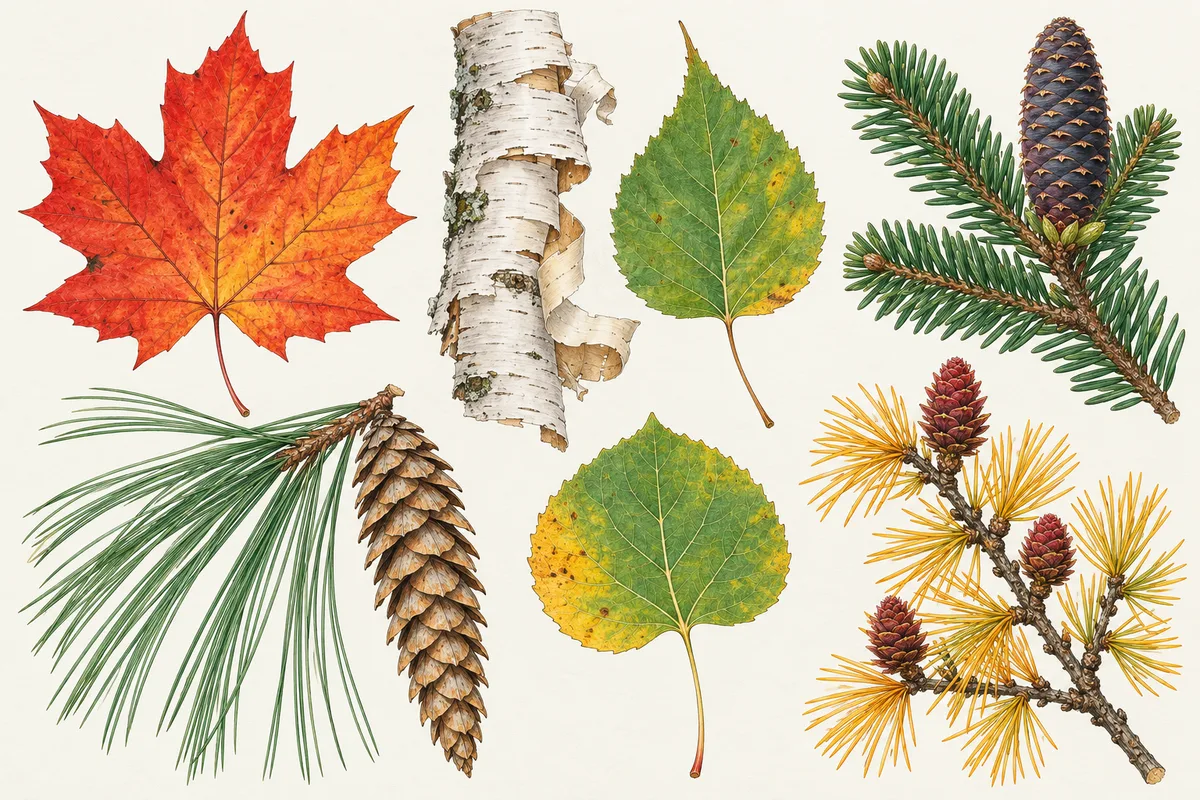
In short
Tree identification in Canada is easiest region by region, because each forest has a short list. In the Atlantic and boreal forest, learn balsam fir, black and white spruce, tamarack and white birch. Around the Great Lakes and St. Lawrence, add sugar maple, yellow birch and eastern white pine. On the Prairies, trembling aspen and balsam poplar. In British Columbia, western redcedar, Douglas-fir and lodgepole pine.
- Twelve of the thirteen provinces and territories have an official tree, and nine of those twelve are conifers.
- The maple genus as a whole, not one species, has been Canada's national arboreal emblem since 1996.
- The standard field guide is Trees in Canada by John Laird Farrar, published with Natural Resources Canada.
Any one Canadian region has a short list of trees that covers much of what you will see on a walk. This guide gives that list for four broad regions, the clue that separates each tree from its neighbours, and the official tree of every province and territory as Canadian Heritage lists it. Measurements are from Natural Resources Canada (NRCan) factsheets unless another source is named.
Start with your region, then needles or leaves
The fastest route to a name in Canada is to narrow the candidates by place first, then by the tree itself:
- Pick your region from the sections below: Atlantic and boreal, Great Lakes–St. Lawrence, Prairies and aspen parkland, or British Columbia.
- Needles, scales or broad leaves? Most of the trees listed below for the boreal forest and BC are conifers. For those, the conifer identification key sorts pines, spruces, firs, larches and cedars with three needle questions.
- For broadleaf trees, check whether leaves sit opposite or alternate on the twig, then the leaf shape, the bark and the fruit. The field method gives the order.
- Confirm with a factsheet. NRCan's free Trees, insects and diseases of Canada's forests has a page for each native tree, with a range map.
If the branches are out of reach, a photo of a cone, a fallen leaf or the bark is enough for Tree Identifier to suggest a name with key traits. It shows no confidence score and no list of look-alikes, so check the answer against the clues below.
Atlantic Canada and the boreal forest
Five trees recur in the Atlantic provinces and the boreal forest; NRCan maps black spruce as transcontinental, and white spruce, tamarack and white birch across Canada. Learn these first:
- Balsam fir (Abies balsamea): flat needles 15 to 25 mm (about 3/4 in) long with rounded or notched tips, shiny dark green above with white lines of dots below and a strong smell when crushed. Young bark is smooth with raised resin blisters, and the 4 to 10 cm cones stand upright, then fall apart on the branch. NRCan gives its range as the northern forests of central and eastern Canada.
- Black spruce (Picea mariana): short needles, 8 to 15 mm, dull greyish-green, on hairy twigs. Its nearly round cones often cluster near the top of the tree and can stay on for up to 30 years (NRCan). A tree of wet, poorly drained ground in the south and moist organic soils in the north.
- White spruce (Picea glauca): needles 15 to 22 mm, stiff, with an "unpleasantly pungent" smell when crushed, on hairless twigs; slender cones 3 to 6 cm with smooth, rounded scale edges. It grows throughout Canada except the Pacific coast.
- Tamarack (Larix laricina): soft needles in tufts of 15 to 60 that turn yellow and drop every autumn. It grows in bogs and muskeg across Canada; see the tamarack profile for how to tell it from planted European and Japanese larch.
- White birch (Betula papyrifera), also called paper birch: bark that turns creamy white and peels in large sheets, and double-toothed leaves 5 to 10 cm long. It grows across Canada.
In the Maritimes, add red spruce (Picea rubens), Nova Scotia's tree: shiny yellowish-green needles 10 to 16 mm long that curve forward along hairy twigs, and chocolate-brown cones 3 to 5 cm long. NRCan places it in the Maritime provinces, uncommon in south-central Ontario and in Quebec north of the St. Lawrence.
Great Lakes–St. Lawrence: southern Ontario and Quebec
In southern Ontario and Quebec, broadleaf trees join the conifers. These are the ones most worth learning:
- Sugar maple (Acer saccharum): leaves 8 to 20 cm, usually 5 lobes with a nearly square central lobe and rounded notches, wider than long; paired winged seeds; grey bark in long, firm ridges that curl outward along one side (NRCan). NRCan gives its range as the Maritimes, southern Ontario and Quebec. To separate it from red maple, use red maple vs sugar maple.
- Yellow birch (Betula alleghaniensis), Quebec's tree: bark in thin, papery shreds that curl at the ends, shiny reddish-brown when young, then dull yellow to bronze; oval leaves 8 to 11 cm with 9 or more straight veins per side (NRCan). It grows on rich, moist soils with beech, sugar maple, eastern hemlock and white pine. The birch guide compares it with white birch.
- Eastern white pine (Pinus strobus), Ontario's tree: soft, bluish-green needles in bundles of five, 5 to 15 cm long, and hanging cylindrical cones 8 to 20 cm long.
- Red oak (Quercus rubra), Prince Edward Island's tree: leaves 10 to 20 cm with 7 to 9 lobes, the larger lobes ending in bristle-tipped teeth, and acorns 12 to 25 mm in a shallow, saucer-shaped cup.
Prairies and aspen parkland
In the aspen parkland and the river valleys of Alberta, Saskatchewan and Manitoba, learn these:
- Trembling aspen (Populus tremuloides), also called quaking aspen: nearly round leaves 3 to 7 cm on a flattened stalk usually longer than the blade; smooth, pale green to nearly white bark (NRCan). It grows throughout Canada's forested areas and often forms pure stands. The poplar guide covers its relatives.
- Balsam poplar (Populus balsamifera): leaves 7 to 12 cm with a long, drawn-out tip, silvery green beneath and often spotted with brownish resin; very resinous, fragrant end buds up to 25 mm long. A tree of river valleys and moist low ground, often planted for shelterbelts and windbreaks.
- Manitoba maple (Acer negundo), also called box-elder: the maple with compound leaves, 3 to 9 leaflets, and paired seeds hanging in drooping clusters. It grows on lakeshores, stream banks and disturbed sites.
- Bur oak (Quercus macrocarpa): leaves 15 to 30 cm, often with two deep notches near the middle, and an acorn cup with a fringe of long-pointed scales enclosing half or more of the nut. NRCan's range runs from southern Saskatchewan east to New Brunswick, including grasslands.
White spruce is Manitoba's tree and white birch Saskatchewan's (both described above). In western Alberta, lodgepole pine, Alberta's tree, takes over (see the next section).
British Columbia: coast and interior
On the coast:
- Western redcedar (Thuja plicata), BC's tree: tiny scale leaves 1 to 2 mm long, shiny yellowish-green; reddish-brown bark that shreds into narrow ridges; and a trunk that flares and buttresses at the base. NRCan gives up to 60 m (200 ft) tall and about 800 years (factsheet).
- Douglas-fir (Pseudotsuga menziesii): flat needles 2 to 3 cm with a slight apple smell when crushed, and hanging cones 6 to 9 cm with three-pronged bracts longer than the scales, the single best clue. The coastal variety grows on Vancouver Island and the Pacific coast from central BC south.
In the interior:
- Lodgepole pine (Pinus contorta): two twisted, stiff needles per bundle, 3 to 7 cm long; cones 3 to 6 cm, often held closed by resin for 10 to 20 years until fire or strong sun opens them. It grows from the Yukon through interior BC into western Alberta. Our pine guide covers bundle counts.
- Western larch (Larix occidentalis): soft needle tufts that drop in autumn, cones 3 to 5 cm with pointed bracts sticking out; southeastern BC into Alberta.
- Subalpine fir (Abies lasiocarpa), Yukon's tree: needles 25 to 40 mm curving upward, upright barrel-shaped cones 4 to 10 cm, and a narrow crown ending in a spire. It grows in central BC, western Alberta and north into the Yukon, at 600 to 2000 m in the south of its range.
Official provincial and territorial trees
Checked against each province's and territory's page in Canadian Heritage's Provincial and territorial symbols on 21 October 2026. Canada's own emblem is the maple genus: the 1996 proclamation designates "the maple tree (genus acer)" and notes ten species native to Canada.
| Province or territory | Official tree | Scientific name |
|---|---|---|
| British Columbia | Western red cedar | Thuja plicata |
| Alberta | Lodgepole pine | Pinus contorta |
| Saskatchewan | White birch | Betula papyrifera |
| Manitoba | White spruce | Picea glauca |
| Ontario | Eastern white pine | Pinus strobus |
| Quebec | Yellow birch | Betula alleghaniensis |
| New Brunswick | Balsam fir | Abies balsamea |
| Nova Scotia | Red spruce | Picea rubens |
| Prince Edward Island | Red oak | Quercus rubra |
| Newfoundland and Labrador | Black spruce | Picea mariana |
| Yukon | Subalpine fir | Abies lasiocarpa |
| Northwest Territories | Tamarack larch | Larix laricina |
| Nunavut | None listed (the floral emblem is purple saxifrage) | — |
A few dates from the same pages: Ontario adopted the eastern white pine on May 1, 1984; the tamarack replaced the jack pine as the Northwest Territories' tree in 1999; and the Yukon selected the subalpine fir in 2001. Newfoundland and Labrador's page notes that black spruce, designated in 1993, is the most abundant tree in Labrador and appears on the Labrador flag.
Field guides and apps for Canadian trees
Trees in Canada by John Laird Farrar is the standard field guide. The Government of Canada publications record lists it as published by Natural Resources Canada's Canadian Forest Service with Fitzhenry & Whiteside (1995, reprinted 2017): 502 pages, nearly 600 colour photographs, about 1,600 drawings, 136 range maps and maps of forest regions and hardiness zones. It is also published in French as Les arbres du Canada.
Online, NRCan's factsheets are free and bilingual, and every species above has one. Use them to confirm a name and to check its Canadian range.
For a quick first answer in the field, Tree Identifier names a tree from one photo of a leaf, needle spray, cone or the bark, with a follow-up chat for questions such as "is this white or black spruce?". Its Tree Map keeps each located find, which helps if you want to come back to a tamarack in October or a sugar maple in spring.
What a photo can't settle
- City streets, parks and gardens across Canada are planted with many non-native trees that a regional short list of native species won't cover, so a street tree may match nothing on this page.
- Ranges here are the broad ones Natural Resources Canada gives; a tree near the edge of its range, or planted far outside it, can't be ruled in or out by location alone.
- Stunted trees in bogs, near the tree line and on exposed ridges have shorter needles and smaller cones than the figures quoted here.
Questions people ask
What is the national tree of Canada?
The maple. A proclamation dated 25 April 1996 designated the maple tree, the whole genus Acer, as Canada's national arboreal emblem. It notes that ten maple species are native to Canada, so no single species is the national tree.
What is the provincial tree of Ontario?
The eastern white pine (Pinus strobus), adopted as an official symbol on May 1, 1984. Canadian Heritage calls it the tallest tree in the province and says it can live over 250 years. Look for soft needles in bundles of five, 5 to 15 cm long.
Does Nunavut have an official tree?
No official tree is listed for Nunavut on the Canadian Heritage page read on 21 October 2026. Its plant emblem is a flower, the purple saxifrage, adopted by the Legislative Assembly in 2000.
What is the best book for identifying trees in Canada?
The standard reference is Trees in Canada by John Laird Farrar, published by Natural Resources Canada's Canadian Forest Service with Fitzhenry & Whiteside (1995, reprinted 2017). It has 502 pages, nearly 600 colour photographs, about 1,600 drawings and 136 range maps.
Is there a free online tree identification guide for Canada?
Natural Resources Canada runs Trees, insects and diseases of Canada's forests, a free website with factsheets for Canada's trees: leaves, cones or fruit, bark, size, habitat and a range map, in English and French.
How do I identify trees in British Columbia?
Start with the conifers. On the coast, check for scale leaves and shredded reddish-brown bark (western redcedar) or cones with three-pronged bracts (Douglas-fir). In the interior, look for two twisted needles per bundle (lodgepole pine), soft needle tufts (western larch) and upright barrel-shaped cones (subalpine fir).
Sources
- Provincial and territorial symbols — Canadian Heritage, Government of Canada
- Trees, insects and diseases of Canada's forests: index of tree names and factsheets — Natural Resources Canada, Canadian Forest Service
- Proclamation Designating the Maple Tree as National Arboreal Emblem of Canada (SI/96-36) — Justice Laws Website, Government of Canada
- Trees in Canada / John Laird Farrar — Government of Canada Publications (Natural Resources Canada, Canadian Forest Service)
Keep reading
- Tree profileTamarack (Larix laricina): how to identify it
- Field guideConifer identification: three questions about the needles, then the cone
- Field guideHow to identify trees, step by step
- Tree profileBirches (Betula): how to identify a birch tree
- Tree comparisonRed maple vs sugar maple: how to tell them apart