Tree comparison
Red maple vs sugar maple: how to tell them apart
A V or a U between the lobes, teeth or smooth edges, red or tan buds. Then snap a leaf stalk to make sure it isn't a Norway maple.
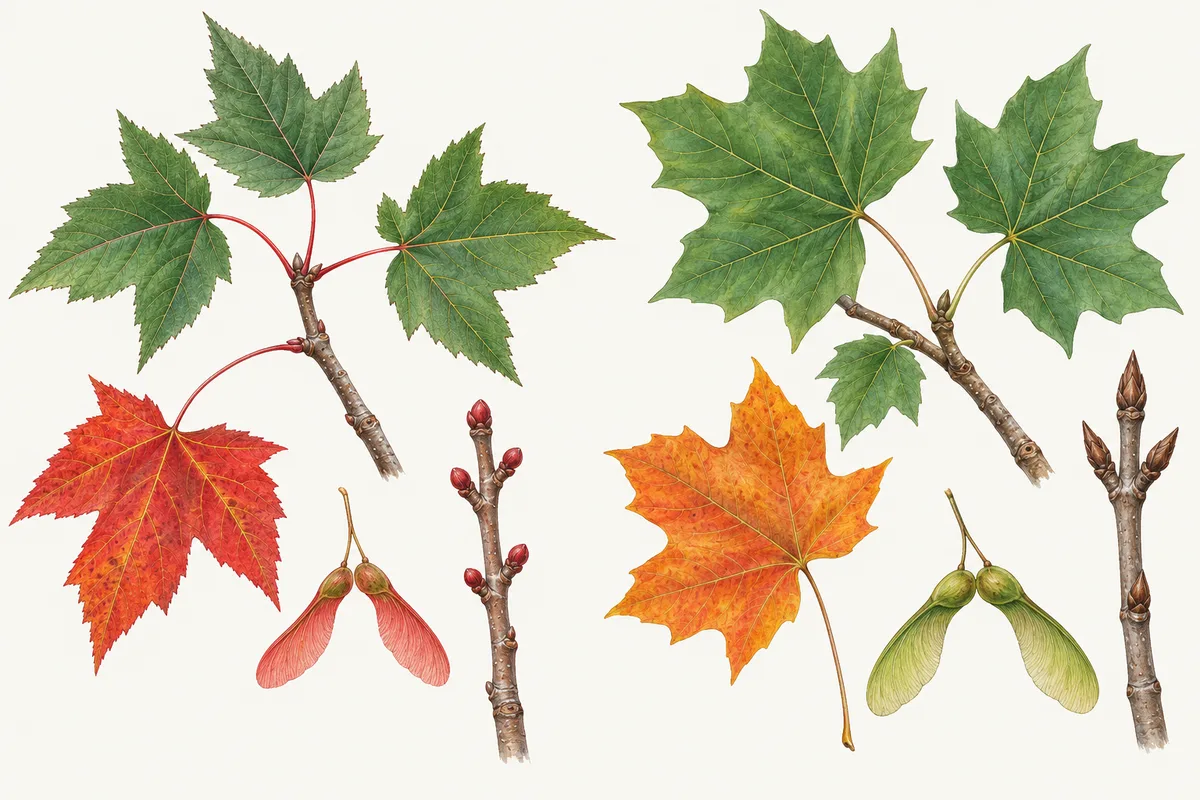
In short
Red maple vs sugar maple comes down to the leaf edge and the buds. Red maple leaves have three main lobes, fine teeth and V-shaped notches between the lobes; sugar maple leaves have five lobes, smooth edges and U-shaped notches ("U" for sugar). In winter, red maple buds are blunt and bright red, sugar maple buds tan to brown and very sharp-pointed.
- V-shaped sinuses and toothed edges mean red maple; U-shaped sinuses and smooth edges mean sugar maple.
- Red maple bark peels off in shaggy plates; sugar maple bark stays tight to the trunk even when it looks shaggy.
- Milky sap from a snapped leaf stalk means neither: it is a Norway maple.
Field marks at a glance
- Scientific name
- Acer rubrum and Acer saccharum
- Family
- Sapindaceae (soapberry family); Virginia Tech lists the older Aceraceae
- Type
- Broadleaf, deciduous
- Sinuses
- Red maple: V-shaped, relatively shallow. Sugar maple: U-shaped, rounded at the base.
- Leaf edge
- Red maple: finely toothed. Sugar maple: smooth (entire) between the lobe points.
- Lobes and size
- Red maple: 3 lobes (5 if you count the small basal ones), 2 to 4 inches, whitish below. Sugar maple: 5 lobes, 3 to 6 inches.
- Winter buds
- Red maple: blunt, bright red, several loose scales. Sugar maple: tan to brown, very sharp-pointed, tight scales.
- Bark
- Red maple: smooth light gray when young, then narrow plates that peel off easily. Sugar maple: textured from the start, later furrowed with firm ridges that stay tight to the tree.
- Flowers
- Red maple: small, usually bright red clusters in early spring, before the leaves. Sugar maple: light yellow-green, hanging on 1- to 3-inch stalks, with or just before the leaves.
- Samaras
- Red maple: 1/2 to 3/4 inch, slightly spread wings, ripe in late spring to early summer. Sugar maple: about 1 inch, horseshoe-shaped, ripe in fall.
- Fall color
- Red maple: brilliant red, most reliably in the north. Sugar maple: yellow, orange and red.
Red maple (Acer rubrum) and sugar maple (Acer saccharum) grow together across much of the Northeast and the Great Lakes, and both turn the hills red and orange in fall. They are easy to tell apart once you know where to look: the shape of the notch between the lobes, the leaf edge, and in winter, the buds.
Red maple vs sugar maple, side by side
Pick a few leaves from the sunlit side of the tree. University of New Hampshire Extension's article "Red or Sugar Maple? How do you tell the difference?" gives the quickest test: red maple has three lobes, fine teeth and a V-shaped sinus; sugar maple has five lobes, smooth edges and a U-shaped sinus, and there is a "U" in sugar. The other rows come from Virginia Tech Dendrology's red maple and sugar maple fact sheets unless noted.
| Feature | Red maple | Sugar maple |
|---|---|---|
| Sinus between lobes | V-shaped, relatively shallow | U-shaped, rounded |
| Leaf edge | Finely toothed | Smooth (entire) |
| Lobes | 3 main lobes, 5 counting the small basal ones | 5 delicately rounded lobes |
| Leaf length | 2–4 in | 3–6 in |
| Underside | Whitened, sometimes hairy | Paler green |
| Winter buds | Blunt, bright red, loose scales | Tan to brown, very sharp-pointed, tight scales |
| Twig | Reddish, lustrous, small lenticels | Brown, slender, shiny, lighter lenticels |
| Young bark | Smooth light gray, can resemble beech | Textured, with a fine diamond pattern (UNH) |
| Old bark | Narrow plates that turn shaggy and peel off easily | Furrowed, firm ridges, tight to the tree |
| Flowers | Usually bright red, early spring, before leaves | Light yellow-green on 1–3 in stalks, with leaves |
| Samaras | 1/2–3/4 in, ripe late spring to early summer | About 1 in, horseshoe-shaped, ripe in fall |
| Fall color | Brilliant red | Yellow, orange and red |
| Wood | Soft maple | Hard (rock) maple, 1.5–2 times harder (UNH) |
Fall colors are from the USDA Forest Service for red maple and The Morton Arboretum for sugar maple, which describes sugar maple's range of color as brilliant yellow to burnt orange.
Leaves: the V, the U and the teeth
Hold the leaf flat and look at the notch between the two largest lobes. On red maple the sides of that notch meet in a point, a V. On sugar maple they curve into a rounded bottom, a U. Then run a finger along the edge: red maple's is finely serrated all the way around, sugar maple's is smooth between the few large points of the lobes.
Lobe count is a weaker test. UNH counts three lobes on red maple, or five if you include the small ones at the base, and Virginia Tech gives 3 to 5, so a five-lobed red maple leaf is normal. Rely on the sinus shape and the teeth first. Size helps a little: sugar maple leaves run 3 to 6 inches, red maple 2 to 4.
Buds and bark in winter
Red maple is named for its buds, not its leaves. UNH notes that they are bright red, especially noticeable in late winter and early spring, while sugar maple buds are tan. Virginia Tech adds the shape: red maple buds are usually blunt with several loose scales, and collateral buds may sit beside the main ones; sugar maple's end buds are brown, very sharp-pointed and tightly scaled.
Bark takes more practice. Young, fast-growing red maple has smooth gray bark that can be mistaken for beech. As it ages it breaks into narrow vertical plates that turn shaggy and knock off easily. Sugar maple bark is never truly smooth: UNH describes a fine diamond pattern on young trees, and on old trees the bark stays tight to the trunk even when it looks shaggy. UNH's own caveat is fair: even seasoned foresters sometimes look twice. For the bud and twig key to other trees, see the winter tree identification guide.
Samaras, flowers and fall color
In spring, red maple flowers first: small, usually bright red clusters before the leaves open, followed by samaras 1/2 to 3/4 inch long that ripen in late spring and early summer. Sugar maple flowers are light yellow-green, hanging on slender stalks 1 to 3 inches long, with or just before the leaves; its horseshoe-shaped samaras, about 1 inch, ripen in fall.
In fall, red maple is the brighter red. The USDA Forest Service's Silvics of North America calls its brilliant fall coloring one of its outstanding features and notes that northern red maples show the most reddish color. Sugar maple turns yellow, orange and red. Color varies too much between trees to settle the identification on its own.
Norway maple: the look-alike to rule out
Norway maple (Acer platanoides) is native to Europe and Asia but, according to The Morton Arboretum, is now found through much of the eastern United States and on the West Coast. Virginia Tech lists sugar maple first among its look-alikes. Check it before you decide:
- Milky sap. Pull a leaf off and look at the end of the stalk. Virginia Tech's Norway maple fact sheet notes that it exudes milky white sap when detached.
- Leaf. Five to seven lobes with long pointed teeth. The Morton Arboretum describes the leaves as slightly broader than sugar maple's.
- Buds. Large and turban-shaped, green maturing to purple, unlike sugar maple's slender, sharp brown buds.
- Samaras. 1 1/2 to 2 inches with widely spread wings, maturing in late summer and hanging on into winter.
- Fall color. Yellow-green to yellow, according to Morton, without sugar maple's oranges and reds.
The Morton Arboretum lists Norway maple as an invasive plant. Its purple-leaved form, Crimson King, is widely planted and easy to spot. The maple page compares Norway, silver, boxelder, Japanese and bigleaf maple as well, and boxelder, the maple with compound leaves, has its own page.
Where each grows and why it matters
UNH describes sugar maple as the fussier of the two: it needs nutrient-rich, well-drained soil that is neither too dry nor too wet, and is found from the Lake States east to Maine and south to Ohio and Pennsylvania. Red maple tolerates a much wider range of soils and sites, turns up in many forest types, and grows from Florida to Maine. The Forest Service adds that sugar maple is very shade tolerant and can reach 300 to 400 years, while red maple seldom lives longer than 150.
The difference matters most in late winter, when sap runs. UNH's rule of thumb is about 40 gallons of sap per gallon of syrup from sugar maple and about 60 from red maple. Mark your trees while the leaves are on; Tree Identifier's Tree Map can hold the location of each identified tree so you can find the sugar maples again in February.
Look-alikes and how to tell them apart
Norway maple (Acer platanoides)
Snap a leaf stalk: Norway maple bleeds milky white sap. Its buds are large and turban-shaped, green turning purple, and its samaras spread wide, 1 1/2 to 2 inches, and hang on into winter.
Silver maple (Acer saccharinum)
Closer to red maple, but its sinuses cut deep, its teeth are coarse and the underside is silvery white. Crushed twigs smell unpleasant, and its samaras are the largest of any native maple, with wings up to 2 1/2 inches.
What a photo can't settle
- Sugar maple and red maple can hybridize, the USDA Forest Service reports, and red maple also crosses with silver maple. A hybrid may show a mix of sinus shapes and teeth.
- Red maple's leaves are highly variable, Virginia Tech notes, with sinuses that are relatively shallow but vary from tree to tree. Compare several sunlit leaves before deciding.
- Tree Identifier gives one name from one photo, with no confidence score and no look-alike list, so a leaf photo of a Norway maple can still need the milky-sap test in hand.
Questions people ask
Do red maples have red leaves?
Not necessarily. University of New Hampshire Extension points out that the name comes from the bright red buds, most noticeable in late winter and early spring, not from the leaves. In fall, though, the USDA Forest Service calls its brilliant red foliage one of its outstanding features.
How do you tell red maple from sugar maple in winter?
Look at the buds first: bright red and blunt with loose scales on red maple, tan to brown and very sharp-pointed with tight scales on sugar maple. Then the bark: old red maple bark forms plates that knock off easily, while sugar maple bark stays tight to the tree.
Which is better for maple syrup, red or sugar maple?
Sugar maple. UNH Extension's rule of thumb is about 40 gallons of sap per gallon of syrup from sugar maple and 60 from red maple, because red maple sap is less sweet. Red maple also buds earlier, so its taps have to be pulled first; sap from budding trees gives off-flavored syrup.
Is red maple a hard maple or a soft maple?
Soft. Sugar maple is the hard or rock maple, which UNH Extension says is one and a half to two times as hard as red maple. Red maple, sold as soft maple, goes into cabinetry and painted furniture and is sometimes stained to stand in for cherry.
How do you tell a Norway maple from a sugar maple?
Snap a leaf stalk: Norway maple oozes milky white sap. Its buds are large and turban-shaped rather than slender and sharp, its samaras are larger and spread wide, and its fall color runs yellow-green to yellow. The Morton Arboretum also describes Norway leaves as slightly broader than sugar maple's.
Sources
- Red or Sugar Maple? How do you tell the difference? — University of New Hampshire Extension
- Red maple fact sheet — Virginia Tech Dendrology
- Sugar maple fact sheet — Virginia Tech Dendrology
- Norway maple fact sheet — Virginia Tech Dendrology
- Red Maple (Acer rubrum), Silvics of North America — USDA Forest Service
- Sugar Maple (Acer saccharum), Silvics of North America — USDA Forest Service
- Sugar maple (Acer saccharum) — The Morton Arboretum
- Norway maple (Acer platanoides) — The Morton Arboretum