Tree profile
Maple trees (Acer): how to identify them
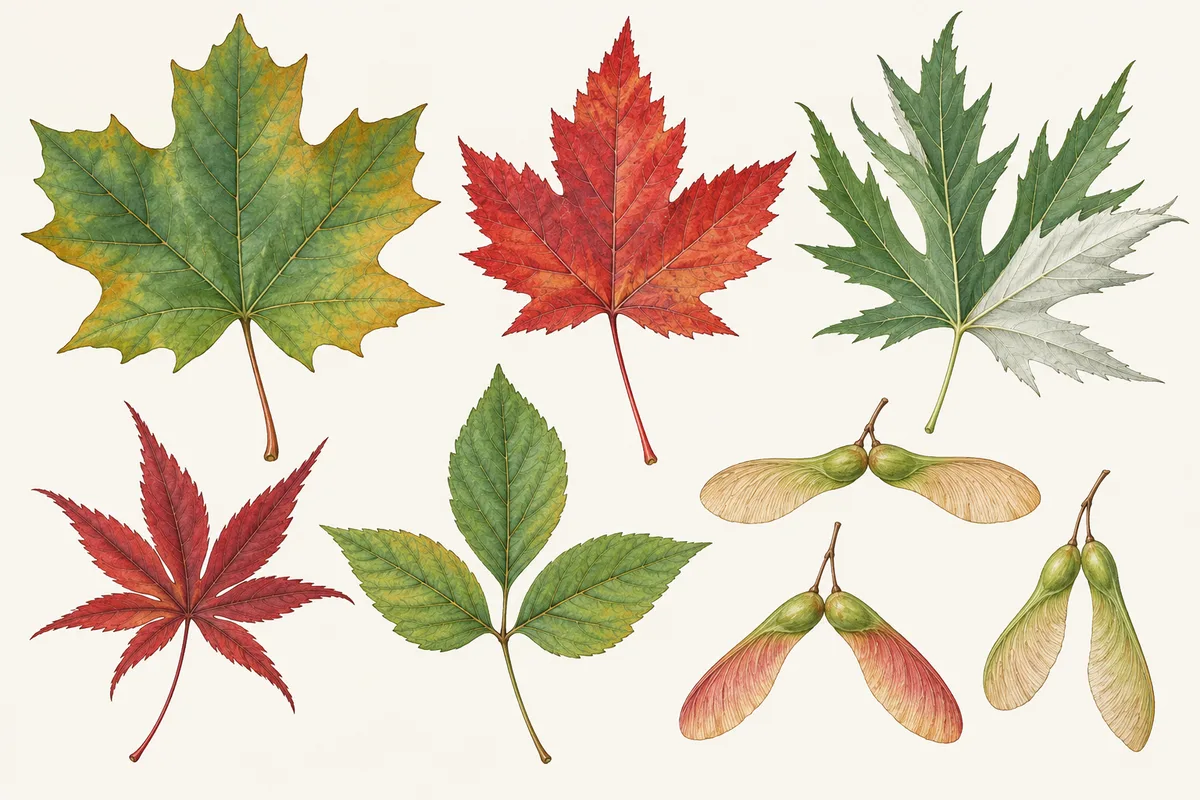
Opposite twigs, palm-shaped leaves and paired winged seeds make a maple. Then the leaf edge, the buds and the sap in the leaf stalk tell you which one.
In short
Maple tree identification starts with the branching: maples grow their leaves, buds and twigs in opposite pairs, and most have palm-shaped leaves with 3 to 7 lobes and paired winged seeds called samaras. To name the species, check the leaf edge (smooth on sugar maple, toothed on red and silver), the winter buds, and whether a snapped leaf stalk bleeds milky sap, the Norway maple test.
- Opposite branching is the first test: an alternate-leaved tree with maple-like leaves, such as sweetgum or American sycamore, is not a maple.
- Sugar maple leaves have smooth edges and U-shaped sinuses; red maple leaves are toothed with V-shaped sinuses.
- Every maple can be tapped, but sugar and black maple have the sweetest sap; red and silver maple bud early and shorten the season.
Field marks at a glance
- Scientific name
- Acer spp.
- Family
- Sapindaceae (soapberry family); Virginia Tech still lists the older Aceraceae
- Type
- Broadleaf, deciduous
- Genus marks
- Leaves, buds and twigs in opposite pairs; fruit a double samara, two winged seeds joined at the base.
- Leaves
- Usually simple and palmately lobed, 3 to 7 lobes from one point. Boxelder is the exception, with compound leaves of 3 to 5 (sometimes 7) leaflets.
- Leaf-edge test
- Smooth edges: sugar maple. Fine teeth: red maple. Coarse teeth and deep sinuses: silver maple. Long pointed teeth plus milky sap: Norway maple.
- Winter buds
- Sugar maple: brown, very sharp-pointed. Red maple: blunt, reddish. Norway maple: large, turban-shaped. Boxelder: white and hairy.
- Samaras
- From 1/2 to 3/4 inch (red maple) to 2 1/2 inches (silver maple, the largest of any native maple). Red and silver ripen in late spring; sugar and Norway later.
- Bark
- Smooth and gray when young on most species; with age, scaly plates (red), loose strips (silver), firm curling ridges (sugar) or tight interlacing ridges (Norway).
- In the app's Collection
- Sugar maple, red maple, Norway maple and Japanese maple.
Maples (Acer) are among the easiest trees to place in a genus and among the hardest to pin to a species, because sugar, red, silver and Norway maple share the same palm-shaped leaf plan. Start with the branching pattern, which confirms a maple in seconds, then use the leaf edge, the buds and the leaf-stalk sap to name it.
Is it a maple: opposite branching and paired seeds
Look at where the leaves join the twig. Maples belong to a small group of trees whose branches, leaves and buds grow in opposite pairs, as Ohio State University Extension's Hobby Maple Syrup Production fact sheet stresses before anyone drills a tap hole. If the leaves alternate along the twig, it is not a maple, however maple-like the leaf. One naming trap: in Britain and Ireland, "sycamore" means a maple, Acer pseudoplatanus, not the American plane tree; the sycamore page covers both trees.
Then confirm with two more marks:
- The leaf. Most maples have a simple leaf with 3 to 7 lobes spreading from one point, like fingers on a hand. Boxelder is the exception: its leaf is compound, with 3 to 5 leaflets.
- The fruit. Maples bear double samaras, two winged seeds joined at the base. They hang in clusters and ripen from late spring (red and silver maple) to fall (sugar maple).
With those three marks you have a maple. The table below narrows it down.
US maples compared: leaves, buds, bark and samaras
Leaf, bud, bark and samara details come from the Virginia Tech Dendrology fact sheets, for example sugar maple and red maple.
| Maple | Leaf | Winter buds | Bark | Samara |
|---|---|---|---|---|
| Sugar (A. saccharum) | 3–6 in, 5 rounded lobes, smooth edges | Brown, very sharp-pointed, tight scales | Brown, darkening; firm ridges that curl outward | About 1 in, horseshoe-shaped, ripe in fall |
| Red (A. rubrum) | 2–4 in, 3–5 lobes, toothed, shallow sinuses, whitish below | Blunt, green or reddish, loose scales | Smooth light gray, then long fine scaly plates | 1/2–3/4 in, slightly spread wings, late spring |
| Silver (A. saccharinum) | 2 1/2–5 in, 5 deep sinuses, coarse teeth, silvery white below | Reddish brown, large scales; flower buds in dense clusters | Light gray, then long thin strips loose at the ends | Wings 1 1/2–2 1/2 in, the largest native maple samara, late spring |
| Norway (A. platanoides) | 5–7 lobes with long pointed teeth; milky sap in the stalk | Large, turban-shaped, green turning purple | Gray-brown, shallow furrows, narrow interlacing ridges | 1 1/2–2 in, widely spread wings, persist into winter |
| Boxelder (A. negundo) | Compound, 3–5 leaflets (sometimes 7), coarsely toothed | White and hairy; twigs green to purplish, often with a bloom | Thin, gray to light brown, shallow interlacing ridges | 1–1 1/2 in, V-shaped, persist through winter |
| Japanese (A. palmatum) | 2–5 in, 5–7 deep lobes, toothed, often deep red | Conical, green or red, base hidden by a tan fuzzy fringe | Smooth, light gray, somewhat fluted trunk | 3/4–1 in, wings at about 90 degrees |
| Bigleaf (A. macrophyllum) | 6–12 in across, 5 deep lobes; milky sap in the stalk | Large end bud with 3–4 greenish-red scales | Smooth grayish brown, then darker interlacing ridges | Wings 1 1/2–2 in, hairy seed |
Bigleaf maple is a western tree: the USDA Forest Service's Silvics of North America places its native range along the Pacific Coast, always within about 186 miles of the ocean, from British Columbia to southern California. Japanese maple, from the Virginia Tech sheet, is a small tree of 10 to 25 feet, usually multistemmed.
In Canada, boxelder goes by the name Manitoba maple: Natural Resources Canada's Manitoba maple factsheet lists it as Acer negundo, with box-elder as a synonym. The leaf on the Canadian flag is a stylized maple leaf that represents no single species, though Canadian Heritage says it is inspired by the leaf of the sugar maple. For the maples and other trees of each Canadian region, see tree identification in Canada.
How to know what type of maple tree you have
Work through these checks in order; most trees are settled by the third.
- Compound leaf? Three to five leaflets on one stalk, opposite on the twig: boxelder.
- Milky sap? Pick a leaf and snap the stalk. A drop of milky white sap means Norway maple (or, on the West Coast, bigleaf maple). Virginia Tech notes a purple-leaved Norway maple, Crimson King, is widely planted.
- Smooth or toothed edges? A leaf with smooth edges and rounded, U-shaped sinuses is sugar maple. University of New Hampshire Extension's tip: there is a "U" in sugar.
- Shallow V or deep cuts? Toothed leaves with shallow V-shaped sinuses and a whitish underside point to red maple; leaves cut deeply, coarsely toothed and silvery white beneath point to silver maple.
- Small, deeply cut, often red leaves on a small tree of 10 to 25 feet: Japanese maple.
The red maple vs sugar maple page takes the most common pair apart mark by mark, including a box on Norway maple.
If the leaves are too high to reach, a photo of a fallen leaf, the bark or a seed cluster in Tree Identifier gives a name. Its answer has no confidence score, so run the five checks above before you trust it.
Maple identification by bark and in winter
In winter, start again with opposite buds. Then:
- Sugar maple: brown, slender, shiny twigs with very sharp-pointed brown buds. UNH Extension adds that even shaggy sugar maple bark stays tight to the tree.
- Red maple: reddish, lustrous twigs with blunt buds that are green or reddish in fall and winter. Old bark forms narrow plates that peel off easily, according to UNH.
- Silver maple: like red maple but stouter and often chestnut-brown, with an unpleasant smell when crushed and conspicuous clusters of flower buds.
- Norway maple: stout brown twigs with large turban-shaped buds; samaras often still hang on the tree.
- Boxelder: green to purplish twigs, often covered with a waxy bloom, with white hairy buds and narrow leaf scars that meet in raised points.
Bark alone is the weakest clue, because most maples start smooth and gray. Young red maple bark can even be confused with healthy beech bark, UNH notes. Use bark to confirm what the buds suggest, not to decide. The winter tree identification guide covers the other opposite-branching trees you may meet, such as ash.
Which maples can be tapped for syrup
All maples can be tapped; they differ in how sweet the sap is and how long the season lasts. Ohio State Extension's fact sheet and the Forest Service's sugar maple account give these figures:
| Maple | Sap sugar | Notes |
|---|---|---|
| Sugar | 2% or higher (Ohio State); about 2.5% on average (USDA Forest Service) | The preferred tree; about 34 to 43 gallons of sap per gallon of syrup |
| Black | Similar to sugar maple | Less common than sugar maple in Ohio |
| Red | Usually 1.5% to 2% | Buds early, shortening the season; UNH puts it at about 60 gallons of sap per gallon of syrup |
| Silver | Not given | One of the first trees to bud, which shortens the season |
| Norway | "Many report" similar to sugar maple | Non-native and considered invasive in some states |
| Boxelder | Not given | Heavy, sorghum-like syrup; keep its sap separate from other maples |
The sap-to-syrup ratio for sugar maple varies by source: the USDA Forest Service gives about 34 gallons per gallon, Ohio State about 43, and UNH a rule of thumb of 40. Syrup from red and silver maple can be good but is more likely to be cloudy, Ohio State notes, and UNH warns that syrup from trees starting to bud, called "buddy" syrup, tastes terrible. Ohio State also advises tapping only healthy trees at least 10 inches in diameter.
The practical point for identification: mark your trees in summer or fall, while the leaves are on. In late winter, when sap runs, you will be working from buds and bark alone.
Maples in the Tree Identifier Collection
Tree Identifier's Collection, the 138-species catalog that fills in as you identify, includes four maples: sugar maple, red maple, Norway maple and Japanese maple. Pinning a tree on the Tree Map is a simple way to find your marked sugar maples again in February.
Look-alikes and how to tell them apart
Sweetgum (Liquidambar styraciflua)
Its star-shaped leaf has 5 to 7 lobes like a maple's, but the leaves are alternate, not opposite, and smell fragrant when crushed. The fruit is a spiny brown gumball 1 to 1 1/2 inches across, not a pair of winged seeds.
American sycamore (Platanus occidentalis)
Lobed, maple-like leaves, but alternate, with a leaf-stalk base that hides the bud. The bark peels in a camouflage pattern of brown, green, tan and white, and round seed balls hang on 3- to 6-inch stalks.
Green ash (Fraxinus pennsylvanica), for boxelder
Both are opposite with compound leaves. Green ash has 7 to 9 leaflets and single-winged seeds; boxelder has 3 to 5 leaflets, paired V-shaped samaras and green to purplish twigs, often with a whitish bloom.
What a photo can't settle
- Maples hybridize: the USDA Forest Service reports red maple crossing naturally with silver maple, and sugar maple with black and red maple. Hybrids show intermediate leaves and buds that no single photo can settle.
- Japanese maple comes in many cultivars whose leaf color and lobing vary widely, so a photo app may name the species but not the cultivar.
- Leaf color is a poor guide: red maple's name comes from its buds, not its leaves, according to UNH Extension, and fall color varies from tree to tree. Judge by shape, edges and buds.
Questions people ask
How do I know what type of maple tree I have?
Check five things in order: are the leaves compound (boxelder); does a snapped leaf stalk bleed milky sap (Norway maple); are the leaf edges smooth (sugar maple) or toothed; are the sinuses shallow and V-shaped (red maple) or cut deep with a silvery underside (silver maple); and, in winter, the bud shape and color.
How do you identify maple trees for tapping?
Confirm opposite branching first: Ohio State Extension notes that hobbyists have tapped oaks and hickories by mistake. Mark trees while the leaves are on, since identification is much easier then. Sugar and black maple have the sweetest sap; Ohio State recommends tapping only trees at least 10 inches in diameter.
How do you identify a maple tree in winter?
Look for opposite buds and twigs, then at the buds. Sugar maple's are brown and very sharp-pointed with tight scales; red maple's are blunt and reddish with loose scales; Norway maple's are large and turban-shaped; boxelder's are white and hairy on green to purplish twigs. Paired samaras may still hang on Norway maple and boxelder.
Is a boxelder a maple?
Yes. Boxelder (Acer negundo) belongs to the maple genus even though its leaves are compound, with 3 to 5 leaflets, rather than lobed. Its opposite branching and paired V-shaped samaras give it away, and Ohio State Extension notes it can even be tapped for a sorghum-like syrup.
Which maple has milky sap?
Norway maple: Virginia Tech and Ohio State Extension both note that its leaf stalk exudes milky white sap when the leaf is detached. Bigleaf maple of the Pacific Coast also has a milky leaf stalk. That makes a snapped leaf stalk the quickest Norway maple test.
Sources
- Sugar maple fact sheet — Virginia Tech Dendrology
- Red maple fact sheet — Virginia Tech Dendrology
- Silver maple fact sheet — Virginia Tech Dendrology
- Norway maple fact sheet — Virginia Tech Dendrology
- Boxelder fact sheet — Virginia Tech Dendrology
- Hobby Maple Syrup Production (F-36) — Ohio State University Extension (Ohioline)
- Red or Sugar Maple? How do you tell the difference? — University of New Hampshire Extension
- Sugar Maple (Acer saccharum), Silvics of North America — USDA Forest Service