Free tool
Tree age calculator
Measure the trunk, pick the species, and get an honest estimate of how old the tree is, with the working shown.
In short
A tree age calculator estimates how old a tree is from its trunk: measure the circumference 4.5 feet above the ground, divide by π to get the diameter, then multiply the diameter in inches by the species' growth factor. A red maple 75.4 inches around is 24 inches across, and 24 × 4.5 gives about 108 years. Yard trees usually grow faster, so they are often younger.
- Measure at 4.5 feet (1.3 m): the standard diameter at breast height.
- Growth factors come from Purdue University's 2018 table and an ISA-based county list.
- Only a ring count is exact; the calculator gives a range and rounds to 5 years.
Tree age calculator
Measure around the trunk, pick the species, and get an estimate from the growth-factor method that arborists use. It works out the age from trunk size, so it gives a range, not a birthday.
Estimated age
Enter the trunk size and pick a species to see an estimate.
Not sure which species it is? Tree Identifier can name it from a photo.
Assumptions and sources
- Diameter = circumference ÷ π, and age ≈ diameter in inches × the species' growth factor. The International Society of Arboriculture published this formula, based on ring counts of felled trees. Allegheny County Parks, quoting Bicentennial Trees of Allegheny County (1988)
- Growth factors come from Purdue University's table. Species Purdue does not list come from the Allegheny County Parks list, compiled in 2016 and updated in 2021 from several published tables. Purdue Landscape Report 18-04 (2018); Allegheny County Parks (2021)
- A growth factor assumes the trunk widens by the same amount every year. Water, soil, climate, root damage, competition for light and the tree's health all change that, so treat the result as a rough estimate. Purdue Landscape Report, 2018
- Trees in yards, parks and streets usually thicken faster than woodland trees. Purdue's arborist deducts about 25% for them, and calls it a rule of thumb from experience, not a measured value. That's where the low figure comes from. Purdue Landscape Report, 2018
- Charts built from forest trees can give older ages: the Morton Arboretum's Chicago-area forest data gives white oak 7.6 and red oak 6.7, against 5.0 and 4.0 here. A tree in old woodland may be older than shown. Friends of the Wildflower Garden, summarizing Morton Arboretum data
- Some charts underestimate the age of very large old trees, according to newer research on big Illinois trees. University of Illinois Extension, 2020
- Where published tables disagree (horse chestnut: 4 to 8), the calculator shows the whole range. Allegheny County Parks, 2021
- Only counting rings gives an exact age: on a stump, or on a core taken with an increment borer, which leaves a wound in the tree. The result here is rounded to the nearest 5 years. Purdue Landscape Report, 2018
- Breast height is 4.5 feet above the ground, measured from the middle of the slope on uneven ground. American Forests, Champion Trees Measuring Guidelines
Nothing you type is sent anywhere. Your last entries are kept in this browser only.
Growth factors turn a trunk measurement into an age estimate. They come from ring counts on felled trees, which tell how many years a species usually takes to add one inch of diameter. The calculator above uses the factor for your species, shows the formula with your numbers in it, and gives a range rather than a false-precise single year.
How to measure a tree for the age calculator
You need a flexible tape measure and about two minutes.
- Find breast height. Measure 4.5 feet (1.37 m) up the trunk from the ground. On a slope, measure from the uphill side. This is the standard height foresters call diameter at breast height (DBH).
- Wrap the tape around the trunk at that height, level and snug, and read the circumference. If a branch, burl or wound sits at breast height, measure just above or below it.
- Forked trunk? If the tree splits below 4.5 feet, measure the narrowest point of the single stem below the fork.
- Pick the species in the calculator and type the circumference. If you already know the diameter, choose diameter instead and the calculator skips the division by π.
- Say where the tree grows if you know: a yard, park or street, or woodland. Leave "Not sure" and the calculator shows both ends of the range.
The method is the one described by Purdue University's landscape extension team: diameter in inches multiplied by a species growth factor. Allegheny County Parks traces the same formula to the International Society of Arboriculture and its ring counts of cut trees, and gives the worked example of a white oak 126 inches around: about 40 inches across, times 5, or roughly 200 years.
Growth factors for common trees
A growth factor is roughly the number of years a species needs to add one inch of trunk diameter. Slow growers have high factors; fast growers have low ones. These are the values the calculator uses for some of the most common North American trees.
| Tree | Scientific name | Growth factor | Source |
|---|---|---|---|
| Eastern cottonwood | Populus deltoides | 2.0 | Purdue |
| Silver maple | Acer saccharinum | 3.0 | Purdue |
| Pin oak | Quercus palustris | 3.0 | Purdue |
| Northern red oak | Quercus rubra | 4.0 | Purdue |
| Red maple | Acer rubrum | 4.5 | Purdue |
| Black walnut | Juglans nigra | 4.5 | Purdue |
| Sugar maple | Acer saccharum | 5.0 | Purdue |
| White oak | Quercus alba | 5.0 | Purdue |
| Eastern white pine | Pinus strobus | 5.0 | Allegheny County |
| American beech | Fagus grandifolia | 6.0 | Allegheny County |
| Flowering dogwood | Cornus florida | 7.0 | Purdue |
| Shagbark hickory | Carya ovata | 7.5 | Purdue |
The calculator lists 39 species in all, including European trees such as Norway maple, European beech, silver birch, small-leaved lime and Scots pine. Where sources disagree, the calculator says so: horse chestnut is given as 4 to 8 because the published figures conflict. Not sure which tree you have? Start with our field method for identifying trees, or check the leaves and acorns against the white oak field marks.
Why the calculator gives a range
A growth factor assumes the trunk widens by the same amount every year. Real trees don't. A wet decade, a drought, a cut root, a neighbour felled next door or a disease can speed growth up or slow it down for years.
Where a tree grows matters most. Trees in yards, parks and along streets have light on every side and usually thicken faster than forest trees, so the table tends to make them look older than they are. Purdue's arborist suggests taking about 25 percent off for them, and is open that this is a rule of thumb from experience. Forest data can point the other way: the Morton Arboretum's forest-grown factors, as summarised by the Friends of the Wildflower Garden, give white oak 7.6 rather than 5. The University of Illinois Extension also notes that standard charts may underestimate the age of very large, old trees, whose growth slows down.
That is why the calculator shows a range when you pick "Not sure", rounds to the nearest five years above 20, and always says "about".
Counting rings: the only exact method
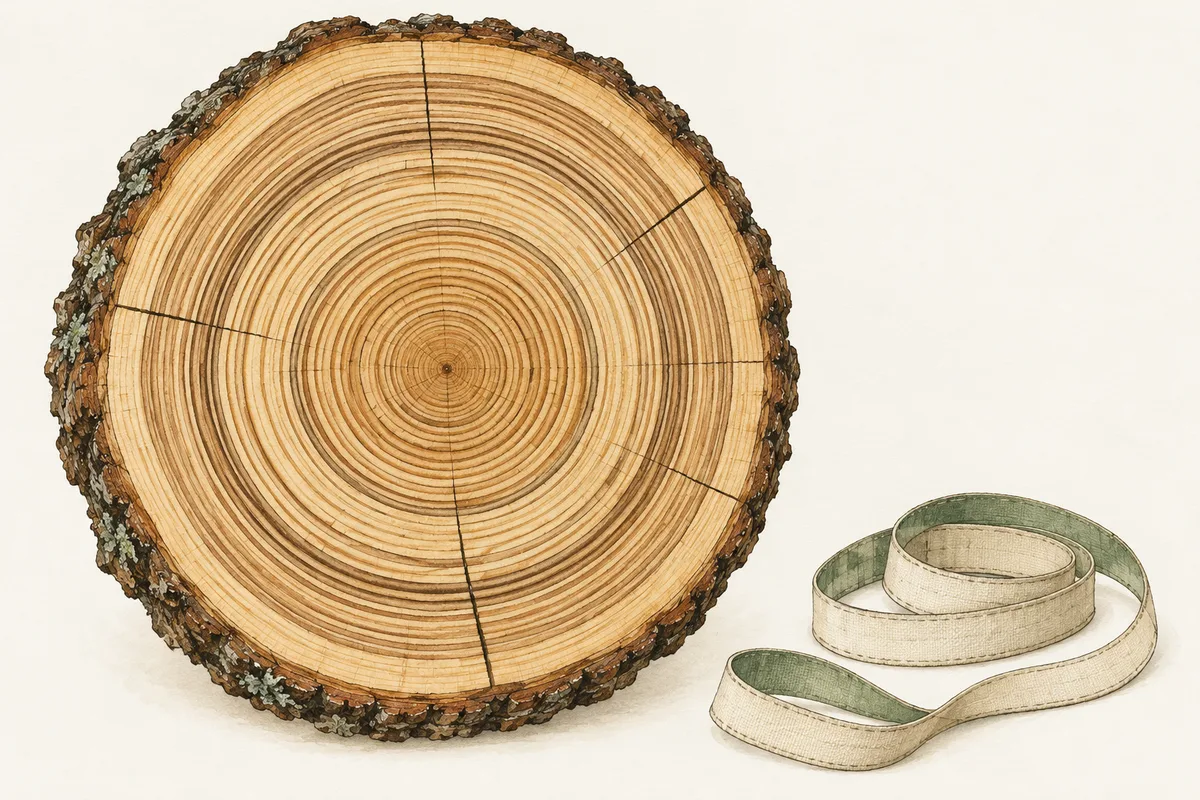
Every growing season adds one ring of wood in most temperate trees: a pale, fast-growing band in spring and a darker, denser band later in the season. On a stump, count the dark bands from the centre outward. On a living tree, an arborist or forester can take a core with an increment borer, a hollow drill about the width of a pencil, and count the rings in the core. Coring leaves a small wound, so it isn't something to do for curiosity on a valuable tree.
A count taken at stump or breast height misses the few years the young tree took to reach that height, so even a ring count slightly understates the true age.
Other ways to date a tree
- Planting records. If you know when the tree was planted, that beats any formula. Purdue notes that nursery trees are usually 5 to 10 years old when they go in the ground, so add that.
- Old photographs and aerial images. Family photos, county aerial surveys and historic maps can show when a tree first appears.
- Local records. Arboretums, parks departments and historical societies sometimes keep records of notable trees.
Knowing the species comes first
The biggest error in this calculation isn't the tape measure; it is the wrong species. A silver maple (factor 3) and a sugar maple (factor 5) of the same size differ by 40 percent in estimated age. If you aren't sure what the tree is, take one photo of a leaf, the bark or the whole tree and Tree Identifier names the species, with its scientific name to match against the list. You can also measure the tree's height with the tree height calculator.
Questions people ask
How accurate is the growth factor method?
It is an estimate, not a measurement. The factors assume a trunk widens by the same amount every year, and no tree does. Expect the true age to sit somewhere inside the range the calculator shows, and treat a single figure as a rounded middle, not a birth date.
Can I find a tree's age without cutting it down?
Yes. An arborist can pull a pencil-thin core with an increment borer and count the rings, which leaves a small wound. Planting records, old photographs and historic maps can also date a tree. The growth-factor method needs only a tape measure.
What if my tree's species isn't in the list?
Choose Other and type a growth factor if you can find one for your species from a university or arboretum source. The list's factors run from 2 for fast cottonwood and aspen to 7.5 for slow shagbark hickory, so guessing blind can double or halve the answer.
Why do yard trees come out younger?
Trees with open space, light and water widen faster than trees competing in a forest. Purdue's arborist knocks about 25 percent off the table age for yard and street trees, a rule of thumb from experience rather than a measured value, and the calculator says so.
Where exactly should I measure the trunk?
At 4.5 feet (1.37 m) above the ground on the uphill side. If the trunk forks below that height, measure the narrowest point below the fork. Pull the tape level and snug, and skip bumps or burls by measuring just above or below them.
Sources
- How Old Is My Tree? — Purdue Landscape Report, Purdue University (Issue 18-04, 2018)
- How to Age a Living Tree — Allegheny County Parks, Latodami Nature Center
- Old Trees — University of Illinois Extension, Naturalist Notebook
- Tree Age Calculator (Morton Arboretum forest-grown factors, secondary summary) — Friends of the Wildflower Garden, Minneapolis