Free tool
Tree height calculator
Measure a tree's height with a phone clinometer, a percent clinometer or a plain stick, and see the formula with your numbers.
In short
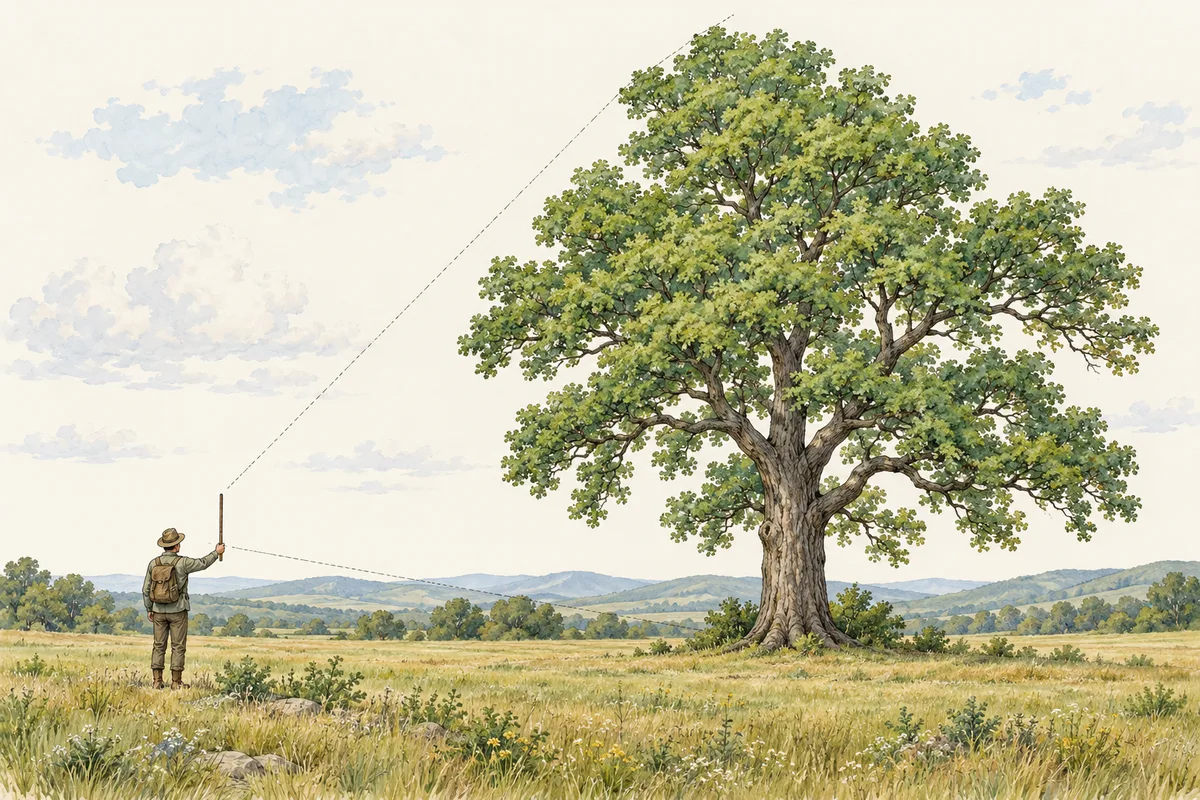
A tree height calculator turns a distance and an angle into a height: stand back from the tree, measure the level distance to the trunk, read the angle to the top with a clinometer or phone app, then multiply the distance by the tangent of that angle and add your eye height. At 50 feet and 45°, with eyes 5 feet up, the tree is about 55 feet tall.
- Four methods: level-ground clinometer, two-angle clinometer for slopes, 45° stick, stick proportion.
- All of them assume the treetop sits straight above the base; a lean skews the result.
- Even professional laser instruments are accurate to only 1.5 to 3 feet.
Tree height calculator
Pick a method, take the measurements it asks for, and the calculator does the trigonometry. All four methods come from forestry handbooks; a phone clinometer app gives the best result.
Estimated height
Fill in the measurements to see the height.
Not sure which species it is? Tree Identifier can name it from a photo.
Assumptions and sources
- Every method here assumes the top of the tree is straight above its base. For a leaning tree, or a top that sits off to one side, measure the distance to the spot on the ground right under the top. American Forests, Champion Trees Measuring Guidelines
- Distances are level (horizontal), measured at eye height. On a slope, the two-angle method avoids needing your eye height on the trunk. American Forests, Champion Trees Measuring Guidelines
- Angles below eye level count as negative, so the part of the tree below your eyes is added, and on a slope where the base is above your eyes it is subtracted. American Forests, Champion Trees Measuring Guidelines
- A percent clinometer reads the tangent × 100, so 70% means tan = 0.70. On level ground, add the top reading and the base reading without its minus sign. Virginia Cooperative Extension 2812-1028
- With the 45° stick, your hand must stay at eye level while you swing the stick upright, or the angle is no longer 45°. American Forests, Champion Trees Measuring Guidelines
- With the stick proportion, a slightly tilted stick or a top that isn't over the base gives a wrong height. A second person helps hold the stick upright. American Forests, Champion Trees Measuring Guidelines
- Errors are common with these traditional methods: good laser hypsometers reach 1.5 to 3 ft. Phone clinometer apps read angles to 0.1°. The result here is rounded to the nearest foot or half meter. American Forests, Champion Trees Measuring Guidelines
Nothing you type is sent anywhere. Your last entries are kept in this browser only.
Measuring a tree's height is geometry: a right triangle with the trunk as one side and your sight line as the long side. You measure what you can reach, the distance on the ground and an angle, and the calculator works out the side you can't reach. The four methods here follow the American Forests champion tree measuring guidelines, the rules used to measure trees for the National Register of Champion Trees.
How to measure tree height with a clinometer or phone
A clinometer measures the angle between level and your sight line. A dedicated clinometer, a forester's hypsometer or a phone app all work; phone apps typically read angles to a tenth of a degree.
- Find the top. Walk around the tree and pick the highest twig. On a broad crown, the highest point is often not straight above the trunk.
- Back away until you can see that top clearly, ideally about as far from the tree as it is tall, on level ground.
- Measure the level distance from your eyes to the trunk. A tape is best; pacing works if you know your pace length.
- Read the angle from your eye to the top.
- Enter the distance, angle and your eye height. The calculator multiplies the distance by the tangent of the angle and adds your eye height.
At 50 feet from the trunk with a 45° reading and your eyes 5 feet up, the tree is 50 × tan 45° + 5 = 55 feet. In metric, 20 m away at 40° with eyes at 1.6 m gives 20 × 0.839 + 1.6, about 18.5 m.
A percent-scale clinometer reads the tangent directly as a percentage, so at exactly 100 feet away the reading to the top plus the reading to the base (taken as a positive number) is the height in feet. The Virginia Cooperative Extension guide to measuring site index describes the same readings: a positive angle to the top, a negative one to the base, added as absolute values.
The stick methods, when you have no instrument
The 45° stick method. Take a straight stick as long as the distance from your eye to your closed fist with your arm stretched out. Hold it level against your cheek, then swing it upright without moving your hand. Walk toward or away from the tree until your sight line over the tip of the stick just touches the treetop. Your sight line is now at 45°, so the tree's height equals your level distance to the trunk plus your eye height. 60 feet away with eyes at 5.5 feet means a tree about 66 feet tall.
The stick proportion method. Hold a ruler or stick upright at arm's length so the part above your hand just covers the tree from base to top. Then the tree's height is the distance from your eye to the tree base, times the length of stick showing, divided by the distance from your eye to your hand. The American Forests handbook's example: 120 feet to the base, 2.5 feet from eye to hand and 2.7 feet of stick showing gives about 130 feet.
Both methods break if the stick tilts or your hand drifts away from eye level, so take two or three readings and use the middle one.
Measuring a tree on a slope
On a hill your eye isn't level with the base of the trunk, so eye height no longer tells you how far the base is below you. Use the two-angle method instead: read the angle to the top and the angle to the base. Angles below eye level are negative. The height is the level distance times the difference between the two tangents. If you stand downhill and the base is above your eye, both readings are positive and you subtract.
American Forests' worked example: 125 feet away, 37.5° to the top and −8.7° to the base gives 125 × (0.767 + 0.153), or 115 feet. Measure the level distance, not the distance along the slope; if you measured along the ground, multiply by the cosine of the slope angle.
Mistakes that skew the answer
- Sighting a top that isn't over the base. This is the most common error with every method here. On a leaning tree or a wide crown, the true height is measured to the point on the ground directly under the highest twig, not to the trunk.
- A sloped distance. Pacing uphill or downhill overstates the level distance.
- Standing too close. At steep angles, a one-degree misreading changes the result far more than it does at 45°. Back up until the angle is moderate.
- Expecting precision. The handbook notes that even good laser hypsometers are accurate to 1.5 to 3 feet. The calculator rounds to the nearest foot or half metre and says "about".
Why measure a tree's height
Height, trunk circumference and crown spread are the three numbers American Forests uses to score champion trees, so measuring your tree is the first step to nominating it for a state or national register. Height also helps you follow growth over the years, size up a tree near a house before calling an arborist, and estimate age together with the trunk measurement in the tree age calculator.
Knowing the species tells you what to expect: the Morton Arboretum gives a mature white oak 50 to 80 feet. If you don't know what you are measuring, one photo in Tree Identifier gives you the species name, its origin and its typical height, and our guide to identifying trees walks through the field marks.
Questions people ask
Can I measure tree height with my phone?
Yes. A clinometer app uses the phone's motion sensors to read the angle to the treetop, often to a tenth of a degree. Measure your level distance to the trunk with a tape or by pacing, enter both in the calculator, and add your eye height.
What is the easiest way to measure a tree without tools?
The 45° stick method. Hold a stick as long as your arm level against your cheek, swing it upright, and walk until your sight line over its tip meets the treetop. The tree's height is your distance to the trunk plus your eye height.
How do I measure a tree on a hill?
Use the two-angle method: read one angle to the top and one to the base of the trunk. Readings below eye level count as negative. Multiply the level distance by the difference of the two tangents; eye height drops out of the sum.
Why does my measurement differ from the last one?
Usually because the highest point you sighted wasn't straight above the trunk base, or the distance wasn't level. Walk around the tree to find the true top, measure the distance to the point under it, and repeat from a second side.
How far from the tree should I stand?
Roughly as far away as the tree is tall, on level ground, where you can see the highest twig clearly. Standing too close makes the angle steep, and at steep angles a small misreading changes the answer a lot.
Sources
- Champion Trees Measuring Guidelines Handbook — American Forests
- Measuring Site Index (publication 2812-1028) — Virginia Cooperative Extension
- White oak (Quercus alba) — The Morton Arboretum