Tree profile
Pines (Pinus): how to identify a pine tree
Count the needles in one bundle, measure them, then look at the cone. Those three checks name most of the pines you will meet in the United States.
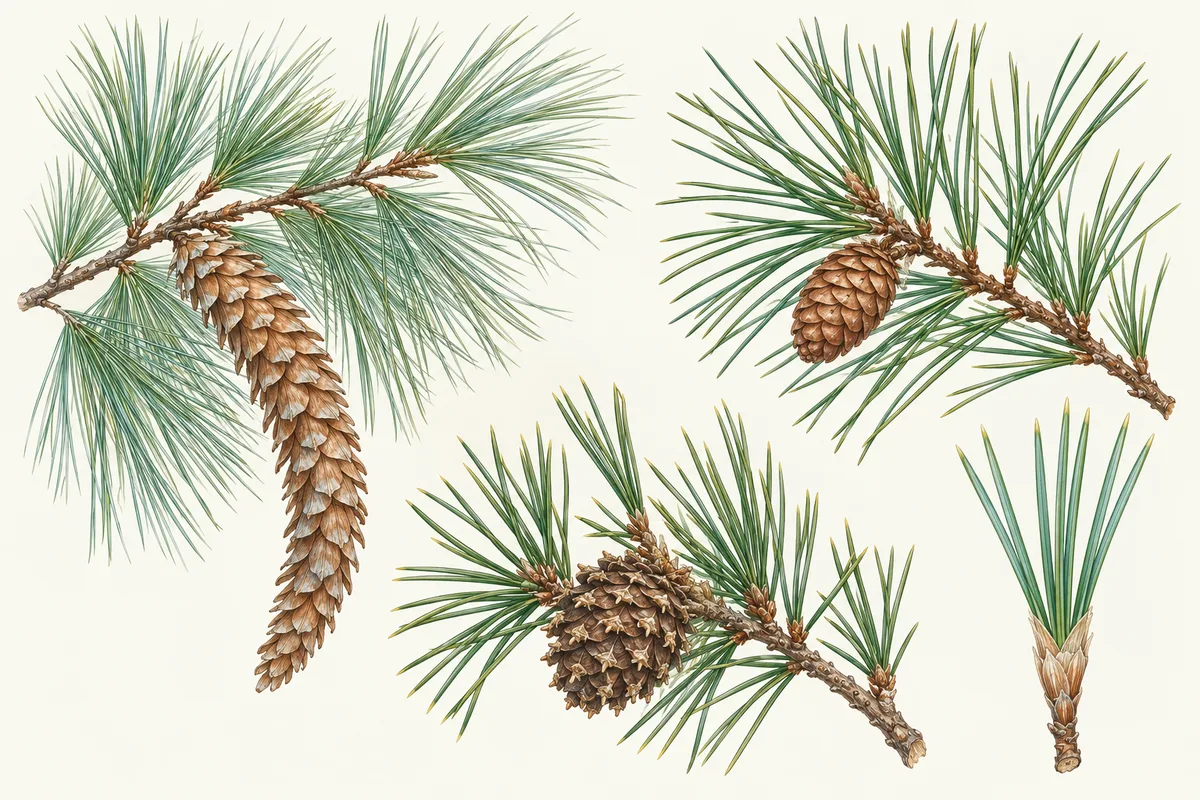
In short
Pine tree identification starts with the needles: pines are the only common conifers whose needles grow in bundles, 2, 3 or 5 to a bundle, wrapped at the base in a papery sheath. Count the needles in several bundles, measure their length (from about 1 inch on jack pine to 18 inches on longleaf pine), then check the cone's size and whether its scales carry a prickle.
- Five needles per bundle in the East means eastern white pine; its cones are 4 to 7 inches long and have no prickles.
- Two-needle and three-needle pines are separated by needle length, cone size and the prickle on each cone scale.
- Spruce and fir needles grow one at a time, never in bundles.
Field marks at a glance
- Scientific name
- Pinus
- Family
- Pinaceae (pine family)
- Type
- Conifer, evergreen
- Needles
- Evergreen needles in bundles (fascicles) of 2, 3 or 5, held together at the base by a sheath. It falls early on the five-needle white pines and stays on pines such as shortleaf and slash.
- Needle count
- 5 per bundle: eastern white pine. 3: pitch, loblolly, longleaf, ponderosa (sometimes 2). 2: red, Virginia, lodgepole, Scots, Austrian, jack, pinyon. Shortleaf carries 2 and 3 on the same branch.
- Needle length
- From 3/4 to 1 1/2 inches (jack pine) up to 8 to 18 inches (longleaf pine), per Virginia Tech Dendrology.
- Cones
- Woody, with scales that end in a raised boss (umbo). On most hard pines the umbo carries a prickle; eastern white pine and red pine cones are unarmed.
- Cone maturity
- Eastern white pine cones mature in August and September of their second year, about 13 months after pollination (USDA Forest Service).
- Bark
- Scaly when young; most species later form plates or ridges. Scots pine shows orange, peeling bark in the upper crown.
- Form
- Eastern white pine has whorls of horizontal, upturning branches; Virginia pine keeps dead gray branch stubs on its trunk; longleaf and slash pine tuft their needles at the branch tips.
Pines (Pinus) are the conifers whose needles come in bundles. That one trait separates them from spruce, fir, hemlock and almost everything else green in winter, and the number of needles in the bundle, their length and the cone narrow a pine down to species. Work in that order: count, measure, then pick up a cone.
Needles per bundle: the chart for common US pines
Pull a bundle (botanists call it a fascicle) from the middle of a branch, not the tip, and count. Then measure a typical needle. Every row below comes from the Virginia Tech Dendrology fact sheet linked in the first column.
| Pine | Needles per bundle | Needle length | Cone |
|---|---|---|---|
| Eastern white pine (P. strobus) | 5, slender and flexible | 3–5 in | 4–7 in, long-stalked, resinous, no prickles |
| Red pine (P. resinosa) | 2, snap cleanly when bent | 4–6 in | 1 1/2–2 1/2 in, shiny chestnut brown, no prickles |
| Pitch pine (P. rigida) | 3, twisted | 2 1/2–5 in | 2–4 in, short stout prickle, stays on the tree for years |
| Virginia pine (P. virginiana) | 2, twisted | 1 1/2–3 in | 1 1/2–2 1/2 in, sharp needle-like prickle |
| Loblolly pine (P. taeda) | 3 (usually) | 6–9 in | 3–6 in, red-brown, short spine |
| Shortleaf pine (P. echinata) | 2 and 3 on the same branch | 3–5 in | about 2 in, egg-shaped, small prickle |
| Longleaf pine (P. palustris) | 3 | 8–18 in | 6–10 in, curved prickle |
| Slash pine (P. elliottii) | 3 (sometimes 2) | 7–10 in | 3–6 in, stalked, glossy caramel color |
| Ponderosa pine (P. ponderosa) | 3 (sometimes 2) | 5–10 in | 3–6 in, slender prickle |
| Lodgepole pine (P. contorta) | 2, twisted | 1 1/2–3 in | 1–2 in, often lopsided, may stay closed for years |
| Scots (Scotch) pine (P. sylvestris) | 2, stout and twisted, blue-green | 1 1/2–3 in | 1 1/2–2 1/2 in, blunt spine |
| Austrian pine (P. nigra) | 2, thick and dark green | 4–6 in | 2–3 in, very short prickle |
| Jack pine (P. banksiana) | 2, divergent | 3/4–1 1/2 in | 1 1/2–2 in, curved, stays closed for years |
| Pinyon pine (P. edulis) | 2 (usually), stiff and curved | 1–2 in | about 2 in, very thick scales |
Two counts deserve care. Shortleaf pine carries bundles of two and three on the same branch, and its sheath stays on. Loblolly, slash and ponderosa pine are three-needle pines that sometimes produce twos. Count ten bundles, not one.
Read the cone and the bark next
The cone. Turn a cone over and look at the tip of each scale. The raised knob there is the umbo, and on most hard pines it ends in a prickle you can feel. Eastern white pine and red pine cones have none. Virginia pine's prickle is sharp and needle-like; Austrian pine's is minute. Size helps too: a 6 to 10 inch cone in the Southeast is longleaf pine, which Virginia Tech calls the largest cone in the eastern United States.
Pine cones take time. The USDA Forest Service's Silvics of North America reports that eastern white pine is fertilized about 13 months after pollination and its cones mature in August and September of the second year. So in summer you may find small, green first-year cones and full-size second-year cones on the same tree. Jack and lodgepole pine cones may stay closed on the branch for years, which gives these trees a knobby, coarse look.
The bark. Most pines start scaly and later form plates or ridges, so bark is a supporting clue, not a first one. A few marks stand out: Scots pine shows orange, peeling bark in the upper crown; ponderosa pine bark turns from nearly black on young trees to cinnamon-colored plates; shortleaf pine bark carries tiny resin pockets that Virginia Tech calls "volcanoes"; pitch pine often sprouts tufts of needles straight from the trunk.
The shape. Eastern white pine grows a straight trunk, often well over 100 feet, with wispy, horizontal, upturning branches. Virginia pine almost always keeps dead, gray branch stubs angled upward along its trunk. Longleaf and slash pine hold their needles in tufts at the branch ends.
Pine, spruce or fir: tell them apart in one minute
Plenty of evergreens called "pine" in conversation are spruces or firs. The bundle is the test, and the conifer identification guide covers the rest of the evergreens. For the two single-needle groups side by side, see spruce vs fir; for the scale-leaved trees sold and searched as cedar, see cedar tree identification.
- Pine: needles in bundles of 2, 3 or 5, with a papery sheath at the base.
- Spruce: needles grow one at a time. On Norway spruce they are stiff, 1/2 to 1 inch long, 4-angled and sharp-tipped, each on a raised woody peg. Roll one between your fingers: being 4-sided, it turns.
- Fir: needles also grow singly, but they are flat. Balsam fir needles are about 3/4 inch long, blunt or notched at the end, shiny dark green above and silvery-blue below. Pull one off and the twig keeps a flat, round scar. Fir cones stand upright and shed their scales on the tree.
If the branches are out of reach, a photo of a fallen bundle or a cone is enough to get a name from Tree Identifier. The app shows no confidence score and no list of look-alikes, so count the needles yourself before you trust the answer.
Common pines by region
- Northeast and Great Lakes: eastern white pine (five needles), red pine (two long needles that snap cleanly), pitch pine (three twisted needles), jack pine (two short needles, curved cones). Scots and Austrian pine, both European, are planted in yards and windbreaks. Eastern white pine grows from Newfoundland west to southeastern Manitoba, south to northeastern Iowa and northern Illinois, and down the Appalachians to northern Georgia (USDA Forest Service).
- Southeast: loblolly, shortleaf, longleaf, slash and Virginia pine. In the South, needle length does most of the work: Virginia pine 1 1/2 to 3 inches, shortleaf 3 to 5, loblolly 6 to 9, slash 7 to 10, longleaf 8 to 18.
- West: ponderosa pine (long needles in threes; Virginia Tech notes that crushed needles smell of turpentine, sometimes of citrus), lodgepole pine (short twisted pairs) and pinyon pine (stiff, curved pairs on a small, bushy tree up to 45 feet).
Eastern white pine, ponderosa pine and Scots pine are among the 138 species in Tree Identifier's Collection, which fills in as you identify trees.
How old is that pine
The Forest Service notes white pines can bear cones at 5 to 10 years, though good seed crops wait until about 20 to 30. For a trunk-based estimate, the tree age calculator uses a growth factor and the trunk's circumference; treat any result as a range, since soil, water and competition change growth rates. For the rest of the year-round method, see how to identify trees, and for buds and bark when snow covers everything, the winter tree identification guide.
Look-alikes and how to tell them apart
Spruce (Picea)
Spruce needles grow singly, are 4-sided so they roll between your fingers, end in a sharp point and each sits on a small woody peg. Pine needles grow in bundles.
Fir (Abies)
Fir needles grow singly, are flat and blunt or notched at the tip, often silvery beneath, and leave a flat round scar when pulled. Fir cones stand upright on the branch and fall apart on the tree.
Tamarack (Larix laricina)
Tamarack is a larch: its soft needles, 3/4 to 1 inch long, grow in spiral clusters on short spur shoots rather than in sheathed bundles of 2, 3 or 5, and they turn yellow and drop in fall. Pines stay green all winter.
Australian pine (Casuarina equisetifolia)
Despite the name, it is not a conifer: its 'needles' are slender, hanging green twigs covered in tiny scale-like leaves, 1/16 to 1/8 inch long, set in whorls. A true pine has real needles in bundles.
What a photo can't settle
- Several species mix needle counts: shortleaf pine carries bundles of 2 and 3 on the same branch, loblolly is 'usually' three, and slash and ponderosa pine sometimes have two. Count at least ten bundles before deciding.
- Two-needle pines planted in yards and windbreaks (red, Austrian, Scots, Japanese black) overlap in needle length, so a single photo of foliage may not separate them: the cone and the bark settle it.
- Many pines are planted far outside their native range, so where a tree stands doesn't rule a species in or out.
Questions people ask
How do you identify a pine tree by its needles?
Pull off one bundle and count the needles: 5 means a white pine, 3 or 2 a hard pine. Then measure: Virginia Tech gives 1 1/2 to 3 inches for Virginia and Scots pine, 4 to 6 for red and Austrian, 6 to 9 for loblolly and 8 to 18 for longleaf. Check several bundles, since some species mix counts.
How many needles does a white pine have?
Eastern white pine carries five slender, flexible needles per bundle, 3 to 5 inches long, with whitish lines of stomata that make the foliage look blue-green. It is the only common eastern pine with five needles; western white, sugar and limber pine also have five.
What is the difference between a pine, a spruce and a fir?
Pine needles grow in bundles of 2, 3 or 5. Spruce needles grow singly, are 4-sided and sharp, and sit on woody pegs. Fir needles grow singly, are flat and blunt or notched, and fir cones stand upright and shatter on the tree.
Which pine has the longest needles?
Longleaf pine, with needles 8 to 18 inches long in bundles of three, tufted at the branch tips. Its cone, 6 to 10 inches long, is the largest in the eastern United States according to Virginia Tech Dendrology. Slash and loblolly pine follow, with needles up to 10 and 9 inches.
How can I identify a pine tree by its cone?
Measure it and run a finger over the scale tips. Eastern white pine cones are 4 to 7 inches, long-stalked and unarmed; red pine cones are 1 1/2 to 2 1/2 inches and unarmed; Virginia pine cones carry sharp prickles; jack pine cones are curved and stay closed on the tree for years.
Sources
- Eastern white pine fact sheet — Virginia Tech Dendrology
- Eastern White Pine (Pinus strobus), Silvics of North America — USDA Forest Service
- Loblolly pine fact sheet — Virginia Tech Dendrology
- Longleaf pine fact sheet — Virginia Tech Dendrology
- Ponderosa pine fact sheet — Virginia Tech Dendrology
- Scots pine fact sheet — Virginia Tech Dendrology
- Norway spruce fact sheet — Virginia Tech Dendrology
- Balsam fir fact sheet — Virginia Tech Dendrology