Tree profile
Palm trees (Arecaceae): how to identify them
Start with the leaf, fan or feather, then read the trunk, from smooth green crownshafts to skirts of dead fronds. Here is the key, and the palms you are most likely to meet in each region.
In short
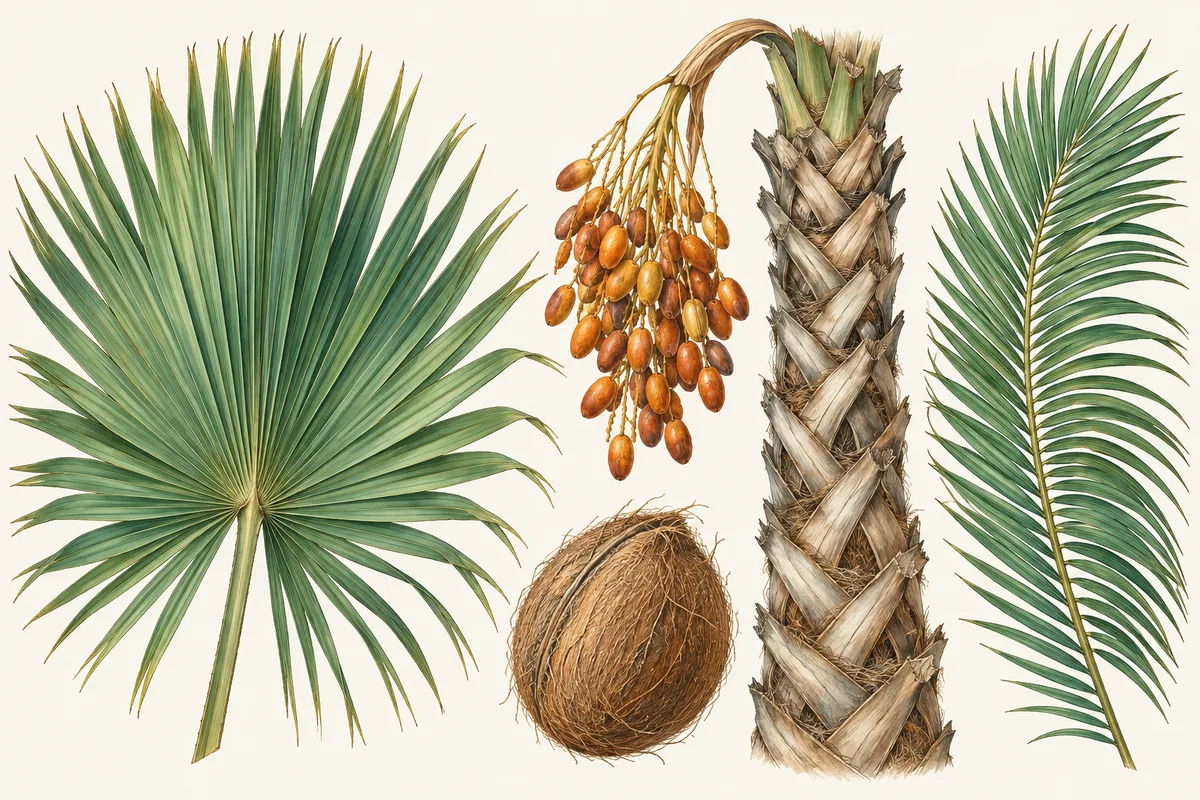
Palm tree identification starts with the leaf type. Fan (palmate) leaves spread from one point at the tip of the stalk; feather (pinnate) leaves carry separate leaflets along a central rachis; costapalmate leaves, as on cabbage palm, are fan-shaped with a midrib running into the blade. Then read the trunk: a smooth green crownshaft, a skirt of dead fronds, diamond-shaped leaf scars or burlap-like fiber.
- Fan or feather is the first split: coconut, queen, pindo and date palms are feather palms; Mexican fan, California fan and windmill palms are fan palms.
- Cabbage palm's leaf is costapalmate: a fan with a midrib running into it, which makes the blade curve.
- A smooth green column under the leaves is a crownshaft: royal palm has one, about five feet long.
Field marks at a glance
- Scientific name
- Arecaceae
- Family
- Arecaceae (palm family)
- Type
- Broadleaf, evergreen
- Leaf types
- Fan (palmate): segments joined and spreading from one point at the stalk tip. Feather (pinnate): separate leaflets along a rachis. Costapalmate: a fan with a midrib (costa) running into the blade, as on Sabal.
- Trunk
- A stem that does not thicken with age, because palms have no cambium. The outer layer is a pseudobark of dried tissue left by shed fronds, not true bark.
- Crownshaft
- On some feather palms, tubular leaf bases wrap into a smooth stem-like column below the leaves. Royal palm's is about 5 ft long; these palms shed dead leaves on their own.
- Leaf bases and scars
- Dead fronds may hang as a skirt (Mexican and California fan palms), leave a diamond pattern of scars (Canary Island date palm) or a burlap-like fiber (windmill palm).
- Spines
- Canary Island date palm's lowest leaflets are modified into long, sharp spines; needle palm has 6 to 10 inch black needles on its trunk; saw palmetto has saw-like teeth on its leaf stalks.
- Flowers and fruit
- Cabbage palm: branched stalks of creamy-white flowers reaching beyond the leaves, then black fruit. Canary Island date palm: orange flower stalks about 3 ft long and orange fruit. Queen palm: orange fruit by winter.
- Size
- From needle palm, a clump about 8 ft tall, to Mexican fan palm, which can pass 100 ft. Cabbage palm reaches about 40 ft; royal palm 50 to 70 ft.
- Cold hardiness
- Sets the regional lineup: coconut only in USDA zones 10B to 11, royal palm to about 28°F, windmill and pindo palms to about 10°F, needle palm several degrees below 0°F.
Palms are the plants of the palm family, Arecaceae, and identifying them works differently from other trees: there are no bark textures or bud scales to read. Check the leaf type first, then the trunk, then your region. Leaf type alone narrows the US palms to a handful.
The key: fan, feather or costapalmate
1. Find the leaf type. UF/IFAS's guide to palm leaf structure sorts palm leaves into three kinds:
- Fan (palmate). The segments are joined for some or most of their length and spread from a single point at the tip of the leaf stalk, often with a small flap there called the hastula. Mexican fan palm and windmill palm are fan palms.
- Feather (pinnate). The leaflets are entirely separate and attached at right angles along the rachis, the extension of the stalk into the leaf. Coconut, queen and date palms are feather palms.
- Costapalmate. In between: a round to oval fan whose segments attach along a costa, a midrib that continues the stalk into the blade. Sabal palms, including the cabbage palm, have them, which is why their fans look curved and folded.
2. Read the trunk.
- A smooth, green, stem-like section just below the leaves is a crownshaft, made of tubular leaf bases wrapped around each other. Royal palm has one, about 5 feet long.
- A thick skirt of dead fronds hanging down the trunk points to the Washingtonia fan palms.
- A diamond pattern of leaf scars on a trunk 2 to 3 feet thick marks the Canary Island date palm.
- A trunk that looks wrapped in burlap is a windmill palm.
- Black needles 6 to 10 inches long on a short trunk belong to the needle palm.
3. Match your region, using the table below.
If the leaves are 50 feet up, a photo of the whole palm is the easiest way to get a name from Tree Identifier, and the guide to identifying a tree from a photo explains how to frame it. The app returns one name, with no confidence score and no list of look-alikes, so check the leaf type and trunk marks before you trust it.
Common palms of Florida, the Gulf Coast and California
Figures from UF/IFAS Extension pages, NC State Extension for Mexican fan palm and the National Park Service for California fan palm.
| Palm | Leaf | Trunk and crown | Size | Where you see it |
|---|---|---|---|---|
| Cabbage or sabal palm (Sabal palmetto) | Costapalmate fan, blade 3–4 ft, stalk 3–6 ft | Single trunk 10–16 in thick, full round canopy | To about 40 ft | Native throughout Florida and north along the coast to North Carolina |
| Royal palm (Roystonea regia) | Feather, fronds 10–15 ft | Smooth crownshaft about 5 ft long | 50–70 ft | South Florida, where it is native; hardy to about 28°F |
| Coconut palm (Cocos nucifera) | Feather | Bears coconuts; husk fiber is coir | Not suited to any freeze | Florida's east and west coasts; zones 10B–11 only |
| Queen palm (Syagrus romanzoffiana) | Feather, in a large feathery canopy | Smooth gray trunk | To about 50 ft | Widely planted in Florida; orange fruit by winter |
| Canary Island date palm (Phoenix canariensis) | Feather, 8–15 ft, up to 200 leaflets, spiny at the base | Trunk 2–3 ft thick with diamond leaf scars | 40–50 ft | Warm parts of the US, zones 9A–11 |
| Date palm (Phoenix dactylifera) | Feather | Very large; a resort and large-landscape palm | 50 ft or more | Planted; UF notes it struggles in Florida humidity |
| Mexican fan palm (Washingtonia robusta) | Fan, 3–5 ft long | Slender trunk up to 12 in thick; skirt of dead leaves | 50–100 ft or more | Native to northwest Mexico; naturalized in Florida, California, Louisiana, Texas and Hawaii |
| California fan palm (Washingtonia filifera) | Fan | Skirt of dried fronds | Up to 75 ft | Native to the low, hot deserts of southern California |
| Pindo palm (Butia odorata) | Feather, blue-gray, arching, up to 6 ft | Slow-growing; dead fronds stay on until cut | 15–25 ft | North Florida and up the East Coast into the Carolinas; hardy to about 10°F |
| Windmill palm (Trachycarpus fortunei) | Fan, 1.5–3 ft wide | Narrow trunk covered in burlap-like fiber | Rarely over 25 ft | North and Central Florida and farther north; zones 8A–11 |
| Needle palm (Rhapidophyllum hystrix) | Fan, 5–12 stiff segments, silvery beneath | Short trunk with 6–10 in black needles | Clump about 8 ft tall | Native floodplains of South Carolina to Mississippi; grown as far north as Washington, D.C. |
Sources for the rows: UF/IFAS pages on cabbage palm, royal palm, coconut palm, queen palm, Canary Island date palm, date palm, cold-hardy palms, pindo palm, windmill palm and needle palm; NC State Extension's Mexican fan palm; and the National Park Service's fan palm oases page.
Florida palms
Florida has the widest lineup, and two of its palms are native trees of note. The cabbage palm, also called sabal palm, is Florida's state tree, designated in 1953, and also the state tree of South Carolina. UF/IFAS describes its curved, fan-shaped leaves on stalks 3 to 6 feet long, a trunk 10 to 16 inches thick and up to 40 feet tall, creamy-white flowers in late spring on branched stalks that reach beyond the leaves, and black fruit in late summer.
The royal palm, native to South Florida, is the one lining avenues: 50 to 70 feet tall, with a smooth green crownshaft and fronds 10 to 15 feet long that weigh upwards of 50 pounds and drop on their own about once a month. UF/IFAS advises gloves when handling its fruit, whose pulp is highly irritating to skin.
The coconut palm, a feather palm, grows on both coasts but only in USDA zones 10B to 11. UF/IFAS's assessment of non-native plants rates it invasive in South Florida, with planting allowed only away from canals and natural areas.
Gulf Coast and cold-hardy palms
North of the frost line the list shrinks to palms that take a freeze, listed in UF/IFAS's cold-hardy palms page:
- Cabbage palm, the native fan palm of the coast.
- Windmill palm, a fan palm with a burlap-wrapped look that UF says grows as far north as Canada and Scotland and handles about 10°F.
- Pindo palm, a slow-growing feather palm with blue-gray, gently curving fronds, hardy to about 10°F.
- Needle palm, a native shrubby fan palm that tolerates temperatures several degrees below 0°F. UF/IFAS notes it is endangered in the wild and protected, so buy only nursery-grown plants.
Under pines and in coastal scrub you will also meet saw palmetto, a native clumping fan palm 5 to 10 feet tall whose stems crawl along the ground and carry saw-like teeth. It grows as far north as South Carolina and as far west as Texas.
California and the desert Southwest
The National Park Service describes the desert fan palm, or California fan palm (Washingtonia filifera), as native to the low, hot deserts of southern California. It grows up to 75 feet tall, can live 80 to 90 years, and its dead fronds often hang down the trunk like a skirt until fire, wind or flood removes them. There are only 118 desert fan palm oases in North America, seven of them in Joshua Tree National Park. UF/IFAS adds that it is more cold hardy than its relative but prefers a drier climate than Florida's.
The Mexican fan palm (Washingtonia robusta) is the taller, slimmer cousin: NC State Extension gives up to 100 feet on a trunk up to 12 inches thick, native to northwest Mexico and naturalized in California, Florida, Louisiana, Texas and Hawaii. Its dead leaves also fold down into a dense skirt. The Canary Island date palm and the date palm, both feather palms, are the other big palms of western landscapes.
Are palms trees?
Botanically, many specialists say no. UF/IFAS writes that the sabal palm is not a true tree and that palms are more closely related to grasses. A Duval County extension agent explains why: palms are monocots, like grasses, lilies and onions; they have no cambium, so their trunks do not grow thicker with age and have no annual rings; and what looks like bark is a pseudobark of dried tissue left by shed fronds. So there are no growth rings to count in a palm trunk.
In everyday speech, and on this site, they are still palm trees. For a yard tree you can't place, see how to identify trees in your yard.
Palms in the app's Collection
Tree Identifier's Collection, the catalog that fills in as you identify, lists 14 palms: coconut, date, royal, Mexican fan, windmill, oil, European fan, cabbage, betel nut, Bismarck, Chilean wine, palmyra, Canary Island date and queen palm. California fan, pindo and needle palm are not among them, though a photo of any palm still returns a name. For reading leaf shapes on broadleaf trees, see how to identify trees by their leaves.
Look-alikes and how to tell them apart
California fan palm vs Mexican fan palm (Washingtonia)
Both are fan palms with skirts of dead fronds. Mexican fan palm grows taller, 50 to 100 ft or more, on a slender trunk up to 12 inches thick; California fan palm reaches about 75 ft. Height and a wild desert oasis setting point to California fan palm.
Saw palmetto (Serenoa repens)
Saw palmetto is a palm, but it stays a clump 5 to 10 ft tall with stems that crawl along the ground and saw-like teeth on the leaf stalks. Cabbage palm grows one upright trunk to about 40 ft with curved, costapalmate leaves.
Dwarf palmetto (Sabal minor)
It looks like a small cabbage palm, but its trunk stays underground and it sends up long flower spikes while under 5 ft tall. Its leaf stalks have no toothed edges, and its fruits are smaller than cabbage palm's.
What a photo can't settle
- UF/IFAS notes that Canary Island date palms readily hybridize with other Phoenix species, giving palms that vary considerably from either parent. A photo can say date palm, but a hybrid may not match any species description.
- Juvenile palms without a trunk still show their leaf type, but trunk marks like crownshafts and leaf-scar patterns appear only with age.
- Trimming changes what you see: skirts are often removed and Canary Island date palms are sometimes cut into a pineapple shape, which hides the leaf bases.
Questions people ask
How do I identify my palm tree?
Look at one healthy leaf. If its segments spread from a single point like a hand, it is a fan palm; if separate leaflets line a central stalk, it is a feather palm. Then check the trunk for a smooth green crownshaft, a skirt of dead fronds, diamond scars or burlap-like fiber, and match it to your region.
What is the difference between a fan palm and a feather palm?
On a fan (palmate) palm the leaf segments are joined for part of their length and radiate from the tip of the leaf stalk. On a feather (pinnate) palm the leaflets are separate and attached along a rachis, an extension of the stalk. Cabbage palm's costapalmate leaf sits in between.
What palm trees grow in Florida?
The native cabbage (sabal) palm grows statewide and is the state tree. South Florida adds royal palm, also native, and coconut palm on the coasts. Queen, Mexican fan and Canary Island date palms are widely planted. North Florida relies on cold-hardy windmill, pindo and needle palms.
Which palm tree is native to California?
The California fan palm, or desert fan palm (Washingtonia filifera), is native to the low, hot deserts of southern California, according to the National Park Service. It can reach 75 feet, and there are only 118 desert fan palm oases in North America. The taller Mexican fan palm is native to northwest Mexico.
Are palm trees really trees?
Botanically, many specialists say no. UF/IFAS Extension notes that palms are monocots, closer to grasses, and lack the cambium that makes a tree's trunk thicken and form annual rings. They grow tall and woody-looking, so in everyday speech they are called trees.
Sources
- Palm Leaf Structure — UF/IFAS Gardening Solutions
- Are palm trees really trees? Here's what you should know — UF/IFAS Extension Duval County
- Sabal Palmetto — UF/IFAS Gardening Solutions
- Cold-Hardy Palms — UF/IFAS Gardening Solutions
- Royal Palm — UF/IFAS Gardening Solutions
- Phoenix canariensis: Canary Island Date Palm (ENH-598/ST439) — UF/IFAS Extension (EDIS)
- Washington Palm — UF/IFAS Gardening Solutions
- Fan Palm Oases — Joshua Tree National Park, U.S. National Park Service