Yard guide
How to identify the trees in your yard
Planted trees hide from native field guides. Start with the paper trail, then use the field method, and know when an ISA Certified Arborist or the extension office is the faster answer.
In short
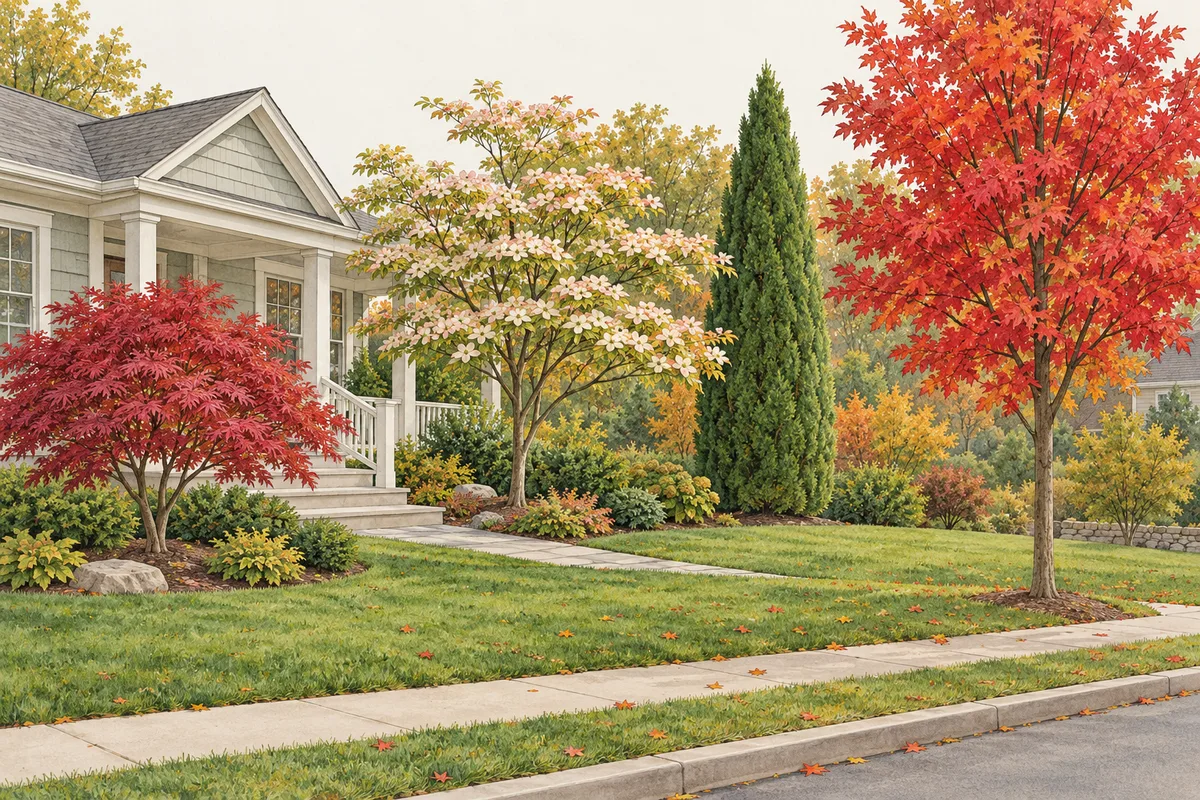
To identify the trees in your yard, look for records first: a nursery tag still wired to a branch, the builder's or HOA's landscape plan, or photos in an old real-estate listing. Then check leaf arrangement, leaf shape, bark and fruit. Many yard trees are planted non-native cultivars such as Japanese maple, crapemyrtle or Callery pear, so use a landscape-plant guide, not only a native-tree key.
- A landscape plan's plant schedule or a nursery tag can give you the exact cultivar, which no photo will.
- Opposite leaves narrow a yard tree fast: Japanese maple and kousa dogwood are opposite, Callery pear and ginkgo are alternate.
- For risk, pruning or removal, hire an ISA Certified Arborist and verify the credential in ISA's directory.
The trees in a yard are a different puzzle from the trees in a forest. Most were planted, many come from other continents, and many are named cultivars bred for leaf color, flowers or a narrow shape. A field guide to native trees often won't list them at all. The good news is that a planted tree usually left a paper trail, and that trail can give you a more exact name, down to the cultivar, than any key or photo.
Start with the paper trail
Before you look at a single leaf, check the records. These are the places a yard tree's name most often turns up:
- Nursery tags. Many trees are planted with a plastic or metal tag wired to a lower branch, and some owners keep them in a drawer or the garage. The tag gives the species and the cultivar, such as Acer palmatum 'Bloodgood', which no photo can.
- Receipts and warranties. Garden-center receipts and planting warranties list what was planted and when, which also tells you the tree's age.
- The builder's or HOA's landscape plan. New subdivisions are often planted from a landscape plan with a plant schedule: a table of every species, its size at planting and its count. Ask the builder, the homeowners association or the previous owner. HOAs sometimes keep an approved-tree list that narrows the choice too.
- City or county records. Permits for tree planting or removal, and the plans filed with them, sometimes name species. Some cities publish a street-tree inventory that names the tree between the sidewalk and the curb.
- Old real-estate listings. Listing photos stay online for years. They show the tree in another season, in flower or in fall color, and sometimes the listing text names "mature Japanese maples" or "flowering pears".
- The previous owner or neighbors. A neighbor who planted the same tree may still have the tag.
Common planted yard trees and the check that separates them
These trees are planted across much of the US and are often missing from native-tree guides. The Virginia Tech Dendrology fact sheets cover each one, and they give the check that settles it.
| Tree | Leaves | The check |
|---|---|---|
| Japanese maple (Acer palmatum) | Opposite, 2 to 5 inches, 5 to 7 deeply palmate lobes; often deep red | A small tree, 10 to 25 feet, with paired wings at 90 degrees |
| Crapemyrtle (Lagerstroemia indica) | Opposite, some alternate or whorled; elliptical, smooth edge, 1½ to 3 inches | Smooth, peeling bark in brown, red-brown and green; 8-inch flower clusters in late summer; seed capsules stay through winter |
| Kousa dogwood (Cornus kousa) | Opposite, oval, smooth edge, 2½ to 4 inches | Flowers after flowering dogwood; round pink-red fruit 1 to 1½ inches across on a long stalk; patchy "camouflage" bark |
| Callery or Bradford pear (Pyrus calleryana) | Alternate, rounded or heart-shaped, finely toothed, 1½ to 3 inches (Penn State) or 2 to 3 inches (Virginia Tech) | White flowers before or with the leaves, with a rancid odor; tiny hard pears about ½ inch |
| Ginkgo (Ginkgo biloba) | Fan-shaped with parallel veins, 2 to 3 inches, on short spur shoots | Female trees drop fleshy seeds with a strong, unpleasant odor after frost |
| Leyland cypress (× Hesperotropsis leylandii) | Evergreen scales in flat sprays | Narrow, 60 to 70 feet in landscapes; rarely bears cones |
Sources: Virginia Tech fact sheets for each species (crapemyrtle, Japanese maple, kousa dogwood, Callery pear, ginkgo, Leyland cypress) and Penn State Extension on Callery pear, which notes that "Bradford" is the most widely planted cultivar of Callery pear and that it has been widely planted as a street and ornamental tree since the 1960s. Penn State also gives the quickest look-alike test: flowering dogwood and viburnums have similar rounded leaves, but theirs are opposite and Callery pear's are alternate. The Bradford pear page covers that tree in detail.
The field method, applied to a yard tree
If the paper trail runs dry, use the same checks as for any tree, in the same order. The hub guide to identifying trees explains each step; for yard trees, three points matter most:
- Opposite or alternate first. Look where leaves or buds join the twig. Among the trees in the table, Japanese maple and kousa dogwood are opposite; Callery pear and ginkgo are alternate. In eastern North America, a native tree with opposite leaves is almost always a maple, ash, dogwood or buckeye.
- Ignore the range map. A range map rules out trees that don't grow wild near you, but planted trees grow far outside their native range. Virginia Tech marks ginkgo, Japanese zelkova, kousa dogwood and Leyland cypress as planted but "not known to widely escape cultivation", which is why wild-tree keys skip them.
- Expect odd leaf colors and shapes. Purple, variegated, weeping or columnar trees are usually cultivars. Virginia Tech notes that some Japanese maple cultivars are so deeply lobed the leaf looks compound, and that leaf color varies with the cultivar.
A yard is also the easiest place to learn trees with children: the tree identification guide for kids turns these checks into short activities.
For yard trees, a landscape-plant database often beats a forest key. The NC State Extension Gardener Plant Toolbox describes 4,725 plants that grow in and around North Carolina, cultivated plants included, with photos and a glossary of identification terms. Many states' extension services publish similar landscape-plant guides.
Photo apps and communities for yard trees
A photo gets you a likely name quickly, and the shot list in how to identify a tree from a photo applies to yard trees too: whole tree, both sides of a leaf, the twig, the bark, and any flowers or fruit.
Two cautions are specific to planted trees. First, community sites treat them differently. On iNaturalist, an observation of a captive or cultivated organism can't reach "Research Grade", according to iNaturalist's help pages, so a yard tree marked as cultivated stays out of Research Grade however many people agree on it. Second, apps name species, not cultivars.
Tree Identifier, an iPhone app, names a tree from one photo using a cloud AI model, so it needs an internet connection. For a yard tree, its Care Guide tool adds watering, sunlight, pruning and seasonal notes for the species in the photo, and the follow-up chat under each result takes questions like "is this a Bradford pear or a native serviceberry?". It shows no confidence score, so check the name against the tree. If you allow location, the Tree Map keeps track of which tree is where, which helps on a large lot.
When to call an ISA Certified Arborist
You rarely need to pay anyone just for a tree's name. You do need a professional when the question is about the tree's care or safety. The International Society of Arboriculture's consumer site, TreesAreGood.org, describes an ISA Certified Arborist as a tree care professional who has documented knowledge of tree biology, diagnosis, maintenance and safety, and who must keep up continuing education to stay certified. ISA lists the jobs where an arborist helps:
- Pruning, for health, appearance or safety.
- Removal, when a tree is dead or dying, an unacceptable risk, an obstruction, crowding other trees, or in the way of new construction.
- Emergency care after storm damage, which ISA calls dangerous work.
- Planting, including choosing species that suit the spot.
An arborist on site will also name the tree. Before you hire one, use ISA's Find an Arborist directory to verify the credential. ISA notes that certification holders are held to a Code of Ethics, and that the listing is voluntary, so a certified arborist may not appear in it.
Ask your county extension office
For identification alone, the Cooperative Extension office in your county is the usual free option in the US. Ask Extension passes questions to Cooperative Extension and university staff and volunteers at participating land-grant institutions. Send several sharp photos (whole tree, leaf top and underside, twig, bark, fruit), your town, and the date.
Once you know what the tree is, you can estimate its age from its trunk or compare it with the native trees on the street. Keep the name with a photo; the next owner will thank you.
What a photo can't settle
- No photo gives you a cultivar name. Japanese maples and crapemyrtles come in many cultivars that differ in leaf color, size and form, and only a tag or a plan names them.
- A photo app can't judge whether a yard tree is safe to keep near a house; that is a job for an ISA Certified Arborist on site.
Questions people ask
How do I find out what kind of tree is in my yard?
Check for records first: a nursery tag on a branch, a receipt, the builder's or HOA's landscape plan, or old listing photos. If there are none, note whether leaves are opposite or alternate, the leaf shape, the bark and any fruit, then compare with a landscape-plant guide or ask your county extension office.
How do I identify the trees on my property for free?
Your county Cooperative Extension office and Ask Extension answer plant questions from the public; Ask Extension routes them to Extension and university staff and volunteers. Photo tools such as Apple's Visual Look Up and Google Lens cost nothing to use, and iNaturalist lets other users review your photos.
Should I hire an arborist just to identify a tree?
Usually not for the name alone; an extension office or a photo is cheaper. Hire an ISA Certified Arborist when the question is about the tree's care or safety: pruning, removal, storm damage, a tree near the house or new construction. ISA's directory lets you verify the credential.
Why can't my field guide find the tree in my yard?
Field guides to native trees leave out most planted species and cultivars. Ginkgo, Japanese zelkova, kousa dogwood and Leyland cypress are planted across much of the US but, per Virginia Tech, are not known to widely escape cultivation, so they rarely appear in wild-tree keys. Use a landscape-plant guide instead.
Sources
- Why Hire an Arborist? — International Society of Arboriculture, TreesAreGood.org
- Find an ISA-Credentialed Arborist — International Society of Arboriculture, TreesAreGood.org
- Callery Pear — Penn State Extension
- Japanese maple fact sheet — Virginia Tech Dendrology
- Crapemyrtle fact sheet — Virginia Tech Dendrology
- What is the Data Quality Assessment and how do observations qualify to become Research Grade? — iNaturalist Help
- North Carolina Extension Gardener Plant Toolbox — NC State Extension
- Ask Extension — Extension Foundation