Field guide
How to identify trees, step by step
Eight checks in a fixed order, from needles or leaves down to buds and acorn caps, then a key or field guide to confirm the name.
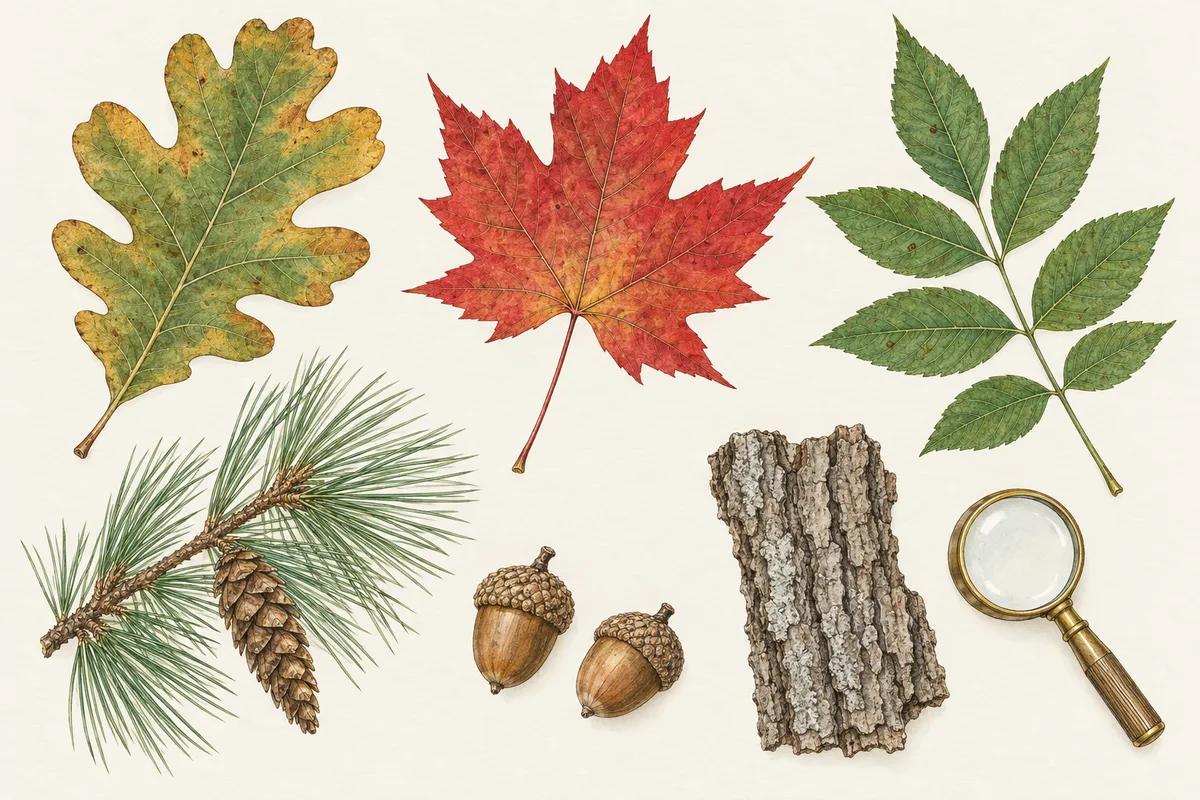
In short
To identify trees, work from the broadest clue to the finest. First decide whether the tree has needles, scales or broad leaves. Then check whether leaves and buds sit opposite or alternate, and whether each leaf is simple or compound. Next read the leaf's shape, margin and lobes, then the bark, twigs and buds, fruit or cones, and the tree's form and range. Confirm the name with a dichotomous key or regional field guide.
- In eastern North America, a native tree with opposite leaves is almost always a maple, ash, dogwood or buckeye (MADCap Horse).
- Oak lobes with bristle tips point to the red oak group; rounded lobes without bristles point to the white oak group.
- Look at several sunlit leaves, not one shaded leaf: shade leaves and young trees often look atypical.
Most trees can be named in the field with eight checks made in a fixed order. You start with the clue that splits trees into the biggest groups (needles or broad leaves) and finish with the details that separate close relatives, such as bud shape or the cap of an acorn. Work through the checks in order, write down what you see, and only then reach for a key, a field guide or an app.
The method at a glance
- Needles, scales or broad leaves. Conifer or broadleaf.
- Opposite or alternate. Do leaves and buds sit in pairs or staggered along the twig?
- Simple or compound. One blade per leaf stalk, or several leaflets?
- Shape, margin and lobes. Outline, smooth or toothed edge, lobe tips.
- Bark. Color and texture on the trunk at chest height.
- Twigs and buds. The main clue from leaf fall to spring.
- Fruit, seeds and cones. In the crown and on the ground.
- Form, site and range. Crown shape, wet or dry ground, your region.
The first three checks already narrow most trees to a handful of groups:
| First clues | Likely group | Next check |
|---|---|---|
| Needles in bundles of 2, 3 or 5 | Pines | Count the needles per bundle |
| Single four-sided needles on small woody pegs | Spruces | Roll a needle between your fingers |
| Single flat needles leaving a round pad on the twig | Firs | Look for upright cones |
| Overlapping scale-like leaves | Cedar family (arborvitae, junipers) | Woody cones or berry-like cones |
| Opposite, simple leaves | Maples, dogwoods | Lobed (maple) or unlobed (dogwood) |
| Opposite, compound leaves | Ashes, buckeyes and horse chestnut, boxelder | Leaflets in a row or in a hand |
| Alternate leaves, lobes with bristle tips | Red oak group | Acorn cap and leaf size |
| Alternate leaves, rounded lobes | White oak group | Acorn cap and bark |
| Alternate, pinnately compound leaves | Walnuts, hickories, locusts | Number of leaflets, nut husk |
One warning before you start: collect several leaves from the sunlit outer crown rather than one leaf from a shaded lower branch or a sprout. The Vanderbilt University oak key notes that the typical sun-leaf characters may not show on shade leaves, and that leaves on immature trees may not be typical for the species.
Step 1: Needles, scales or broad leaves
A conifer carries needles or small overlapping scales; a broadleaf tree carries flat leaves with a stalk and a blade. "Evergreen" is not the same thing: a few broadleaf trees keep their leaves all winter, and one common conifer, the eastern larch or tamarack, drops its needles every fall.
If the tree has needles, the attachment tells you the genus. Cornell forester Peter Smallidge's guide to needle-bearing trees gives the field marks:
- Pines carry needles in bundles (fascicles) of 2, 3 or 5. Red pine and Scotch pine have 2 per bundle; pitch pine has 3.
- Spruces have single, four-sided needles, each on a woody peg about 1 mm long that stays on the twig after the needle falls.
- Firs have single, flat needles attached directly to the twig, leaving a slightly raised round pad. Their cones stand upright and drop their scales on the branch.
- Hemlocks look like firs but have small hanging cones and tiny extra needles along the top of the twig.
- Cedar-family trees (arborvitae, junipers) have scale-like leaves; junipers also grow sharp, awl-like needles on young shoots.
The conifer identification guide goes further, species by species.
Step 2: Opposite or alternate
Look at where the leaves join the twig. If two leaves leave the twig at the same point, facing each other, the arrangement is opposite. If they are staggered, one per point, it is alternate. In winter, read the buds and leaf scars the same way. Check three or four twigs, because a broken twig or a lost bud can make an opposite tree look alternate.
Opposite trees are the minority. University of New Hampshire Extension lists the native groups with opposite branching: maples, ashes, horse chestnut, dogwoods, viburnums and elderberry. Students learn them as MADCap Horse: Maple, Ash, Dogwood, Caprifoliaceae (the honeysuckle family), Horse chestnut. As Ohio State's EEOB 2210 companion site points out, viburnums and elderberries have since moved to a different family (Adoxaceae), and for trees alone "MADBUCK" (maple, ash, dogwood, buckeye) works almost as well. If a native tree in eastern North America is alternate, you can set those four aside.
Step 3: Simple or compound leaves
A simple leaf has one blade on its stalk. A compound leaf has several leaflets on a shared stalk, and a single leaflet is easy to mistake for a whole leaf. The fix is the bud: a bud sits in the angle where a whole leaf meets the twig, never at the base of a leaflet. Find the bud and you have found where the leaf starts.
Compound leaves come in two patterns. Pinnate leaves carry leaflets in two rows along a central stalk, like a feather (ashes, walnuts, hickories, black locust). Palmate leaves spread their leaflets from one point, like fingers (buckeyes and horse chestnut).
Combine this with step 2 and the field shrinks fast. Opposite and compound points to the ashes (pinnate), the buckeyes and horse chestnut (palmate), or boxelder, a maple with 3 to 5 leaflets. Alternate and pinnately compound points to walnuts, hickories and locusts.
Step 4: Leaf shape, margin and lobes
Now measure one typical leaf and describe it in three parts:
- Outline: oval, egg-shaped, heart-shaped, triangular, lance-shaped, fan-shaped.
- Margin: smooth (entire), toothed (fine or coarse, single or double teeth) or lobed.
- Veins: a single midrib with side veins (pinnate) or several main veins from the base (palmate, as in maples).
Lobe tips matter most in oaks. Ohio State's Woody Plants of Ohio separates the white oak group, with blunt lobes that do not end in bristle tips, from the red oak group, whose lobes end in bristles. A white oak leaf is 4 to 7 inches long with 7 to 10 rounded, finger-like lobes and a whitish underside, according to the Virginia Tech Dendrology fact sheet. For the common shapes and margins, see how to identify trees by their leaves.
Step 5: Bark
Bark confirms a candidate better than it finds one, because it changes with age: UNH Extension shows that a young shagbark hickory looks quite different from an old one, which only develops the peeling "shag" as it matures. Look at the main trunk at chest height and note:
- Color: whitish, ashy gray, dark gray, red-brown.
- Texture: smooth, scaly, in plates or blocks, furrowed with ridges, peeling in strips or papery layers.
- Pattern: Virginia Tech compares northern red oak's flat-topped ridges to ski tracks; white oak's pale bark breaks into scales and irregular plates.
Step 6: Twigs and buds
From leaf fall to spring, twigs carry most of the information. Buds sit opposite or alternate exactly as the leaves did, so step 2 still works. Then look at:
- Bud shape and size: pointed or rounded, long or short, pressed to the twig or standing off it, with or without scales.
- Clustered end buds: oaks have several buds bunched at the twig tip. White oak group buds are blunt; red oak group buds are sharp-pointed (Ohio State).
- Leaf scars: the marks left where last year's leaves fell, with tiny dots where the veins passed through.
- Smell: UNH Extension notes that a broken black birch twig smells strongly of wintergreen.
Fruit that hangs on into winter and dead leaves under the tree help too. The winter tree identification guide covers buds and twigs in more detail.
Step 7: Fruit, seeds and cones
Fruit is often the strongest single clue, and it is easy to find: look in the crown, then on the ground beneath it.
- Acorns mean an oak. Ohio State's dendrology notes give the group test: white oak group acorns mature in one season and the inside of the nut shell is hairless; red oak group acorns take two seasons and the shell is lined with hairs. You have to crack the nut to see the lining.
- Winged seeds (samaras) joined in pairs mean a maple; single winged seeds hanging in clusters point to an ash.
- Nuts in a husk point to walnuts and hickories; large glossy seeds in a leathery, sometimes spiny husk point to a buckeye or horse chestnut.
- Cones: upright cones that fall apart on the branch mean a fir; berry-like cones mean a juniper or eastern redcedar (Cornell).
Step 8: Form, site and range
Step back and look at the whole tree. The same species can take two shapes: an open-grown white oak has a wide, spreading crown on a stocky trunk, while a forest-grown one has an upright, oval crown on a tall, straight trunk (Virginia Tech).
Then note the site, because wet or dry ground can split look-alikes. In the Vanderbilt oak key, swamp white oak is a tree of wetlands, while the USDA Forest Service's Silvics of North America describes white oak as an upland tree that avoids poorly drained flats and wet bottomland.
Last, check your region. A range map rules out species that do not grow wild where you are. Planted trees break that rule: Virginia Tech notes that a native tree's range "may be expanded by planting", and yards and streets are full of species from other continents.
Confirm the name with a key or field guide
With notes from steps 1 to 8, a dichotomous key takes minutes. A key is a chain of paired statements: pick the one that fits and follow it to the next pair. In the Vanderbilt oak key, one pair reads "Lobes of leaves with rounded ends, not bristle-tipped" against "Lobes of leaves pointed and bristle-tipped", and each choice sends you down a different branch until one species is left. Our interactive tree identification key runs the same kind of key in your browser for 26 common US trees, and each answer opens the page on that tree.
For beginners in North America, the Arbor Day Foundation's What Tree Is That? is an illustrated, step-by-step key that starts from your region and works from the leaves. For harder groups, use a regional field guide or your state's extension service. Whatever you use, check every feature of the final match against the tree, not only the one that got you there.
Where a photo app helps, and where it doesn't
A photo app is useful when the method stalls: the leaves are 60 feet up, or the tree is planted and missing from your field guide. A photo of a fallen leaf, the bark, the fruit or the whole tree is enough to get a name from Tree Identifier, an iPhone app that uses a cloud AI model and needs an internet connection. It shows the common and scientific names, the origin and key traits.
Tree Identifier does not show a confidence score or a list of look-alike species, so treat its answer as a lead and check it against steps 2 to 7. If something doesn't match, the follow-up chat under each result lets you ask how the species differs from a look-alike. If you allow location, the Tree Map in Tree Identifier pins the find so you can come back in fall for the fruit.
No photo, whatever the app, settles a hybrid oak, a garden cultivar or a tree known only from shade leaves. For those, the field checks above and a local expert are still the answer.
What a photo can't settle
- A photo of one leaf can't separate hybrids or closely related species. Oaks hybridize often: white oak alone has seven named hybrids with other oaks in the white oak group.
- Shade leaves and leaves on young trees may not show the typical features of sunlit leaves from a mature crown, so neither a key nor an app may match them reliably.
- Planted cultivars (columnar, purple-leaved or variegated forms) can look unlike the wild species, and a photo won't give you the cultivar name.
Questions people ask
What is the easiest way to identify a tree?
Start with two checks that split trees into small groups: needles or broad leaves, then opposite or alternate leaves. An opposite-leaved tree in eastern North America is almost always a maple, ash, dogwood or buckeye. From there, leaf shape, bark and fruit usually narrow it to one or two names.
How do you identify a tree in winter without leaves?
Read the twigs. Buds sit opposite or alternate just as the leaves did, so MADCap Horse still works. Then note bud shape, size, color and scales, whether buds cluster at the twig tip (as on oaks), the leaf scars, the bark, and any fruit or dead leaves left on the tree or the ground.
Can you identify a tree from a picture?
Often, yes. A clear photo of a leaf, the bark, fruit or the whole tree is enough for a photo app or an expert to suggest a name. Confirm that name yourself with the leaf arrangement, lobes, buds and fruit, because one photo can't separate hybrids, cultivars or atypical shade leaves.
What does MADCap Horse stand for?
Maple, Ash, Dogwood, Caprifoliaceae (the honeysuckle family) and Horse chestnut, which includes the buckeyes. It lists the trees and shrubs with opposite leaves and buds. Viburnums and elderberries, once in Caprifoliaceae, are now placed in Adoxaceae but are still opposite.
How do you tell a red oak from a white oak?
Check the lobe tips. Red oak group leaves end in small bristles; white oak group lobes are rounded with no bristle. Acorns confirm it: white oak group acorns mature in one season and have a hairless inner shell, red oak group acorns take two seasons and have a hairy inner shell lining.
What is a dichotomous key for trees?
A dichotomous key is a chain of paired choices, such as 'lobes rounded' or 'lobes bristle-tipped'. Each choice sends you to the next pair until one species is left. Keys work best when you already know the leaf arrangement, leaf type and fruit, which is why the field checks come first.
Sources
- Aren't They All Just Pines? How to ID Needle-Bearing Trees — Cornell Small Farms Program (Peter Smallidge, Cornell University)
- Mind Your B's to Identify Winter Trees — University of New Hampshire Extension
- Ohio buckeye (Aesculus glabra) twig — Ohio Plants, companion site to EEOB 2210 (Ohio State University course)
- White oak (Quercus alba) — Woody Plants of Ohio, companion to ENR 3321 (Ohio State University course)
- White Oak (Quercus alba), Silvics of North America — USDA Forest Service
- Oak illustrated key — Bioimages, Vanderbilt University
- Tree Identification (What tree is that?) — Arbor Day Foundation
- White oak fact sheet — Virginia Tech Dendrology