Tree profile
White oak (Quercus alba): how to identify it
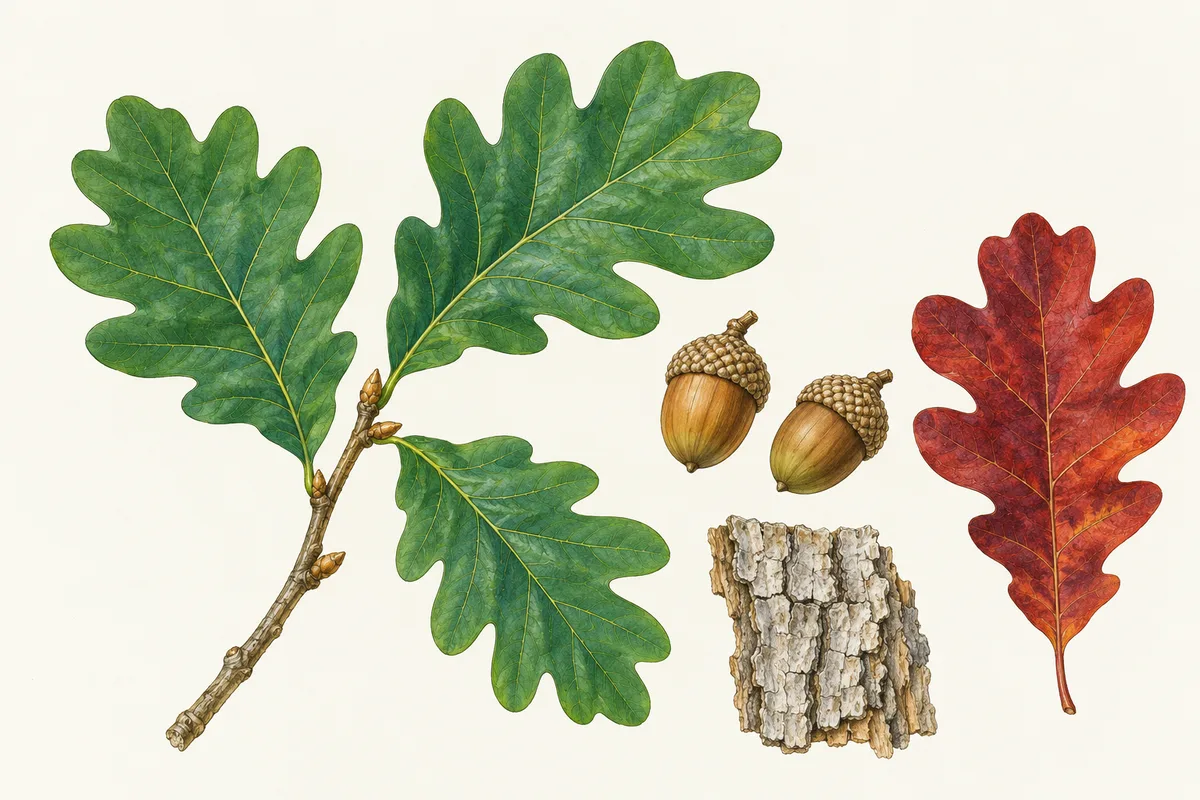
Rounded lobes with no bristle tips, a warty acorn cap that covers about a quarter of the nut, and pale, scaly bark. Here is the order to check them in.
In short
White oak tree identification starts with the leaf: 4 to 7 inches long, with 7 to 10 rounded, finger-like lobes, no bristle tips and a whitish underside. Confirm with the acorn, about 1 inch long, its warty bowl-shaped cap covering roughly a quarter of the nut, and with whitish to ashy-gray bark that breaks into scales or loose plates. Quercus alba grows wild across eastern North America.
- No bristle tips on the lobes: that alone puts the tree in the white oak group, not the red oak group.
- The acorn ripens in a single season and drops in early fall; the cap comes off cleanly.
- Bur, post and swamp white oak are the usual look-alikes, and white oak hybridizes with all three.
Field marks at a glance
- Scientific name
- Quercus alba
- Family
- Fagaceae (beech family)
- Type
- Broadleaf, deciduous
- Leaves
- Alternate, simple, 4 to 7 inches long, with 7 to 10 rounded, finger-like lobes and no bristle tips; sinuses deep to shallow; green to blue-green above, whitish below.
- Acorns
- Ovoid to oblong, about 1 inch long; warty, bowl-shaped cap covers about 1/4 of the nut and comes off at maturity. Ripens in one season, early fall.
- Bark
- Whitish or ashy gray; scaly on young stems, irregularly platy or blocky on large trunks. Old trees often show smooth patches.
- Twigs and buds
- Red-brown to gray, hairless, often shiny. End buds clustered, small, rounded and hairless.
- Form and size
- Often 80 to 100 ft tall in forests (record 150 ft); 50 to 80 ft in landscapes. Open-grown trees have a wide, rugged crown on a stocky trunk.
- Native range
- Eastern North America: southwestern Maine and southern Quebec west to southeastern Minnesota, south to eastern Kansas, Oklahoma and Texas, east to northern Florida.
- Habitat
- Upland slopes, ridges, coves and sandy plains on well-drained soil; generally not on wet bottomland. USDA hardiness zones 3 to 9.
- Fall color
- Wine red to purplish red; new spring leaves open pinkish.
- Lifespan
- Long-lived: trees of 600 years have been recorded. Purdue gives 300 or more years in good conditions, about 150 under urban stress.
White oak (Quercus alba) is one of the most widespread large trees of eastern North America and the reference point for a whole group of oaks. You can identify it in three checks, in this order: the leaf lobes, the acorn, then the bark. The buds take over in winter.
What to check first: lobes, then acorn, then bark
1. The leaf lobes. Pick several leaves from the sunlit part of the crown. A white oak leaf is 4 to 7 inches long and has 7 to 10 rounded, finger-like lobes with no bristle at the tip, according to the Virginia Tech Dendrology fact sheet. The sinuses between the lobes vary from deep to shallow, the base is wedge-shaped, and the underside is whitish. Ohio State's Woody Plants of Ohio counts 6 to 12 lobes, about equal in depth and width. Run your thumb along the edge: if every lobe is blunt and smooth, you are in the white oak group.
2. The acorn. Look on the ground in early fall. White oak acorns are ovoid to oblong, about 1 inch long (The Morton Arboretum). The cap is warty and bowl-shaped, covers about a quarter of the nut and comes away cleanly at maturity. Acorns ripen in a single season, so in summer you will find only this year's small green acorns on the twigs, never a second, older size class.
3. The bark. White oak bark is whitish or ashy gray: scaly on small stems, then irregularly platy or blocky on large trunks. Old trees often have smooth patches; Morton notes these come from a harmless fungus called smooth patch.
In winter, look at the twig tips. Oaks carry a cluster of end buds; on white oak they are small, rounded, red-brown and hairless, and Ohio State notes that white oak group buds are blunt where red oak group buds are sharp-pointed.
If the leaves are 60 feet up and none have fallen yet, a photo of the bark or of an acorn on the ground is enough to get a name from Tree Identifier. The app shows no confidence score and no list of look-alikes, so check its answer against the three marks above before you trust it.
White oak through the seasons
- Spring: leaves open pinkish (Morton) at the same time as the flowers. Male flowers hang in yellow-green catkins 2 to 4 inches long; the reddish female flowers are tiny and easy to miss.
- Summer: leaves turn green to blue-green above and stay pale beneath. Young acorns sit singly or in pairs on short stalks.
- Fall: leaves turn wine red (Morton) to purplish red. Acorns mature about 120 days after pollination and drop in September or October, then germinate almost immediately, putting down a root before winter, according to the USDA Forest Service.
- Winter: clustered, rounded red-brown buds at the twig tips and pale, scaly bark carry the identification.
Acorn years are uneven. The Forest Service's Silvics of North America reports good crops only every 4 to 10 years, and individual trees tend to stay either good or poor producers from year to year.
Where white oak grows
White oak grows throughout most of the eastern United States: from southwestern Maine and extreme southern Quebec west to southern Ontario, central Michigan and southeastern Minnesota; south to western Iowa, eastern Kansas, Oklahoma and Texas; and east to northern Florida and Georgia (USDA Forest Service). It is generally absent from the high Appalachians, the Delta of the lower Mississippi and the coastal areas of Texas and Louisiana.
Within that range it grows on sandy plains, gravelly ridges, rich uplands and coves, on every upland slope position except extremely dry, shallow ridges. The Forest Service says it avoids poorly drained flats and wet bottomland and is sensitive to flooding, though Ohio State quotes E. Lucy Braun's Woody Plants of Ohio listing wet flats among its Ohio habitats. The Forest Service names the west slopes of the Appalachians and the Ohio and central Mississippi valleys as its best growing conditions. Common neighbors are other oaks and hickories, yellow-poplar, American beech and sugar maple.
The Morton Arboretum lists it for USDA hardiness zones 3 to 9, and it is the state tree of Illinois. Planted white oaks turn up outside the native range, so a range map alone can't rule it in or out.
White oak vs the red oak group
The oaks of eastern North America fall into two groups, and white oak gives its name to the first. Northern red oak, from the second, is a frequent neighbor: the Forest Service lists a White Oak–Black Oak–Northern Red Oak forest type. These marks, from Virginia Tech's white oak and northern red oak fact sheets and Ohio State's dendrology notes, tell the two apart:
| Feature | White oak | Northern red oak |
|---|---|---|
| Lobe tips | Rounded, no bristle | Bristle-tipped |
| Leaf | 4–7 in, 7–10 lobes, whitish below | 5–8 in, 7–11 lobes, sinuses 1/3 to 1/2 of the way to the midvein |
| Acorn cap | Warty bowl, covers about 1/4 | Flat, thick "beret", covers 1/4 or less |
| Acorn maturity | One season | Two seasons |
| Inside of the nut shell | Hairless | Lined with hairs |
| End buds | Small, rounded, blunt | Large, conical, sharp-pointed |
| Bark | Whitish to ashy gray, scaly to platy | Darker, flat-topped ridges like ski tracks |
The shell test needs a cracked acorn, but it works even when the leaves are gone. The acorn-maturity test works in summer: a red oak group tree carries two sizes of acorns on its twigs (this year's tiny ones and last year's nearly ripe ones), a white oak only one.
How old is that white oak
White oak is the worked example in Purdue University's How Old Is My Tree?: measure the trunk's circumference at 4.5 feet, divide by 3.14 to get the diameter, then multiply by the species' growth factor, which is 5.0 for white oak.
- Circumference 70 inches ÷ 3.14 = about 22 inches in diameter.
- 22 × 5.0 = about 110 years for a woodland tree.
- For a yard, park or street tree, Purdue's arborist deducts about 25 percent, an anecdotal rule: about 83 years.
The tree age calculator runs the same method with the same Purdue factor and shows both ends of that range. Treat the answer as an estimate: Purdue calls it "a very rough estimate" because water, soil, competition and stress change growth rates, and the Forest Service notes that white oak is slow-growing compared with northern red oak or black oak.
Why white oak matters
Wildlife. The Forest Service calls the acorns an important food for many kinds of wildlife; more than 180 kinds of birds and mammals eat oak acorns, among them squirrels, blue jays, red-headed woodpeckers, deer, wild turkey, quail and raccoons. Deer also browse white oak twigs and foliage.
Wood. White oak is the most important lumber tree of the white oak group. Its wood makes tight barrel staves, which is why it is also called stave oak.
Longevity. White oaks often reach 80 to 100 feet and 3 to 4 feet in diameter; individual trees 150 feet tall, 8 feet in diameter and 600 years old have been recorded. White oak is also less susceptible to oak wilt than the red oak group, and may lose only a limb at a time.
If you want to come back to a particular tree, for its acorns in a mast year or its fall color, Tree Identifier's Tree Map pins every located identification so you can find it again. For the full field method that works on any tree, see how to identify trees.
Look-alikes and how to tell them apart
Bur oak (Quercus macrocarpa)
Bur oak's leaf is longer (6 to 12 inches), wider near the tip and nearly cut in half by two deep middle sinuses. Its acorn is larger, about 1 1/2 inches, and half enclosed in a cap with a long fringe. Twigs often carry corky ridges.
Post oak (Quercus stellata)
Post oak leaves are leathery, with lobes that form a cross shape, and their surface carries star-shaped (stellate) hairs: use a hand lens. White oak leaves are not leathery, have fairly even lobes and no stellate hairs.
Swamp white oak (Quercus bicolor)
Swamp white oak leaves are coarsely toothed, without the deep sinuses of white oak, and velvety to the touch beneath. Its acorns hang on long stalks, 2 to 7 cm (about 1 to 3 inches). It is a tree of wetlands; white oak is sensitive to flooding.
Northern red oak (Quercus rubra)
Each lobe of a northern red oak leaf ends in a bristle tip. The acorn has a flat, beret-like cap and takes two seasons to mature. The bark shows flat-topped ridges like ski tracks, darker than white oak's pale scales.
What a photo can't settle
- White oak hybridizes with other oaks in its group: the USDA Forest Service lists seven named hybrids, including crosses with bur, swamp white, post and chestnut oak. A single leaf, or a single photo of one, can't settle a hybrid.
- Shade leaves and leaves on young trees may not show the typical lobing of sunlit leaves (Vanderbilt's oak key warns of this), so collect leaves from the sunlit crown before deciding.
- Good acorn crops come only every 4 to 10 years, so in many seasons the acorn test isn't available and the leaves, buds and bark have to carry the identification.
Questions people ask
What does a white oak tree look like?
A large tree, often 80 to 100 feet tall in forests, with pale whitish to ashy-gray scaly bark. Its leaves are 4 to 7 inches long with 7 to 10 rounded lobes and no bristle tips. In the open it grows a wide, rugged crown on a short, stocky trunk.
How do I tell a white oak from a red oak?
Look at the lobe tips: white oak lobes are rounded, red oak lobes end in bristles. Then check the acorn: white oak's matures in one season and the inside of its shell is hairless, while red oak acorns take two seasons and have a hairy shell lining. Red oak bark is darker, with ski-track ridges.
How can I tell how old a white oak tree is?
Measure the trunk's circumference at 4.5 feet, divide by 3.14 for the diameter in inches, and multiply by white oak's growth factor of 5. Purdue's example: 70 inches around gives 22 inches across and about 110 years. For a yard or park tree, Purdue's arborist deducts about 25 percent.
Do white oaks produce acorns every year?
Not reliably. The USDA Forest Service reports that good white oak acorn crops are irregular, coming only every 4 to 10 years, and several years can pass without a crop. Individual trees also tend to be consistently good or poor producers.
Are white oak trees worth money?
White oak is the most important lumber tree of the white oak group, prized for barrel staves, which is why it is also called stave oak. What a particular tree is worth depends on its size, trunk quality and local markets; a consulting forester can give a real figure.
Sources
- White oak fact sheet — Virginia Tech Dendrology
- White Oak (Quercus alba), Silvics of North America — USDA Forest Service
- White oak (Quercus alba) — The Morton Arboretum
- White oak (Quercus alba) — Woody Plants of Ohio, companion to ENR 3321 (Ohio State University course)
- Northern red oak fact sheet — Virginia Tech Dendrology
- Bur oak fact sheet — Virginia Tech Dendrology
- Oak illustrated key — Bioimages, Vanderbilt University
- How Old Is My Tree? (Purdue Landscape Report, Issue 18-04) — Purdue University