Tree comparison
Red oak vs white oak trees: how to tell the living trees apart
Bristle tips or rounded lobes, a beret or a warty bowl on the acorn, ski-track ridges or pale scales on the trunk. Here is the order to check them in.
In short
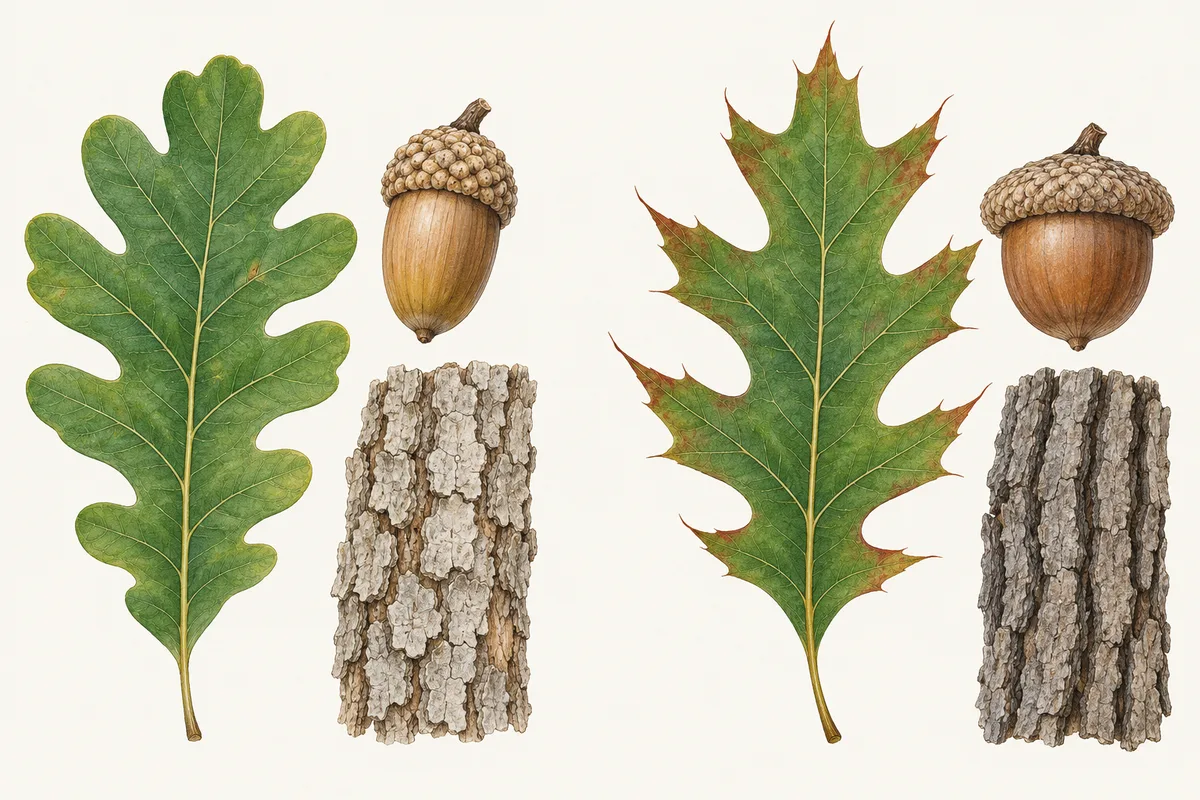
Red oak vs white oak, on the living tree, comes down to the lobe tips: northern red oak lobes end in bristles, white oak lobes are rounded with no bristle. Confirm with the acorn: red oak's has a flat, beret-like cap and takes two seasons to ripen, white oak's sits in a warty bowl and ripens in one. Red oak bark shows flat-topped ridges; white oak bark is pale and scaly.
- Bristle-tipped lobes mean red oak; rounded lobes with no bristle mean white oak.
- Crack an acorn: the shell is lined with hairs in red oaks and smooth inside in white oaks.
- In summer a red oak carries two sizes of acorn on its twigs; a white oak carries one.
Field marks at a glance
- Scientific name
- Quercus rubra and Quercus alba
- Family
- Fagaceae (beech family)
- Type
- Broadleaf, deciduous
- Lobe tips
- Red oak: each lobe ends in a bristle. White oak: lobes rounded, no bristle.
- Leaf size and lobes
- Red oak: 5 to 8 inches, 7 to 11 lobes, sinuses 1/3 to 1/2 of the way to the midvein. White oak: 4 to 7 inches, 7 to 10 finger-like lobes, sinuses deep to shallow, whitish below.
- Acorn cap
- Red oak: flat, thick cap like a beret, covering 1/4 of the nut or less. White oak: warty bowl covering about 1/4, detaching at maturity.
- Acorn ripening
- Red oak: two growing seasons, ripening late August to late October. White oak: one season, dropping in early fall.
- Inside the shell
- Red oak group: lined with hairs. White oak group: hairless.
- End buds
- Red oak: large, conical, red-brown, pointed. White oak: small, rounded, red-brown, blunt.
- Bark
- Red oak: dark gray with wide, flat-topped ridges like ski tracks. White oak: whitish to ashy gray, scaly to platy, often with smooth patches.
- Fall color
- Red oak: russet-red to bright red. White oak: wine red to purplish red.
Red oak and white oak are the two most familiar oaks of eastern North America, and each gives its name to a whole group of species. This page compares the living trees, northern red oak (Quercus rubra) and white oak (Quercus alba), mark by mark, in the order that settles it fastest: the lobe tips, the acorn, then the buds and bark.
Red oak vs white oak, side by side
Pick several leaves from the sunlit part of the crown and run your thumb along the lobe tips. That single check sorts most trees. The rest of the table confirms it. Figures are from Virginia Tech Dendrology's fact sheets for northern red oak and white oak, with the shell-lining test from Ohio State's Woody Plants of Ohio.
| Feature | Northern red oak | White oak |
|---|---|---|
| Lobe tips | End in a bristle | Rounded, no bristle |
| Leaf length | 5–8 in | 4–7 in |
| Number of lobes | 7–11 | 7–10 |
| Sinus depth | 1/3 to 1/2 of the way to the midvein, very uniform | Deep to shallow, varies |
| Underside of leaf | Paler | Whitish |
| Acorn | 3/4–1 in, nearly round | About 1 in, ovoid to oblong |
| Acorn cap | Flat, thick "beret", covers 1/4 or less | Warty bowl, covers about 1/4 |
| Ripening | Two growing seasons | One growing season |
| Inside the shell | Lined with hairs | Hairless |
| End buds | Large, conical, pointed | Small, rounded, blunt |
| Bark | Flat-topped ridges, shallow furrows like ski tracks | Whitish to ashy gray, scaly to platy |
| Fall color | Russet-red to bright red | Wine red to purplish red |
| Height | Up to 90 ft | Up to 100 ft in forests |
The acorn sizes come from The Morton Arboretum's pages for northern red oak and white oak, which also give the fall colors.
Leaves: bristle tips and sinus depth
The bristle is a short, stiff point at the end of each lobe, easy to feel even when it is hard to see in a photo. Every lobe of a northern red oak leaf has one. White oak lobes are blunt and finger-like, and the Ohio State course notes put it in one line: white oak group leaves are bluntly lobed, red oak group leaves bristle-tipped.
Sinus depth helps tell northern red oak from its own relatives. Its sinuses reach only a third to halfway to the midvein and the leaf is very uniform from one to the next. A red oak group tree with sinuses cut almost to the midrib is more likely pin oak or scarlet oak; the oak page has a table of the common US species.
Acorns: cap, ripening time and the shell lining
Acorns carry three separate tests.
The cap. Northern red oak's cap is flat and thick and sits on top of a nearly round nut like a beret. White oak's cap is a warty bowl that covers about a quarter of the nut and comes off cleanly at maturity.
The ripening time. Red oak group acorns take two growing seasons to mature, and the USDA Forest Service's Silvics of North America puts northern red oak's ripening between late August and late October, depending on location. White oak acorns ripen in a single season. In summer this gives a test you can do from the twigs: a red oak carries this year's tiny acorns and last year's nearly full-sized ones at the same time, a white oak only one size.
The shell lining. Crack an acorn open. In red oaks the inside of the shell is lined with hairs; in white oaks it is smooth. This works on a fallen acorn in any season.
Buds and bark: the winter test
When the leaves are down, look at the cluster of buds at the twig tips. Northern red oak's are quite large, conical and covered in red-brown, mostly hairless scales. White oak's are small, rounded and blunt. The Ohio State notes generalize this to the groups: white oak group buds are blunt, not sharp-pointed.
The bark gives a second winter check. Northern red oak develops wide, flat-topped ridges separated by shallow furrows; Virginia Tech compares the pattern to ski tracks. White oak bark is whitish or ashy gray and breaks into scales or loose plates; old trees often show smooth patches. For more on reading twigs and buds once the leaves have fallen, the winter tree identification guide covers other common trees.
If the buds are out of reach, a photo of the bark in Tree Identifier gives a name; use the ridge-and-scale test above to check whether it said red or white for the right reason.
Growth, range and where each grows
Growth rate. Northern red oak is the faster grower. The Forest Service describes it as moderate to fast growing, with average diameter growth of about 0.2 inch a year in the Central States. Its white oak account reports white oak's 10-year diameter growth at 1.2 to 1.8 inches, slower than northern red, scarlet or black oak, and notes that white oak is less favored as an ornamental partly because of its slow growth.
Range. Both cover most of the East and often share a stand; the Forest Service names a White Oak–Black Oak–Northern Red Oak forest type. Northern red oak is the only native oak that reaches Nova Scotia, and its range runs west to Minnesota, eastern Nebraska and Oklahoma. White oak reaches Texas and northern Florida, which fall outside northern red oak's range.
Site. White oak avoids poorly drained flats and wet bottomland. Northern red oak grows on a wide variety of soils and slopes, and its seedlings are less drought tolerant than white or black oak seedlings.
Red oak vs white oak wood, in one paragraph
Most searches for this pair are about lumber, and the difference starts in the tree. University of Kentucky extension forester Laurie Taylor Thomas, in "Oaks of Kentucky", explains that the summerwood vessels of white oak wood contain tyloses, which plug them, while red oak's larger vessels do not. That is why white oak is used for "tight" cooperage, barrels that hold liquids such as bourbon without leaking. For grading, pricing or flooring choices, ask a forester or a lumber dealer.
To estimate how old either tree is from its trunk, the tree age calculator uses species growth factors.
Look-alikes and how to tell them apart
Black oak (Quercus velutina)
A red oak group tree often mistaken for northern red oak. Its end buds are 1/4 to 1/2 inch long, buff-colored, fuzzy and angled, its bark nearly black and deeply furrowed with horizontal breaks, and its inner bark yellow-orange. Northern red oak buds are mostly hairless.
Pin oak (Quercus palustris)
Also red oak group, but its sinuses reach nearly to the midrib, its acorn is only about 1/2 inch with a thin saucer cap, and its bark stays smooth and gray for many years. The tree is pyramid-shaped with drooping lower branches.
Bur oak (Quercus macrocarpa)
A white oak group tree with a much larger leaf, 6 to 12 inches, nearly cut in half by two deep middle sinuses, and a 1 1/2-inch acorn half enclosed in a fringed cap.
Post oak (Quercus stellata)
White oak group, with bark very like white oak's. Its thick leaves have five lobes, the middle two square, forming a cross, and star-shaped hairs on the surface.
What a photo can't settle
- Northern red oak hybridizes readily with other red oaks, including pin, black, willow and Shumard oak (USDA Forest Service), and white oak with other white oaks. A hybrid can blur the species marks on this page, although the group marks usually hold.
- Shade leaves and leaves on young trees are often shallow-lobed and atypical, so judge sinus depth on sunlit leaves from the outer crown.
- A photo app, Tree Identifier included, returns one name with no confidence score. When the photo shows only bark, check the buds or an acorn before trusting a red-or-white call.
Questions people ask
Do red oaks or white oaks grow faster?
Red oaks. The USDA Forest Service calls northern red oak moderate to fast growing and reports white oak growing more slowly than northern red, scarlet and black oak in Central States forest data. The Morton Arboretum rates northern red oak one of the faster-growing oaks for home landscapes and white oak moderate to slow.
What is the difference between red oak and white oak acorns?
Red oak acorns are 3/4 to 1 inch long under a flat, beret-like cap, take two seasons to ripen and have a hairy lining inside the shell. White oak acorns are about 1 inch long in a warty bowl covering about a quarter of the nut, ripen in one season and are smooth inside.
How do you identify a red oak tree?
Look for leaves 5 to 8 inches long with 7 to 11 bristle-tipped lobes and sinuses reaching a third to halfway to the midvein, acorns with a flat beret cap, large pointed end buds, and dark bark with flat-topped ridges like ski tracks. Black, pin and scarlet oak are the red oak group look-alikes.
Can you tell red oak from white oak in winter?
Yes. Check the end buds: large, conical and pointed on red oak, small, rounded and blunt on white oak. Then the bark, dark with flat-topped ridges on red oak, pale and scaly on white oak. Fallen leaves and acorn caps under the tree usually settle it.
Which is more common, red oak or white oak?
Both are widespread in the East and often grow together: the USDA Forest Service lists a White Oak–Black Oak–Northern Red Oak forest type. Northern red oak reaches farther north and is the only native oak extending to Nova Scotia; white oak reaches Texas and northern Florida.
Sources
- Northern red oak fact sheet — Virginia Tech Dendrology
- White oak fact sheet — Virginia Tech Dendrology
- Northern Red Oak (Quercus rubra), Silvics of North America — USDA Forest Service
- White Oak (Quercus alba), Silvics of North America — USDA Forest Service
- White oak (Quercus alba) — Woody Plants of Ohio, companion to ENR 3321 (Ohio State University course)
- Northern red oak (Quercus rubra) — The Morton Arboretum
- White oak (Quercus alba) — The Morton Arboretum
- Oaks of Kentucky (Kentucky Woodlands Magazine, Vol. 15, Issue 1) — University of Kentucky Cooperative Extension, Dept. of Forestry and Natural Resources