Tree profile
Oak trees (Quercus): how to identify them
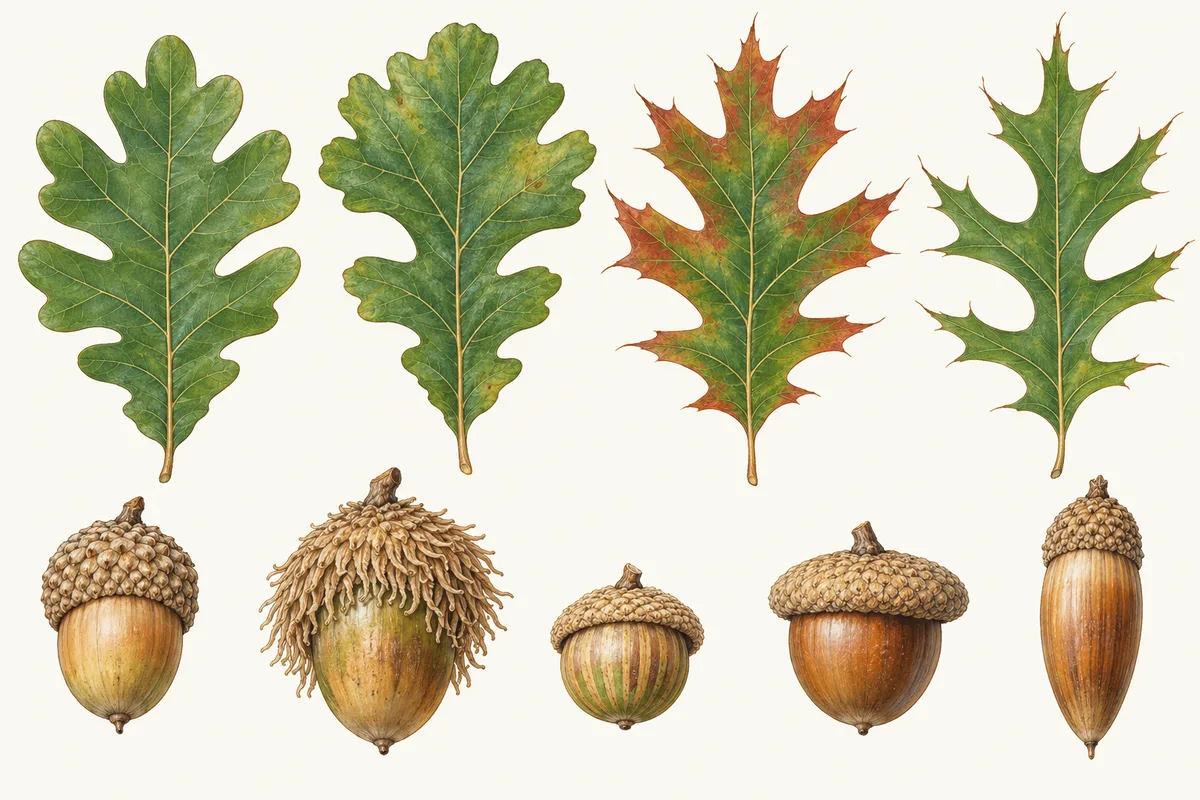
Every oak carries acorns and a cluster of buds at the twig tip. Sort it into the red or white oak group first, then the species is usually two or three checks away.
In short
Oak tree identification starts with two marks every oak shares: acorns, and a cluster of buds at the tip of each twig among alternate leaves. Then sort the tree into a group by the lobe tips: bristle-tipped lobes mean the red oak group, rounded lobes the white oak group. Acorn size, how much of the nut the cap covers, and the bark narrow it to a species.
- Bristle tips on the lobes put a tree in the red oak group; rounded, bristle-free lobes put it in the white oak group.
- White oak group acorns ripen in one season and have a hairless shell lining; red oak group acorns take two seasons and are hairy inside.
- The United States has 60 to 70 native oak species, so the group key comes first and the species second.
Field marks at a glance
- Scientific name
- Quercus
- Family
- Fagaceae (beech family)
- Type
- Broadleaf, deciduous
- Genus marks
- Alternate, simple leaves that crowd toward the twig tips; a cluster of end buds at each twig tip; the fruit is an acorn, a nut sitting in a scaly cap.
- Leaves
- Most eastern US oaks have lobed leaves. Willow oak and shingle oak have narrow, unlobed leaves; chestnut and swamp white oak have wavy or blunt teeth instead of lobes.
- Red oak group
- Lobes (or the leaf tip) end in bristles; acorns take two seasons to mature; inside of the shell is hairy; end buds usually pointed.
- White oak group
- Lobes rounded, no bristles; acorns mature in one season; inside of the shell is hairless; end buds blunt and rounded.
- Acorns
- From about 1/4 inch across (willow oak) to about 1 1/2 inches long (bur oak, chestnut oak). Cap coverage runs from a thin saucer to half the nut.
- Bark
- White oak group: pale ashy gray, scaly or platy. Red oak group: darker, from smooth gray (pin oak) to flat-topped ridges (northern red) or near-black blocks (black oak).
- Leaf habit
- Most US oaks are deciduous. Southern live oak is evergreen, with leathery leaves 2 to 5 inches long and edges rolled under.
- US species
- 60 to 70 native to the United States, out of 200 to 300 oak species worldwide (University of Kentucky Extension).
- In the app's Collection
- White oak, northern red oak, English oak, southern live oak and cork oak.
Oaks (Quercus) are the trees most people mean when they ask "what tree is this" in an eastern US woodland. The University of Kentucky's extension foresters count 60 to 70 species native to the United States, so the fastest route is a two-step key: first decide that it is an oak, then sort it into the red or white oak group, then match the species.
The two-step oak key: is it an oak, then which group
Step 1: is it an oak. Look at the twig tip. Oaks carry a cluster of end buds there, and their alternate leaves crowd toward the tip because the upper internodes are very short, as Ohio State's Woody Plants of Ohio course notes. The fruit, an acorn sitting in a cap made of a tight spiral of scales, confirms it. Most eastern US oaks have lobed leaves, but not all: willow oak and shingle oak have narrow, unlobed leaves.
Step 2: red oak group or white oak group. Run your thumb along the leaf edge.
| Check | Red oak group | White oak group |
|---|---|---|
| Lobe tips | End in a bristle | Rounded, no bristle |
| Acorn maturity | Two growing seasons | One growing season |
| Inside of the acorn shell | Hairy lining | Hairless |
| End buds | Usually sharp-pointed | Blunt, rounded |
| Bark | Darker; ridged or smooth | Pale ashy gray; scaly or platy |
Ohio State and the University of Kentucky's "Oaks of Kentucky" give the same split: bristle-tipped lobes, two-season acorns and a hairy shell lining for the red oaks; blunt lobes, one-season acorns and a hairless lining for the white oaks. The acorn-maturity test works in summer, before anything falls: a red oak group tree carries two sizes of acorn on its twigs (this year's tiny ones and last year's nearly ripe ones), a white oak group tree only one.
The full side-by-side for the two flagship species is on red oak vs white oak.
Common US oaks and their field marks
Once you know the group, these marks from the Virginia Tech Dendrology fact sheets (for example northern red oak, bur oak and live oak) narrow it to a species. Leaf lengths are typical sun leaves.
| Oak | Group | Leaf | Best field mark |
|---|---|---|---|
| White oak (Q. alba) | White | 4–7 in, 7–10 rounded lobes, whitish below | Whitish to ashy-gray scaly bark |
| Bur oak (Q. macrocarpa) | White | 6–12 in; two middle sinuses nearly reach the midrib | Fringed acorn cap; corky ridges on twigs |
| Swamp white oak (Q. bicolor) | White | 3–7 in, large blunt teeth, very pale below | Acorns on a stalk about 2 in long |
| Post oak (Q. stellata) | White | 5 lobes, the middle two square, forming a cross; thick | Star-shaped hairs on the leaf surface |
| Chestnut oak (Q. montana) | White | 4–6 in, wavy rounded teeth | Hard, thick, sharp-topped bark ridges |
| Northern red oak (Q. rubra) | Red | 5–8 in, 7–11 bristle lobes, sinuses 1/3–1/2 to the midvein | Flat-topped bark ridges like ski tracks |
| Pin oak (Q. palustris) | Red | 3–6 in, 5–9 lobes, sinuses nearly to the midrib | Pyramid shape; lower branches droop |
| Black oak (Q. velutina) | Red | 4–10 in, mostly 5–7 lobes, scruffy hairs below | Buff, fuzzy, angled buds 1/4–1/2 in; yellow-orange inner bark |
| Scarlet oak (Q. coccinea) | Red | 3–7 in, very deep sinuses, shiny | Concentric rings at the acorn tip |
| Willow oak (Q. phellos) | Red | 2–5 in, narrow, smooth-edged, bristle tip | Leaf looks like a willow's |
| Southern live oak (Q. virginiana) | — | 2–5 in, evergreen, leathery, edges rolled under | Crown up to 150 ft across on old open-grown trees |
Virginia Tech gives southern live oak's leaf as "generally not bristle-tipped" and its acorn as maturing in the first year; it is evergreen, the one tree in this table that keeps its leaves through winter. Pin oak and scarlet oak are the classic confusion pair: Vanderbilt University's oak illustrated key separates them by the buds (scarlet oak's are hairy on the upper half, pin oak's are not) and the acorn rings.
For white oak's full profile, with seasons, range and age, see the white oak page.
Oak identification by acorn
In fall, acorns on the ground are often easier to reach than the leaves. Check three things: length, how much of the nut the cap covers, and what the cap looks like. All figures are from the Virginia Tech fact sheets.
| Oak | Acorn length | Cap covers | Cap look | Matures in |
|---|---|---|---|---|
| White oak | — | About 1/4 | Warty bowl, detaches at maturity | 1 season |
| Bur oak | About 1 1/2 in | About 1/2 | Warty, with a long fringe on the rim | 1 season |
| Swamp white oak | About 1 in | About 1/3 | Bowl, on a stalk about 2 in long | — |
| Post oak | 1/2–2/3 in | 1/3–1/2 | Warty bowl, scales more visible than white oak's | 1 season |
| Chestnut oak | 1–1 1/2 in | — | Thin, warty teacup with very thin edges | 1 season |
| Northern red oak | 3/4–1 in | 1/4 or less | Flat, thick "beret" | 2 seasons |
| Pin oak | About 1/2 in | Thin saucer | Red-brown scales; nut striped | 2 seasons |
| Black oak | 1/2–3/4 in | 1/3–1/2 | Loose, fuzzy, light-brown scales | 2 seasons |
| Scarlet oak | 1/2–1 in | About 1/2 | Shiny scales; rings at the nut's tip | 2 seasons |
| Willow oak | 1/4–1/2 in across | About 1/4 | Thin saucer | — |
| Southern live oak | About 3/4 in, dark | About 1/3 | Warty bowl; acorns in clusters of 3 to 5 | 1 season |
A dash means the fact sheet does not state it. Cracking an acorn open settles the group even when the leaves are gone: a hairy lining inside the shell is red oak group, a smooth one white oak group.
Oak identification by bark and in winter
Bark separates the groups more easily than it separates species. White oak group bark is pale: ashy gray and scaly on white, bur and post oak. Red oak group bark is darker. Northern red oak develops wide, flat-topped ridges with shallow furrows that Virginia Tech compares to ski tracks; black oak becomes thick and nearly black, and a cut through it shows yellow-orange inner bark; pin oak stays gray-brown, tight and smooth for many years.
In winter, go to the twig tips. Every oak has clustered end buds. White oak's are small, rounded and red-brown; northern red oak's are large and conical; black oak's are the giveaway, 1/4 to 1/2 inch long, buff-colored, fuzzy and angled. Look on the ground under the tree too: a fallen leaf gives you the lobe test, and an old acorn cap the cap test.
If the leaves are out of reach, a photo of the bark or of an acorn on the ground is enough for Tree Identifier to give a name. Treat that name as a starting point and run it through the group key above.
Oaks in the Tree Identifier Collection
Tree Identifier's Collection, the 138-species catalog that fills in as you identify, includes five oaks: white oak (Quercus alba), northern red oak (Q. rubra), English oak (Q. robur), southern live oak (Q. virginiana) and cork oak (Q. suber). English oak turns up in American parks and yards, but The Morton Arboretum describes it as native to Europe and southwestern Asia, with lobed leaves 2 to 5 inches long, an earlobe-like base, and 1-inch acorns in a warty cap on a long stalk. Those earlobes at the leaf base, and the long acorn stalk, are the quickest way to tell it from a native white oak.
Oaks of Britain and Ireland. In Britain and Ireland, English oak is one of two native oaks; the other is sessile oak (Q. petraea). Both have lobes without bristle tips, and they swap their stalks: English (pedunculate) oak has acorns on long stalks and almost stalkless leaves, sessile oak has stalkless acorns and leaves on longer stalks. Forest Research describes English oak as dominant in southern, eastern and central England and sessile oak as more prominent in the west, Wales, Scotland and Ireland. The two hybridize, so check several leaves; the full key is on English oak vs sessile oak.
Oaks also live long enough that age questions come up. The tree age calculator estimates age from trunk circumference with species growth factors. For a full method that works on any tree, not just oaks, see how to identify trees.
Why oaks are worth knowing
Oaks are a foundation of eastern forests. The USDA Forest Service's Silvics of North America calls white oak the most important lumber tree of its group and its acorns an important food for many kinds of wildlife, and the University of Kentucky reports that oaks and hickories make up about 75 percent of Kentucky's forests, that oaks host more than 530 species of caterpillars, and that acorns feed more than 100 US vertebrate species, among them blue jays, wild turkey, wood ducks, squirrels and deer. The two groups also matter for wood: white oak wood has its pores plugged by tyloses, which is why it makes watertight barrels, while red oak wood does not.
Look-alikes and how to tell them apart
Maples (Acer)
Maple leaves are lobed too, but they grow in opposite pairs, their lobes spread from one point like fingers on a hand, and the fruit is a winged samara. Oak leaves are alternate, veined along a central midrib, and the fruit is an acorn.
Chinkapin oak (Quercus muehlenbergii) vs chestnut oak
Both have toothed, unlobed leaves. Vanderbilt's oak key: chestnut oak's teeth are rounded, its acorn is over 1 inch long and its bark deeply furrowed; chinkapin oak's teeth are gland-tipped, its acorn under 1 inch and its bark thin and flaky.
Shingle oak (Quercus imbricaria) vs willow oak
Both have smooth-edged, unlobed leaves. Measure the width: shingle oak's leaf is wider than 1 inch and hairy underneath; willow oak's is narrower than 1 inch and hairless, or hairy only along the midvein.
What a photo can't settle
- Oaks hybridize within their group: the USDA Forest Service names seven hybrids of white oak alone, with bur, swamp white, post and chestnut oak among the partners. A hybrid can carry a mix of both parents' marks, and neither a single leaf nor a single photo can settle it.
- Shade leaves and leaves on young trees often lack the typical lobing, so a leaf picked low on a seedling may point to the wrong species. Collect from the sunlit crown.
- A photo app returns one name, and Tree Identifier shows no confidence score and no list of alternatives, so check its answer against the group key on this page.
Questions people ask
How do I tell what kind of oak tree I have?
Work in two steps. First the group: bristle-tipped lobes mean red oak group, rounded lobes white oak group. Then the species: measure the leaf, count the lobes, check how deep the sinuses cut, and look at the acorn's size and cap. In winter, the end buds and bark carry the identification.
How do I identify a white oak tree?
Look for leaves 4 to 7 inches long with 7 to 10 rounded, finger-like lobes and no bristle tips, a warty bowl-shaped acorn cap covering about a quarter of the nut, and whitish to ashy-gray scaly bark. Virginia Tech lists overcup, bur and post oak as its look-alikes.
How do you identify young oak trees?
Use the twig: a cluster of buds at the tip and alternate leaves crowded near it. Leaf shape is less reliable, because Vanderbilt University's oak key warns that leaves on immature trees may not be typical for the species. The bristle-tip test still sorts a seedling into the red or white oak group.
Can you identify an oak tree by its bark?
Often to the group, sometimes to the species. White oak group bark is pale and scaly or platy. Northern red oak shows flat-topped ridges like ski tracks, black oak is nearly black with yellow-orange inner bark, and pin oak stays smooth and gray for many years. Confirm with a leaf or acorn.
How many kinds of oak trees are there in the US?
The University of Kentucky's extension foresters put it at 60 to 70 oak species native to the United States, out of 200 to 300 worldwide. Kentucky alone has about 20. Most eastern species fall into the red oak group or the white oak group.
Sources
- Oaks of Kentucky (Kentucky Woodlands Magazine, Vol. 15, Issue 1) — University of Kentucky Cooperative Extension, Dept. of Forestry and Natural Resources
- White oak (Quercus alba) — Woody Plants of Ohio, companion to ENR 3321 (Ohio State University course)
- Oak illustrated key — Bioimages, Vanderbilt University
- Northern red oak fact sheet — Virginia Tech Dendrology
- Bur oak fact sheet — Virginia Tech Dendrology
- Live oak fact sheet — Virginia Tech Dendrology
- White Oak (Quercus alba), Silvics of North America — USDA Forest Service
- English oak (Quercus robur) — The Morton Arboretum