Tree comparison
Sessile oak vs English oak: how to tell them apart
Britain's two native oaks swap their stalks: one has stalked acorns and almost stalkless leaves, the other the reverse. Check ten leaves, not one.
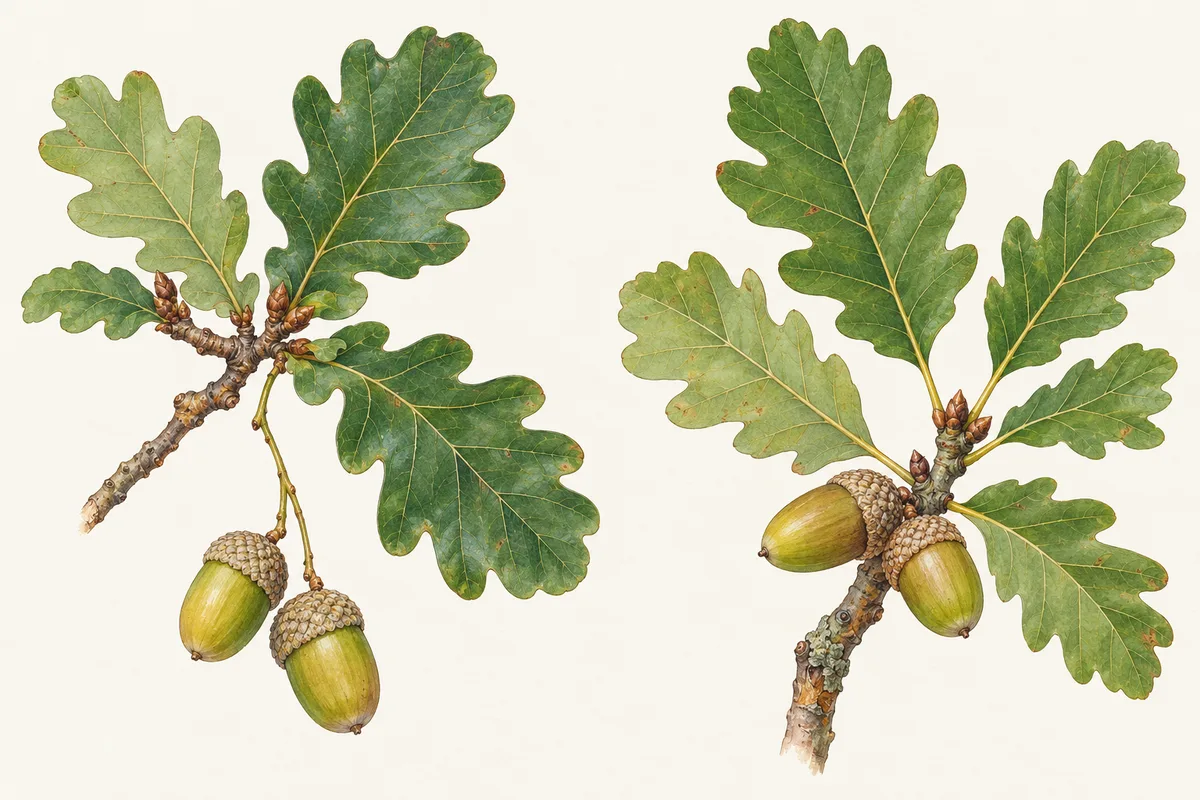
In short
Sessile oak vs English oak comes down to the stalks. English (pedunculate) oak has acorns on long stalks and leaves with tiny stalks, often under 10 mm, plus two small ear-like lobes at the leaf base. Sessile oak has acorns sitting directly on the twig and leaves on stalks usually over 10 mm, with a wedge-shaped base. The two hybridise, so check several leaves.
- The cross rule: English oak = short leaf stalk, long acorn stalk. Sessile oak = long leaf stalk, no acorn stalk.
- Leaf-stalk length and the veins running into the gaps between lobes are the two features Bavaria's forestry institute rates most reliable.
- Pedunculate oak dominates south, east and central England; sessile oak is more prominent in the west, Wales, Scotland and Ireland (Forest Research).
Field marks at a glance
- Scientific name
- Quercus robur and Quercus petraea
- Family
- Fagaceae (beech family)
- Type
- Broadleaf, deciduous
- Leaf stalk
- English oak 2–12 mm, sessile oak 8–32 mm (LWF). Field rule: under 10 mm (0.4 in) English oak, over 10 mm sessile oak.
- Acorn stalk
- English oak: acorns on long stalks, the origin of "pedunculate". Sessile oak: acorns attached directly to the twig, the meaning of "sessile".
- Leaf base
- English oak: usually two small ear-like lobes (auricles) either side of the stalk. Sessile oak: wedge-shaped, usually without them.
- Lobes and veins
- English oak: deep lobes, with numerous side veins running into the gaps between lobes. Sessile oak: shallower lobes, such veins rare.
- Leaf underside
- Sessile oak: always hairy underneath (use a hand lens). English oak: rarely hairy (LWF).
- Leaf arrangement
- English oak: leaves bunched at the shoot tips, usually lopsided. Sessile oak: spread more evenly along the shoot, usually symmetrical (LWF).
- Acorns
- English oak: 2–2.5 cm (about 1 in), usually cylindrical with dark lengthwise stripes. Sessile oak: usually rounder, without stripes.
- Form
- Both 20–40 m (65–130 ft). Sessile oak has a more upright trunk and straighter branches (Woodland Trust).
- In the app's Collection
- English oak (Quercus robur) is in Tree Identifier's Collection; sessile oak is not listed there.
English oak (Quercus robur) and sessile oak (Quercus petraea) are Britain's two native oaks, and at a glance they look the same: lobed leaves, acorns, rugged grey-brown bark. The difference is in the stalks, and it is easy to remember once you know that each tree is named after its acorns, not its leaves.
The four-point check
Collect at least ten leaves from one tree, ideally from the sunny side of the crown or freshly fallen directly under it. Then check, in this order:
1. The leaf stalk. Measure from the twig to where the leaf blade starts. Bavaria's forestry institute (LWF) gives 2 to 12 mm for English oak and 8 to 32 mm for sessile oak, and its inspectors use a simple cut-off in the field: under 10 mm is English oak, over 10 mm is sessile oak (LWF Wissen 75). The institute calls stalk length the most reliable single feature. The Woodland Trust puts it more simply: English oak has tiny or no leaf stalks.
2. The acorn stalk. From late summer, the acorns decide it. English oak acorns hang on long stalks, which is where the name pedunculate comes from. Sessile oak acorns sit directly on the twig: the Woodland Trust's sessile oak page explains that "sessile" means stalkless and refers to the acorns. Remember the cross rule: English oak has short leaf stalks and long acorn stalks; sessile oak has long leaf stalks and short acorn stalks.
3. The lobes and veins. Hold a leaf up to the light. On English oak the lobes are deep, and some side veins run into the bottom of a gap between lobes instead of out to a lobe tip. On sessile oak the lobes are shallower and such veins are rare. The LWF rates this feature, with the leaf stalk, as very reliable.
4. The ears. Look at the leaf base. English oak usually has two small, rounded lobes either side of the stalk, called auricles. Sessile oak tapers into the stalk in a wedge. The LWF calls this a useful extra, not a deciding feature, which is why it comes last.
If three or four points agree, the identification is sound in most cases.
Side by side
| Feature | English oak (Q. robur) | Sessile oak (Q. petraea) |
|---|---|---|
| Leaf stalk | 2–12 mm, often looks stalkless | 8–32 mm |
| Acorn stalk | Long | None or very short; acorns in clusters on the twig |
| Leaf base | Usually two ear-like lobes | Wedge-shaped, usually no ears |
| Lobes | Deep, veins run into the gaps | Shallower, veins end in the lobes |
| Leaf underside | Rarely hairy | Always hairy (hand lens) |
| Leaves on the shoot | Bunched at the tips, lopsided | Spread more evenly, symmetrical |
| Acorn shape | Usually cylindrical, dark stripes when fresh | Usually rounder, no stripes |
| Crown and trunk | Irregular, open crown; trunk splits early into big limbs | More regular crown; straighter trunk |
| Typical ground | Heavy, moist, richer soils | Light, well-drained soils, often hilly |
Leaf, acorn and crown rows come from the LWF's field table; soils from Forest Research and the LWF, which describes English oak as preferring wetter, more nutrient-rich ground. The Woodland Trust gives both species a height of 20 to 40 m (65 to 130 ft) and describes sessile oak as having a more upright trunk and straighter branches.
Where each one grows in Britain and Ireland
Geography gives you a head start before you pick up a leaf. Forest Research's sessile oak profile describes pedunculate oak as dominant in the south, east and central England, and sessile oak as prominent in the west of England, Wales, Scotland and Ireland, with a more westerly and upland range. The ranges overlap.
Soil follows the same pattern. Forest Research says sessile oak prefers light, well-drained but moist soils, tolerates slightly drier ground than pedunculate oak and is not suited to compacted or wet soils. The Woodland Trust notes it is commonly found in hilly regions. English oak, by contrast, is especially common in the deciduous woods of southern and central Britain, and the LWF describes it as the oak of wetter, richer soils, tolerating even slight waterlogging. An oak wood on a steep, rocky Welsh or Scottish valley side is likely to be sessile; a big oak in a lowland hedgerow on clay is likely to be English oak. Likely is not certain, so still run the four-point check.
Hybrids: why some trees will not fit
The two species are not fully separated. Forest Research recognises the hybrid Quercus × rosacea and warns that its mix of both parents' characteristics can cause problems in identification. The LWF goes further: hybrids cross back with either parent, and the features overlap so much that some fully developed sessile oak leaves have stalks as short as an English oak's. Only genetic markers separate the species and their hybrids with certainty.
In practice that means three rules. Judge the tree, not a leaf. Use sun leaves, which are more typical than shade leaves. And accept "hybrid or uncertain" as an honest answer for trees where the leaves split evenly.
Using a photo, and other oaks you may meet
Tree Identifier can suggest a name from one photo of a leaf or an acorn, and English oak is in the app's Collection. The app shows no confidence score and no list of look-alikes, so it will not tell you that a leaf sits on the 10 mm borderline. Put a ruler beside the leaf and check the stalk yourself; if you are still unsure, ask the app's Tree Expert which feature to check next.
Not every oak you meet is native. Northern red oak from North America belongs to the red oak group, whose lobes end in bristles; neither English nor sessile oak has them, and the red oak vs white oak page shows the test. The oak genus page covers acorns, buds and bark across the genus, and the UK tree identification guide places both native oaks among the other common British trees.
Old oaks often raise the question of age. The tree age calculator estimates it from the trunk circumference measured at breast height: 1.3 m above the ground in British forestry, 1.37 m (4.5 ft) in the American tables the calculator uses.
Look-alikes and how to tell them apart
Hybrid oak (Quercus × rosacea)
Forest Research recognises the hybrid between the two and notes it carries characteristics of both parents. Expect leaf stalks around 10 mm and mixed features across the crown; if ten leaves disagree, the tree cannot be named by eye.
Northern red oak (Quercus rubra)
A North American oak of the red oak group. Its lobes end in fine bristle points, which neither native British oak has; run a thumb along the lobe tips. The red oak vs white oak page explains the bristle test.
What a photo can't settle
- A photo shows leaf-stalk length only if something gives scale. Lay a ruler or a coin next to the leaf before you photograph it.
- Hybrids are common enough that one leaf proves nothing. Neither an app nor a web page can name a hybrid oak from a photo; the LWF says only genetic markers settle it.
- Shade leaves and leaves from young regrowth vary most. Collect from the sunlit crown or from fresh leaf fall directly under the tree.
Questions people ask
What is the difference between English oak and sessile oak?
The stalks. English oak has acorns on long stalks and leaves with almost no stalk; sessile oak has stalkless acorns and leaves on longer stalks. English oak leaves usually have two small ear-like lobes at the base. They also differ in where they grow: English oak on heavier, moister soils, sessile oak on lighter, well-drained ones.
Why is it called a sessile oak?
Sessile means stalkless, and the Woodland Trust explains that it refers to the acorns, which are attached directly to the twig at their base. English oak's other name, pedunculate oak, comes from the peduncle, the long stalk its acorns hang on.
Is sessile oak native to the UK?
Yes. The Woodland Trust lists both sessile oak and English oak as native, and Forest Research calls them the two native oaks in Britain. Sessile oak is more prominent in the west of England, Wales, Scotland and Ireland, and more often found in hilly regions.
Is English oak the same as pedunculate oak?
Yes. *Quercus robur* is called English oak, pedunculate oak and common oak. The Woodland Trust lists all three names for the same species.
Is sessile oak evergreen?
No. Both native oaks are deciduous and drop their leaves in autumn. Fallen leaves are still useful for identification: the leaf stalk, the ear-like lobes and the veins in the gaps between lobes can all be checked on fresh leaves on the ground under the crown.
Can sessile oak and English oak hybridise?
Yes, and often. Forest Research names the hybrid *Quercus × rosacea* and notes it has characteristics of both parents. Bavaria's forestry institute adds that the features overlap so much that some fully grown sessile oak leaves have stalks as short as English oak's; only genetic markers separate the species with certainty.
Sources
- English oak (Quercus robur) — Woodland Trust
- Sessile oak (Quercus petraea) — Woodland Trust
- Sessile oak (SOK), Tree species database — Forest Research
- Traubeneiche und Stieleiche – zwei ungleiche Schwestern (LWF Wissen 75) — Bayerische Landesanstalt für Wald und Forstwirtschaft (LWF)