Field guide
Conifer identification: three questions about the needles, then the cone
Bundled, square or flat. Three questions sort most North American conifers in under a minute, and the cone or the twig confirms the genus.
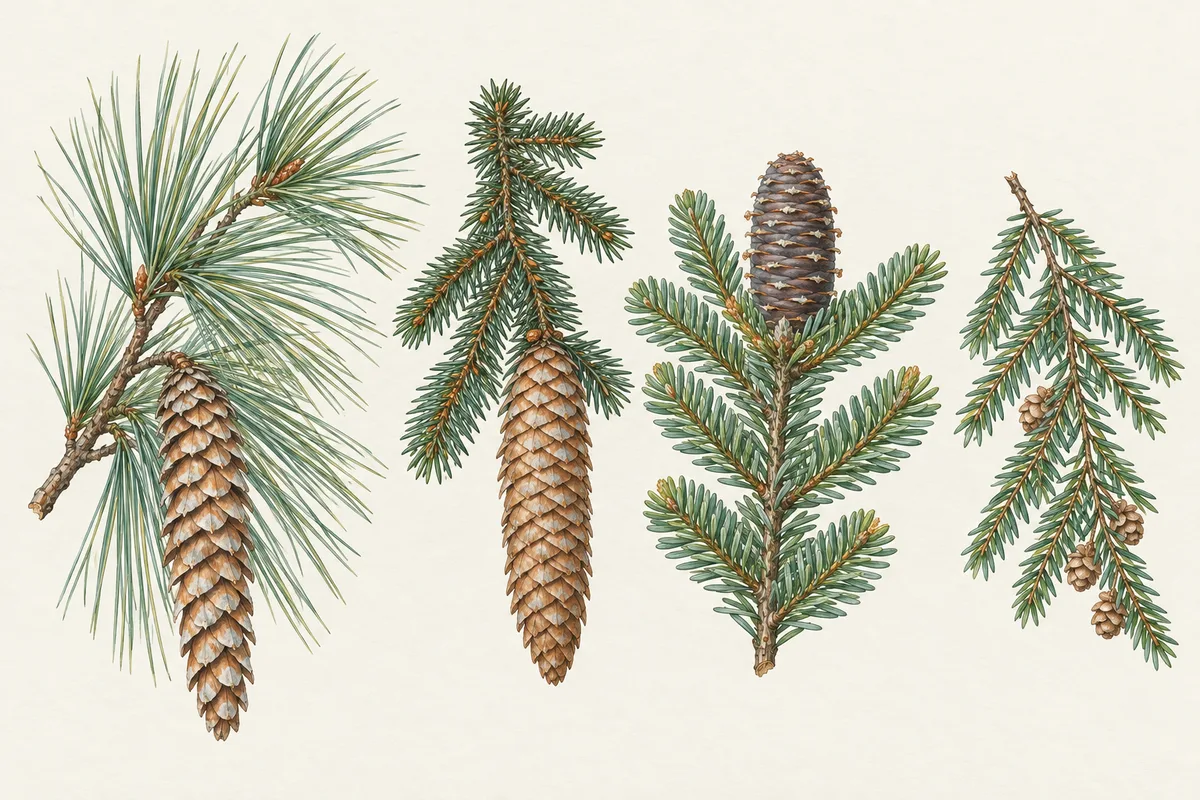
In short
Conifer identification starts with three questions about the needles. Bundled in groups of 2, 3 or 5? It is a pine. Single, four-sided and easy to roll between your fingers, each on a tiny woody peg? A spruce. Single, flat and soft? A fir, hemlock, Douglas-fir or yew, which the cones and twigs separate. Small overlapping scales instead of needles mean a juniper, arborvitae or another member of the cypress family.
- Count the needles in a bundle: 5 in eastern white pine, 2 in red pine and Scots pine, 3 in pitch pine.
- Pull a single needle: a spruce leaves a woody peg about 1 mm long, a fir leaves a flat, round scar.
- Fir cones stand upright and drop their scales on the branch; Douglas-fir cones carry three-pointed bracts between the scales.
Most conifers in North America can be named to genus by asking three questions about a single needle, then checking the cone. You need nothing but your fingers. Start by deciding whether the tree has needles or small overlapping scales; then work through the key below and use the cone table to confirm.
The three-question needle key
Question 1: Are the needles bundled? Look where the needles join the twig. If they come in bundles (fascicles) of 2, 3 or 5, the tree is a pine. Cornell forester Peter Smallidge's guide to needle-bearing trees gives the common cases: red, Scotch, jack and black pine have 2 needles per bundle, pitch pine has 3. Eastern white pine has 5 slender, flexible needles 3 to 5 inches long (Virginia Tech). Soft needles in tufts on short spur shoots, with no sheath, are not bundles: that is a larch.
Question 2: Are they square and rollable? If the needles grow singly, roll one between your thumb and finger. Nebraska Extension puts it simply: a four-sided needle that rolls easily belongs to a spruce, and pulling one off leaves a tiny woody peg, a feature unique to spruces. Cornell gives the peg as about 1 mm long. Norway spruce needles are stiff, 1/2 to 1 inch long, with a sharp tip; blue spruce needles are 3/4 to 1 1/4 inches and very sharp, almost spine-like (Virginia Tech).
Question 3: Are they flat and soft? A flat needle that won't roll means a fir or a yew in Nebraska Extension's key, and in the wider list a hemlock, a Douglas-fir or a baldcypress too. Separate them like this:
- Fir: the needle attaches directly to the twig and leaves a slightly raised round pad when it falls (Cornell). Balsam fir needles are about 3/4 inch, blunt or notched at the tip, shiny dark green above and silvery blue below (Virginia Tech).
- Hemlock: needles about 1/2 inch, with two white lines beneath, mostly in two flat rows (Virginia Tech), plus tiny extra needles along the top of the twig (Cornell).
- Douglas-fir: single needles 3/4 to 1 1/4 inches that lack both the woody pegs of spruce and the round bases of fir, with long, sharp-pointed red-brown buds (Virginia Tech).
- Yew: shiny, flat needles about 1 inch long that aren't stiff or prickly; English yew holds them in a V along the twig and has yellowish or pale green undersides (Nebraska Extension, Virginia Tech).
- Baldcypress: small, linear needles 1/4 to 3/4 inch in two rows on branchlets that look like a feathery compound leaf and are shed whole, needles attached (Virginia Tech).
No needles, only scales? Overlapping scale-like leaves mean the cypress family: juniper (including eastern redcedar), arborvitae (northern white-cedar) or Atlantic white-cedar. Nebraska Extension separates juniper, with scales lapped like roof shingles, from arborvitae, with soft, flat, vertical sprays.
Cone table: confirm the genus
Cones, on the tree or on the ground below it, confirm the needle key. Sizes are from Virginia Tech Dendrology fact sheets unless another source is named.
| Group | Needles | Cone |
|---|---|---|
| Pine (Pinus) | Bundles of 2, 3 or 5 | Woody, with thick scales; eastern white pine 4 to 7 in, cylindrical, resinous, on a long stalk; red and Scots pine 1 1/2 to 2 1/2 in, egg-shaped |
| Spruce (Picea) | Single, four-sided, on woody pegs | Cylindrical with thin scales; Norway spruce 4 to 6 in with stiff, irregularly toothed scales; blue spruce 2 to 4 in with flexible scales |
| Fir (Abies) | Single, flat, round scar | Upright on the branch, about 3 in, scales fall off as seeds ripen (Cornell); balsam fir 2 to 3 1/2 in, green tinged purple |
| Hemlock (Tsuga) | Single, flat, 1/2 in, two white lines | Small and hanging, marble-sized (Cornell); eastern hemlock about 3/4 in with rounded scales |
| Douglas-fir (Pseudotsuga) | Single, flat, no peg, sharp buds | 3 to 4 in, with three-lobed bracts sticking out beyond the scales |
| Cedar family: juniper, arborvitae, white-cedar | Scales (juniper also needle-like on young shoots) | Eastern redcedar: berry-like, about 1/4 in, dark blue with a white bloom; northern white-cedar: about 1/2 in, upright, leathery scales, like "miniature wooden roses" (Cornell) |
| Larch (Larix) | Soft, in tufts on spur shoots, deciduous | Tamarack: 3/4 to 1 in, egg-shaped, held upright (Cornell), stays on through winter |
| Yew (Taxus) | Single, flat, pointed, pale green beneath | No woody cone: one seed about 1/4 in in a bright red, fleshy cup (aril) |
| Cypress: baldcypress, Atlantic white-cedar | Baldcypress: soft, two-ranked, deciduous; white-cedar: tiny scales | Baldcypress: woody sphere 3/4 to 1 in that breaks apart; Atlantic white-cedar: about 1/4 in, blue to purple with a bloom, 4 or 5 scales |
Cones also help in winter, when a larch or baldcypress has lost its needles: look under the tree. The winter tree identification guide covers the other clues that work without foliage, and bark helps too: balsam and Fraser firs have smooth bark with raised resin blisters, and eastern redcedar peels in long fibrous strips (see tree bark identification).
In Canada's boreal forest, the conifers to learn first are balsam fir, black spruce, white spruce and tamarack. Black spruce has short needles, 8 to 15 mm (about 1/2 inch), on hairy twigs, while white spruce has needles 15 to 22 mm on hairless twigs and smells unpleasantly pungent when crushed, according to Natural Resources Canada's black spruce and white spruce factsheets. Tamarack is a larch that drops its needles every fall; the tamarack page tells it apart from planted European and Japanese larch.
Pines by needle count
Pines are the largest group of conifers people ask about. Once the bundle count is known, needle length, stiffness and color narrow the species:
- Eastern white pine: 5 needles per bundle, 3 to 5 inches, slender and flexible, blue-green from lines of pores (Virginia Tech).
- Red pine: 2 needles, 4 to 6 inches, dark green, snapping cleanly when bent (Virginia Tech).
- Scots (Scotch) pine: 2 stout, twisted needles, 1 1/2 to 3 inches, blue-green; orange, peeling bark in the upper crown (Virginia Tech).
- Pitch pine: 3 needles per bundle (Cornell).
The pine page has a fuller needles-per-bundle table for common US pines.
Christmas tree identification
These are six conifers you are likely to meet as cut Christmas trees. The needle key above identifies each of them; these are the details that tell them apart once the tree is in your living room. Needle details are from Virginia Tech; the notes on needle feel and retention are from the Cornell Cooperative Extension Christmas Tree Guide.
| Christmas tree | Needle key result | What to check |
|---|---|---|
| Fraser fir | Flat, single, round scar | About 3/4 in, dark green above, silvery below, denser than balsam fir; Cornell Extension calls it the most used, with soft needles and great needle retention |
| Balsam fir | Flat, single, round scar | About 3/4 in, blunt or notched, silvery blue below; Fraser fir's cone bracts stick out between the scales, balsam's don't; balsam scent |
| Douglas-fir | Flat, single, no peg | 3/4 to 1 1/4 in, soft, very fragrant; long, sharp-pointed buds; not a true fir |
| Noble fir | Flat, single | About 1 in, bluish-white bloom on all sides, base curved like a hockey stick, needles swept upward |
| Scotch (Scots) pine | Bundles of 2 | 1 1/2 to 3 in, stout and twisted |
| Colorado blue spruce | Square, on pegs | 3/4 to 1 1/4 in, stiff and very sharp, silvery blue to dark green; Cornell Extension rates its needle retention as average |
Where a photo helps with conifers
The needle key works best with a twig in your hand. When the lowest branches are 40 feet up, a photo of the whole tree or of a fallen cone in Tree Identifier gives you a name to start from, with common and scientific names and key traits. The app does not show a confidence score or a list of look-alikes, so check the name with the questions above: a spruce answer is easy to confirm if you can find one needle on the ground and roll it. For the broadleaf trees around your conifers, use how to identify trees, and the Tree Map in Tree Identifier pins each located find so you can return when the cones are ripe.
What a photo can't settle
- Christmas tree farms, parks and yards grow many cultivars and non-native conifers (dwarf, weeping or blue forms) that a regional key may not cover, and a photo won't give you the cultivar name.
- Junipers, arborvitae and white-cedars can be hard to separate from a photo of foliage alone; the cones and the shape of the foliage sprays settle most cases.
- Young shoots of eastern redcedar carry sharp, needle-like leaves instead of scales, so one branch can mislead both a key and an app.
Questions people ask
How do you tell a pine from a spruce from a fir?
Pine needles grow in bundles of 2, 3 or 5. Spruce needles grow singly, are four-sided, roll between your fingers and sit on tiny woody pegs. Fir needles grow singly, are flat and soft, will not roll and leave a round, flat scar when pulled. Fir cones stand upright on the branch.
How do you identify a pine tree by its needles?
Count the needles in one bundle, then measure them. Eastern white pine has 5 soft, flexible needles 3 to 5 inches long. Red pine has 2 needles 4 to 6 inches long that snap cleanly when bent. Scots pine has 2 stout, twisted, blue-green needles 1 1/2 to 3 inches long.
Is a Douglas-fir a true fir?
No. Douglas-fir belongs to its own genus, Pseudotsuga. Its single needles lack both the woody pegs of spruce and the round, flat bases of true firs, its buds are long and sharply pointed, and its 3- to 4-inch cones carry three-lobed bracts sticking out beyond the scales.
Which conifer loses its needles in winter?
Larches, including the native tamarack, are deciduous: their soft needles grow in tufts on short spur shoots, turn yellow in fall and drop. Baldcypress of southern swamps also drops its feathery branchlets with the needles attached.
Sources
- Aren't They All Just Pines? How to ID Needle-Bearing Trees — Cornell Small Farms Program (Peter Smallidge, Cornell University)
- Pine Trees or Evergreens? — Nebraska Extension in Lancaster County, University of Nebraska–Lincoln
- Christmas Tree Guide — Cornell Cooperative Extension of Monroe County
- Eastern white pine fact sheet — Virginia Tech Dendrology
- Norway spruce fact sheet — Virginia Tech Dendrology
- Balsam fir fact sheet — Virginia Tech Dendrology
- Douglas-fir fact sheet — Virginia Tech Dendrology
- Eastern hemlock fact sheet — Virginia Tech Dendrology