Tree profile
Tamarack (Larix laricina): how to identify it
A conifer that drops all its needles every autumn. Soft tufts on spur shoots, small cones with few scales and a bog or muskeg habitat give it away.
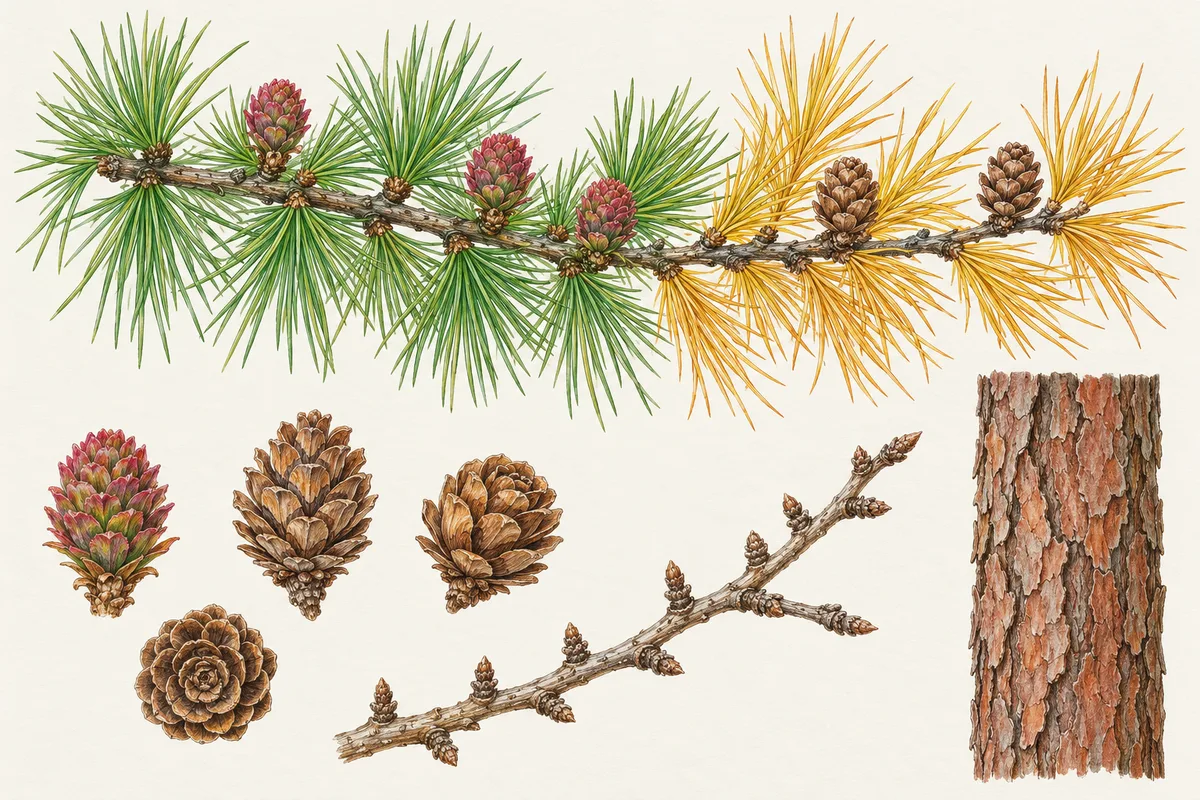
In short
Tamarack tree identification rests on three marks: soft, bluish-green needles 2 to 5 cm long in tufts of 15 to 60 on short spur shoots; egg-shaped cones only 1 to 2 cm long with no more than 20 smooth scales; and needles that turn yellow and fall every autumn. Larix laricina is a deciduous conifer of bogs, muskeg and wet ground across Canada.
- A tamarack that turns yellow and goes bare in autumn is not dying: it is a deciduous conifer and grows new needles in spring.
- Count the cone scales: tamarack has up to 20, European larch 40 to 50, western larch about 30.
- Tamarack cones are shorter than the needles; European larch cones are longer than the needles.
Field marks at a glance
- Scientific name
- Larix laricina
- Family
- Pinaceae (pine family)
- Type
- Conifer, deciduous
- Needles
- Soft, bluish-green, 2 to 5 cm (3/4 to 2 in) long, 15 to 60 per tuft on short spur shoots. Flattened above, keeled below.
- Autumn
- Needles turn yellow and fall. The tree stands bare all winter with its spur shoots and small cones still on the twigs.
- Cones
- Broadly egg-shaped, 1 to 2 cm (about 1/2 to 3/4 in), on short curved stalks, with up to 20 smooth scales; bracts hidden except at the base. Shorter than the needles. Stay on through winter.
- Twigs and buds
- Twigs hairless, orange-brown to pinkish, with many short spur shoots. Buds dark red or brown; on spur shoots ringed by hairs.
- Bark
- Thin and smooth on young trees, then scaly; grey at first, becoming reddish-brown. Newly exposed bark is reddish-purple.
- Form and size
- Up to 25 m (82 ft) tall and 40 cm (16 in) across, with a narrow, open, conical crown. Often stunted in poor bogs and near the tree line. Lives to about 150 years.
- Habitat
- Cold, wet, poorly drained sites: sphagnum bogs and muskeg, often with black spruce. Grows best on moist, well-drained light soils.
- Range
- Across Canada (Natural Resources Canada); across most of northern North America (University of Wisconsin).
- Other names
- Eastern larch, American larch, Alaska larch, hackmatack. French: mélèze laricin.
Tamarack (Larix laricina) is the conifer that confuses people every October: a tree with needles and cones that turns gold and then stands bare all winter. It grows across Canada, from Atlantic bogs to the muskeg of the Northwest Territories. Three checks, in this order, identify it: the needle tufts, the cone, then the season.
What to check first: tufts, cone, then the season
1. The needles. Look at an older twig. Tamarack needles grow in soft tufts of 15 to 60 on short, knobby spur shoots, according to the Natural Resources Canada tamarack factsheet. Each needle is 2 to 5 cm (3/4 to 2 in) long, bluish-green, flattened above and keeled below. Pines hold their needles in sheathed bundles of 2, 3 or 5, and spruces and firs carry them singly: soft tufts on spur shoots mean a larch.
2. The cone. Tamarack cones are small: broadly egg-shaped, 1 to 2 cm (about 1/2 to 3/4 in) long, on short curved stalks, with up to 20 smooth scales (NRCan). The bracts are much shorter than the scales and show only at the cone's base. Young cones are red, pink or yellowish-green and 5 to 10 mm long; mature cones start to open in mid-August and shed seed over the following months. The Virginia Tech tamarack fact sheet notes that the light brown cones stay on through the winter, which makes them the best winter clue.
3. The season. In autumn the needles turn yellow and drop (Virginia Tech). A conifer that is gold in October and bare in December, still carrying spur shoots and small cones, is a larch.
Then confirm with the bark and the site. Bark is thin and smooth on young trees, then scaly, grey turning reddish-brown, and freshly exposed bark is reddish-purple (NRCan). Twigs are hairless and orange-brown to pinkish.
Why a tamarack looks dead in autumn (and isn't)
"Tamarack tree dying", "turning yellow" and "turning brown" are common searches every fall, and most of them describe a healthy tree. Tamarack is deciduous: like a maple, it drops its whole crop of needles each year. The yellow phase comes first, then the needles fall and the tree stays bare until spring.
How to tell a resting tamarack from a dead conifer in winter:
- Spur shoots. Run a finger along a twig. A larch twig carries numerous short spur shoots (Virginia Tech), the points where the needle tufts grow.
- Cones still attached. Small egg-shaped cones remain on the branches through winter (Virginia Tech).
- The habitat. A bare conifer at the edge of a bog or in muskeg, often next to green black spruce, fits tamarack's usual site (NRCan).
Judge a tamarack's health in spring, when new needle tufts should open on the spur shoots. If they don't, or if the bark is damaged, a certified arborist is the right person to ask; a web page or an app can't diagnose a tree from here.
Tamarack vs larch: European, Japanese and western
"Larch" is the genus (Larix) and tamarack is one of its species, so every tamarack is a larch. The question people really mean is which larch they are looking at. Besides tamarack, the larches you are most likely to meet are two planted trees from overseas, European larch (native to Europe) and, less often, Japanese larch, and a second native, western larch, in southeastern British Columbia and Alberta. Cones settle it.
| Larch | Cone | Scales | Other clue |
|---|---|---|---|
| Tamarack | 1–2 cm, egg-shaped, shorter than the needles | Up to 20, smooth, bracts hidden | Wet sites, bogs and muskeg across Canada |
| European larch | Egg-shaped, upright, longer than the needles | 40–50, straight or slightly curved in | Planted; old trees keep dead cones for ten years or more |
| Japanese larch | Flattened, bun-shaped | Edges turned out and down, like a rose | Planted; needles broader and greyer-green than European larch |
| Western larch | 3–5 cm, reddish-brown | About 30, with pointed bracts sticking out beyond each scale | Southeastern BC and southwestern Alberta; young twigs hairy |
The European and Japanese descriptions are from the University of Wisconsin's European larch profile, which also gives the simplest test: the tamarack's small, blunt cones are shorter than its needles, while European larch cones are longer than the needles. The western larch figures are from NRCan's western larch factsheet.
Two more differences help with western larch. Its needles grow 15 to 30 per tuft and are 3 to 5 cm long, shiny pale green, and its bark becomes thick, up to 15 cm, and deeply furrowed. It is also a much bigger tree: up to 70 m (230 ft) tall and 400 years old, against 25 m and 150 years for tamarack (NRCan).
Wisconsin notes that Dunkeld larch, the hybrid of European and Japanese larch, differs mainly in its yellow, slightly waxy-bloomed shoots and conical cones. Expect mixed features on planted trees, and check several cones.
Where tamarack grows in Canada
NRCan gives tamarack's range as across Canada. It grows on cold, wet, poorly drained sites such as sphagnum bogs and muskeg, often with black spruce or eastern white-cedar, and may form a pure, narrow band around a bog. On drier, well-drained ground it mixes with black and white spruce, trembling aspen and white birch, and it grows best on moist, well-drained light soils.
Forest-grown trees reach 25 m (82 ft) tall and 40 cm (16 in) across, with a slender, straight or wavy trunk and an open, narrowly conical crown that becomes irregular with age. The roots are shallow and wide-spreading. In nutrient-poor bogs, near the northern tree line and on mountain slopes, trees are often stunted, with short needles and narrow cone scales.
The Canada hub has the table of provincial and territorial trees, where tamarack stands for the Northwest Territories, and the conifers you will meet next to it region by region.
Tamarack in the Tree Identifier app
A photo works when the spur shoots and cones are within reach. Shoot one twig with its needle tufts, or a cone, against the sky or your hand, and Tree Identifier returns a common and scientific name with key traits. In winter, photograph a twig with spur shoots and a cone rather than the bare crown. The app shows no confidence score and no look-alike list, so confirm a larch answer with the cone test above, then ask the follow-up chat about anything the result leaves open.
Tamarack is not one of the 138 species in the app's Collection; European larch is. For the other conifers of a bog or boreal stand, the conifer identification key sorts pines, spruces and firs with three needle questions, and Tree Identifier's Tree Map keeps a pin on each located find so you can come back in October for the gold.
Look-alikes and how to tell them apart
European larch (Larix decidua)
A planted tree in Canada. Its egg-shaped cones are longer than the needles and carry 40 to 50 scales, straight or slightly curved in at the tips. A tamarack cone is shorter than the needles and has no more than 20 scales.
Japanese larch (Larix kaempferi)
Another planted larch. Its cones are flattened and bun-shaped, with the edges of the scales turned out and down like a rose; its needles are broader and greyer-green. Tamarack cone scales lie smooth and close, and the cone is egg-shaped.
Western larch (Larix occidentalis)
Native to southeastern British Columbia, extending east into Alberta, on deep, well-drained soils. Cones are 3 to 5 cm with pointed bracts sticking out beyond each scale; young twigs are hairy; old trunks carry thick, deeply furrowed bark. Tamarack cones are under 2 cm with hidden bracts.
What a photo can't settle
- Hybrid larches such as Dunkeld larch (European × Japanese) show a mix of their parents' features, so a single cone, or a photo of one, may not settle a planted larch.
- In winter a tamarack has no needles, so a photo of the bare crown can be mistaken for a dead spruce or a broadleaf tree; photograph the twig with its spur shoots and a cone instead.
- Stunted bog tamaracks have shorter needles and narrower cone scales than forest trees, so measurements from a bog tree can fall below the usual ranges.
Questions people ask
Is a tamarack deciduous or coniferous?
Both. Tamarack is a conifer: it has needles and cones and belongs to the pine family. It is also deciduous: its needles turn yellow in autumn and drop, and the tree stays bare until new tufts open in spring.
Why is my tamarack turning yellow and losing its needles?
In autumn that is normal. Tamarack sheds all its needles every year after they turn yellow. Look for small cones and short spur shoots still on the twigs: a bare tree carrying both is a resting larch. Judge its health in spring, when new needle tufts should open; for a real concern, ask a certified arborist.
Is a tamarack the same as a larch?
Tamarack is one species of larch, Larix laricina, also called eastern or American larch. Natural Resources Canada also lists western larch and subalpine larch, and European and Japanese larch are grown as planted trees. Cone size and scale count tell them apart.
How tall do tamarack trees grow?
Natural Resources Canada gives up to 25 metres (82 feet) tall and 40 centimetres across, with a maximum age of about 150 years. Trees in nutrient-poor bogs and near the northern tree line are often stunted, with shorter needles and narrower cone scales.
Is tamarack a hardwood or a softwood?
A softwood. Natural Resources Canada files tamarack with the conifers (softwoods), in its own group of larches and tamaracks, even though it loses its needles like a broadleaf hardwood.
What is tamarack called in French?
Mélèze laricin, according to Natural Resources Canada. The same factsheet lists other English names: eastern larch, American larch, Alaska larch and hackmatack.
Sources
- Tamarack (Larix laricina), Trees, insects and diseases of Canada's forests — Natural Resources Canada, Canadian Forest Service
- Western larch (Larix occidentalis), Trees, insects and diseases of Canada's forests — Natural Resources Canada, Canadian Forest Service
- Tamarack fact sheet — Virginia Tech Dendrology
- European Larch, Larix decidua — Wisconsin Horticulture, University of Wisconsin–Madison Division of Extension
Keep reading
- Field guideConifer identification: three questions about the needles, then the cone
- Canada field guideTree identification in Canada, region by region
- Winter field guideWinter tree identification, from buds to bark
- Tree profilePines (Pinus): how to identify a pine tree
- Field guideHow to identify trees, step by step