Invasive tree profile
Bradford pear and Callery pear (Pyrus calleryana): how to identify them
One of the first trees to turn white in spring, flowers with a foul smell, and thorny wild offspring. How to recognize it, tell it from its look-alikes, and where it can no longer be sold.
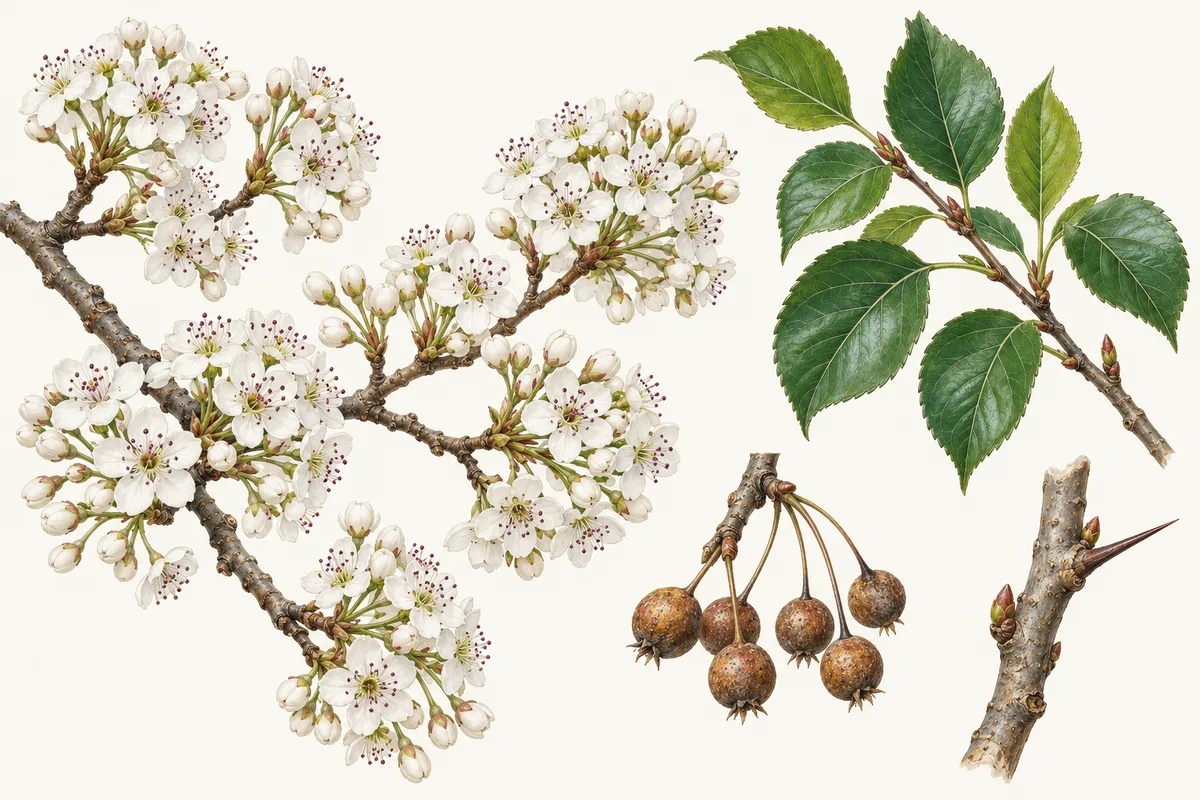
In short
Bradford pear tree identification starts in early spring: the tree is covered in clusters of white, five-petaled flowers, each about 3/4 inch across, before or as the leaves open, and the blossoms smell unpleasant. Confirm with the leaves, glossy, oval and up to about 3 inches long with small rounded teeth, and with an upright, egg-shaped crown of steep branches. Wild Callery pears carry thorns.
- Bradford is a cultivar of Callery pear (Pyrus calleryana); the wild, thorny trees spreading along roads are the same species.
- Rounded white petals that touch at their bases and stamens no longer than the petals separate Callery pear from serviceberry and wild plum.
- As of October 2026, Ohio, Pennsylvania, South Carolina and Minnesota ban its sale, and Illinois, Missouri and New Jersey have bans scheduled.
Field marks at a glance
- Scientific name
- Pyrus calleryana
- Family
- Rosaceae (rose family)
- Type
- Broadleaf, deciduous
- Flowers
- Dense clusters of white, five-petaled flowers, each 1/2 to 3/4 inch across, in early spring before or as the leaves open; often so many that the whole tree looks white. The smell is unpleasant.
- Leaves
- Alternate, simple, oval to heart-shaped, 2 to 3 inches long, glossy dark green with small rounded or wavy teeth, on long stalks that let them bob in the wind.
- Fall color
- Orange, gold, red, pink or purple; reddish purple or orange-red is common, and some cultivars show colored spots.
- Fruit
- Small, hard, round pomes about 1/2 inch across, brown or greenish yellow with pale flecks, with 2 to 4 black seeds. They soften and darken after freezes.
- Twigs and thorns
- Glossy brown twigs with spur shoots and large, woolly terminal buds. Planted cultivars are thornless; wild trees and stump sprouts have twigs that end in thorns.
- Bark
- Smooth with lenticels when young, light to reddish brown; grayish brown with shallow furrows and scaly ridges with age.
- Form and size
- Upright, pyramidal to egg-shaped crown with steep, narrow-angled branches. 30 to 50 ft for 'Bradford'; Virginia Tech gives up to 60 ft for the species.
- Origin
- Native to China and Taiwan. Long popular in landscaping in the United States and now invasive on roadsides, old fields and other open, disturbed ground.
Callery pear (Pyrus calleryana) was planted for decades in yards, parking lots and along streets, mostly as the 'Bradford' cultivar. It is now an invasive tree in much of the eastern United States, and several states have banned its sale. You can recognize it in four checks: the timing and smell of the bloom, the leaves, the crown, and, on wild trees, the thorns. Never eat a berry, nut or seed on the strength of a web page or an app; check with a local expert.
What to check first: early white bloom, glossy leaves, steep crown
1. The bloom. Callery pear is one of the first trees to bloom in spring, NC State Extension notes, and its creamy white flowers have an objectionable, foul smell. The Virginia Tech Dendrology fact sheet describes clusters 2 to 4 inches across of flowers each 1/2 to 3/4 inch wide, appearing before or with the leaves, often so dense that the entire tree appears white. Look into one flower: five rounded white petals that touch or overlap at their bases, and stamens no longer than the petals (Missouri Department of Conservation).
2. The leaves. Alternate and simple, oval to heart-shaped, 2 to 3 inches long, shiny green above and paler and dull below. The edge has small rounded, slightly wavy teeth. The Missouri Department of Conservation notes that the leaves bob in the wind on long stalks, and that in fall they turn orange, gold, red, pink or purple.
3. The crown. Planted Callery pears are upright and symmetrical, pyramidal when young and egg-shaped later, with branches that climb steeply from the trunk. 'Bradford' is narrower than most selections, with strongly ascending branches (NC State Extension).
4. Thorns, on wild trees. Cultivated trees are thornless. Wild Callery pears, and sprouts from the stump of a felled one, have twigs that end in thorns, and MDC notes that escaped trees develop long thorns that make thickets impenetrable. MDC adds that Callery pear thickets are most noticeable in spring, when they bloom, and in fall, when their leaves turn deep red.
If you have a photo of the tree in bloom, Tree Identifier will give you a name; it returns one answer, with no confidence score and no list of look-alikes. Callery pear is not in the app's Collection, the catalog that fills in as you identify, so check the petals and the smell yourself.
Bradford pear vs serviceberry, dogwood, cherry and plum
Several trees flower white in early spring. These checks come from the Missouri Department of Conservation, Virginia Tech and NC State Extension.
| Tree | Flower | Leaves | Other marks |
|---|---|---|---|
| Callery or Bradford pear | Rounded white petals touching at the base; stamens not longer than petals; foul smell | Alternate, glossy, oval, rounded teeth | Steep symmetrical branches; thorns on wild trees |
| Serviceberry | Brighter white, narrow, strap-shaped, wavy petals with gaps between | Alternate | Native; often recommended as a replacement |
| Flowering dogwood | Four large white bracts, about 2 in across, around a tight cluster of tiny flowers; mid-spring | Opposite, 3–5 in, smooth or wavy edge | Branches in opposite pairs, candelabra-like; red fruit in fall |
| Wild plum | Stamens longer than the petals | Alternate, sharply pointed | Shrubby, suckers into thickets; some twigs become thorns |
| Ornamental cherry | Yoshino: single white, slight almond scent | Alternate, tiny glands on the leaf stalk | Glossy bark with horizontal lenticels (young Callery pear bark can show lenticels too) |
| Apple, crabapple | Slightly pink tint | Alternate | Branches nearer horizontal, less uniform |
Dogwood details are from Virginia Tech's flowering dogwood fact sheet, wild plum from its American plum sheet. Wild plum is the trickiest: like wild Callery pear it can be thorny and form thickets, so check the stamens. For the cherries, see the cherry tree guide; for every white-flowering tree by month, see trees with white flowers.
Why Bradford pears split and spread
Splitting. NC State Extension explains that 'Bradford' develops tight crotches, branches that leave the trunk at narrow angles, which are likely to be split in half by heavy wind and rainstorms. Virginia Tech describes the species as upright and conical with very narrow branch angles. MDC adds that the tree grows quickly but dies young, and after a broken tree is removed, the stump sprouts into the wild, thorny form.
Spreading. 'Bradford' trees are grafted: a cutting of the cultivar on a wild Callery pear rootstock. A single cultivar can't pollinate itself, which is why these trees were once thought sterile. But different cultivars planted near each other cross-pollinate, rootstock sprouts can flower, and birds eat the softened fruit after freezes and spread the seed (MDC; Clemson Extension). The result is dense thickets on roadsides, old fields and woodland edges that leaf out early and shade out native plants.
State sale bans, as of October 2026
Each row was checked on the state agency's or extension service's own page on October 21, 2026. Bans cover sale, and in some states propagation or planting. Where the sources address trees already in the ground (Ohio, South Carolina, Illinois), those trees do not have to be removed.
| State | Status as of October 2026 | Source |
|---|---|---|
| Ohio | Sale and purchase of Callery pear and its cultivars banned since January 7, 2023, the end of a five-year grace period; landscapers and homeowners may not buy and install them | Ohio State University Extension |
| Pennsylvania | Class B noxious weed: cannot be sold, transported, planted or otherwise propagated in the state | Pennsylvania Department of Agriculture |
| South Carolina | Sale of all P. calleryana cultivars illegal since October 1, 2024; trees already planted are not affected | Clemson Extension |
| Minnesota | Restricted noxious weed (listed 2023): may not be imported, sold or transported except by permit | Minnesota Department of Agriculture |
| Illinois | Added to the Exotic Weeds Act in October 2025; for Callery pear the ban on buying, selling, distributing or planting takes effect January 1, 2028 | University of Illinois Extension |
| Missouri | Nursery dealers may not sell any variety or cultivar of Callery pear on or after January 1, 2029 (law passed in 2025) | Revised Statutes of Missouri, section 263.070 |
| New Jersey | On the prohibited list of the Invasive Species Management Act (January 8, 2026): propagation prohibited from January 1, 2027 and sale from January 1, 2030 without a conditional use permit | New Jersey Department of Agriculture |
States not listed here may have rules this page could not confirm from an official source. If your state isn't in the table, ask its department of agriculture or your county extension office.
What to plant instead, and what to do with an existing tree
Extension services suggest native spring-flowering trees in its place. NC State Extension names eastern redbud, flowering dogwood, common serviceberry and American plum; MDC adds yellowwood and hornbeam. Clemson Extension notes that South Carolina's ban does not affect trees already growing in your yard, and Ohio State Extension says existing Ohio trees do not require removal. If you decide to take one out, your county extension office can advise on removal and on any local replacement programs. Remember that a cut Callery pear resprouts from the stump into the thorny wild form, so the stump needs follow-up.
If you are not sure whether the white tree in your yard is a Callery pear, the guide to identifying trees in your yard covers nursery tags, property records and when to call an arborist. For the general method that works on any tree, see how to identify trees.
Look-alikes and how to tell them apart
Serviceberry (Amelanchier)
Serviceberry petals are brighter white, long, narrow and wavy, with gaps between them. Callery pear petals are rounded and touch or overlap at their bases. Serviceberry flowers don't have Callery pear's unpleasant smell.
Flowering dogwood (Cornus florida)
A dogwood's leaves grow in opposite pairs, and each 'flower' is four large white bracts about 2 inches across around a tight button of tiny flowers. Callery pear has alternate leaves and true five-petaled flowers in clusters.
Wild plums (Prunus americana and relatives)
In plum flowers the stamens, the thread-like stalks in the center, are longer than the petals; in Callery pear they are not. American plum is a shrubby small tree that suckers into thickets, and its fruit is a juicy drupe up to 1 inch.
Ornamental cherries (Prunus)
Flowering cherries bloom in early spring too, but Yoshino's flowers have a slight almond scent, not a foul one. Cherry leaves have tiny glands on the leaf stalk, and they lack Callery pear's wavy, rounded teeth.
Apples and crabapples (Malus)
Apple and crabapple blossoms have a slightly pink tint, and the branches spread nearer to horizontal and less evenly, not in Callery pear's steep, symmetrical cone.
What a photo can't settle
- A photo of a flowering tree can't tell Bradford from the other Callery pear cultivars; they differ in crown shape and branch structure more than in flowers.
- Telling a planted cultivar from a wild seedling depends on thorns and on whether the tree was grafted, which a photo of the crown won't show; look at the twigs and the base of the trunk.
- Sale bans change: the table below is dated October 2026. Check your state's department of agriculture before buying, selling or planting.
Questions people ask
What is the difference between a Bradford pear and a Callery pear?
Bradford is a cultivar of Callery pear, Pyrus calleryana, propagated by grafting a Bradford cutting onto Callery pear rootstock. Other cultivars include Aristocrat, Cleveland Select, Autumn Blaze and Whitehouse. The wild, thorny trees spreading along roads are Callery pears grown from seed.
Why do Bradford pear trees smell bad?
Extension services describe the flowers themselves as foul or unpleasant-smelling; NC State calls them malodorous. The smell comes with the bloom in early spring and fades when the petals drop. Serviceberry, dogwood and Yoshino cherry, which bloom white at about the same time, don't share it.
Are Bradford pear trees bad?
They are invasive. Planted cultivars cross-pollinate with each other and with rootstock sprouts, birds spread the seed, and the offspring form thorny thickets that crowd out native plants, according to the Missouri Department of Conservation. Large trees also split at weak, narrow branch angles in wind and ice.
Do Bradford pear trees produce fruit?
Yes. They bear small, hard, round fruits about 1/2 inch across, brown or greenish yellow, with 2 to 4 seeds, which birds eat after freezes soften them. A Bradford can't pollinate itself, but different cultivars planted near each other can cross-pollinate. Never eat a berry, nut or seed on the strength of a web page or an app.
How do you tell a Bradford pear from a dogwood?
Look at the leaves and flowers. Dogwood leaves are opposite, and its white 'flowers' are four large bracts around a central button. Callery pear leaves alternate, and it bears clusters of small five-petaled flowers. Dogwood also blooms a little later, in mid-spring, and its fruit is shiny red.
Do I have to cut down my Bradford pear?
Not in the states covered here. The bans apply to selling, propagating or planting, and Clemson Extension says South Carolina's rules do not affect trees already growing in your yard. Removal is encouraged; ask your extension office about local replacement or bounty programs.
Sources
- Callery pear fact sheet — Virginia Tech Dendrology
- Callery Pear (Bradford Pear) — Missouri Department of Conservation
- Pyrus calleryana (Callery pear) — NC State Extension Gardener Plant Toolbox
- The Ball Drops on Callery Pear in 2023! — Ohio State University Extension, Buckeye Yard and Garden onLine
- Controlled Plant & Noxious Weed Lists — Pennsylvania Department of Agriculture
- Bradford Pear and Elaeagnus to be Banned from Sale in South Carolina: What Do I Need To Know? — Clemson Cooperative Extension, Home & Garden Information Center
- Minnesota Noxious Weed List — Minnesota Department of Agriculture
- Invasive Species (Invasive Species Management Act prohibited list) — New Jersey Department of Agriculture, Division of Plant Industry