Invasive tree profile
Tree of heaven (Ailanthus altissima): how to identify it
Turn a leaflet over and look at its base. One or two gland-tipped teeth on an otherwise smooth edge, and a rank smell when you crush it, settle the identification.
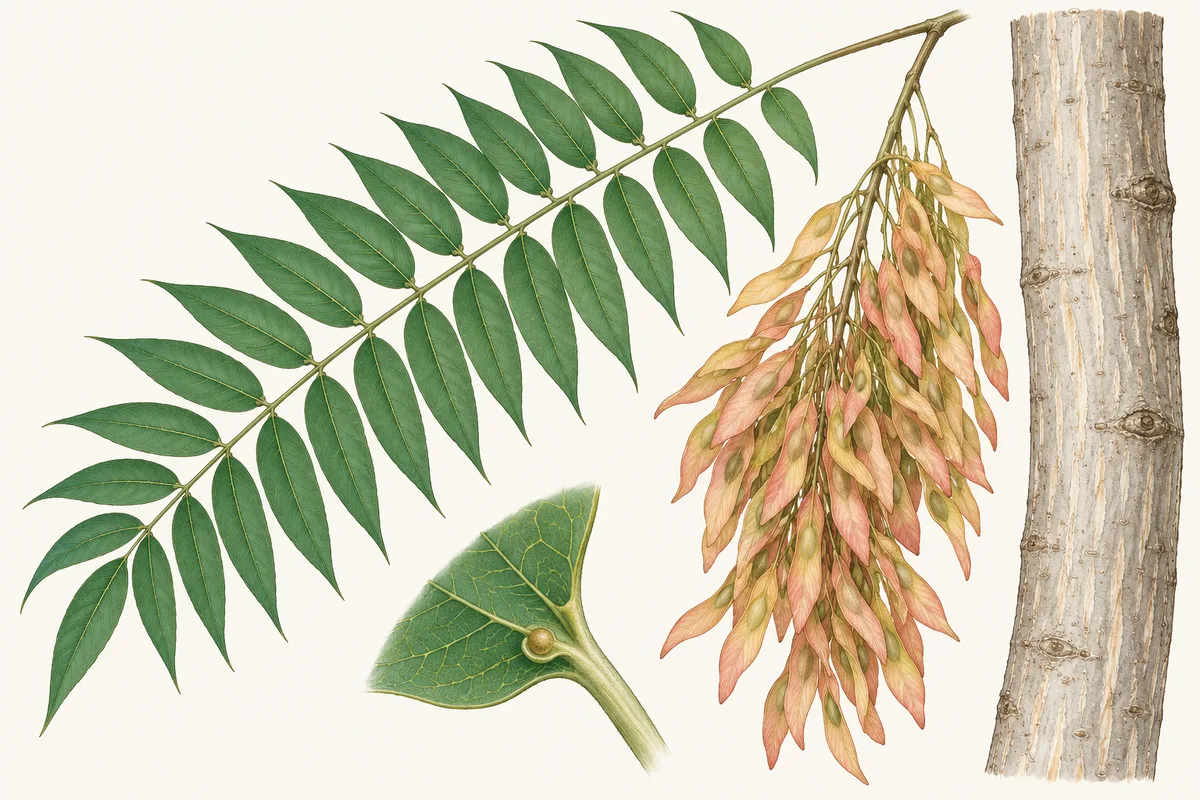
In short
Tree of heaven identification comes down to the leaflets: each leaf is 1 to 3 feet long with 11 to 41 leaflets, and every leaflet has a smooth edge except for one or two gland-tipped teeth near its base. Crushed leaves and broken twigs give off a strong, unpleasant smell. Sumacs, black walnut and hickories have teeth along the whole leaflet edge, and ashes have opposite leaves.
- Look at the leaflet base: one or two glandular teeth on an otherwise smooth edge is the signature.
- Crush a leaflet or break a twig: Penn State Extension describes a strong, offensive odor.
- Tree of heaven is a favored host of spotted lanternfly and a Class B noxious weed in Pennsylvania (as of October 2026).
Field marks at a glance
- Scientific name
- Ailanthus altissima
- Family
- Simaroubaceae (quassia family)
- Type
- Broadleaf, deciduous
- Leaves
- Alternate, pinnately compound, 1 to 3 ft long with 11 to 41 leaflets (Virginia Tech); Penn State gives 1 to 4 ft and 10 to 40. Leaflets lance-shaped, 2 to 6 inches long.
- Leaflet base
- One or two gland-tipped teeth near the base of each leaflet; the rest of the edge is smooth.
- Smell
- Crushed leaves and broken twigs give off a strong, offensive odor; Virginia Tech notes some people are reminded of peanut butter.
- Twigs
- Stout, yellow to red-brown, velvety when young, with large heart- or V-shaped leaf scars, no end bud, and a large, spongy, reddish-brown pith.
- Bark
- Thin, light brown to gray; on young trees it resembles the skin of a cantaloupe (Virginia Tech, Penn State), later turning darker gray and rough.
- Seeds
- Twisted, single-seeded samaras 1 to 2 inches long in large hanging clusters on female trees, often staying on the tree through winter.
- Size
- To about 70 ft (Virginia Tech) or 80 ft and 6 ft in diameter (Penn State). Often grows in dense clumps from root suckers.
- Origin
- Native to China, Taiwan and northern Vietnam. First recorded in North America in Philadelphia in 1784 (USDA Forest Service).
Tree of heaven (Ailanthus altissima) is a fast-growing invasive tree from East Asia, now common along roadsides, railways, fencerows and woodland edges in much of North America. It is easy to confuse with native trees that also have long compound leaves, such as sumacs and black walnut. One close look at a leaflet, and one sniff, tell them apart.
The leaflet-gland test, then the smell
1. Find the glands. Pick a leaf and look at the base of any leaflet, where it meets the leaf stalk. Tree of heaven leaflets are lance-shaped with smooth edges, except for one or two protruding bumps near the base, called glandular teeth (Penn State Extension). The Virginia Tech fact sheet describes them as large, glandular teeth near the base. The USDA Forest Service's Silvics of North America notes these glands are nectaries, found at the tips of the shallow basal lobes.
2. Crush a leaflet and smell it. Penn State describes a strong, offensive odor from crushed leaves and all plant parts. Break a twig: Virginia Tech notes that some people are reminded of peanut butter.
3. Check the size of the leaf. A tree of heaven leaf is huge: 1 to 3 feet long with 11 to 41 leaflets according to Virginia Tech, 1 to 4 feet with 10 to 40 according to Penn State. Leaves alternate along stout twigs that have no end bud and large heart- or V-shaped leaf scars.
4. Look for seeds and clumps. Female trees carry big hanging clusters of twisted samaras, 1 to 2 inches long, that often stay on through winter. Trees usually grow in dense colonies of root sprouts.
Tree Identifier can suggest a name from a photo of a leaf, the bark or a seed cluster. Tree of heaven is not listed in the app's Collection, which covers 138 species, but the app can still name it from a photo. It shows no confidence score and no look-alike list, so check the leaflet glands yourself before acting on the answer, especially before reporting or removing a tree.
Tree of heaven vs sumac, black walnut and ash
These are the trees people most often mistake for tree of heaven, and the reverse. Penn State notes that native look-alikes such as staghorn sumac, black walnut and hickory all have toothed (serrated) leaflet edges, while tree of heaven's are smooth.
| Feature | Tree of heaven | Staghorn sumac | Shining sumac | Black walnut | Ashes |
|---|---|---|---|---|---|
| Leaf arrangement | Alternate | Alternate | Alternate | Alternate | Opposite |
| Leaf length, leaflets | 1–3 ft, 11–41 | 16–24 in, 11–31 | Up to 12 in, 7–15 | 12–24 in, 10–24 | 6–14 in, 7–11 |
| Leaflet edge | Smooth, 1–2 glandular teeth at the base | Toothed all along | Smooth | Finely toothed all along | Toothed, or smooth on some white ash |
| Leaf stalk | Not winged | Fuzzy | Winged between leaflets | Somewhat hairy | Not winged |
| Fruit | Hanging clusters of twisted samaras | Upright clusters of fuzzy red drupes | Upright clusters of sticky red drupes | Round nut in green husk | Single paddle-shaped samaras |
| Size | To 70–80 ft | Shrub or tree to 25 ft | Shrub or tree to 25 ft | To 100 ft or more | To 70–120 ft |
Sources: Virginia Tech fact sheets for tree-of-heaven, staghorn sumac, shining sumac and black walnut; Penn State Extension. Penn State adds that the foul odor of crushed foliage and broken twigs is unique to tree of heaven among these look-alikes. Black walnut also has chambered pith, which tree of heaven lacks; see the walnut profile. For the ashes, see ash.
Sumac or tree of heaven along a roadside? In late summer and fall the fruit settles it without touching the leaves: staghorn and shining sumac fruit stands in upright, dense red clusters, while tree of heaven seeds hang in long clusters of twisted samaras.
Young trees, seedlings and root sprouts
Seedlings and sprouts carry the same leaflet glands and the same smell as mature trees, so the test works at any size. For other saplings, see how to identify young trees. Two things make young growth confusing:
- Speed. The Forest Service reports that seedlings can grow 1 to 2 meters (3 to 7 feet) in a single year, and that young trees are often nearly as wide as they are tall.
- Root suckers. Penn State says established trees send up root suckers as far as 50 feet from the parent, and that a cut or injured tree may send up dozens of stump and root sprouts. Seedlings are easily confused with root suckers. Sprouts as young as two years can produce seed.
Penn State notes that cutting or mowing alone does not control tree of heaven, because the tree answers with more sprouts. For removal, its tree-of-heaven fact sheet gives timing and methods; a county extension office can advise on local rules.
Spotted lanternfly host and state status (as of October 2026)
Tree of heaven matters beyond its own spread because of spotted lanternfly (Lycorma delicatula), an invasive planthopper. Penn State Extension's Spotted Lanternfly Management Guide says it was first detected in North America in 2014 in southeastern Pennsylvania and has spread to other states, and that heavy lanternfly feeding has contributed to the death of grapevines, tree of heaven and black walnut saplings. The Forest Service's Silvics chapter adds that spotted lanternfly feeds on ailanthus in all life stages and shows a preference for feeding and reproducing where ailanthus is abundant. If you see lanternflies on a tree with long compound leaves, the leaflet-gland test will tell you whether it is their favored host.
Pennsylvania. The Pennsylvania Department of Agriculture's Controlled Plant & Noxious Weeds Lists include tree-of-heaven as a Class B noxious weed, a class defined as widely established in the state and not feasible to eradicate. The department states that noxious weeds cannot be sold, transported, planted or otherwise propagated in Pennsylvania. Status checked October 21, 2026.
Other states have their own lists and lanternfly quarantines, which change. Penn State notes that spotted lanternfly is under quarantine in most Pennsylvania counties and in several other states. Check your state's department of agriculture for the current rules where you live.
Where it came from and why it spreads
The Forest Service records the first introduction to North America in 1784 in Philadelphia; Penn State adds that it reached the West Coast in the 1850s and was widely planted as a street tree from New York City to Washington, D.C., before its weedy habit and odor made it unpopular by the early 1900s. A single female tree can produce more than 300,000 seeds a year (Penn State), and the Forest Service says the samaras travel as far as 100 meters (330 feet) on the wind, rarely up to 200.
Handling. Penn State Extension reports that some people get skin irritation from contact with leaves, bark, seeds or sap, and recommends gloves and protective clothing for anyone with extensive contact. If you are mapping tree of heaven on your property before calling an expert, Tree Identifier's Tree Map keeps each located identification. For other trees to check in your yard, see identify trees in your yard, and for another invasive often planted in yards, Bradford pear.
Look-alikes and how to tell them apart
Staghorn sumac (Rhus typhina)
Staghorn sumac leaflets are toothed along the whole edge, its twigs are densely velvety like a deer's antler in velvet, and it bears upright, dense clusters of fuzzy red fruit. It is a shrub or small tree to about 25 feet.
Shining sumac (Rhus copallinum)
Shining sumac leaflets have smooth edges too, so check the leaf stalk: shining sumac's carries thin wings between the leaflets. Its leaves are shorter, up to 12 inches, with only 7 to 15 leaflets, and it bears upright clusters of sticky red fruit.
Black walnut (Juglans nigra)
Black walnut leaflets are finely toothed all along the edge, and a lengthwise cut through a twig shows buff pith divided into chambers. It bears round green-husked nuts, not winged seeds.
Ashes (Fraxinus)
Ash leaves grow in opposite pairs, with only 7 to 11 leaflets, and ash seeds are single paddles, not twisted samaras. Tree of heaven leaves alternate.
What a photo can't settle
- Tree of heaven is dioecious and grows in clones of one sex, so many trees never carry seed clusters; the leaflet glands and the smell are the dependable marks.
- Root suckers can come up as far as 50 feet from the parent tree (Penn State), so a single photo of a sprout won't show whether it belongs to a larger clone.
- State rules on planting, selling and controlling tree of heaven change; the Pennsylvania status here was read on October 21, 2026 and other states differ.
Questions people ask
How do I identify a tree of heaven?
Find a leaf: alternate, 1 to 3 feet long, with 11 to 41 lance-shaped leaflets. Check the base of a leaflet for one or two gland-tipped teeth on an otherwise smooth edge, then crush it and smell. A strong, unpleasant odor, no end bud on the twig and large heart-shaped leaf scars confirm tree of heaven.
What does tree of heaven smell like?
Penn State Extension describes the crushed leaves and all plant parts as giving off a strong, offensive odor, and Virginia Tech says the broken twigs remind some people of peanut butter. Male flowers also have a disagreeable smell in late spring and early summer.
How do you tell tree of heaven from sumac?
Look at the leaflet edges. Staghorn sumac leaflets are toothed all the way along; tree of heaven leaflets are smooth except for glandular teeth at the base. Shining sumac has smooth leaflets but a winged leaf stalk and no basal glands. Sumacs carry upright red fruit clusters; tree of heaven carries hanging, twisted samaras.
How do you identify a young tree of heaven or seedling?
Young plants show the same signature: long compound leaves whose leaflets have one or two glandular teeth at the base, and the rank smell when crushed. They grow fast; the USDA Forest Service reports seedlings can grow 3 to 7 feet in a single year. Shoots in a clump are often root suckers from a nearby tree.
Is tree of heaven illegal to plant?
In Pennsylvania, tree of heaven is listed as a Class B noxious weed by the state Department of Agriculture, and noxious weeds cannot be sold, transported, planted or otherwise propagated there (list read October 21, 2026). Rules differ by state, so check your state's department of agriculture.
Sources
- Tree-of-heaven fact sheet — Virginia Tech Dendrology
- Tree-of-Heaven — Penn State Extension
- Ailanthus (Ailanthus altissima), Silvics of North America (2025 revision) — USDA Forest Service
- Spotted Lanternfly Management Guide — Penn State Extension
- Controlled Plant & Noxious Weeds Lists — Pennsylvania Department of Agriculture
- Staghorn sumac fact sheet — Virginia Tech Dendrology
- Shining sumac fact sheet — Virginia Tech Dendrology
- Black walnut fact sheet — Virginia Tech Dendrology