Tree profile
Walnut trees (Juglans): how to identify them
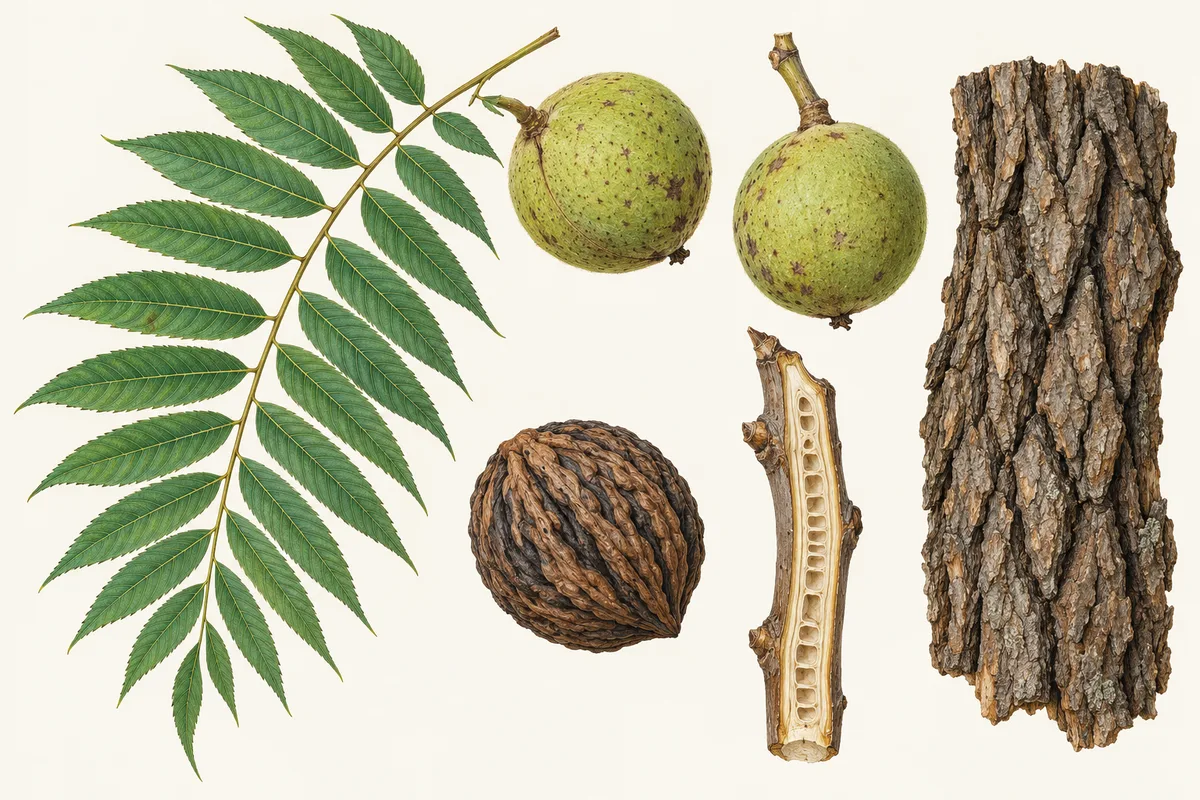
Split a twig and look for a ladder of small chambers in the pith. Then the leaflet count, the nut and the leaf scar tell black walnut, butternut and English walnut apart.
In short
Walnut tree identification starts with the twig: slice it lengthwise and the pith is divided into small chambers, a mark no common look-alike shares. Black walnut has 10 to 24 leaflets, often with no end leaflet, a round nut 2 to 2½ inches across in a green husk that does not split, and dark ridged bark. Butternut and English walnut differ in leaflet count, nut shape and bark color.
- Chambered pith means walnut or butternut; hickory pith is solid and tree of heaven's is large and reddish brown.
- Buff pith is black walnut or English walnut; very dark brown pith is butternut.
- English walnut has only 5 to 7 (occasionally 9) leaflets; black walnut has 10 to 24.
Field marks at a glance
- Scientific name
- Juglans
- Family
- Juglandaceae (walnut family)
- Type
- Broadleaf, deciduous
- Leaves
- Alternate, pinnately compound. Black walnut 12 to 24 inches with 10 to 24 finely toothed leaflets; butternut 15 to 25 inches with 11 to 17; English walnut 12 to 18 inches with 5 to 7 (occasionally 9).
- Pith
- Chambered: split a twig lengthwise to see thin crosswalls. Buff on black and English walnut, very dark brown on butternut.
- Fruit
- A nut in a husk that does not split open. Black walnut round, 2 to 2½ inches; butternut lemon-shaped and sticky; English walnut round, to 2 inches, with a thinner, smoother shell.
- Twigs and buds
- Stout twigs, large three-lobed leaf scars shaped like a monkey face, large woolly buds. Butternut adds a hairy fringe, the eyebrow, above each leaf scar.
- Bark
- Black walnut: brown to dark, ridged in a rough diamond pattern. Butternut and English walnut: light ashy gray with flat-topped ridges.
- Size
- Black walnut 100 to 120 ft on good sites (150 ft recorded in Indiana); butternut usually 40 to 60 ft; English walnut generally to 60 ft.
- Range
- Black walnut: central and eastern US from Vermont to Nebraska, south to central Texas and northwestern Florida. Butternut: farther north, into New Brunswick. English walnut: planted, not native.
Walnuts (Juglans) are large nut trees with long compound leaves, and the USDA Forest Service counts black walnut among the most coveted native hardwoods of eastern North America. Never eat a berry, nut or seed on the strength of a web page or an app; check with a local expert. This page is about naming the tree, and one test does most of the work: the chambered pith.
The fastest test: split a twig and look at the pith
1. The pith. Cut a twig lengthwise with a pocketknife. In a walnut the soft center is divided by thin crosswalls into a row of small chambers, like a ladder. The Virginia Tech black walnut fact sheet describes it as a "buff-colored chambered pith"; on butternut the chambered pith is very dark brown. Hickories have solid pith, and tree of heaven a large, reddish-brown one without chambers.
2. The leaf. Walnut leaves alternate along the twig and are pinnately compound. Count the leaflets on several leaves:
- Black walnut: 10 to 24 leaflets, finely toothed, 3 to 3½ inches long, on a leaf 12 to 24 inches long (Virginia Tech). Ohio State's Woody Plants of Ohio gives 11 to 23, or an even 10 to 22 because the end leaflet is often reduced or missing.
- Butternut: 11 to 17 leaflets on a leaf 15 to 25 inches long, with a well-developed end leaflet.
- English walnut: only 5 to 7 (occasionally 9), mostly smooth-edged, up to 5 inches long, very aromatic when crushed (Virginia Tech).
3. The nut. Walnut husks do not split open on the tree. Black walnut's fruit is round, 2 to 2½ inches across, in a thick green husk; it ripens in September or October and drops shortly after the leaves fall, according to the USDA Forest Service's Silvics of North America. Butternut's is oblong and lemon-shaped, with a sticky husk.
Tree Identifier can name a walnut from one photo of a leaf, a nut or the bark. Black walnut and English walnut are both in the app's Collection; butternut is not listed there, though the app can still name it. The app gives no confidence score or list of look-alikes, so if the answer is "walnut" and you have a twig, the pith test is a quick check.
Black walnut vs butternut vs English walnut
| Feature | Black walnut (J. nigra) | Butternut (J. cinerea) | English walnut (J. regia) |
|---|---|---|---|
| Leaflets | 10–24, end leaflet often missing | 11–17, end leaflet well developed | 5–7, occasionally 9; end leaflet largest |
| Leaflet edge | Finely toothed | Toothed | Smooth or finely toothed |
| Nut | Round, 2–2½ in; thick green husk | Oblong, lemon-shaped; sticky husk | Round, to 2 in; thinner, smoother shell |
| Pith | Buff, chambered | Very dark brown, chambered | Buff, chambered |
| Leaf scar | Monkey face, no fringe | Monkey face with a hairy eyebrow above | Three-lobed |
| Bark | Brown, darker when cut; rough diamond ridges | Light ashy gray, flat-topped shiny ridges | Light ashy gray, flat ridges in a striking diamond pattern |
| Size | Up to 100–120 ft on good sites | Usually 40–60 ft; rarely over 100 ft | Generally to 60 ft, crown as wide as tall |
| Origin | Native, central and eastern US | Native, northeastern US and Canada | Planted; not known to widely escape cultivation |
Sources: Virginia Tech fact sheets for the three species, including English walnut, and the Forest Service Silvics chapters on black walnut and butternut.
Butternut is uncommon. The Forest Service says that through most of its range butternut is not a common tree and its frequency is declining, mainly because of butternut canker, a fungal disease that kills branches and stems. It is short-lived, seldom reaching 75 years. Its range overlaps black walnut's but runs farther north, into New Brunswick and Quebec, and not as far south.
Black walnut in winter
A bare black walnut still shows four marks, from the Ohio State and Virginia Tech descriptions:
- Buds: large, cream to tan and woolly, with a true end bud.
- Leaf scars: large, three-lobed and shaped like a monkey face. Butternut's look the same but carry a hairy fringe across the top, the "eyebrow".
- Pith: buff and chambered.
- Bark: brown with rough ridges in a diamond pattern; a shallow cut shows darker brown underneath.
Fallen nuts under the tree help confirm the call. The Forest Service maps the native range from western Vermont and Massachusetts west to southern Minnesota, eastern South Dakota and northeastern Nebraska, south to western Oklahoma and central Texas, and east to northwestern Florida and Georgia, excluding the Mississippi Delta.
Walnut vs tree of heaven, hickory and ash
Tree of heaven is the look-alike that matters most, because it is invasive and often grows along the same roadsides and fencerows. Its leaves are longer, 1 to 3 feet with 11 to 41 leaflets according to the Virginia Tech tree-of-heaven fact sheet, and each leaflet has a smooth edge except for one or two large, gland-tipped teeth near the base. Crush a leaflet: tree of heaven smells strongly unpleasant. Its pith is large and reddish brown, never chambered, and it bears twisted winged seeds in hanging clusters, never nuts. See the tree of heaven profile for the full test.
Hickories have fewer leaflets (5 to 9 on most species), solid pith and a husk that splits open. See hickory.
Ashes have compound leaves too, but in opposite pairs, and winged seeds. See ash.
Black walnut and juglone
Black walnut is known for affecting plants that grow under it. The University of Wisconsin–Madison Division of Extension's Black Walnut Toxicity to Plants explains that black walnut produces juglone, which occurs in all parts of the tree but is most concentrated in the buds, nut hulls and roots. Problems occur mainly for sensitive plants growing in the root zone under the tree; symptoms range from stunting and yellowing to wilting and death. Butternut also produces juglone, in lesser amounts. Wisconsin Extension lists tomatoes, peppers and potatoes as sensitive and beans, beets, carrots and corn among tolerant vegetables, but warns that these lists are based on observation rather than formal testing. For a yard tree that is struggling near a walnut, a county extension office is the place to ask.
Why black walnut matters
The Forest Service calls black walnut one of the scarcest and most coveted native hardwoods: its straight-grained wood went into fine furniture and gunstocks, and quality logs now go mostly to veneer. Mature trees on good sites reach 100 to 120 feet, and Indiana has recorded trees 150 feet tall. Nut crops are irregular: the Forest Service puts good crops at perhaps twice in five years. To come back to a particular tree in fall, Tree Identifier's Tree Map keeps each located identification. For fallen fruit of other trees, see identifying trees by seeds and nuts.
Look-alikes and how to tell them apart
Tree of heaven (Ailanthus altissima)
Tree of heaven leaflets are smooth-edged except for one or two gland-tipped teeth at the base; walnut leaflets are toothed all along. Crushed tree of heaven leaves smell strongly unpleasant, its pith is large and reddish brown, not chambered, and it bears twisted winged seeds, not nuts.
Hickories (Carya)
Most hickories have 5 to 9 leaflets, fewer than black walnut, with a large end leaflet. Hickory pith is solid, and hickory husks split open into sections, while walnut husks stay closed.
Ashes (Fraxinus)
Ash leaves and twigs come in opposite pairs; walnut leaves alternate. Ashes have 7 to 11 leaflets and carry single-winged paddle seeds, never nuts.
What a photo can't settle
- This page covers the three walnuts most people meet in the eastern US. Western natives such as California black walnut, which Virginia Tech lists as an English walnut look-alike, and Arizona walnut need their own references.
- The pith test needs a twig in hand. On a tall tree with no low branches, use fallen twigs or nuts on the ground.
- Leaflet counts vary from leaf to leaf, and black walnut's end leaflet is sometimes present, so count several leaves before relying on the number.
Questions people ask
How do you identify a black walnut tree in winter?
Look for stout twigs with large, cream, woolly buds and big three-lobed leaf scars shaped like a monkey face, with no hairy fringe above them. Slice a twig lengthwise: the pith is buff and chambered. Round nuts under the tree and dark, diamond-ridged bark confirm it.
What is the difference between black walnut and English walnut trees?
English walnut has only 5 to 7 (occasionally 9) large leaflets, mostly smooth-edged and up to 5 inches long, and light ashy gray bark. Black walnut has 10 to 24 smaller, finely toothed leaflets and dark brown, rough bark. English walnut is planted; Virginia Tech notes it is not known to widely escape cultivation.
How do you identify a young black walnut tree?
A sapling shows the same alternate leaves with 10 to 24 finely toothed leaflets, often with the end leaflet missing or poorly formed. The pith test works at any age: a lengthwise cut through a twig shows buff, chambered pith. Tree of heaven saplings, the usual mix-up, have smooth-edged leaflets with glands at the base and pith without chambers.
How do you tell a butternut from a black walnut?
Butternut has a well-developed end leaflet, lemon-shaped sticky nuts, light ashy gray bark with flat shiny ridges, very dark brown chambered pith, and a hairy eyebrow above each leaf scar. Black walnut usually lacks the end leaflet, has round nuts, dark rough bark, buff pith and no eyebrow.
Do black walnut trees kill other plants?
University of Wisconsin Extension says black walnut produces juglone, which inhibits many plants, mainly sensitive ones growing in the root zone; tomatoes, peppers and potatoes are listed as sensitive. It adds that sensitivity lists come from observation rather than formal testing, so lists sometimes disagree.
Sources
- Black walnut fact sheet — Virginia Tech Dendrology
- Butternut fact sheet — Virginia Tech Dendrology
- English walnut fact sheet — Virginia Tech Dendrology
- Black Walnut (Juglans nigra), Silvics of North America — USDA Forest Service
- Butternut (Juglans cinerea), Silvics of North America — USDA Forest Service
- Black walnut (Juglans nigra) — Woody Plants of Ohio, companion to ENR 3321 (Ohio State University course)
- Black Walnut Toxicity to Plants — University of Wisconsin–Madison Division of Extension
- Tree-of-heaven fact sheet — Virginia Tech Dendrology
Keep reading
- Field guideHow to identify trees, step by step
- Tree profileHickory trees (Carya): how to identify them
- Invasive tree profileTree of heaven (Ailanthus altissima): how to identify it
- Tree profileAsh trees (Fraxinus): how to identify them
- Field guideTree seed identification: from acorn, pod or samara to the tree