Field guide
How to identify young trees and saplings
Saplings rarely flower or fruit and their leaves and bark can look unlike the parent's. Read the twig instead, then check the parent trees nearby.
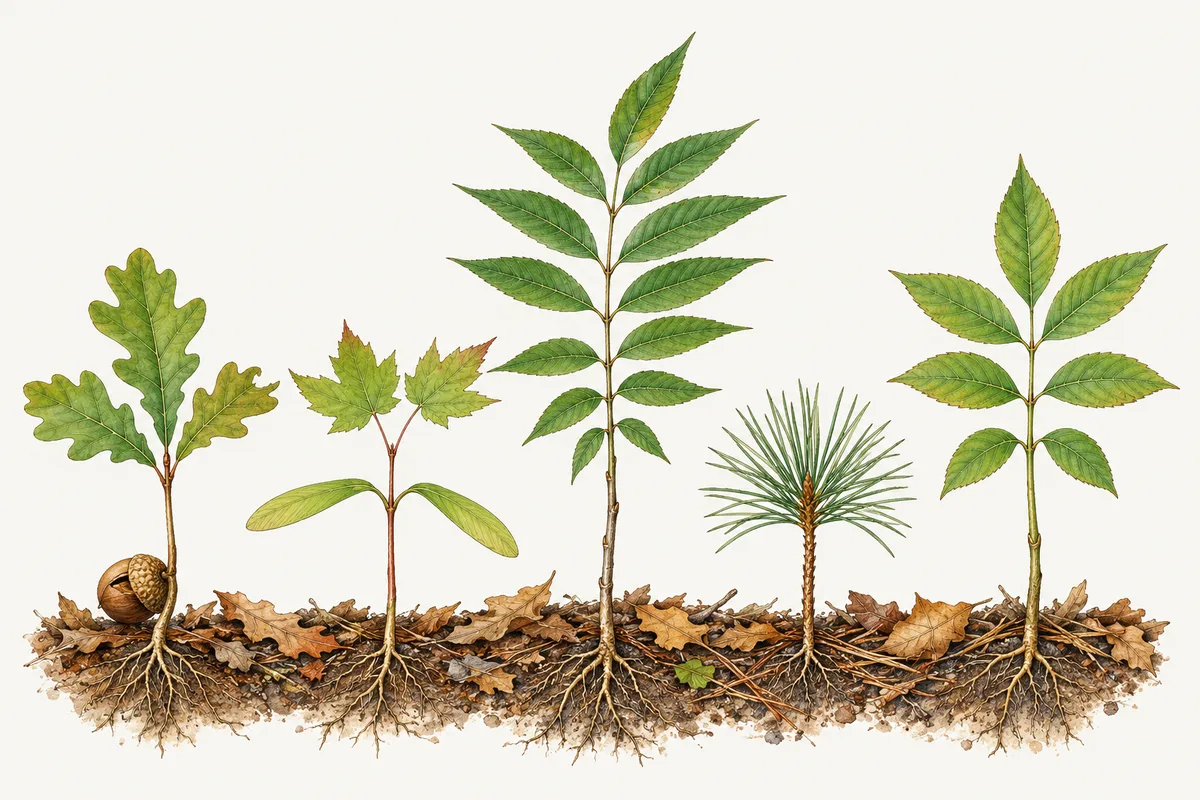
In short
To identify young trees, rely on features that don't change with age. Check whether leaves sit opposite or alternate and whether each leaf is simple or split into leaflets. Then read the twig: bud color, leaf scar shape, the pith inside, and the smell of a broken twig or crushed leaf. Finish by looking for a nut or acorn at the base and for the parent trees nearby.
- Leaf arrangement and leaf type stay the same from seedling to old tree, so check them first.
- Break a twig: chambered pith means walnut, a large spongy brown pith and a rank smell mean tree of heaven, a bitter almond smell means black cherry.
- Tree of heaven leaflets have smooth edges with one or two glandular teeth at the base; sumac, walnut and hickory leaflets are toothed all along.
Saplings are some of the hardest trees to name. Most will not flower or fruit for years, their bark is often smooth and unlike the parent's, and their leaves can be a different size or shape from the leaves on a mature crown. The fix is to lean on features that hold from seedling to old tree: how leaves are arranged, how they are divided, and what the twig looks, feels and smells like.
The seven checks for any young tree
Work through these in order. Write down each answer, because the combination is what narrows the field.
- Opposite or alternate. Pairs of leaves at the same point on the stem are opposite; staggered leaves are alternate. This never changes with age, and in eastern North America only a few tree groups are opposite: maples (including boxelder), ashes, dogwoods and buckeyes.
- Simple or compound. Find the bud at the base of the leaf stalk. One blade above it is a simple leaf; a row or fan of leaflets is a compound leaf. On a big compound seedling leaf, a single leaflet is easy to mistake for a whole leaf.
- Leaflet count and edges. Count leaflets and run a finger along the edges. Toothed all the way, or smooth with a gland or two at the base, separates the walnut group from tree of heaven.
- Buds and leaf scars. Bud color and hairiness and the shape of the leaf scar work all year.
- Smell. Break a twig or crush a leaf. Several young trees announce themselves this way.
- Pith. Slice a twig lengthwise with a knife: solid, spongy or chambered pith is a strong clue.
- Seed and parent. A nut shell or acorn in the soil at the base, or a mature tree of the same leaf type nearby, often settles it.
The table puts these checks against the young trees people ask about most.
| Young tree | Leaves | Twig and pith | Smell and other clues |
|---|---|---|---|
| Black walnut | Alternate, compound, 10–24 toothed leaflets, tip leaflet often missing | Chambered, buff pith; three-lobed "monkey face" leaf scar | Large tan buds; nut husk nearby |
| Tree of heaven | Alternate, compound, 10–40 leaflets with smooth edges and 1–2 glandular teeth at the base | Large spongy brown pith; big V- or heart-shaped leaf scars | Strong, offensive smell when crushed |
| Staghorn sumac | Alternate, compound, leaflets toothed all along | Not covered by these sources | Penn State lists it as a tree of heaven look-alike |
| White ash | Opposite, compound, usually 7 leaflets | Stout gray-green twig; leaf scar notched at the top with a bud in the notch | Brown terminal bud with two side buds |
| Boxelder | Opposite, compound, 3–5 (rarely 7) coarsely toothed leaflets | Green to purplish twig, often with a whitish waxy bloom | White, hairy buds; leaf scars meet in raised points |
| Black cherry | Alternate, simple, finely toothed, tiny glands on the leaf stalk | Slender reddish-brown twig | Strong bitter almond smell; smooth young bark with short horizontal lenticels |
| White mulberry | Alternate, simple, unlobed, mitten-shaped or 3-lobed on the same tree | Milky sap from young twigs when broken | Glossy upper leaf surface |
| Oaks | Alternate, simple, usually lobed | Lobes bristle-tipped (red oak group) or rounded (white oak group) | A seedling may still have its acorn at the base |
Leaf and twig details for walnut, ash, boxelder and cherry come from Virginia Tech Dendrology's fact sheets for black walnut, white ash, boxelder and black cherry; tree of heaven and sumac from Penn State Extension; mulberry from the NC State Extension Plant Toolbox.
Why young trees are hard to identify
Field guides describe mature trees, and keys are written around sunlit leaves from the outer crown. Vanderbilt University's oak illustrated key is blunt about it: the typical sun-leaf characters may not show on shade leaves, leaves on immature trees also may not be typical for the species, and it may not be possible to reliably identify some of those individuals. A sapling in the understory has both problems at once.
Three other things go missing on a young tree:
- Flowers and fruit. Most trees take years to bear, so the acorns, samaras, cones and nuts that make identification easy aren't there yet. Tree of heaven is an exception: Penn State Extension notes that sprouts as young as two years can produce seed.
- Mature bark. Young bark is often smooth. Virginia Tech describes young black cherry bark as smooth with many short, horizontal lenticels, a long way from the dark "burnt corn flakes" plates of an old trunk, and young boxelder bark as warty.
- Seedling leaves. In its first weeks a seedling carries seed leaves (cotyledons) that look nothing like the true leaves. The USDA Forest Service published a whole photo guide, Identifying Juvenile Seedlings in Southern Hardwood Forests, to describe the cotyledons, leaves, stems and buds of first-year seedlings of 68 species. Wait for a few true leaves before you try to name one.
Young black walnut, tree of heaven and sumac
These three are the most common mix-up in yards and along fences, because all of them have long, alternate leaves split into many leaflets. Two checks separate them.
Run a finger along a leaflet edge. Penn State Extension explains that the leaflets of black walnut, sumac and hickory all have teeth, while tree of heaven leaflets are smooth, with one to two protruding glandular teeth at the base of each leaflet. Those basal glands are the clincher.
Crush a leaf and break a twig. Penn State says the leaves and all parts of tree of heaven give off a strong, offensive odor, and its twigs snap easily to show a large, spongy brown pith. A black walnut twig sliced lengthwise shows pith divided into small buff chambers, like a ladder, according to Virginia Tech. Walnut leaves run 12 to 24 inches with 10 to 24 leaflets, and the leaflet at the tip is often poorly formed or missing.
Tree of heaven also spreads by root suckers, which Penn State says can come up as far as 50 feet from the parent tree and are easily confused with seedlings. If you find a stand of young ones along a fence or a building, look for an older tree nearby. The tree of heaven page covers control and the spotted lanternfly link, and the walnut page covers butternut and English walnut.
Young ash, maple and boxelder
Opposite leaves put a sapling into a short list. Simple, lobed opposite leaves point to a maple. Opposite compound leaves point to an ash or to boxelder, the maple with leaflets.
Ash. White ash has opposite, pinnately compound leaves with usually 7 leaflets, a stout, hairless, gray-green twig, and a leaf scar that is round at the bottom and notched at the top, with a side bud sitting in the notch (Virginia Tech). Virginia Tech describes the trunk bark as interlacing corky ridges that form diamonds; on a thin sapling, rely on the twig and the leaf scar instead.
Boxelder. Virginia Tech lists green ash among boxelder's look-alikes. Boxelder usually has only 3 to 5 leaflets, coarsely toothed or lobed and often shaped like a small maple leaf, on a green to purplish twig often coated with a whitish waxy bloom. Its buds are white and hairy, and the edges of each pair of leaf scars meet in raised points. Virginia Tech also lists poison ivy as a boxelder look-alike, so don't handle a three-leaflet seedling until you know what it is. The boxelder page has more.
Other maples. Young maple leaves are opposite, simple and palmately lobed. Telling red from sugar maple on a sapling comes down to the same notch and teeth tests as on an old tree.
Young oak, cherry and mulberry
Oak. Oak seedlings have alternate, simple leaves, and the lobe tips sort them into two groups. In the Vanderbilt key, one pair of choices reads lobes rounded and not bristle-tipped (the white oak group) against lobes pointed and bristle-tipped (the red oak group). With the warning about immature leaves in mind, compare several leaves, and on a small seedling scrape away an inch of soil at the base: you may find the split acorn it grew from.
Black cherry. Alternate, simple leaves 2 to 5 inches long with fine teeth and tiny glands on the leaf stalk. Virginia Tech notes a strong bitter almond smell and taste in the twig; scratch it and smell, but don't taste it. Young bark is smooth with short horizontal lenticels.
Mulberry. NC State describes white mulberry leaves as unlobed, mitten-shaped or 3-lobed, often on the same plant, which makes young mulberries look like several different trees at once. Break a young twig: NC State notes that white mulberry exudes a milky sap, and reports that latex in the leaves and young shoots as mildly toxic. A glossy upper surface separates white mulberry from the native red mulberry. The mulberry page compares the two.
Where a photo app helps with young trees
A photo helps most when the checks above leave two or three names. Photograph a whole leaf flat against a plain background, including the base of the stalk and the bud, and Tree Identifier will suggest a name from that one photo. Because it shows no confidence score and no list of look-alikes, treat the answer as a lead: if it says black walnut, slice a twig for chambered pith; if it says tree of heaven, look for the glands at the leaflet bases.
The follow-up chat under each result in Tree Identifier can answer questions like how a young ash differs from boxelder. In winter, when saplings are bare, the buds and leaf scars described here still work, and the winter tree identification guide goes further.
What a photo can't settle
- Leaves on immature trees may not be typical for the species, and Vanderbilt University's oak key says some such trees cannot be reliably identified from the leaves alone.
- First-year seedlings can carry seed leaves (cotyledons) unlike the true leaves that follow; the USDA Forest Service needed a separate photo guide for 68 southern hardwood species to cover them.
- Tree Identifier names a plant from one photo with no confidence score and no look-alike list, so a young tree of heaven, sumac or walnut still needs the leaflet-edge and pith checks in hand.
Questions people ask
How do you identify a young black walnut tree?
Look for alternate, pinnately compound leaves 12 to 24 inches long with 10 to 24 toothed leaflets, often without a proper leaflet at the tip. Slice a twig lengthwise: black walnut pith is chambered and buff-colored. Below each bud, the leaf scar has three lobes, like a small monkey face.
How do you tell a young tree of heaven from a black walnut or sumac?
Check the leaflet edges. Penn State Extension says tree of heaven leaflets are smooth apart from one or two glandular teeth at the base, while sumac, black walnut and hickory leaflets are toothed all along. Crushed tree of heaven leaves smell strong and offensive, and its pith is large, spongy and brown, not chambered.
How do you identify young ash trees?
Ash leaves are opposite and pinnately compound; white ash usually has 7 leaflets. In winter, look at the leaf scar: on white ash it is round at the bottom and notched at the top, with the side bud sitting in the notch. Boxelder is the opposite-leaved look-alike, with only 3 to 5 leaflets and a green twig.
How do you identify young oak trees?
Leaves are alternate and simple, and lobe tips sort them into groups: bristle-tipped lobes for the red oak group, rounded lobes for the white oak group. Vanderbilt University's oak key warns that leaves on immature trees may not be typical, so check several leaves and any acorn still attached at the base.
What sapling has three leaflets?
Boxelder is one: opposite leaves with 3 to 5 coarsely toothed leaflets, often shaped like small maple leaves, on a green twig with a whitish bloom. Virginia Tech lists poison ivy as a boxelder look-alike, so don't touch a three-leaflet plant until you know which it is.
Can an app identify a tree seedling from a photo?
Sometimes. A sharp photo of a full leaf, including the base of the stalk, gives an app its best chance. Vanderbilt University's oak key notes that leaves on immature trees may not be typical and that some individuals cannot be reliably identified, so confirm the name with the twig, pith and smell checks.
Sources
- Oak illustrated key — Bioimages, Vanderbilt University
- Identifying Juvenile Seedlings in Southern Hardwood Forests (Maisenholder, 1969, Res. Pap. SO-47) — USDA Forest Service, Southern Forest Experiment Station
- Tree-of-Heaven — Penn State Extension
- Black walnut fact sheet — Virginia Tech Dendrology
- White ash fact sheet — Virginia Tech Dendrology
- Boxelder fact sheet — Virginia Tech Dendrology
- Black cherry fact sheet — Virginia Tech Dendrology
- Morus alba (white mulberry) — NC State Extension Gardener Plant Toolbox