Tree profile
Mulberry (Morus): how to identify it
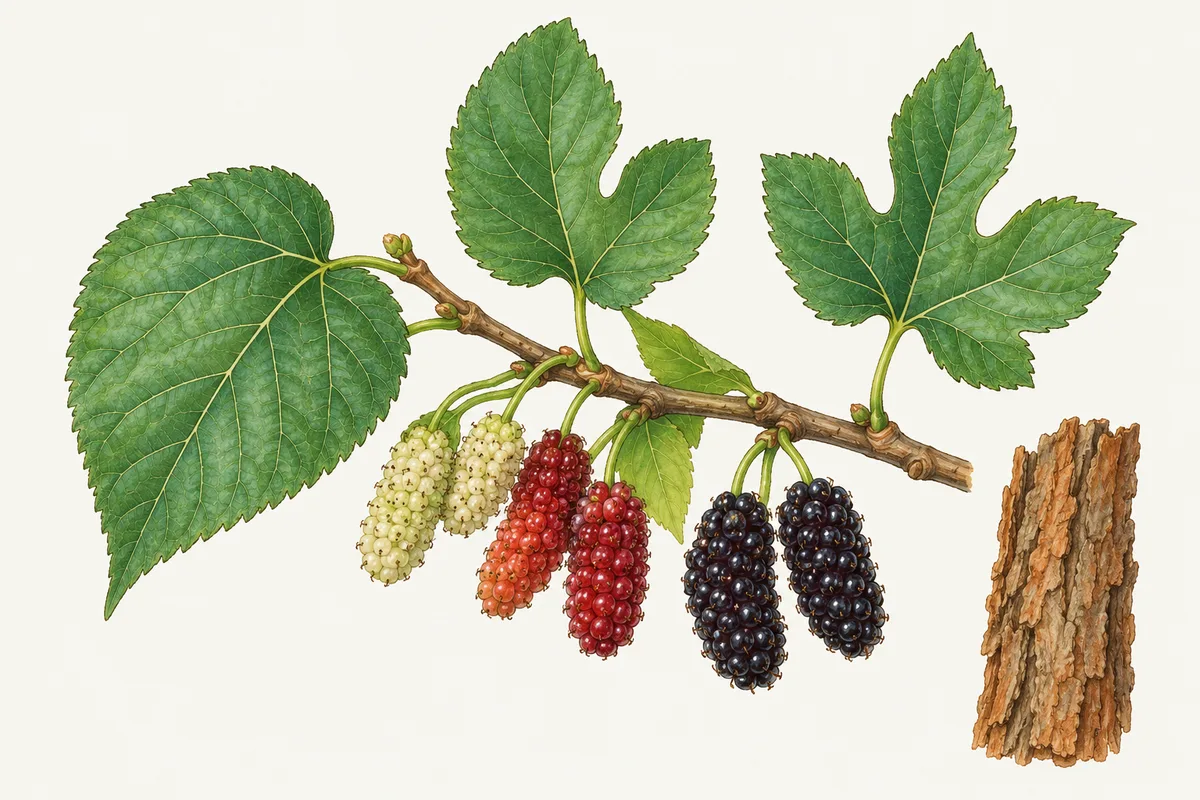
Unlobed, mitten-shaped and three-lobed leaves on one tree, every one of them toothed, and a milky sap when you snap a leaf stalk. Then the leaf surface tells red mulberry from white.
In short
To identify a mulberry tree, look for alternate, toothed leaves 3 to 6 inches long that come in several shapes on the same tree: unlobed and heart-shaped, mitten-shaped, or deeply lobed. Snap a leaf stalk or young twig: mulberries bleed milky sap. Then feel the top of the leaf: rough like sandpaper on native red mulberry, smooth and glossy on introduced white mulberry.
- Several leaf shapes on one tree, all with toothed edges: mulberry. Several shapes with smooth edges and a spicy smell: sassafras.
- Rough, sandpapery upper leaf surface points to red mulberry; smooth, glossy leaves to white mulberry. Hybrids blur the line.
- A 'fruitless mulberry' is a male white mulberry: no fruit, but plenty of pollen in spring.
Field marks at a glance
- Scientific name
- Morus rubra and Morus alba
- Family
- Moraceae (mulberry family)
- Type
- Broadleaf, deciduous
- Leaves
- Alternate, simple, toothed, broadly ovate to nearly round, usually 3 to 6 inches long; unlobed, mitten-shaped or deeply lobed, often several shapes on one tree.
- Leaf surface
- Red mulberry: rough, sandpaper-like above, soft and hairy below. White mulberry: smooth and glossy above, usually hairless below.
- Sap
- Milky white sap from broken leaves and young twigs. A snapped twig also shows silvery-white filaments.
- Flowers
- Small green catkins in spring; male catkins 1 to 2 inches, female about 1 inch. Male and female flowers usually grow on separate trees.
- Fruit
- Cylindrical, blackberry-like clusters about 1/2 to 1 1/4 inches long, on female trees only. Red mulberry ripens red to dark purple; white mulberry white, pink, red, purple or black.
- Twigs and buds
- Slender and zigzag. Red mulberry bud scales have dark brown edges; white mulberry's often lack them.
- Bark
- Orangish to orange-brown on young trees; later gray-brown to gray with long, narrow, scaly ridges.
- Form and size
- Red mulberry 15 to 70 ft, with a short trunk that branches low. White mulberry usually 30 to 50 ft, with a wide, dense, rounded crown.
- Range
- Red mulberry: native to the eastern US, from south Florida to Texas, north to Minnesota and southern Ontario. White mulberry: from China, recorded in every state except Nevada and Alaska (2009).
Mulberries (Morus) are trees of yards, fence lines, roadsides and river bottoms across the United States. Two species account for nearly every tree you will meet: the native red mulberry (Morus rubra) and the white mulberry (Morus alba), introduced from China in the 1600s and now naturalized almost everywhere. Never eat a berry, nut or seed on the strength of a web page or an app; check with a local expert. This page is only about naming the tree.
How to identify a mulberry tree in three checks
1. Several leaf shapes, all toothed. Mulberry leaves are alternate and simple, broadly ovate to nearly round, with a toothed (serrate) edge. The Virginia Tech red mulberry fact sheet gives 3 to 5 inches and says leaves may have no lobes or be "highly dissected into lobes"; its white mulberry fact sheet gives 3 to 6 inches, often irregularly lobed. Walk around the tree: finding heart-shaped, mitten-shaped and three- or five-lobed leaves on the same tree, every one of them toothed, is the strongest single sign of a mulberry.
2. Milky sap. Snap a leaf stalk or the tip of a young twig. Mulberries bleed milky white sap; the USDA Forest Service says white mulberry leaves "exude a milky juice when broken". Virginia Tech adds a twig test: a broken mulberry twig shows fine, silvery-white filaments. Wash your hands afterward. NC State Extension lists red mulberry's milky sap as able to cause contact dermatitis, and the Forest Service describes white mulberry's as toxic to humans and an irritant to skin.
3. Blackberry-like fruit on some trees. Female trees bear cylindrical clusters of tiny fruits, about 1 to 1 1/4 inches long, that look like elongated blackberries. Male and female flowers usually grow on separate trees, so half the mulberries you meet never fruit at all. That is why the leaves and sap, not the fruit, carry the identification.
If you can't reach the leaves, one photo of a low branch with several leaf shapes in the frame gives Tree Identifier enough to suggest a name; white mulberry is one of the species in the app's Collection. The app does not show look-alikes, so check the toothed edges and milky sap yourself before you rule out sassafras.
Red mulberry vs white mulberry
Once you know it's a mulberry, the leaf surface usually tells which one. Rub the top of a leaf between your fingers.
| Feature | Red mulberry (M. rubra) | White mulberry (M. alba) |
|---|---|---|
| Upper leaf surface | Rough, sandpaper-like ("scabrous"), dull green | Smooth and glossy, dark green |
| Underside | Paler, hairy and soft | Usually hairless |
| Leaf length | 3–5 in (Virginia Tech); 2–8 in (UF/IFAS) | 3–6 in (Virginia Tech); 2–7 in (Utah State) |
| Bud scales | Brown-margined | Often lack dark edges |
| Fruit when ripe | Red to dark purple | White, pink, red, purple or black |
| Bark | Gray-brown, long scaly ridges; orangish when young | Orange-brown with lenticels when young, then gray with long narrow ridges |
| Size | 15–70 ft, short trunk, low branches | Up to 40–50 ft, wide spreading crown |
| Origin | Native, eastern US and southern Ontario | China; naturalized nationwide |
The University of Florida's red mulberry fact sheet describes the upper surface as "dull green and rough" with a hairy, fuzzy underside, while Utah State University Extension describes white mulberry leaves as dark green, glossy and usually hairless on both sides. Fruit color is the weakest test: white mulberry fruit, despite the name, can ripen pink, red, purple or nearly black.
Hybrids. The USDA Forest Service's white mulberry review reports that white mulberry hybridizes with red mulberry in North America, that the two species are "highly variable and frequently confused", and that hybrids in Ontario resembled their white mulberry parents more closely, a concern for the native species. If a tree's leaves are rough on some branches and glossy on others, or everything sits in between, call it a mulberry and stop there.
How to identify a young mulberry tree
Mulberry seedlings and saplings are common in yards and along fences, because white mulberry seeds itself readily into disturbed ground. Four marks work on a tree only a few feet tall:
- Deeply lobed leaves. NC State Extension's red mulberry profile notes that lobed leaves are more frequent on new shoots and unlobed leaves in the crown, so a young mulberry often carries mostly lobed leaves. The toothed edge is still there.
- Milky sap from a snapped leaf stalk, the same as on a mature tree.
- Zigzag twigs, slender, green turning red-brown on red mulberry, gray to orange-brown on white mulberry.
- Orange bark. Virginia Tech describes young red mulberry bark as often orangish, especially when wet, and young white mulberry bark as orange-brown with lenticels.
The Forest Service records white mulberry as nonnative and invasive in the United States, establishing in floodplain and riparian forests and on disturbed ground such as roadsides, fencerows and old fields. A young mulberry in a fence line far from any planted tree is more likely white than red. For the general method on small trees, see how to identify trees by their leaves.
How to identify a fruitless mulberry tree
"Fruitless mulberry" is a nursery and landscaping name, not a species. Utah State University Extension says male white mulberry trees produce no fruit and are generally preferred for landscaping, and lists a cultivar sold simply as 'Fruitless'. Because the tree is male, it identifies exactly like any white mulberry:
- the same glossy, toothed, variably lobed leaves, usually hairless on both sides;
- the same milky sap and zigzag twigs;
- in spring, only male catkins, which Utah State describes as longer than the female ones and Virginia Tech gives as narrow, 1 to 2 inches long;
- no fruit in summer, ever, and no seedlings coming up under the tree.
A fruitless mulberry is not pollen-free. The University of Florida warns that male mulberry trees are "extremely allergenic" while female trees cause few or no allergies, so expect pollen, not fruit, from a fruitless mulberry. A tree planted in a front yard, a street strip or a parking lot that never fruits is usually one of these male trees. Our guide to trees in your yard covers how to track down what a builder or a previous owner planted.
Mulberry look-alikes
Sassafras is the tree most often confused with mulberry, because it also grows unlobed, mitten-shaped and three-lobed leaves, sometimes all on one branch. The Virginia Tech sassafras fact sheet gives the difference: sassafras leaves have an entire (smooth) margin, are green on both surfaces, and are fragrant when crushed, while broken twigs smell spicy-sweet. Mulberry leaves are always toothed, have no spicy smell and bleed milky sap. The heart-shaped leaves guide sets both against redbud, linden and catalpa.
Paper mulberry (Broussonetia papyrifera), once classified as a Morus, is in the same family and is the hardest look-alike. NC State Extension's paper mulberry profile describes toothed, oval to mitten-shaped to lobed leaves up to 8 inches long, rough on top and hairy below, much like red mulberry's. Check three things: new stems are hairy, some leaves sit opposite or in whorls instead of alternate, and the fruit on female trees is a round, ball-shaped purple-red cluster rather than an elongated berry. NC State reports it as invasive, spreading into thickets from root suckers.
Virginia Tech also lists Osage-orange and Texas mulberry among the look-alikes on both mulberry fact sheets. Neither is covered in detail here; if a tree passes the toothed-leaf and milky-sap tests but the fruit or leaves look wrong, photograph a twig with leaves and fruit and compare it with those two before settling on red or white mulberry.
Look-alikes and how to tell them apart
Sassafras (Sassafras albidum)
Sassafras also has unlobed, mitten-shaped and three-lobed leaves on one branch, but their edges are smooth, with no teeth, and crushed leaves are fragrant while broken twigs smell spicy-sweet. Mulberry leaves are always toothed and bleed milky sap.
Paper mulberry (Broussonetia papyrifera)
Its leaves are toothed, rough on top and hairy beneath like red mulberry's, and up to 8 inches long, but new stems are hairy and the fruit is a round, ball-shaped purple-red cluster, not a cylindrical berry. Some leaves sit opposite or in whorls, which true mulberries don't do.
Hybrid red x white mulberry
Where both species grow, hybrids are common and in Ontario tend to resemble white mulberry. A tree with half-rough, half-glossy leaves or mixed features is best recorded as 'mulberry' unless an expert can examine it.
What a photo can't settle
- Red and white mulberry hybridize, and the USDA Forest Service says the two are highly variable and frequently confused. Leaf texture is a good guide but not proof; a hybrid can show features of both.
- Male and female flowers usually grow on separate trees, so a tree without fruit may simply be male, or a female in an off year. Fruit color varies within white mulberry and cannot name the species on its own.
- Lobed and unlobed leaves differ between shoots and crown on the same tree, so judge from several leaves, not one, before deciding between mulberry and a look-alike.
Questions people ask
What does a mulberry tree look like?
A small to medium tree, usually 30 to 60 feet, with a short trunk that branches low and a wide, rounded crown. Its leaves are toothed and come in several shapes on the same tree, from heart-shaped to deeply lobed. Female trees carry cylindrical, blackberry-like fruit in early to mid summer.
How do I tell what kind of mulberry tree I have?
Feel the top of a leaf. Red mulberry, the native, is rough like sandpaper above and soft and hairy below. White mulberry, from China, is smooth and glossy above and usually hairless below. Then check the buds: dark-edged scales suggest red, scales without dark edges suggest white. Hybrids are common, so not every tree will fit.
How do you identify a young mulberry tree?
Look for toothed leaves that are often deeply lobed, since lobed leaves are more frequent on new shoots, and a zigzag twig. Snap a leaf stalk: milky sap. Young bark is orangish to orange-brown, and white mulberry's shows lenticels. Seedlings of white mulberry come up readily along fences, roads and old fields.
How do you identify a fruitless mulberry tree?
A fruitless mulberry is a male white mulberry, planted because it drops no fruit. It has the same glossy, toothed, variably lobed leaves and milky sap as any white mulberry, but in spring it carries only long male catkins and no fruit ever follows. Utah State University lists a cultivar named 'Fruitless'.
What tree looks like a mulberry?
Sassafras is the usual mix-up, because it also has unlobed, mitten and three-lobed leaves, but its leaf edges are smooth and it smells spicy. Paper mulberry has similar toothed, rough leaves but round fruit and hairy new stems. Virginia Tech also lists Osage-orange and Texas mulberry among the look-alikes.
Sources
- Red mulberry fact sheet — Virginia Tech Dendrology
- White mulberry fact sheet — Virginia Tech Dendrology
- Morus alba, white mulberry (Fire Effects Information System) — USDA Forest Service
- Morus rubra (Red Mulberry) — NC State Extension Gardener Plant Toolbox
- Morus rubra, Red Mulberry (FR326) — University of Florida IFAS Extension
- Mulberry, White (TreeBrowser) — Utah State University Extension
- Broussonetia papyrifera (Paper Mulberry) — NC State Extension Gardener Plant Toolbox
- Sassafras fact sheet — Virginia Tech Dendrology