Field guide
Fruit tree identification by leaf, bark and blossom
The five common backyard fruit trees can be told apart without fruit. The variety is another matter, and it usually takes the fruit plus an expert or a lab.
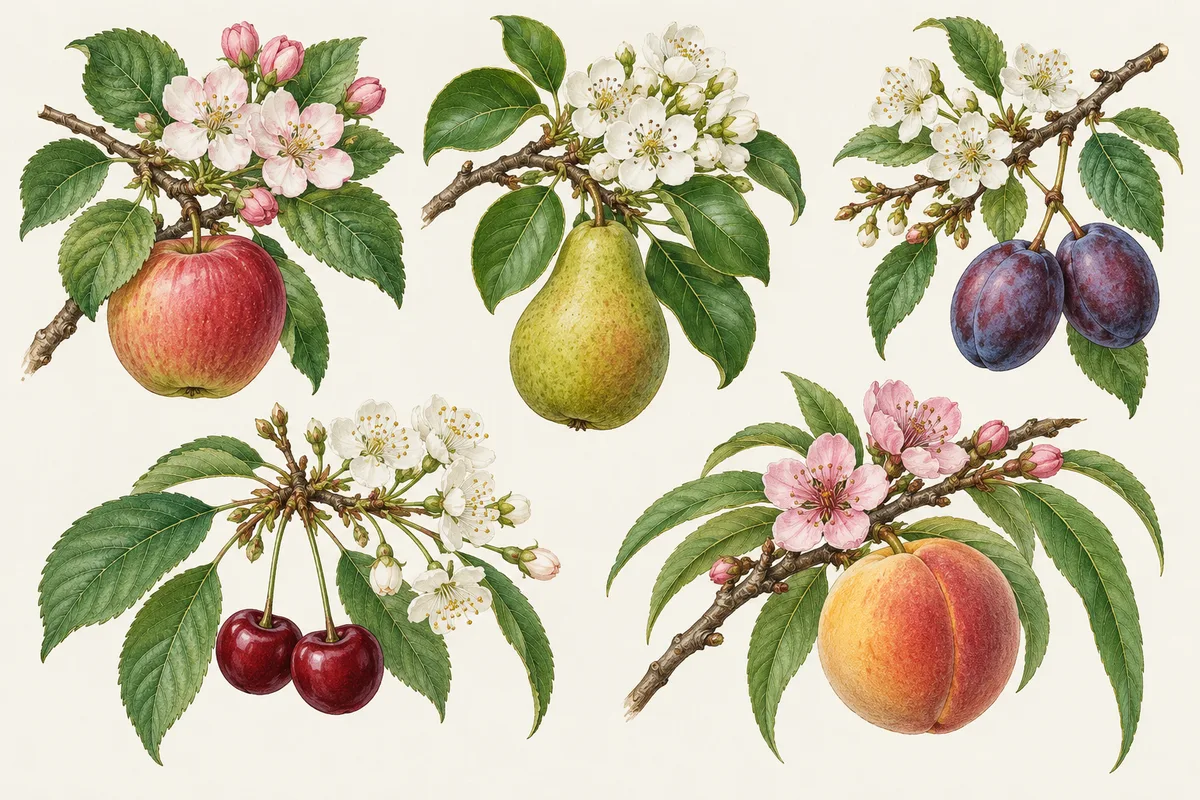
In short
Fruit tree identification starts with the leaf and the bark. Two tiny glands at the base of a toothed leaf and bark with strong horizontal lines point to a cherry or a peach; a peach leaf is long, narrow and curls along the midrib. Without glands, oval leaves 1 to 4 inches on an upright tree suggest a pear; variable leaves with raised veins beneath, an apple. The variety needs fruit or DNA.
- Look for two small glands where a cherry or peach leaf blade meets its stalk; NC State's apple and pear profiles list none.
- Peach and European plum bloom before the leaves; sweet cherry blooms as the leaves emerge.
- Hundreds of apple varieties exist; extension horticulturists say it is almost impossible to name one by looking at the fruit.
Fruit tree identification works at two levels. Telling an apple from a pear, a plum, a cherry or a peach is a field skill: the leaves, bark, blossoms and shape of the tree are enough. Naming the variety, say 'Honeycrisp' or 'Bartlett', is a different problem that usually needs the fruit and an expert, and sometimes a DNA test. Never eat a berry, nut or seed on the strength of a web page or an app; check with a local expert.
The five fruit trees side by side
| Apple | Pear | Plum (European) | Cherry (sweet, sour) | Peach | |
|---|---|---|---|---|---|
| Leaf | Very variable; raised veins underneath, may be hairy | Oval, 1–4 in, toothed; yellow in fall | Egg-shaped, 2–4 in, wedge base, toothed, hairy above | Toothed; 2 small glands at the base of the blade (sweet); grooved stalk | Long and narrow, 2–6 in, long-pointed tip, toothed, 2 glands; curls along the midrib |
| Bark | Gray, smooth, raised lenticels | Smooth and gray with lenticels; blocky or furrowed with age | Thin, smooth | Strong horizontal lenticels; gray ridges on old wood | Gray with horizontal lenticels; rough and scaly with age |
| Blossom | 1–1.5 in, white tinged pink, clusters of 4–6 | White, in clusters; April in the Southeast | White, single or paired, before leaves | White; with the leaves (sweet), groups of 3–5 in late spring (sour) | Pink, single or paired, before leaves, fragrant |
| Habit | Dense, rounded; 15–30 ft from seed, smaller on dwarfing rootstock | Upright; 40–50 ft, usually grafted smaller | Large shrub or small tree, 10–20 ft | Sweet: conical, 15–30 ft; sour: rounded, to 30 ft | Open, spreading, 15–25 ft, often several trunks |
| Fruit | Round, firm, late summer or fall | Variable; teardrop shape most familiar | Blue to black drupe, 2–3 in, September | Fleshy drupe, long stem (sweet); round, red, sour (sour) | Fuzzy (smooth in nectarines), summer |
All rows come from the NC State Extension Gardener Plant Toolbox profiles of each species.
Leaves: start with the glands
Pick a typical leaf from the outer crown and look at the place where the blade meets the leaf stalk. The NC State profile of sweet cherry describes 2 small red or green glands at the base of the blade and a grooved leaf stalk; sour cherry leaves sometimes have them too. Peach leaves also carry 2 small glands at the base. Apple and pear profiles mention no such glands.
Then read the shape:
- Peach. The NC State peach profile gives leaves 2 to 6 inches long but only 1/2 to 1.5 inches wide, with a long-pointed tip, a toothed edge and a tendency to curl inward along the central vein.
- Plum. European plum leaves are egg-shaped, 2 to 4 inches long and 1 to 2 inches wide, with a wedge-shaped base, a pointed tip and a hairy upper surface.
- Pear. Pear leaves are oval and toothed, 1 to 4 inches long, and turn yellow in fall.
- Apple. NC State calls apple leaf shape and size "very variable"; the underside has raised veins and may be hairy.
All five have alternate leaves.
Bark: horizontal lines mean Prunus
Cherry and peach bark carries lenticels, the small breathing pores of bark, stretched into horizontal lines. NC State describes sweet cherry bark as having "very distinct horizontal lenticels", with old wood gray and horizontally ridged; sour cherry bark is gray-brown, may peel and has prominent horizontal lenticels; peach bark is gray with horizontal lenticels and becomes rough and scaly with age.
Apple bark is gray and smooth with raised lenticels, and NC State notes it looks similar to Prunus bark, so bark alone won't separate an apple from a young cherry. Pear bark starts smooth and gray, then becomes blocky or furrowed. European plum has thin, smooth bark on mature trees. For bark in general, see how to identify trees by bark.
Blossoms: color, cluster and timing
Spring is the easiest season for fruit tree identification, because the five trees flower differently.
- Peach: pink flowers, single or in pairs, 1 to 1.5 inches across, fragrant, opening before the leaves.
- Plum: showy white flowers with five petals and long stamens, single or in pairs, before the leaves. NC State notes European plum is the latest-blooming plum.
- Sweet cherry: white flowers 1 to 1.5 inches across, one to a few in a rounded cluster, emerging with the leaves. Sour cherry flowers come in groups of 3 to 5 in late spring.
- Apple: flowers 1 to 1.5 inches, white with a pink tinge that fades, in clusters of 4 to 6. The central "king bloom" opens first, according to the NC State apple profile.
- Pear: white flowers with parts in fives, in clusters. NC State Extension's Callery pear publication lists common pear as blooming in April in the Southeast, while ornamental Callery pear blooms from February to April.
If a pear-like tree blooms early and its flowers smell like rotting fish, it is a Callery pear, not a fruiting pear: see the Bradford pear page. Ornamental flowering cherries are covered on the cherry tree page.
Shape of the tree
Habit helps when the tree is bare. Peach grows to 15 to 25 feet with a rounded, open crown of upward-growing branches, and often has several trunks unless pruned. European plum is a large shrub or small tree, 10 to 20 feet, and may carry some spines. Sweet cherry is columnar to conical. Pear is upright and spreading. An apple grown from seed reaches 15 to 30 feet with a dense, rounded crown.
Size is a weak clue in a yard, though. NC State notes that many apple trees sold are grafted onto dwarfing rootstocks that keep them much smaller, and that pears are usually grafted onto a dwarfing rootstock too.
Naming the variety: fruit, records and DNA
Here an honest answer matters. Once you know the tree is an apple, NDSU Extension's horticulturist writes that there are hundreds of varieties and that it is almost impossible to look at an apple and say which one it is. NDSU's suggested route is a DNA test: Washington State University's MyFruitTree.org sends a kit, you snip young leaves into the tubes and mail them back, and the lab compares them with a database of thousands of apple trees. The result may be an exact match, a description of the tree's ancestry, or the finding that it is a one-of-a-kind seedling.
For pears, plums, cherries and peaches the logic is the same. A variety is defined mostly by its fruit (size, color, flavor, ripening date) and by its genetics, not by its leaves. The best evidence you can collect is the ripe fruit, the date it ripened, photos of the blossom and any records from the previous owner or the nursery. Take that to your county extension office.
Two traps. First, grafted trees can sprout from the rootstock at their base; NC State's Callery pear publication notes that such sprouts are genetically different enough to cross-pollinate with the flowers on the grafted top, so fruit from a sprout tells you nothing about the variety above it. Second, a tree that came up from a seed may turn out, as NDSU puts it, to be a one-of-a-kind seedling with no variety name at all.
What a photo app can and can't do here
A photo of a leaf, a blossom or the bark is usually enough for Tree Identifier to say apple, pear, plum, cherry or peach; all five are in the app's Collection. It cannot tell you the variety, and it shows no confidence score, so check its answer against the glands, bark and blossom tests above. Tree Identifier's Care Guide and follow-up chat can help with general care questions once you know the species. NC State reports peach seeds and wilted leaves as poisonous, especially in quantity; for anything about eating fruit from an unknown tree, ask a local expert. For the general method, see how to identify trees.
What a photo can't settle
- A photo can name the species (apple, pear, plum, cherry, peach) but not the variety: NDSU Extension calls naming an apple variety by sight almost impossible.
- Many fruit trees are grafted onto rootstocks; sprouts from the rootstock are a different plant from the grafted top, and a photo of one says nothing about the variety.
- Ornamental cherries, plums and pears are close relatives of the fruiting ones; without fruit, a photo may not tell them apart.
Questions people ask
How do I identify what type of apple tree I have?
You can confirm it is an apple from the leaves, blossoms and bark, but the variety is much harder. NDSU Extension says there are hundreds of varieties and it is almost impossible to name one by looking at the fruit. Its suggested route is a mail-in DNA test from Washington State University's MyFruitTree.org, using young leaves.
How do I know what pear tree I have?
First rule out Callery (Bradford) pear: it blooms early, its flowers smell like rotting fish and its fruit is small and hard. A common pear has 1 to 4 inch oval, toothed leaves, white spring flowers and teardrop fruit. For the variety, take the ripe fruit, its ripening date and any planting records to your county extension office.
How can you tell a cherry tree from a plum tree?
Look at the bark and the bloom. Sweet and sour cherries have bark with prominent horizontal lenticels and flowers that open with the leaves, in clusters. European plum has thin, smooth bark and flowers singly or in pairs before the leaves, and its 2 to 4 inch leaves are hairy on top.
How do you identify a peach tree?
Peach leaves are long and narrow, 2 to 6 inches by 1/2 to 1.5 inches, with a long-pointed tip, a toothed edge, two small glands at the base and a tendency to curl along the midrib. Pink flowers open singly or in pairs before the leaves, and the tree is 15 to 25 feet with an open, spreading crown.
Can an app tell me the variety of my fruit tree?
No photo app can reliably name a fruit variety. It can tell you apple, pear, plum, cherry or peach, which is the species. Varieties differ mainly in fruit traits and genetics, so the reliable routes are fruit taken to an expert, nursery or planting records, or a DNA test.
Sources
- Malus domestica (apple) — North Carolina Extension Gardener Plant Toolbox, NC State University
- Pyrus communis (common pear) — North Carolina Extension Gardener Plant Toolbox, NC State University
- Prunus domestica (common plum) — North Carolina Extension Gardener Plant Toolbox, NC State University
- Prunus avium (sweet cherry) — North Carolina Extension Gardener Plant Toolbox, NC State University
- Prunus cerasus (sour cherry) — North Carolina Extension Gardener Plant Toolbox, NC State University
- Prunus persica (peach) — North Carolina Extension Gardener Plant Toolbox, NC State University
- Dakota Gardener: Apple tree identification — mystery solved! — NDSU Extension (North Dakota State University)
- Callery Pear: Bradford Pear, Other Varieties, and Their Invasive Offspring — NC State Extension
Keep reading
- Tree profileCherry trees (Prunus): how to identify them
- Invasive tree profileBradford pear and Callery pear (Pyrus calleryana): how to identify them
- Clue guideWhich tree has white flowers? Start with the month
- Field guideTree bark identification: seven bark types and the trees that have them
- Field guideHow to identify trees, step by step