Clue guide
Which tree has white flowers? Start with the month
White-flowering trees bloom in a predictable order, from star magnolia in March to catalpa in June. Note the month, then check the flower shape and the leaves.
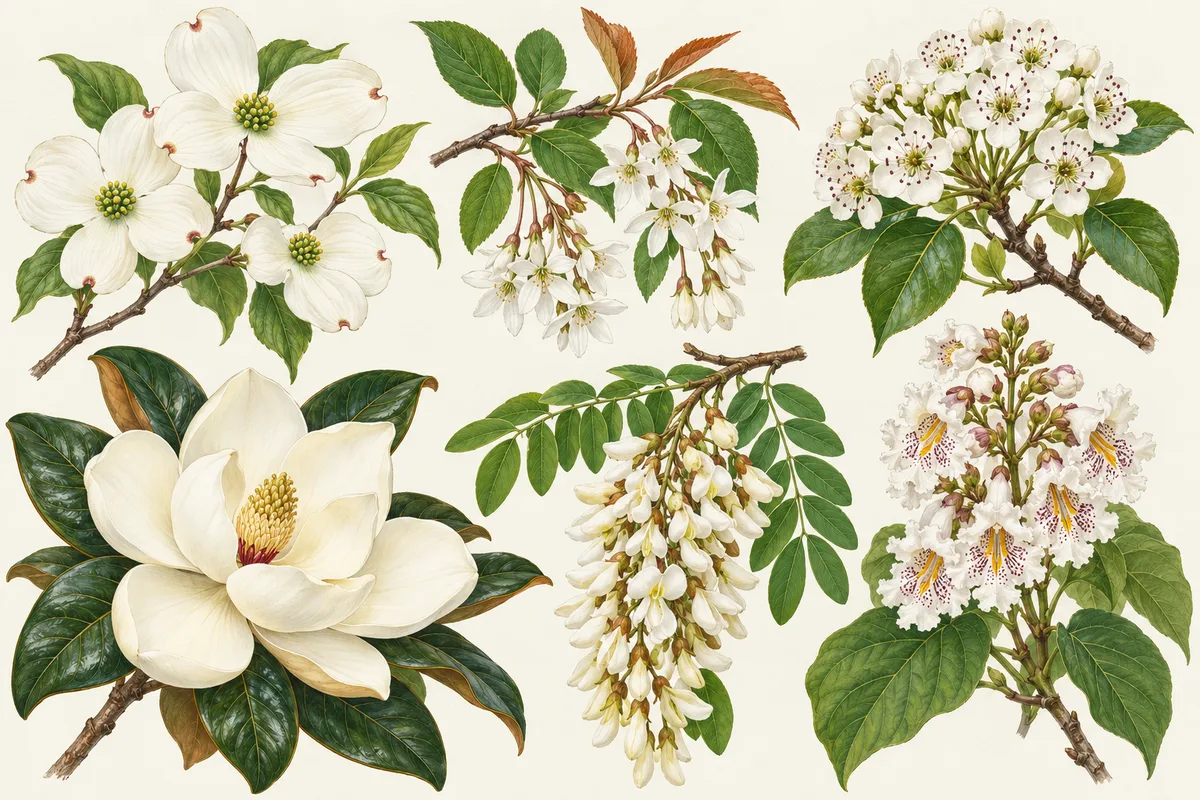
In short
A tree with white flowers in early spring is most often a Callery (Bradford) pear, which blooms February to April and smells like rotting fish, a serviceberry with drooping star-shaped flowers, or a flowering dogwood with four notched, petal-like bracts. Yoshino cherry and star magnolia bloom in March; black locust, southern magnolia and catalpa follow from April to June.
- A white-flowering tree that smells like rotting fish in early spring is almost always a Callery pear, including the Bradford cultivar.
- Dogwood's 'petals' are four notched bracts around a small cluster of green true flowers.
- White flowers followed by long, thin seed pods mean catalpa (pods 12 to 22 inches) or black locust (flat pods 2 to 4 inches).
A tree with white flowers can usually be named from three facts: the month it is blooming, the shape of a single flower, and the leaves (or the lack of them). This guide lists the common white-flowering trees of the United States in bloom order, then gives the field checks for each.
White-flowering trees by bloom month
| Tree | Typical bloom | Flower | Leaves at bloom time |
|---|---|---|---|
| Callery pear, incl. Bradford (Pyrus calleryana) | February–April (Southeast) | Showy white, smelling of rotting fish | Glossy, oval, toothed; leafs out early |
| Star magnolia (Magnolia stellata) | March | Fragrant, star-shaped, 12 to 18 narrow tepals | None yet |
| Yoshino cherry (Prunus × yedoensis) | March–April | Fragrant, white or pink-tinged, in clusters of 3 to 6 | Before or with the leaves |
| Chickasaw plum (Prunus angustifolia) | March–April (Southeast) | White | — |
| Downy serviceberry (Amelanchier arborea) | March–May | Drooping clusters of 6 to 14 star-shaped flowers | Before or with the leaves |
| Flowering dogwood (Cornus florida) | March–April (Southeast); March–May | 4 white, notched bracts around tiny green flowers | Before the leaves |
| Black cherry (Prunus serotina) | April–May (Southeast) | White | — |
| Common pear (Pyrus communis) | April (Southeast) | White | — |
| Black locust (Robinia pseudoacacia) | April–June | Fragrant, pea-like, in hanging clusters 5–8 in | Compound, 7 to 23 leaflets |
| Southern magnolia (Magnolia grandiflora) | May–June, a few through summer | Fragrant, creamy, 8–12 in across | Evergreen, leathery, 5–10 in |
| Northern catalpa (Catalpa speciosa) | May–June | Bell-shaped, about 2 in, purple and yellow spots | Large, heart-based, up to 12 in |
Bloom windows for Callery pear, Chickasaw plum, black cherry and common pear come from the Southeastern table in NC State Extension's Callery pear publication; dogwood and serviceberry appear there and in the NC State Plant Toolbox; magnolias, cherry, locust and catalpa come from the NC State Plant Toolbox and the Missouri Botanical Garden Plant Finder (St. Louis). Farther north, expect each window to start later.
Callery pear: the one that smells
If a white-flowering tree along a road or parking lot smells like rotting fish in early spring, it is almost certainly a Callery pear. NC State Extension writes that the flowers "emit an unpleasant odor, often described as rotting fish", attributed to chemicals the flowers release to attract pollinators. Bradford is the best-known cultivar, developed in the 1950s; other varieties include Chanticleer, Cleveland Select, Autumn Blaze and Aristocrat.
To confirm it, check the leaves: glossy and oval with serrated edges, turning red or purple in fall. The fruit is small and hard. NC State lists Callery pear's bloom as February to April in the Southeast, ahead of most native trees, which is why wild stands show up as white drifts along highways each spring. Once the original Bradford trees could cross-pollinate with newer varieties, they began setting fertile seed; birds spread it, and the wild offspring can carry thorns up to 4 inches long. Details, look-alikes and state sale bans are on the Bradford pear page.
Serviceberry, dogwood and cherries: the early-spring natives and ornamentals
Downy serviceberry. Look for drooping clusters of 6 to 14 star-shaped white flowers on a small tree with no leaves yet, or with leaves just unfolding. The NC State Plant Toolbox gives a bloom window of March to May, with flower clusters 3 to 7 inches long. Young leaves are covered with fine hairs underneath. Serviceberry grows wild from New Brunswick to Florida and west to Minnesota and Texas.
Flowering dogwood. What looks like four white petals is four bracts, each about 2 inches long and notched at the tip, around a small button of green true flowers, according to the NC State profile. It blooms before the leaves, from March to May. The leaves that follow are opposite, with veins that curve up toward the tip, and the tree carries clusters of glossy red fruit from August to October.
Yoshino cherry and other cherries. The Missouri Botanical Garden lists Yoshino cherry as blooming March to April, with fragrant white flowers, sometimes tinged pink, in clusters of 3 to 6 that open before or with the leaves. Small black cherries about half an inch across follow, and the leaves are toothed, elliptic to oval, up to 5 inches long. Wild black cherry blooms later, April to May in the Southeast, according to NC State. The cherry tree page covers how to tell cherries apart by bark and leaf.
Magnolias: early stars and summer giants
Star magnolia is a small tree, 15 to 20 feet tall, often grown as a large shrub, from Japan. The Missouri Botanical Garden's Plant Finder gives March as its bloom time, with fragrant, star-shaped white flowers in late winter to early spring, each with 12 to 18 narrow, strap-like tepals (petal-like parts). The Garden notes that frost damage to the flowers is a concern.
Southern magnolia blooms much later and is unmistakable. The NC State profile describes fragrant, creamy white flowers 8 to 12 inches across, opening from May to June, with sparse flowering through summer. The leaves are evergreen, leathery and glossy, 5 to 10 inches long, often with rusty-brown fuzz underneath. NC State gives its distribution as Maryland southwest to Texas and southeast to Florida.
Black locust and catalpa: late spring, with pods
Black locust blooms from April to June with fragrant, pea-like white flowers in hanging clusters 5 to 8 inches long. The NC State profile describes alternate, pinnately compound leaves with up to 23 leaflets and flat, purple-brown seed pods 2 to 4 inches long that can stay on the tree through winter. Native to the Appalachian and Ozark mountains, it has naturalized in all 48 contiguous states. For the locusts in more depth, see the locust page.
Northern catalpa is the late-spring answer to "white flowers and long seed pods". The Missouri Botanical Garden's Plant Finder entry lists a May to June bloom of bell-shaped, orchid-like white flowers up to 2 inches long, with purple and yellow spotting inside, in upright clusters. Slender green pods 12 to 22 inches long follow, ripen brown in fall and split lengthwise. Its broad leaves reach 12 inches and are rounded to heart-shaped at the base. For other heart-shaped leaves, see trees with heart-shaped leaves.
How to tell them apart in the field
- Look closely at one flower. Four notched "petals" around a green button: dogwood. A star of 12 to 18 narrow tepals: star magnolia. Pea-shaped: black locust. Bell-shaped and spotted inside: catalpa. Wider than your hand: southern magnolia. Small, open flowers in clusters: pear, cherry, plum or serviceberry, so go on to steps 2 and 3.
- Smell it. Fishy: Callery pear. Sweet and fragrant: black locust, star magnolia, southern magnolia, Yoshino cherry.
- Check the leaves. None yet: star magnolia, dogwood, often serviceberry. Compound: black locust. Huge and evergreen: southern magnolia. Opposite: dogwood.
- Note the month and your region. A white tree in February in Georgia and one in June in Illinois are not the same list.
A photo while it is in bloom
Flowers last only a week or two, so a photo taken now is worth more than a description later. Tree Identifier names a tree from one photo of the flowers, leaves or the whole crown; flowering dogwood, southern magnolia, black locust and Japanese flowering cherry are in its Collection, and it also names trees outside the Collection, such as Callery pear. Tree Identifier shows no confidence score, so check its answer against the petal count and leaves above. If you allow location, its Tree Map pins the find so you can come back in fall for the fruit and fall color.
What a photo can't settle
- Bloom months shift by weeks from Florida to Minnesota and from one spring to the next; the table gives typical windows from the sources, not a calendar for your yard.
- Many white-flowering trees are planted cultivars (ornamental cherries, crabapples, Callery pear varieties); a photo can name the species but rarely the cultivar.
- Wild Callery pear offspring can look different from the planted Bradford pear, with thorns and a less regular shape.
Questions people ask
What tree has white flowers that smell bad?
Callery pear, the species that includes the Bradford pear. NC State Extension says its flowers give off an unpleasant odor often described as rotting fish, from chemicals the flowers release to attract pollinators. It blooms in early spring, February to April in the Southeast, often before other trees leaf out.
What tree has white flowers and long seed pods?
Usually a catalpa. Northern catalpa blooms in May and June with bell-shaped white flowers spotted purple and yellow, then hangs slender pods 12 to 22 inches long that ripen brown in fall. Black locust also has white flowers and pods, but its pods are flat and only 2 to 4 inches long.
What is the first tree to bloom white in spring?
In much of the Southeast, Callery pear, which can open in February. Star magnolia, Yoshino cherry, serviceberry and Chickasaw plum follow in March, with flowering dogwood from March to April. Exact dates shift by several weeks with latitude and the weather each year.
How do I tell a Bradford pear from a dogwood?
Smell first: Callery pear flowers smell like rotting fish. Then look at one flower. A dogwood 'flower' is four notched bracts around a button of tiny green flowers, on bare twigs; its leaves come later and are opposite with smooth edges. Callery pear has many small white flowers and glossy, oval leaves with serrated edges.
What tree has big white flowers in summer?
Southern magnolia. Its fragrant, creamy white flowers are 8 to 12 inches across and open mainly in May and June, with a few more through summer, against glossy evergreen leaves 5 to 10 inches long. Catalpa also blooms white in late spring and early summer, in upright clusters of smaller bell-shaped flowers.
Sources
- Callery Pear: Bradford Pear, Other Varieties, and Their Invasive Offspring — NC State Extension
- Amelanchier arborea (downy serviceberry) — North Carolina Extension Gardener Plant Toolbox, NC State University
- Cornus florida (flowering dogwood) — North Carolina Extension Gardener Plant Toolbox, NC State University
- Prunus × yedoensis (Yoshino cherry), Plant Finder — Missouri Botanical Garden
- Magnolia stellata (star magnolia), Plant Finder — Missouri Botanical Garden
- Magnolia grandiflora (southern magnolia) — North Carolina Extension Gardener Plant Toolbox, NC State University
- Robinia pseudoacacia (black locust) — North Carolina Extension Gardener Plant Toolbox, NC State University
- Catalpa speciosa (northern catalpa), Plant Finder — Missouri Botanical Garden
Keep reading
- Invasive tree profileBradford pear and Callery pear (Pyrus calleryana): how to identify them
- Clue guideTrees with heart-shaped leaves, and how to tell them apart
- Tree profileCherry trees (Prunus): how to identify them
- Tree profileLocust trees: how to identify black locust and honey locust
- Clue guideWhich tree has red berries? Sort it by leaf and season