Tree profile
Locust trees: how to identify black locust and honey locust
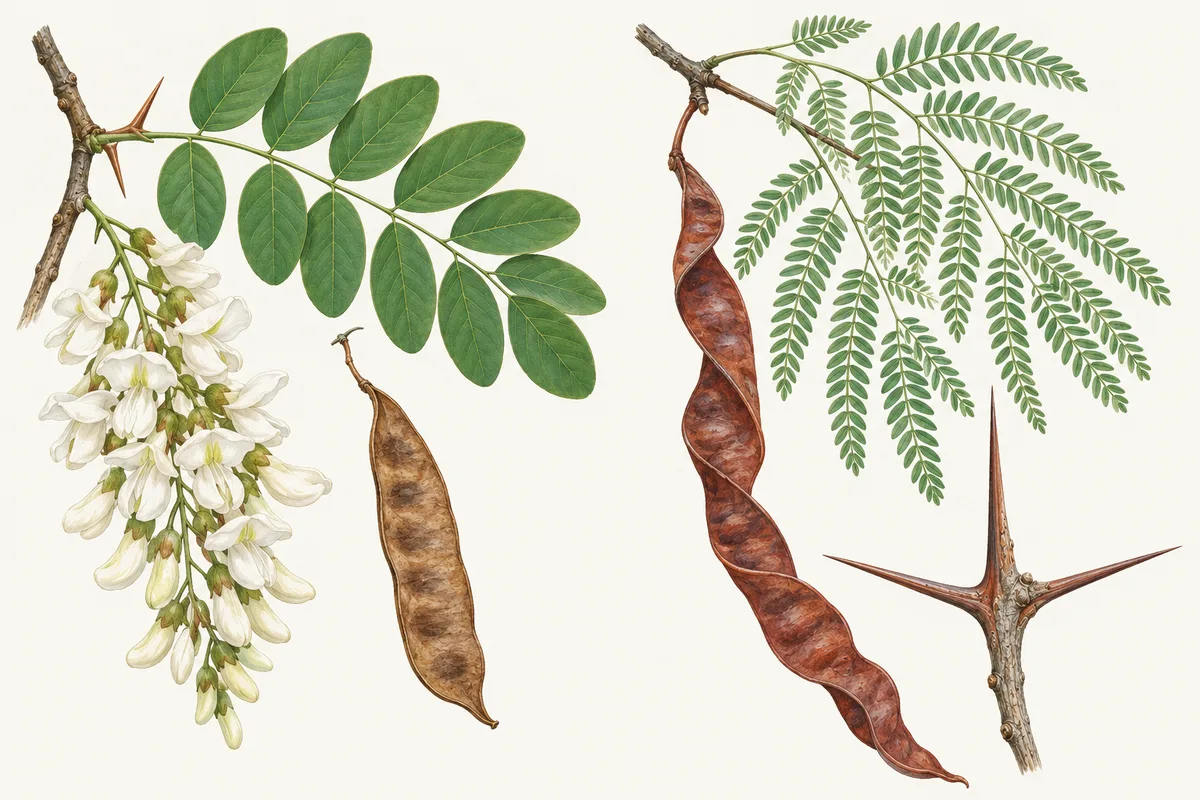
Two unrelated-looking trees share the name. Paired spines and short pods mean black locust; branched thorns and long twisted pods mean honey locust.
In short
Locust tree identification means telling two trees apart. Black locust has 7 to 19 oval, smooth-edged leaflets about an inch long, a pair of short spines at each leaf scar, white fragrant flowers in hanging clusters and flat pods 2 to 4 inches long. Honey locust has smaller, more numerous leaflets, branched thorns on twigs and trunk, and twisted pods 6 to 8 inches long.
- Thorns: a pair of short spines at each leaf scar is black locust; large branched thorns, often in clusters on the trunk, are honey locust.
- Pods: 2 to 4 inches and flat is black locust; 6 to 8 inches, leathery and twisted is honey locust.
- Yard honey locusts are often thornless cultivars, and many of them set few or no pods.
Field marks at a glance
- Scientific name
- Robinia pseudoacacia and Gleditsia triacanthos
- Family
- Fabaceae (legume family)
- Type
- Broadleaf, deciduous
- Leaves
- Both alternate and compound. Black locust: 8 to 14 inches, 7 to 19 oval leaflets about 1 inch long, smooth edges. Honey locust: 5 to 8 inches, 15 to 30 leaflets 1/2 to 1 1/2 inches long, or doubly compound.
- Thorns
- Black locust: paired spines at each leaf scar, often absent on older or slow-growing twigs. Honey locust: large branched thorns on twigs and in clusters on the trunk, except thornless forms.
- Pods
- Black locust: flat, light brown, 2 to 4 inches, with 4 to 8 seeds. Honey locust: flat, red-brown, leathery, 6 to 8 inches, drying and twisting, with many shiny seeds.
- Flowers
- Black locust: showy, white, fragrant pea-like flowers in hanging clusters about 5 inches long, mid to late spring. Honey locust: small greenish-yellow, fragrant but not showy, late spring to early summer.
- Bark
- Black locust: thick, fibrous, deeply ridged and furrowed, like woven rope. Honey locust: smooth with horizontal lenticels when young, later long, narrow, curling plates.
- Size
- Black locust usually 40 to 60 ft, up to 100 ft on good sites. Honey locust 70 to 80 ft in natural stands, up to 140 ft on the best sites.
- Range
- Black locust: native to the Appalachians and the Ozark and Ouachita region, now naturalized across the US. Honey locust: east-central US, Pennsylvania to South Dakota and Texas.
"Locust" is the name for two different trees in the legume family: black locust (Robinia pseudoacacia) and honey locust (Gleditsia triacanthos). Both have compound leaves, both make pods, and both can be thorny, which is why they are confused. Thorns, pods and leaflets tell them apart in under a minute.
Black locust vs honey locust: the four checks
The table draws on the Virginia Tech Dendrology fact sheets for black locust and honeylocust.
| Feature | Black locust | Honey locust |
|---|---|---|
| Thorns | A pair of short spines at each leaf scar; often absent on older or slow twigs | Large, branched thorns on twigs and in clusters on the trunk (none on thornless forms) |
| Leaves | 8–14 in, 7–19 leaflets | 5–8 in, 15–30 leaflets, or doubly compound with 4–7 pairs of side branches |
| Leaflets | Oval, about 1 in, smooth edges | 1/2–1 1/2 in, ovate to elliptical |
| Pods | Flat, light brown, 2–4 in, 4–8 seeds | Flat, red-brown, leathery, 6–8 in, drying and twisting, many seeds |
| Flowers | White, showy, fragrant, pea-like, in hanging clusters about 5 in long; mid to late spring | Small, greenish yellow, not showy but very fragrant; late spring to early summer |
| Bark | Thick, fibrous, ridged like woven rope | Smooth with horizontal lenticels, later long narrow curling plates |
| Twigs | Zigzag, red-brown; buds hidden under the leaf scar | Prominently zigzag; side buds very small and sunken |
1. Thorns. On a black locust, look at a vigorous young twig: two short spines sit at the base of each leaf, one on each side. On a wild honey locust, the thorns are much bigger and branched, and they grow in clusters straight out of the trunk.
2. Pods. Look under the tree in fall and winter. Black locust pods are short and flat, 2 to 4 inches, light brown. Honey locust pods are long (6 to 8 inches), leathery and red-brown, and twist as they dry.
3. Leaflets. Black locust leaflets are oval, about an inch long and smooth-edged; Virginia Tech says the leaves resemble sprigs of grapes. Honey locust's are smaller and far more numerous, giving a fine, feathery look, and some leaves are doubly compound.
4. Bark. Black locust bark is deeply ridged and furrowed, like a woven rope. Honey locust bark starts smooth with horizontal lenticels and breaks into long, narrow plates that curl at the edges.
Both trees are in Tree Identifier's Collection, and a photo of a leaf, the bark or a pod is enough for the app to suggest a name. It shows no confidence score, so when the answer is "locust", the four checks above confirm which one.
Black locust: flowers, spines and rope bark
Black locust, also called yellow locust, is easiest to name in mid to late spring, when it hangs out clusters of white, pea-like, fragrant flowers about 5 inches long. The rest of the year, look for the paired spines on young twigs, the rope-like bark and the short flat pods.
The USDA Forest Service's Silvics of North America describes a disjunct native range: an eastern section centered on the Appalachians, from central Pennsylvania and southern Ohio to northeastern Alabama and northern Georgia, and a western section in the Ozark Plateau and the Ouachita Mountains. It has been planted widely and is now naturalized throughout the United States and southern Canada. It is a nitrogen fixer, often planted for land reclamation, and it often forms thickets by root suckering (Virginia Tech). Typical trees are 40 to 60 feet tall; on better sites, up to 100 feet.
For other spring-flowering trees, see trees with white flowers.
Honey locust: thorns, pods and feathery leaves
Honey locust, also called sweet-locust or thorny-locust, grows naturally in the east-central United States, from central Pennsylvania west to southeastern South Dakota and south to central and southeastern Texas, according to the Forest Service's honeylocust chapter. In natural stands it reaches 70 to 80 feet; on the best sites, 140 feet.
Its leaves are fine-textured, as NC State describes them: 15 to 30 small leaflets, or doubly compound leaves with 4 to 7 pairs of side branches. NC State's Plant Toolbox notes that juvenile leaves are doubly compound while mature leaves are singly compound, and that leaves turn yellow in early fall. On wild trees the long pods mature in late summer and early fall (Virginia Tech) and are hard to miss.
Thornless honey locust in yards and streets
Planted honey locusts are usually thornless: the Forest Service notes that honeylocust, especially the thornless form, is widely cultivated as an ornamental and shade tree. The thornless variety, Gleditsia triacanthos var. inermis, occurs in the wild, and the Forest Service notes that it has been planted to replace the elm in many urban areas. Even on thorny trees, the Forest Service reports that thorn production diminishes and finally stops in the upper and outer crown as the tree ages; cuttings taken from that thornless zone generally stay thornless.
NC State Extension's Plant Toolbox lists the cultivars sold in the trade, among them 'Emerald Kascade', 'Halka', 'Impcole' (IMPERIAL), 'Moraine', 'Shademaster', 'Skycole' (SKYLINE), 'Summer Lace' and 'Sunburst'. It describes IMPERIAL as rounded, compact, thornless and seedless, and SKYLINE as pyramidal, thornless and seedless, up to 40 to 45 feet. It adds that most thornless cultivars bear no fruit, though some occasionally set many pods, and that the tree grows in USDA hardiness zones 4a to 9b.
On a yard tree with no thorns and no pods, identify honey locust by the feathery leaves of many small leaflets, the prominently zigzag twigs with tiny sunken buds, and the bark that breaks into long, curling plates. For other trees around the house, see identify trees in your yard.
Locust look-alikes and pods on the ground
Tree of heaven also has long compound leaves. It has no thorns, its leaves are 1 to 3 feet long with 11 to 41 leaflets that each carry one or two gland-tipped teeth near the base (Virginia Tech), and the crushed leaves smell strongly unpleasant. See tree of heaven.
Black walnut saplings have compound leaves too, but no thorns, 10 to 24 pointed, finely toothed leaflets, chambered pith and round husked nuts (Virginia Tech).
Pods are often the first thing people notice. Never eat a berry, nut or seed on the strength of a web page or an app; check with a local expert. For pods, nuts and seeds of other trees, see identifying trees by seeds and nuts. Tree Identifier's Tree Map keeps each located identification, which helps if you want to see a black locust again in flower next May.
Look-alikes and how to tell them apart
Tree of heaven (Ailanthus altissima)
Tree of heaven has no thorns and much larger leaves, 1 to 3 feet with 11 to 41 lance-shaped leaflets 2 to 6 inches long, each with one or two gland-tipped teeth at the base. Crushed leaves smell strongly unpleasant, and its seeds are twisted samaras, not pods.
Black walnut (Juglans nigra)
Black walnut also has long compound leaves, but no thorns; its 10 to 24 leaflets are pointed and finely toothed, 3 to 3 1/2 inches long, and a twig cut lengthwise shows chambered pith. It bears round husked nuts instead of pods.
What a photo can't settle
- Thornless honey locust cultivars remove the most obvious field mark, and podless ones remove the second; on those trees the leaf, the zigzag twig and the bark carry the identification.
- Black locust spines are often absent on older or slow-growing twigs, so a lack of spines in the upper crown doesn't rule it out.
- Other trees share the name, such as bristly locust and New Mexican locust (Virginia Tech lists both as black locust look-alikes), and Virginia Tech lists waterlocust as a honeylocust look-alike; this page covers only the two common species.
Questions people ask
How do you tell a black locust from a honey locust?
Check thorns and pods. Black locust has a pair of short spines at each leaf scar and flat pods 2 to 4 inches long; honey locust has large branched thorns, often clustered on the trunk, and leathery twisted pods 6 to 8 inches long. Black locust leaflets are about an inch long; honey locust's are smaller and more numerous.
How do you identify a honey locust tree?
Look for fine, feathery compound leaves with 15 to 30 small leaflets, or doubly compound leaves, on zigzag twigs. Wild trees carry large branched thorns on twigs and trunk; planted ones are often thornless. Long, flat, red-brown pods that dry and twist, and bark breaking into long curling plates, confirm it.
Do honey locust trees have thorns?
Wild honey locusts usually do, branched and often in clusters on the trunk. The thornless variety (var. inermis) occurs in the wild and is the basis of most planted cultivars. The USDA Forest Service notes that even thorny trees stop producing thorns in the upper and outer crown as they age, while the lower trunk may keep them.
Are thornless honey locusts seedless?
Many are sold as seedless or fruitless, but not all. NC State Extension says most thornless cultivars do not have fruit, though some occasionally set a large number of pods. It lists 'Impcole' (IMPERIAL) and 'Skycole' (SKYLINE) as thornless and seedless.
What does black locust bark look like?
Gray or light brown, thick and fibrous, heavily ridged and furrowed so that it resembles woven rope (Virginia Tech). On young twigs, look for the paired spines at each leaf scar instead; they are often missing on older or slow-growing branches.
Sources
- Black locust fact sheet — Virginia Tech Dendrology
- Honeylocust fact sheet — Virginia Tech Dendrology
- Black Locust (Robinia pseudoacacia), Silvics of North America — USDA Forest Service
- Honeylocust (Gleditsia triacanthos), Silvics of North America — USDA Forest Service
- Gleditsia triacanthos var. inermis (Thornless honeylocust) — North Carolina Extension Gardener Plant Toolbox, NC State University
- Tree-of-heaven fact sheet — Virginia Tech Dendrology
- Black walnut fact sheet — Virginia Tech Dendrology
Keep reading
- Field guideHow to identify trees, step by step
- Invasive tree profileTree of heaven (Ailanthus altissima): how to identify it
- Field guideTree seed identification: from acorn, pod or samara to the tree
- Clue guideWhich tree has white flowers? Start with the month
- Yard guideHow to identify the trees in your yard