Tree profile
Cherry trees (Prunus): how to identify them
Horizontal lines on the bark, tiny glands on the leaf stalk and a bitter-almond smell from a scratched twig. Here is the order to check them in, wild or ornamental.
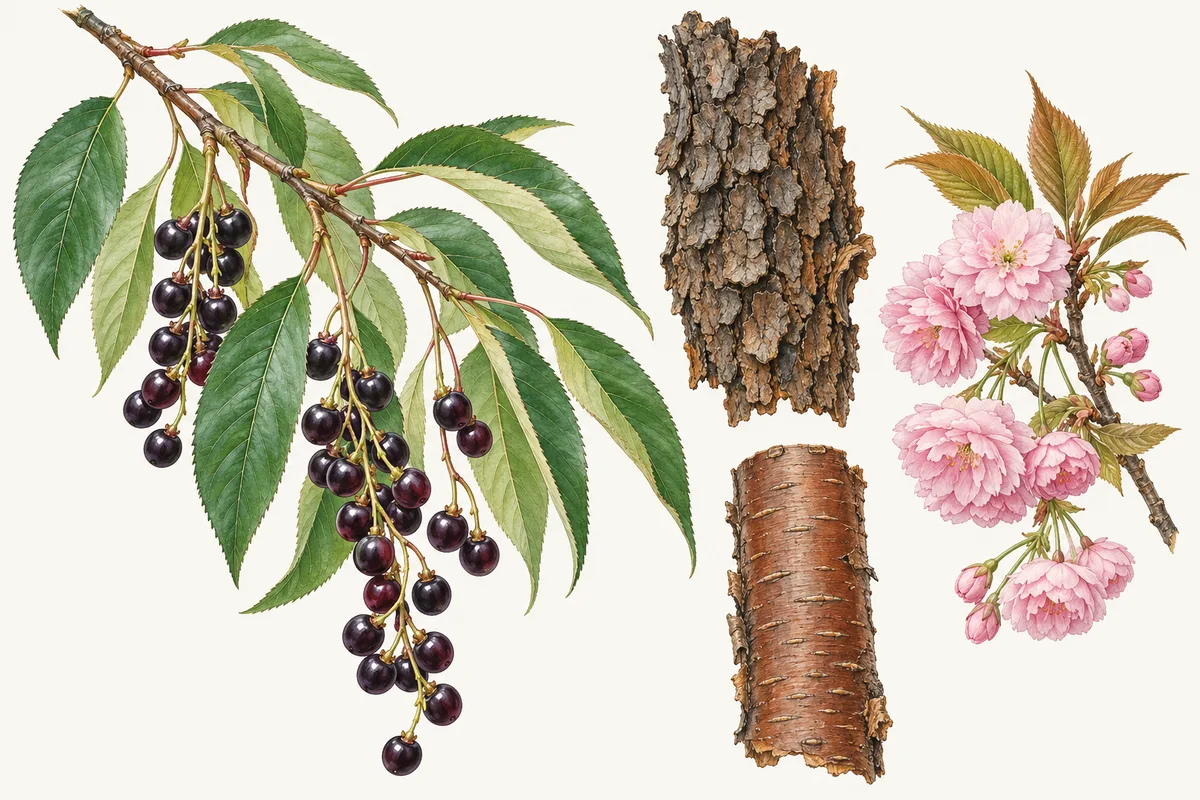
In short
Cherry tree identification starts with the bark: on young cherries it is smooth with short, horizontal lines called lenticels, and on old wild black cherry it breaks into dark, upturned scales like burnt potato chips. Confirm with the leaf, alternate, finely toothed, with small glands on the stalk, and with a scratched twig that smells of bitter almond.
- Wild black cherry flowers after its leaves are almost full-grown; Yoshino, Kwanzan and sweet cherry flower before or as the leaves open.
- Turn a black cherry leaf over: a band of rusty or whitish hairs along the midrib, near the stalk, is the quickest leaf mark.
- Kwanzan has double, deep pink flowers with 20 to 30 petals; Yoshino has single, white to very pale pink flowers.
Field marks at a glance
- Scientific name
- Prunus
- Family
- Rosaceae (rose family)
- Type
- Broadleaf, deciduous
- Leaves
- Alternate, simple, oval to lance-shaped, about 2 to 5 inches long, with a finely toothed edge. Most cherries carry small glands on the leaf stalk near the blade.
- Bark
- Smooth and often glossy when young, with horizontal lenticels. Old wild black cherry bark turns nearly black and breaks into small, rough, upturned plates.
- Twigs and buds
- Slender; a scratched black cherry twig has a strong bitter-almond smell. Buds are small and covered in several glossy scales.
- Flowers
- White on the wild cherries, in hanging clusters on black cherry and chokecherry. Ornamental cherries: white to deep pink, single or double, in early spring.
- Fruit
- A one-seeded drupe with a hard stone. Black cherry: about 1/3 inch, nearly black when ripe in late summer, in hanging clusters.
- Size
- Black cherry approaches 100 ft on good forest sites. Sweet cherry to about 50 ft; Yoshino 30 to 40 ft; Kwanzan 25 to 36 ft; chokecherry rarely over 25 ft.
- Native range
- Black cherry: eastern North America, from Nova Scotia west to Minnesota, south to Texas and central Florida. Yoshino, Kwanzan and sweet cherry are planted.
Cherries (Prunus) include one big native forest tree, black cherry, a few small wild cherries, and the flowering cherries planted along streets and in yards. Never eat a berry, nut or seed on the strength of a web page or an app; check with a local expert. This page is about naming the tree, in this order: bark, leaf, twig, then flowers and fruit.
What to check first: lenticels, leaf glands, bitter-almond twig
1. The bark. Look for lenticels: short, narrow, horizontal lines on smooth bark. Young black cherry bark is smooth with numerous short horizontal lenticels, and on older trees it turns very dark, nearly black, and breaks into small, rough, upturned plates, according to the Virginia Tech Dendrology fact sheet. Virginia Tech calls them burnt corn flakes; the Upper Peninsula tree key maintained by MSU Extension forester Bill Cook calls them burnt potato chips. Either image describes the same dark, flaky scales.
2. The leaf. Cherry leaves are alternate and simple with a finely toothed edge. Black cherry's are 2 to 5 inches long, oblong to lance-shaped, glossy dark green above and paler below. Two marks help:
- Glands on the leaf stalk. Look closely where the stalk meets the blade for one or more tiny bumps. They are very small on black cherry and obvious and dark on sweet cherry.
- Midrib hairs. Turn a black cherry leaf over. Virginia Tech describes a dense band of yellowish-brown, sometimes white, hairs along the midrib; the U.P. key calls it rusty fuzz, strongest near the leaf stalk.
3. The twig. Scratch a black cherry twig with a fingernail and smell it: Virginia Tech notes a pronounced bitter-almond odor. Its buds are very small, about 1/5 inch, covered in several glossy reddish-brown scales.
If the flowers are high in the crown or the tree is not in bloom, a photo of the bark or a single leaf is enough to get a name from Tree Identifier. The app returns one name, with no confidence score and no list of look-alikes, so check the lenticels, the stalk glands and the twig before you trust it.
Wild black cherry vs ornamental cherries vs chokecherry
These are the cherries most people in the United States want to name. Figures come from Virginia Tech's fact sheets for black cherry, chokecherry and sweet cherry, and NC State Extension's pages for Yoshino and Kwanzan.
| Cherry | Flowers | When it blooms | Leaf | Bark | Size |
|---|---|---|---|---|---|
| Black cherry (Prunus serotina) | Small, white, in hanging clusters 4–6 in long | Late spring, after leaves are nearly full-grown | 2–5 in, narrow; hairy midrib beneath; tiny stalk glands | Lenticels young; nearly black upturned scales old | Approaching 100 ft |
| Chokecherry (P. virginiana) | White, in loose clusters 3–6 in long | After the leaves | 2–4 in, oblong to nearly oval; minute stalk glands | Gray-brown, warty lenticels, shallow fissures | Shrub or small tree to 25 ft |
| Sweet cherry (P. avium) | White, about 1 in across, 3–5 per cluster | Early spring | 2–5 in, wider toward the tip; obvious dark stalk glands | Gray-brown, long horizontal lenticels, often peeling | To about 50 ft |
| Yoshino (P. × yedoensis) | Single, snow-white, slightly almond-scented, 5–6 per cluster | Early spring | 2.5–4.5 in; large wart-like glands usually touching the blade | Glossy, prominent horizontal lenticels | 30–40 ft, broad crown |
| Kwanzan (P. 'Kanzan') | Double, deep pink, 20–30 petals, 2.5 in across, 3–5 per cluster | Spring, before the leaves | Up to 5 in, bronze when unfolding; 2–4 shiny glands on the stalk | Reddish-brown, later gray, conspicuous lenticels | 25–36 ft, stiffly ascending branches |
The USDA Forest Service's Silvics of North America gives the timing test in one line: unlike domestic cherries, which flower before the leaves appear, black cherry flowers late in relation to leaf development. In Pennsylvania and New York that is around May 15 to 20. A cherry covered in blossom on bare branches in March or April is a planted one.
NC State adds a trick for Yoshino and Kwanzan out of bloom: on Yoshino, the leaf-stalk glands touch the base of the blade 70 to 80 percent of the time; on Kwanzan they sit apart from it 80 to 90 percent of the time, and NC State compares them to spider eyes. Check several leaves, not one.
Black cherry, the native forest cherry
The Forest Service calls black cherry the largest of the native cherries and the only one of commercial value. It grows from Nova Scotia and New Brunswick west through southern Quebec and Ontario into Michigan and eastern Minnesota; south to Iowa, extreme eastern Nebraska, Oklahoma and Texas; then east to central Florida. Its best trees, prized for furniture wood and veneer, grow on the Allegheny Plateau of Pennsylvania, New York and West Virginia. Elsewhere it is often a small, poorly formed tree that matters more to wildlife than to sawmills.
The fruit is a one-seeded drupe about 0.38 inch across, black when ripe, and an important food for songbirds, squirrels, deer, turkey and other wildlife, which spread the seeds. Fruit ripens from late June in the Southeast to mid-September on the Allegheny Plateau. Good crops come every 1 to 5 years across the range.
A note for anyone with livestock. The Forest Service reports that black cherry leaves, twigs and bark contain cyanide in a bound form, prunasin. As the foliage wilts, for example on branches broken by a storm, the cyanide is released, and domestic livestock that eat wilted foliage may get sick or die. Deer eat unwilted foliage without harm. If animals graze near black cherry, talk to your extension office or a veterinarian; this page can't assess a pasture.
What else you will see on a cherry
Black knot. Elongated, rough, black swellings several times as thick as the twig are black knot, a native fungal disease that the Forest Service calls common on black cherry. Small twigs can die within a year, and cankers a foot or more long can form on trunks. The swellings stay visible all winter.
Leaf-eating caterpillars. The Forest Service names the eastern tent caterpillar and the cherry scallop shell moth as the most important insects that defoliate black cherry. Heavy attacks are sporadic.
Bark texture with age. The lenticel-striped bark of a young cherry can look like a birch's. For more bark comparisons, see how to identify trees by their bark.
Cherries and their look-alikes in bloom
Several trees flower white in spring. The most common confusion is Callery pear, including the Bradford pear. NC State Extension describes its flowers as creamy white and malodorous, in dense clusters, among the first trees to bloom; cherry blossoms do not smell bad. Callery pear leaves are glossy with wavy, rounded teeth, and wild trees carry thorns. See the Bradford pear guide for the full comparison, and the trees with white flowers guide for the rest of the spring lineup.
Chokecherry is the wild cherry most often mixed up with black cherry. It is usually a shrub or small tree, its fruit ripens in August, before black cherry's, and the U.P. key notes that its bark is gray with raised, warty spots rather than black scales.
Cherries in the app's Collection
Tree Identifier's Collection, the field-guide catalog that fills in as you identify, includes sweet cherry (Prunus avium) and Japanese cherry (Prunus serrulata). Black cherry and chokecherry are not in that catalog, though a photo of either still returns a name. For telling cherries from apples, pears and plums by leaf and blossom, see the fruit tree identification guide.
Look-alikes and how to tell them apart
Chokecherry (Prunus virginiana)
Chokecherry is usually a shrub or small tree to 25 feet, often in thickets. Its leaves are oval and widest toward the tip, not long and narrow, and its gray bark has warty spots instead of black scales. A broken twig smells unpleasant, not like almond.
Callery pear, including Bradford pear (Pyrus calleryana)
Callery pear blooms white in early spring like a cherry, but its flowers smell bad, its glossy leaves have wavy, rounded teeth, and wild trees carry thorny twigs. Its fruit is a small, hard, brownish pome, not a juicy drupe.
Sweet cherry (Prunus avium)
Sweet cherry is a planted cherry that may seed into the landscape. Its leaves are wider toward the tip with obvious dark glands on the stalk, its white flowers come in early spring, and its gray-brown bark peels in strips along long horizontal lenticels.
What a photo can't settle
- Ornamental cherries are grafted cultivars and hybrids, some of unknown parentage (NC State says this of Yoshino). A photo can say flowering cherry; the exact cultivar often needs nursery records.
- Seedlings and young wild cherries have smooth, lenticel-striped bark with none of the black scales of an old black cherry, so a bark photo of a young tree can't tell black cherry from its relatives.
- Whether a cherry's fruit is safe to eat is not something an app or a web page can settle; never decide that from an identification.
Questions people ask
How do I identify a cherry tree?
Check the bark for short horizontal lines (lenticels), then the leaf: alternate, finely toothed, with small glands on the stalk. A scratched black cherry twig smells of bitter almond. Old wild black cherries have nearly black bark broken into small upturned scales.
What does black cherry tree bark look like?
On young trees it is smooth, dark and marked with many short horizontal lenticels. On older trees it turns very dark, nearly black, and breaks into small, rough, upturned plates. Virginia Tech compares them to burnt corn flakes; Michigan State's extension forester to burnt potato chips.
How do you tell a wild cherry from an ornamental cherry?
Timing and flowers. Wild black cherry flowers in late spring, when its leaves are nearly full-grown, in narrow hanging clusters of small white flowers. Ornamental Yoshino and Kwanzan bloom in early spring, before or as the leaves open, with larger flowers in short clusters; Kwanzan's are double and deep pink.
Are black cherry leaves toxic to animals?
The USDA Forest Service reports that black cherry leaves, twigs and bark contain a bound form of cyanide that is released as the foliage wilts, and that livestock eating wilted leaves may get sick or die. If animals graze near cherry trees, ask your extension office or a veterinarian.
How can you tell a Yoshino cherry from a Kwanzan cherry?
In bloom, Yoshino has single white flowers with a slight almond scent; Kwanzan has double, deep pink flowers about 2.5 inches across with 20 to 30 petals. Out of bloom, NC State notes that Yoshino's leaf-stalk glands usually touch the blade, while Kwanzan's usually sit apart from it.
Sources
- Black cherry (Prunus serotina), Silvics of North America — USDA Forest Service
- Black cherry fact sheet — Virginia Tech Dendrology
- Choke cherry fact sheet — Virginia Tech Dendrology
- Sweet cherry fact sheet — Virginia Tech Dendrology
- Cherries (U.P. Tree Identification Key) — Michigan Tech, maintained by Bill Cook, MSU Extension
- Prunus x yedoensis (Yoshino cherry) — NC State Extension Gardener Plant Toolbox
- Prunus 'Kanzan' (Kwanzan cherry) — NC State Extension Gardener Plant Toolbox
- Pyrus calleryana (Callery pear) — NC State Extension Gardener Plant Toolbox
Keep reading
- Field guideFruit tree identification by leaf, bark and blossom
- Clue guideWhich tree has white flowers? Start with the month
- Field guideTree bark identification: seven bark types and the trees that have them
- Invasive tree profileBradford pear and Callery pear (Pyrus calleryana): how to identify them
- Field guideHow to identify trees, step by step