Clue guide
Trees with heart-shaped leaves, and how to tell them apart
Five common trees carry heart-shaped leaves. Leaf size, a smooth or toothed edge and whether leaves sit in pairs separate them in under a minute.
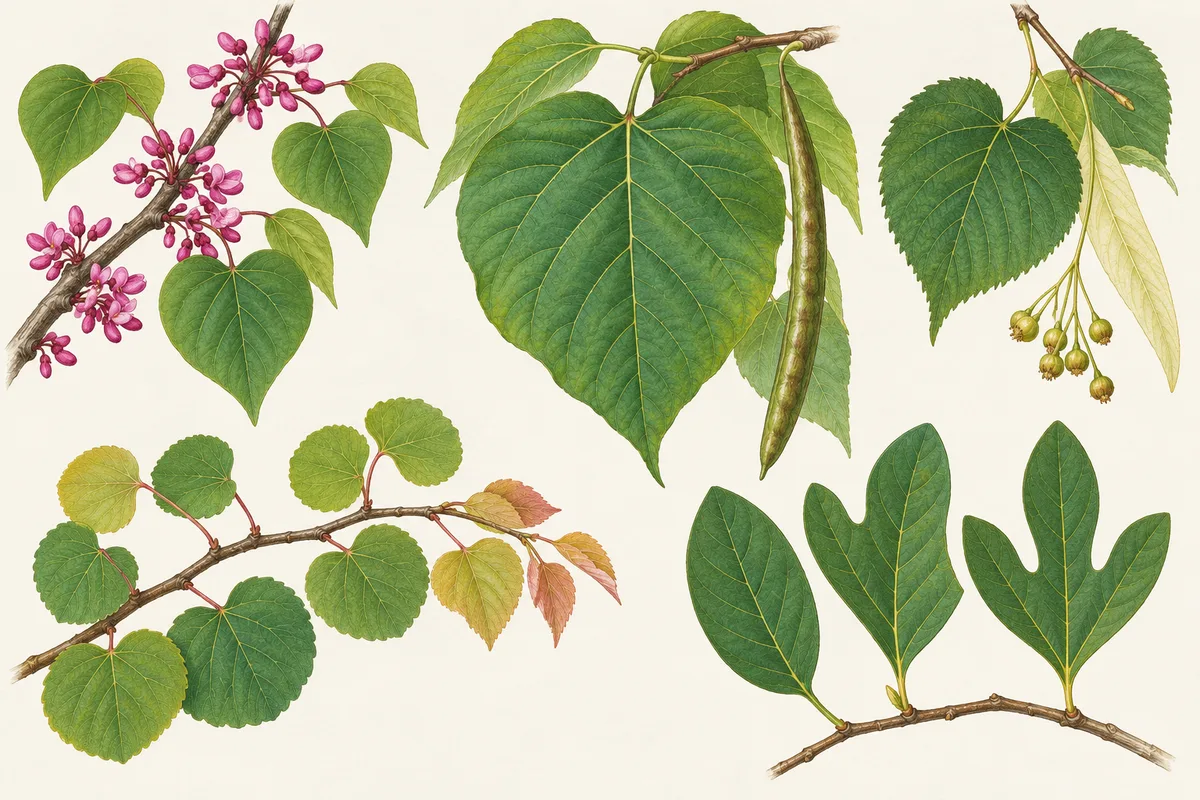
In short
For tree identification by heart-shaped leaves, check three things. Smooth-edged hearts 3 to 5 inches long on alternate twigs mean eastern redbud. Toothed, lopsided hearts up to 10 inches mean American linden (basswood). Small, rounded hearts in pairs mean katsura. Huge hearts, 6 to 12 inches, in pairs or whorls of three mean a catalpa or a princess tree (paulownia).
- Edge first: redbud and catalpa leaves are smooth-edged; linden, katsura and mulberry leaves are toothed or scalloped.
- Arrangement next: redbud, linden and mulberry are alternate; katsura, catalpa and princess tree are opposite or whorled.
- A tree with three leaf shapes on one branch (oval, mitten and three-lobed) is a sassafras or a mulberry.
Heart-shaped leaves (botanists say cordate) narrow a tree to a short list. Most of the common candidates in the United States can be separated with three checks: leaf size, whether the edge is smooth or toothed, and whether the leaves sit alternate or in pairs along the twig. Measure several leaves from the sunlit outer crown before you decide.
The heart-shaped leaf candidates at a glance
| Tree | Leaf size | Edge | Arrangement | Other clue |
|---|---|---|---|---|
| Eastern redbud (Cercis canadensis) | 3–5 in long and wide | Smooth | Alternate | Swollen joint where the stalk meets the leaf; pink-purple flowers before leaves |
| American linden or basswood (Tilia americana) | Up to 10 in long, 3–6 in wide | Coarsely toothed | Alternate | Lopsided base; flowers and nutlets hang from a leaf-like bract |
| Katsura (Cercidiphyllum japonicum) | 2–4 in | Scalloped to finely toothed | Opposite or nearly opposite | Leaves open reddish purple; fallen leaves smell of burnt sugar |
| Northern catalpa (Catalpa speciosa) | 6–12 in | Smooth | Opposite or whorled (3 per node) | White flowers in late spring; pods up to 22 in |
| Princess tree (Paulownia tomentosa) | 5–12 in | Smooth | Opposite | Velvety on both sides; violet flowers; egg-shaped capsules |
| Red mulberry (Morus rubra) | 3–5 in | Toothed | Alternate | Some leaves lobed; soft hairs underneath |
Source for every row: the NC State Extension Gardener Plant Toolbox profile of each species.
Eastern redbud: small, smooth hearts
The tree most people mean when they ask about heart-shaped leaves is the eastern redbud. The NC State Plant Toolbox describes simple, alternate, heart-shaped leaves 3 to 5 inches long and about as wide, with smooth edges, a pointed tip and a swelling on the leaf stalk just below the blade. In early spring, from March to May, clusters of small pink to purple pea-like flowers open directly on new stems and older branches, before the leaves. Flat brown pods 2 to 4 inches long follow and can hang on into winter.
Redbud is a small tree, 20 to 30 feet tall in NC State's profile, native from Ontario and Michigan south to Florida and west to Nebraska and New Mexico. If the leaves are smooth-edged hearts on a small tree, check for the pods and the swollen stalk joint.
American linden (basswood): big, toothed and lopsided
If the heart is toothed and lopsided, with one side of the base lower than the other, look at American linden, also called basswood. According to the NC State profile, the leaves are alternate, ovate to heart-shaped, unequal at the base and coarsely serrated, up to 10 inches long and 3 to 6 inches wide, dark green above and matte gray underneath.
Linden has a clue no other tree here shares: its fragrant yellow flowers (May to July) and then its pea-sized, downy nutlets hang from a stalk attached to the middle of a leaf-like bract that acts as a wing. One of those bracts on the ground under a tree with heart-shaped leaves is close to proof. American linden grows wild from New Brunswick to Florida, west to Texas and north to Manitoba.
Katsura: small rounded hearts in pairs
Katsura is a planted tree native to China and Japan. The NC State profile describes leaves 2 to 4 inches long, broadly heart-shaped or kidney-shaped, with veins spreading from the base like fingers and scalloped to finely toothed edges. They grow opposite or nearly opposite on short side shoots. New leaves open reddish-bronze to purple, turn blue-green in summer and yellow to apricot in fall.
The best test comes in autumn: NC State notes that the decaying leaves smell like caramel, burnt sugar or cotton candy. No other tree on this list does that.
Catalpa and princess tree: the giant hearts
Two trees carry heart-shaped leaves the size of a dinner plate, and they are easy to confuse.
Northern catalpa. The NC State profile describes light green leaves 6 to 12 inches long, whorled (three at a node) or opposite, smooth-edged, pointed at the tip and heart-shaped at the base, with soft hairs underneath. In late spring to early summer, upright clusters of white, bell-shaped flowers with yellow and purple markings inside appear, followed by cigar-like pods up to 22 inches long that ripen dark brown in fall. It is native to the eastern and central United States. Southern catalpa looks similar; NC State separates the two by smell, since crushed southern catalpa leaves have a fetid odor and northern catalpa leaves a "green" one. The flowers make catalpa one of the late trees with white flowers, and the catalpa page covers the tree through the year.
Princess tree (paulownia). The NC State profile describes opposite, oval or heart-shaped leaves 5 to 12 inches long with velvety hairs on both sides, and notes that they resemble catalpa leaves. The difference shows in flower and fruit: princess tree blooms in spring with upright clusters, up to 14 inches long, of pale violet, foxglove-like flowers, and its fruit is a woody, egg-shaped capsule only 1 to 1.5 inches long, holding thousands of tiny winged seeds. NC State lists princess tree as invasive in North Carolina.
Quick test: long, thin pods mean catalpa; clusters of short, pointed, woody capsules mean princess tree. Velvety leaves on both sides also point to princess tree.
The tree with three leaf shapes: sassafras (and mulberry)
If one tree carries heart-shaped or oval leaves alongside mitten-shaped and three-lobed ones, it is almost always a sassafras. The USDA Forest Service describes sassafras as an aromatic tree "with three distinctive leaf shapes: entire, mittenshaped, and threelobed". The Forest Service calls the whole tree aromatic, so crush a leaf or scratch a twig and smell it. Greenish-yellow flowers appear in March and April as the leaves unfold.
Mulberries do the same trick with toothed leaves. The NC State profile of red mulberry describes heart-shaped, thin, toothed leaves 3 to 5 inches long that range from unlobed to deeply lobed; lobed leaves are more frequent on new shoots, unlobed ones in the crown. The underside has fine hairs and feels soft. White mulberry, an Asian species now naturalized across much of the United States, has alternate, toothed leaves that are unlobed, mitten-shaped or three-lobed; NC State says their glossy upper surface distinguishes them from red mulberry. The mulberry page separates red, white and fruitless mulberries.
How to work through it
- Run a finger along the edge. Smooth: redbud, catalpa, princess tree. Toothed or scalloped: linden, katsura, mulberry.
- Check the arrangement. Alternate: redbud, linden, mulberry, sassafras. Opposite or whorled: katsura, catalpa, princess tree.
- Measure. Under 5 inches: redbud, katsura, red mulberry. Up to 10 inches: linden. Up to 12 inches: catalpa (soft hairs underneath) and princess tree (velvety on both sides).
- Look for the extra clue. Pods, bracts, a burnt-sugar smell, mixed leaf shapes.
For leaf shapes, margins and arrangement in general, see how to identify trees by their leaves.
When to use a photo
A single photo of a typical leaf, ideally with a pod, flower or bract in the frame, gives Tree Identifier enough to suggest a name. Eastern redbud, sassafras, white mulberry, princess tree and southern catalpa are among the species in the app's Collection. Tree Identifier does not show look-alikes, so if it says catalpa, check the pods against the princess-tree test above, or ask the follow-up chat how the two differ.
What a photo can't settle
- Leaves on vigorous young shoots, sprouts and saplings are often much larger or differently shaped than leaves in the mature crown, so measure several sunlit leaves.
- Planted lindens include Asian and European species and cultivars as well as American linden; one leaf or one photo may not separate them.
- White mulberry can hybridize with the native red mulberry (NC State), so a mulberry's leaf alone may not settle which one you have.
Questions people ask
What kind of tree has heart-shaped leaves?
In the United States, most often an eastern redbud: smooth-edged, heart-shaped leaves 3 to 5 inches long and wide, on a small tree that blooms pink-purple before it leafs out. American linden, katsura, catalpa and princess tree also have heart-shaped leaves; size, edge and arrangement separate them.
What tree has 3 different shaped leaves?
Sassafras. The USDA Forest Service describes three distinctive leaf shapes on the same tree: unlobed (oval), mitten-shaped with one side lobe, and three-lobed. Crush a leaf: the Forest Service calls sassafras an aromatic tree. Mulberries also mix unlobed, mitten-shaped and three-lobed leaves, but mulberry leaves have toothed edges.
What tree has large heart-shaped leaves?
Catalpa or princess tree. Northern catalpa leaves are 6 to 12 inches long, smooth-edged, with soft hairs underneath, and the tree carries pods up to 22 inches long. Princess tree leaves are 5 to 12 inches, velvety on both sides, with egg-shaped woody capsules 1 to 1.5 inches long. American linden leaves reach 10 inches but are toothed and alternate.
What tree has heart-shaped leaves that smell sweet in fall?
Katsura. NC State Extension notes that its fallen fall leaves give off a scent of caramel, burnt sugar or cotton candy. The leaves are small, 2 to 4 inches, rounded to heart-shaped, with scalloped edges, and they grow in pairs or nearly in pairs on short side shoots.
Sources
- Cercis canadensis (eastern redbud) — North Carolina Extension Gardener Plant Toolbox, NC State University
- Catalpa speciosa (northern catalpa) — North Carolina Extension Gardener Plant Toolbox, NC State University
- Tilia americana (American basswood) — North Carolina Extension Gardener Plant Toolbox, NC State University
- Cercidiphyllum japonicum (katsura tree) — North Carolina Extension Gardener Plant Toolbox, NC State University
- Paulownia tomentosa (princess tree) — North Carolina Extension Gardener Plant Toolbox, NC State University
- Sassafras (Sassafras albidum), Silvics of North America — USDA Forest Service
- Morus rubra (red mulberry) — North Carolina Extension Gardener Plant Toolbox, NC State University
- Morus alba (white mulberry) — North Carolina Extension Gardener Plant Toolbox, NC State University