Tree profile
Catalpa tree: how to recognize northern and southern catalpa
Huge heart-shaped leaves in threes, white trumpet flowers in late spring, then pods a foot or more long. Here is how to confirm it, and how to rule out paulownia.
In short
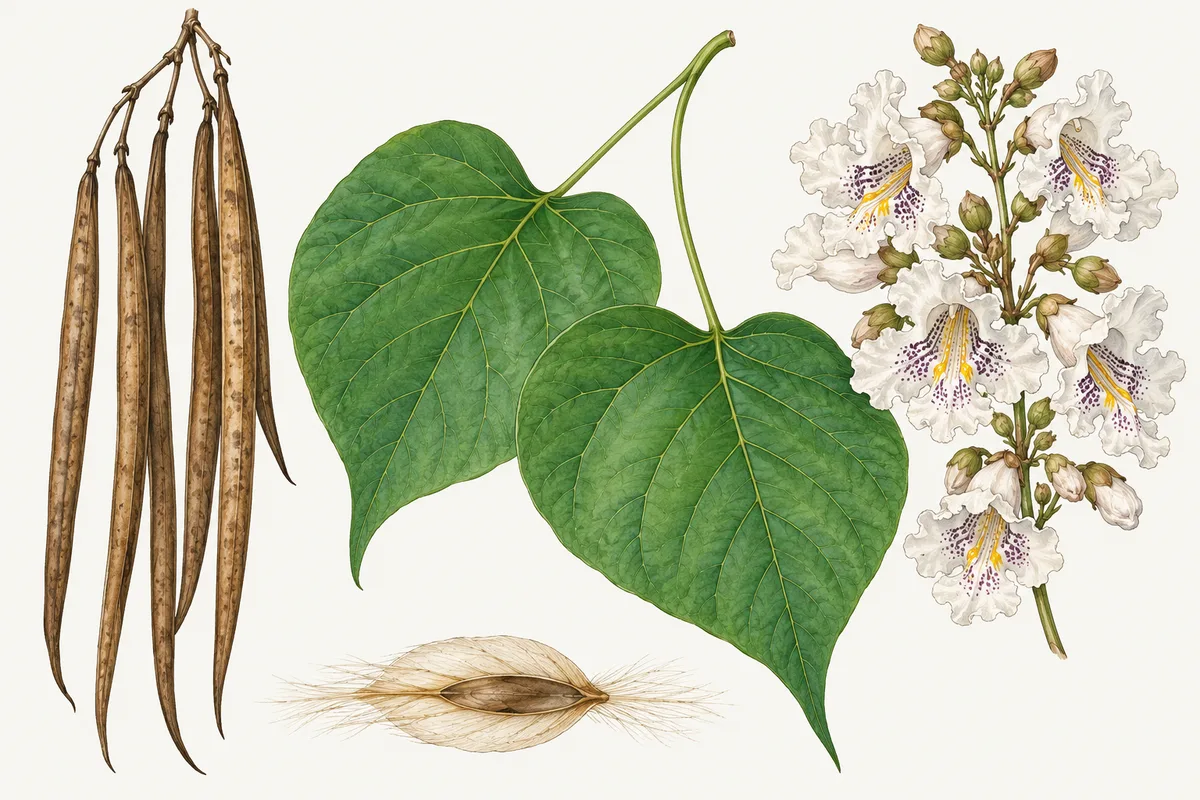
A catalpa tree is a North American shade tree with heart-shaped leaves 5 to 12 inches long, set in whorls of three or in opposite pairs. In late spring it carries upright clusters of white, bell-shaped flowers spotted purple and yellow inside, followed by slender bean-like pods 8 to 22 inches long that hang on through winter. Two species grow in the US: northern and southern catalpa.
- Three leaves at one node (a whorl) plus long, thin pods is the catalpa signature.
- Northern catalpa blooms first and its crushed leaves smell green; southern catalpa blooms later and its crushed leaves smell unpleasant.
- Paulownia blooms purple before its leaves open and carries short, egg-shaped woody capsules, not long beans.
Field marks at a glance
- Scientific name
- Catalpa speciosa and Catalpa bignonioides
- Family
- Bignoniaceae (trumpet-creeper family)
- Type
- Broadleaf, deciduous
- Leaves
- Simple, heart-shaped, 5 to 12 inches long, smooth-edged, soft hairs underneath. Whorled (three at a node) or opposite.
- Flowers
- White and bell-shaped, about 1 to 2 inches long, with purple spots and yellow markings inside, in upright branched clusters at the branch tips.
- Bloom time
- Northern catalpa: late spring (late May to early June in St. Louis). Southern catalpa: early to late summer, later than northern.
- Pods
- Hanging, stiff, bean-like capsules, round in cross-section: 10 to 18 inches on northern catalpa (up to 22 in some sources), 8 to 15 inches on southern. Green, then dark brown; they stay on through winter.
- Seeds
- Many flat seeds, each with two papery wings fringed at the ends, released when the pod splits lengthwise.
- Twigs and buds
- Stout, green turning reddish brown, many pale lenticels. No end bud. Leaf scars are round, sunken and saucer-like. Southern catalpa's pith is continuous (solid).
- Bark
- Gray to reddish brown, with shallow irregular fissures and scaly ridges; pale gray-brown and ridged on old northern catalpas.
- Size and form
- Northern catalpa usually 40 to 70 ft, rarely 100; southern catalpa 30 to 60 ft. Crooked trunk, spreading branches and an irregular crown.
- Native range
- Northern: southern Illinois and Indiana south to western Tennessee and northeastern Arkansas. Southern: the Gulf States, Florida to Texas and Georgia. Both are planted far outside these areas.
The catalpa tree stops people in late spring, when the whole crown turns white with trumpet-shaped flowers, and again in late summer, when it hangs full of long green "beans". Two species grow wild in the United States, northern catalpa (Catalpa speciosa) and southern catalpa (Catalpa bignonioides), and both are planted in yards and along streets far beyond their native ranges. Never eat a berry, nut or seed on the strength of a web page or an app; check with a local expert.
How to recognize a catalpa tree in four checks
1. Count the leaves at one node. Look at where the leaves join a twig. Catalpa leaves often come in whorls of three. Virginia Tech Dendrology's northern catalpa fact sheet describes the leaves as whorled, or opposite with one leaf of each whorl often smaller. Three leaves around one point, or a pair with a small third, is the first and strongest clue.
2. Measure a leaf. Catalpa leaves are heart-shaped, 5 to 12 inches long, smooth along the edge, soft and flexible, light to medium green above with soft hairs underneath. The Missouri Botanical Garden describes northern catalpa leaves as up to 12 inches long, pointed at the tip and rounded to heart-shaped at the base, and densely hairy below. Fall color is an undistinguished yellow.
3. Look for flowers or pods. From late spring into summer, upright branched clusters of white, bell-shaped flowers open at the branch tips. Each flower has five lobes and purple spots and yellow markings inside. The pods follow: hanging, stiff and round in cross-section, like a long thin bean. Virginia Tech gives 10 to 18 inches for northern catalpa; the Missouri Botanical Garden's Plant Finder gives 12 to 22. They ripen dark brown in fall, split lengthwise and often stay on the tree through winter.
4. In winter, read the twig. Catalpa twigs are stout, green turning reddish brown, dotted with pale lenticels, and have no end bud. The leaf scars are the giveaway: round, light-colored and sunken like small saucers. A few old pods still hanging confirm it.
If the flowers are high up, a photo of a fallen leaf or a pod on the ground is enough for Tree Identifier to suggest a name. Southern catalpa is in the app's Collection. The app shows one name, without a confidence score or alternatives, so confirm it with the whorl and pod checks above.
Catalpa leaves, flowers and pods through the year
- Spring: Northern catalpa flowers open in late spring; the Missouri Botanical Garden gives late May to early June in St. Louis. The blooms are orchid-like and up to 2 inches long by that source, about 1 inch by Virginia Tech's measure.
- Summer: southern catalpa blooms now, early to late summer, according to North Carolina Extension. Green pods lengthen on both species. Leaves can look ragged by August: the Missouri Botanical Garden notes that the large leaves are easily damaged by hail, wind and insects.
- Fall: pods turn dark brown and begin to split. Each holds many flat seeds with two papery, fringed wings. The Missouri Botanical Garden notes that heavy pod crops come every 2 to 3 years.
- Winter: bare, crooked branches hung with dark pods, and those saucer-shaped leaf scars.
Catalpa is one of the late trees with white flowers, and its pods make it easy to place among trees identified by their seeds and pods.
Northern catalpa vs southern catalpa
The two species look nearly the same, and Virginia Tech's southern catalpa fact sheet lists northern catalpa as its first look-alike. North Carolina Extension's southern catalpa profile gives the field differences:
| Feature | Northern catalpa (C. speciosa) | Southern catalpa (C. bignonioides) |
|---|---|---|
| Crushed leaf | Smells "green" | Unpleasant, fetid odor |
| Bloom | Late spring, earlier | Early to late summer, later |
| Purple spotting in the flower | Sparse | Dense |
| Lowest flower lobe | Notched (cleft) | Entire |
| Pod length | 10–18 in (Virginia Tech), 12–22 in (Missouri Botanical Garden) | 8–14 in (Virginia Tech), up to 15 in (NC State) |
| Height | 40–70 ft, rarely 100 | 30–60 ft |
| Native range | Southern Illinois and Indiana to western Tennessee and northeastern Arkansas | Gulf States, Florida to Texas and Georgia |
The smell test is the quickest: crush a leaf and sniff. The Missouri Botanical Garden makes the same point from the other side: northern catalpa leaves do not give off an unpleasant smell when bruised. Planted trees of both species turn up well outside their native ranges, so location alone won't settle which one you have.
Catalpa vs paulownia (princess tree)
Princess tree (Paulownia tomentosa), also called empress tree or royal paulownia, is the tree most often mistaken for catalpa. It also has huge heart-shaped leaves and showy clusters of tubular flowers, and Virginia Tech's royal paulownia fact sheet lists both catalpas among its look-alikes. Four checks separate them:
- Flower color and timing. Paulownia flowers are pale violet to pink, about 2 inches long, in upright clusters 8 to 12 inches tall, and they open in April and May before the leaves, according to Vermont Invasives. Catalpa flowers are white and open among the leaves, in late spring or summer.
- Fruit. Paulownia's fruit is an egg-shaped, woody capsule 1 to 2 inches long that splits in late winter to release up to 2,000 tiny winged seeds. Catalpa's is a long, thin bean.
- Leaves. Paulownia leaves are opposite, never in threes, and hairy on both surfaces; root sprouts can carry leaves 2 feet long. Catalpa leaves carry their soft hairs underneath.
- Pith. Cut a twig lengthwise. Paulownia pith is chambered or sometimes hollow (Vermont Invasives), hollow in the second year (Virginia Tech). Southern catalpa pith is continuous, per Virginia Tech.
Paulownia is native to China. North Carolina Extension's princess tree profile states that it is an invasive species in North Carolina, listed by the NC Invasive Plant Council, the North Carolina Forest Service and the USDA's National Invasive Species Information Center, and notes that it self-seeds freely and resprouts from roots after cutting. Vermont lists it as a watch-list species. Both trees appear on the guide to trees with heart-shaped leaves, along with redbud and linden.
Catalpa worms: the caterpillars on the leaves
In some summers a catalpa is stripped bare by large caterpillars. These are catalpa sphinx caterpillars, often called catalpa worms. Penn State Extension's catalpa worm fact sheet says they are the only sphinx moth caterpillars that feed on catalpa, and they eat nothing else. What you will see:
- Young caterpillars mostly white with black spots; older ones from mostly yellow to almost black, most often black on the back with a broad yellow stripe along each side.
- A stiff, straight black "horn" near the tail end.
- Caterpillars from May through November, with one generation a year in the north and up to five in the south. Outbreaks come and go: none for one to a few years, then many.
Penn State notes that healthy trees can withstand complete defoliation and often grow a second set of leaves when it happens early in the season; repeated outbreaks can harm trees that are already stressed. The caterpillars are also prized as fishing bait in the South, which is why some anglers have planted catalpa groves.
Where catalpa grows and why it is planted
Both catalpas have small native ranges. The Missouri Botanical Garden places northern catalpa from western Tennessee, northeastern Arkansas and the lowlands of southeastern Missouri north to southern Illinois and southern Indiana, along streams, bluff bases and in low and upland woods. North Carolina Extension places southern catalpa in the Gulf States, from Florida to Texas and Georgia; in North Carolina it grows where it has escaped from or persisted after cultivation.
People planted them widely as street and lawn trees for the flowers and their tolerance of tough sites: the Missouri Botanical Garden lists tolerance of wet and dry soils, clay, seasonal flooding and urban conditions, in USDA zones 4 to 8. The trade-off is brittle branches, messy pods and leaves that look tired by late summer. If you find one in a park and want to see it in flower next year, Tree Identifier's Tree Map keeps the location of each identified tree.
Look-alikes and how to tell them apart
Princess tree, royal paulownia (Paulownia tomentosa)
Paulownia opens pale violet, upright flower clusters in April and May before its leaves, and its fruit is a woody, egg-shaped capsule only 1 to 2 inches long. Its leaves are opposite, never in threes, and velvety on both sides. Cut a second-year twig: paulownia pith is chambered or hollow, southern catalpa pith is continuous.
Northern vs southern catalpa (Catalpa speciosa and C. bignonioides)
Crush a leaf: southern catalpa smells fetid, northern catalpa only green. Southern catalpa blooms weeks later, its flowers are more densely spotted purple, and its pods are shorter (8 to 15 inches against 10 to 22).
What a photo can't settle
- Northern and southern catalpa share every visible feature except leaf smell, bloom date and small flower details. A photo of a leaf can name the genus but rarely settle the species: crush a leaf and note the bloom month.
- Leaves on young paulownia and on root sprouts can be lobed, toothed and up to 2 feet long, so a sapling of either tree is easy to confuse in a photo. Check the leaf arrangement and the pith of a twig.
- Tree Identifier gives one name from one photo, with no confidence score and no look-alike list. Southern catalpa and paulownia are in the app's Collection; check its answer against the pod and flower tests on this page.
Questions people ask
What does a catalpa tree look like?
A medium to large tree, often 40 to 70 feet, with a crooked trunk and an irregular crown. Its leaves are huge hearts, 5 to 12 inches long, in threes or pairs. In late spring it is covered in white, purple-spotted trumpet flowers, and from summer through winter long, thin pods hang from the branches.
What is the difference between northern and southern catalpa?
Smell and timing. North Carolina Extension notes that crushed southern catalpa leaves smell fetid, while northern catalpa leaves smell green. Southern catalpa blooms later, in summer, with more densely spotted flowers and shorter pods, 8 to 15 inches against 10 to 22 on northern catalpa.
How do you tell a catalpa from a paulownia tree?
Check the flowers and fruit. Paulownia flowers are pale violet and open before the leaves; catalpa flowers are white and open among the leaves. Paulownia fruit is a short, egg-shaped woody capsule; catalpa fruit is a long, thin bean. Paulownia leaves are always opposite and velvety on both sides, never in threes.
When do catalpa trees bloom?
Northern catalpa blooms in late spring; the Missouri Botanical Garden gives late May to early June in St. Louis. Southern catalpa follows in early to late summer. Both bloom among their leaves, which separates them from paulownia, whose violet flowers open in April and May on bare branches.
What are the worms on my catalpa tree?
Almost certainly catalpa sphinx caterpillars, the only sphinx moth caterpillars that feed on catalpa, according to Penn State Extension. Mature ones are mostly black on the back with a broad yellow side stripe and a stiff black horn near the tail. Healthy trees can withstand even complete defoliation.
Why is catalpa called a cigar tree?
For its pods. The Missouri Botanical Garden lists cigar tree and Indian cigar among northern catalpa's common names, and notes that the pods are actually longer and thinner than most cigars. North Carolina Extension lists bean tree and cigar tree for southern catalpa.
Sources
- Northern catalpa fact sheet — Virginia Tech Dendrology
- Southern catalpa fact sheet — Virginia Tech Dendrology
- Royal paulownia fact sheet — Virginia Tech Dendrology
- Catalpa speciosa, Plant Finder — Missouri Botanical Garden
- Catalpa bignonioides (Bean Tree, Cigar Tree, Southern Catalpa) — North Carolina Extension Gardener Plant Toolbox
- Paulownia tomentosa (Empress Tree, Princess Tree) — North Carolina Extension Gardener Plant Toolbox
- Princess Tree — Vermont Invasives
- Catalpa Worm/ Catalpa Sphinx Moth — Penn State Extension