Clue guide
Which tree has red berries? Sort it by leaf and season
Read the leaf first (spiny, compound, opposite, needle-like or plain), then note the month and your region. Together they narrow a red-berried tree to one or two names.
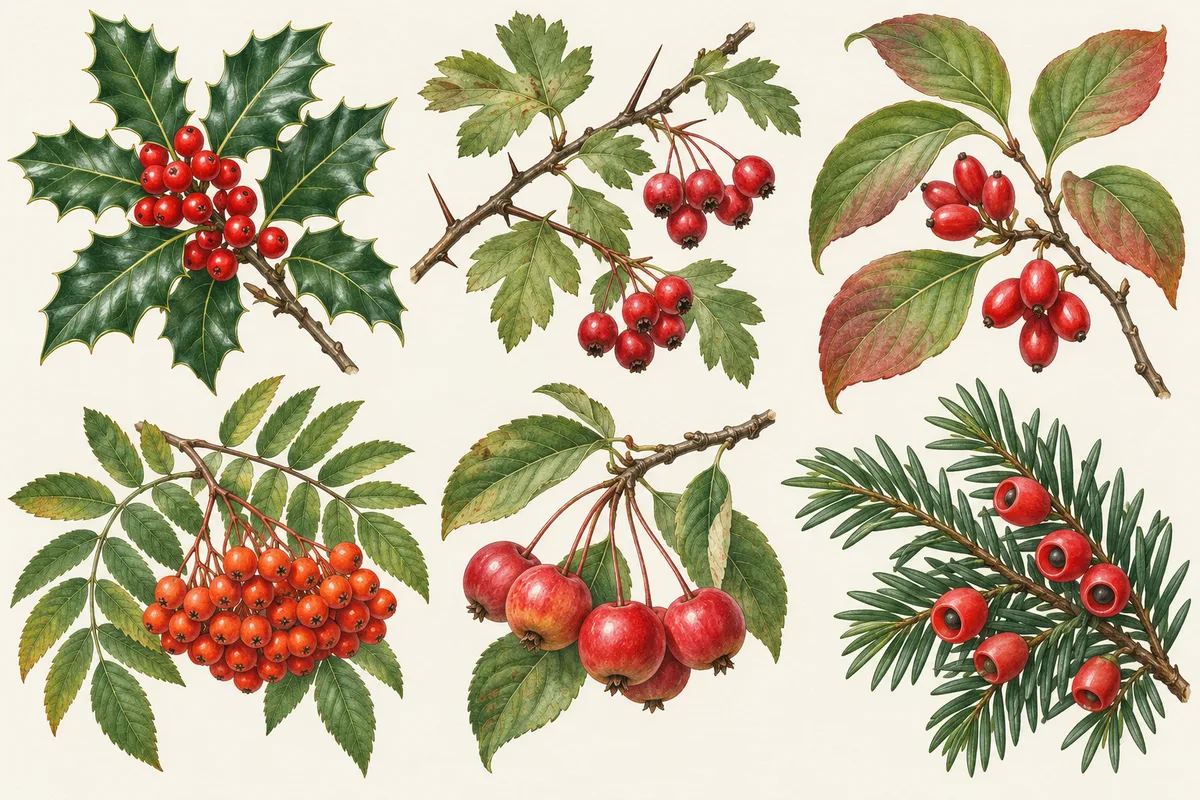
In short
A tree with red berries is most often an American holly (spiny evergreen leaves, berries September to February), a hawthorn (long thorns, small red fruit through winter), a flowering dogwood (opposite leaves, clusters of 3 or 4 glossy berries, August to October), a mountain-ash (feather-like compound leaves) or a crabapple. Flat needles with a red, cup-shaped fruit mean a yew, a conifer.
- Leaf type sorts red-berried trees fastest: spiny and evergreen, compound, opposite, needle-like or plain and alternate.
- In winter, red berries on bare branches point to possumhaw, hawthorn or a persistent crabapple; on an evergreen with spiny leaves, to American holly.
- Hollies and possumhaw only fruit on female trees, so a holly with no berries may simply be male.
A tree with red berries is easiest to name in two moves: read the leaf, then match the month and your region. Never eat a berry, nut or seed on the strength of a web page or an app; check with a local expert. Several of the trees below have fruit that people or pets should not eat, and this guide is only for putting a name on the tree.
Red-berried trees by leaf and season
| Tree | Leaf | Red fruit | When | Where |
|---|---|---|---|---|
| American holly (Ilex opaca) | Evergreen, leathery, 2–4 in, spiny teeth, alternate | Red or orange, on female trees only | September–February | Massachusetts and Pennsylvania south to Florida, west to Texas |
| Possumhaw (Ilex decidua) | Deciduous, 2–3 in, glossy, round-toothed, alternate | Orange-red, on female trees only | Ripens September; holds until mid-March | Texas and Kansas east to Illinois, Maryland and Florida |
| Washington hawthorn (Crataegus phaenopyrum) | 1–3 in, triangular, 3–5 lobes, toothed; long straight thorns | Glossy, about 1/4 in, in clusters | September–November, lasting into winter | Virginia to Georgia, Illinois to Kansas |
| Flowering dogwood (Cornus florida) | Opposite, 2.5–6 in, smooth edge, veins curving toward the tip | Glossy, oval, about 0.5 in, in tight clusters of 3 or 4 | August–October | Eastern US from Maine to Florida, west to Texas and Kansas |
| American mountain-ash (Sorbus americana) | Compound, 6–10 in, 9 to 17 toothed leaflets | Red-orange, about 1/4 in, in clusters | September–October, into winter | Northeastern North America, south in the Appalachians |
| Crabapples (Malus species and cultivars) | Simple; green to purple-red, depending on cultivar | Red, orange or yellow, 1/4–2 in | Ripens July–November; some cultivars hold fruit all winter | Planted everywhere |
| Cornelian cherry (Cornus mas) | Opposite, 2–4 in, glossy, smooth edge | Olive-shaped, 0.5–1 in, dark red when ripe | Midsummer | Planted; native to Europe and western Asia |
| English yew (Taxus baccata), a conifer | Flat needles 0.4–1.6 in, in two rows | A single seed partly wrapped in a red, fleshy cup (aril) | Fall | Planted; native to Europe, western Asia and North Africa |
Leaf, fruit and season data come from the NC State Extension Gardener Plant Toolbox, except crabapples, which come from the Morton Arboretum. Ranges are the native ranges NC State lists; planted trees grow far outside them.
Spiny evergreen leaves: American holly
If the leaves stay green all winter, feel leathery and end in sharp spines, you are looking at a holly. The NC State profile of American holly describes thick, leathery, alternate leaves 2 to 4 inches long with spiny teeth along the edge and a spine at the tip. The bright red, sometimes orange, berry-like fruit stays on the tree from September through February. Holly bark is light gray and smooth, often splotched with lichens.
Only female hollies fruit, and only when a male tree grows close enough to pollinate them. Two hollies of the same size side by side, one covered in berries and one bare, are usually a female and a male. American holly grows wild from Massachusetts and Pennsylvania south through Florida and west to Texas, and reaches 40 to 60 feet.
Bare branches covered in red: possumhaw and hawthorns
In late fall and winter, a small tree with no leaves and a full load of red fruit narrows the list to a few names.
Possumhaw is a deciduous holly of the South and lower Midwest. According to NC State, its orange-red berries ripen in September and stay on the twigs through winter until new growth starts in about mid-March. Its leaves, when present, are glossy, 2 to 3 inches long, with round teeth. As with American holly, only female trees fruit.
Hawthorns are the answer to "red berries and thorns". The NC State profile of Washington hawthorn describes glossy red fruit clusters from September to November that last through winter, each fruit about 1/4 inch across, plus long, straight thorns. The leaves are small (1 to 3 inches), triangular, toothed and often 3- to 5-lobed. In spring the tree carries flat-topped clusters of white flowers from April to June. Washington hawthorn is one of many hawthorns in North America; most share the thorns and the small apple-like fruit.
Opposite leaves: flowering dogwood and Cornelian cherry
Check where the leaves join the twig. If they sit in pairs, the red-berried tree is almost certainly a dogwood.
Flowering dogwood is the native one. The NC State profile describes glossy, bright red, oval fruit about half an inch long, held in tight clusters of 3 or 4 from August to October. The leaves are opposite, 2.5 to 6 inches long, with veins that arch up toward the tip. In spring the tree is covered in the white, petal-like bracts that make it one of the classic trees with white flowers.
Cornelian cherry is a planted dogwood from Europe and western Asia and the best answer to "red berries that look like cherries". NC State describes olive-shaped fruit 0.5 to 1 inch long that colors in midsummer and turns dark red, on a tree with glossy, opposite, smooth-edged leaves 2 to 4 inches long. Its small yellow flowers open very early, from late March to early April. If the leaves are alternate rather than opposite, it is not a Cornelian cherry; the cherry tree page covers true cherries.
Compound leaves: American mountain-ash
A tree with feather-like compound leaves and big clusters of small red-orange fruit is a mountain-ash. The NC State profile gives leaves 6 to 10 inches long with 9 to 17 toothed leaflets, and fruit about 1/4 inch across that ripens in September and October and stays on into winter. Creamy white flowers appear in flat clusters in June and July. It is a small tree, 15 to 35 feet, native to northeastern North America and south along the Appalachians.
Simple leaves and tiny apples: crabapples
If the leaves are simple and the red fruit looks like a miniature apple, it is probably a crabapple. The Morton Arboretum gives fruit from 1/4 to 2 inches across, in red, orange or yellow, ripening between July and November. Some cultivars keep their fruit through winter. By the Arboretum's definition, a Malus tree whose fruit is larger than 2 inches is an apple, not a crabapple. Crabapples bloom in spring, usually in May, in white, pink or red. For apple trees, see fruit tree identification.
Needles and a red cup: yew
A dark green conifer with flat needles in two rows and red, cup-shaped fruit is a yew. On female plants, each red, fleshy cup (an aril) partly wraps a single seed. The NC State profile of English yew gives needles 0.4 to 1.6 inches long, shiny and dark green above, yellowish green below, on reddish-brown, scaly bark. English yew is native to Europe, western Asia and northern Africa and is planted in North America.
NC State reports English yew as highly poisonous to people, children, dogs, cats and horses: the bark, needles and seeds are listed as the toxic parts.
Region and season shortcuts
- Southeast, fall and winter: American holly and possumhaw are the usual red-berried trees in woods and yards.
- Northeast, Great Lakes and mountains: red-orange clusters on a tree with compound leaves are mountain-ash.
- Late summer to early fall, anywhere in the East: clusters of 3 or 4 glossy berries above opposite leaves mean flowering dogwood.
- Yards and parks, any region: crabapples, hawthorns, Cornelian cherry and yews are all planted far outside their native ranges.
If the fruit is woody or spiny instead of fleshy, go to trees with spiky balls.
Using a photo
When the fruit is out of reach, a photo that shows the fruit and a few leaves together usually gives a solid lead. Tree Identifier names a tree from one photo, and flowering dogwood, European mountain-ash, English yew and apples are among the species in its Collection. It does not show a confidence score or alternative species, so check the result against the leaf and season table above. The follow-up chat under each result is useful for questions such as how a hawthorn differs from a crabapple. Tree Identifier's Toxicology notes are AI-written and are not a safety verdict: for anything about eating fruit, ask a local expert.
What a photo can't settle
- There are many hawthorn species and hybrids in North America; a photo of the fruit alone rarely names the species, which needs the flowers, thorns and leaves.
- Crabapples are grown as hundreds of cultivars; a photo can say crabapple, but not which cultivar.
- No page or app can tell you a berry is safe to eat. Treat any identification as a name to check, not a permission.
Questions people ask
What tree has red berries in winter?
On an evergreen with spiny leaves, American holly, whose berries persist from September to February. On bare branches, possumhaw (a deciduous holly that keeps its berries until about mid-March), a hawthorn, or a crabapple cultivar with persistent fruit. American mountain-ash fruit also hangs on into winter in the Northeast and Appalachians.
What tree has red berries and thorns?
A hawthorn. Washington hawthorn, for example, carries long, straight thorns and clusters of glossy red fruit about 1/4 inch wide from September into winter. Do not confuse thorns with spiny leaves: American holly's spines are on the leaf edges, not on the twigs.
What tree has red berries that look like cherries?
Cornelian cherry, a dogwood from Europe and western Asia, has olive-shaped red fruit 0.5 to 1 inch long in midsummer. Small-fruited crabapples look similar but are tiny apples. Check the leaves: Cornelian cherry's are opposite and smooth-edged, so a tree with alternate leaves is something else, such as a crabapple or a true cherry.
Are red berries on trees poisonous?
Some are. NC State Extension reports English yew as highly poisonous to people, children, dogs, cats and horses, including its seeds. Never eat a berry, nut or seed on the strength of a web page or an app; check with a local expert, and call poison control if a child or pet has eaten one.
Why does my holly tree have no berries?
American holly is dioecious: male and female flowers grow on separate trees, and only females bear fruit. NC State notes that both sexes must be present nearby for a female to set berries, so a berry-less holly is either male or a female with no male in range.
Sources
- Ilex opaca (American holly) — North Carolina Extension Gardener Plant Toolbox, NC State University
- Crataegus phaenopyrum (Washington hawthorn) — North Carolina Extension Gardener Plant Toolbox, NC State University
- Cornus florida (flowering dogwood) — North Carolina Extension Gardener Plant Toolbox, NC State University
- Sorbus americana (American mountain ash) — North Carolina Extension Gardener Plant Toolbox, NC State University
- Crabapple cultivars — The Morton Arboretum
- Ilex decidua (possumhaw) — North Carolina Extension Gardener Plant Toolbox, NC State University
- Taxus baccata (English yew) — North Carolina Extension Gardener Plant Toolbox, NC State University
- Cornus mas (Cornelian cherry) — North Carolina Extension Gardener Plant Toolbox, NC State University
Keep reading
- Clue guideWhich tree has spiky balls? Six candidates and how to tell them
- Clue guideWhich tree has white flowers? Start with the month
- Field guideTree seed identification: from acorn, pod or samara to the tree
- Tree profileCherry trees (Prunus): how to identify them
- Field guideHow to identify trees, step by step