Tree profile
Rowan tree (mountain ash): how to identify it
Feather-like leaves of toothed leaflets, flat heads of creamy flowers in late spring and heavy bunches of red berries from late summer. Here is what to check, in order.
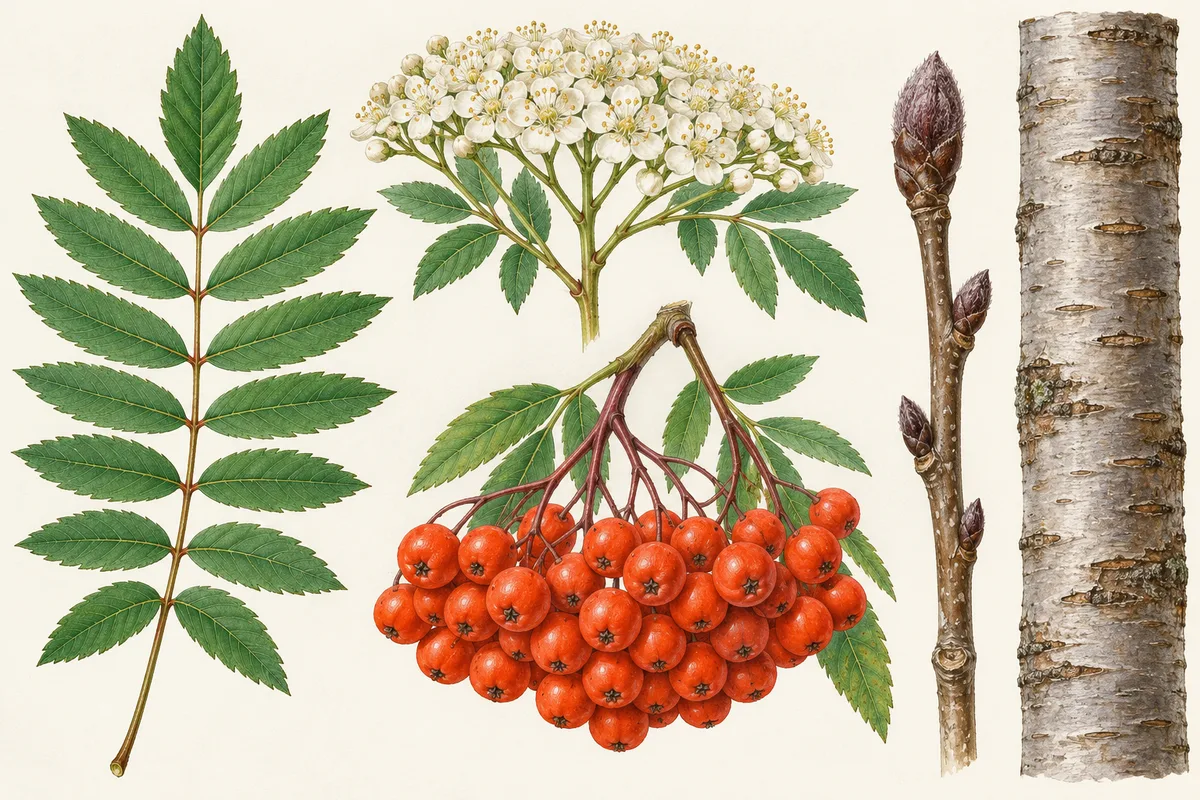
In short
A rowan tree, also called mountain ash, is a small tree up to about 15 m (50 ft) with alternate, feather-like leaves made of 5 to 8 pairs of toothed leaflets plus one at the tip. Creamy-white flowers open in flat clusters in May or early June, followed by bright red berries about 8 mm across from August. Europe's rowan is Sorbus aucuparia; North America has its own mountain-ashes.
- Rowan is not an ash: the Woodland Trust says it took the name for its ash-like leaves and its liking for high ground.
- Rowan grows higher than any other tree in Scotland, to almost 1,000 m in parts of the Highlands (Trees for Life).
- In North America, American and showy mountain-ash are native; European rowan is planted and occasionally escapes.
Field marks at a glance
- Scientific name
- Sorbus aucuparia
- Family
- Rosaceae (rose family)
- Type
- Broadleaf, deciduous
- Leaves
- Alternate, pinnate, up to 20 cm (8 in) long, with 5 to 8 pairs of toothed leaflets plus one at the tip; leaflets long, oval and more or less pointed. Orange-red in autumn.
- Flowers
- Creamy-white, five petals, about 1 cm across, in dense flat clusters 8–15 cm (3–6 in) wide; strongly sweet-scented. May or early June, after the leaves.
- Berries
- Bright red, about 8 mm (1/3 in) across, in heavy clusters; ripe in August or early September. Usually two seeds inside, up to eight.
- Bark
- Smooth and silvery or greyish-brown, shiny when wet, with dark raised lenticels.
- Buds and twigs
- Purple, hairy, egg-shaped buds, the end bud up to 8 mm long; young twigs hairy, then smooth.
- Size and lifespan
- Usually 10–15 m (33–50 ft), occasionally about 20 m; often several stems where deer browse. Can live up to 200 years.
- Range
- Most of Europe and North Africa, and central and northern Asia into northern China. In Britain everywhere, but commonest in the north and west.
- North America
- Native mountain-ashes are Sorbus americana (American mountain-ash) and Sorbus decora (showy mountain-ash); European rowan is a planted landscape tree.
The rowan, or mountain ash, is the small tree of hills, streets and gardens that turns heavy with red berries at the end of summer. In Britain and Ireland it is Sorbus aucuparia, a native tree of the rose family. In North America, "mountain-ash" usually means two native relatives, with the European rowan as a planted tree.
Never eat a berry, nut or seed on the strength of a web page or an app; check with a local expert.
How to identify a rowan: leaves, flowers, berries, bark
1. The leaves. A rowan leaf is pinnate, like a feather: the Woodland Trust's rowan profile counts 5 to 8 pairs of leaflets plus one at the tip, each long, oval and toothed. The leaves are arranged alternately along the twig. Trees for Life's rowan facts give leaves up to 20 cm (8 in) long, out in April and turning orange-red in autumn.
2. The flowers. In May or early June, after the leaves, rowan carries dense, flat clusters of creamy-white flowers, 8–15 cm (3–6 in) across and holding up to 250 flowers each. Each flower is about 1 cm wide with five petals, and the clusters have a strong, sweet scent.
3. The berries. From August or early September the flower heads become bunches of bright red berries about 8 mm (1/3 in) across. Most hold two seeds, some up to eight. Birds eat them and spread the seeds.
4. The bark and buds. The bark is smooth, silvery to greyish-brown, shiny when wet and dotted with dark raised lenticels. In winter look for purple, hairy, egg-shaped buds; the Woodland Trust gives the end bud as up to 8 mm long.
If the berries are out of reach, a photo of a leaf and a berry cluster together is a good one to give Tree Identifier. The app shows no confidence score or alternative species, so check its answer against the leaflet count and the flower or berry season.
Rowan through the year
- Spring: leaves open in April; buds are purple and hairy before that.
- Late spring: flat heads of scented cream flowers in May or early June, visited by flies, bees and beetles.
- Late summer: red berries ripen in August or early September. Trees for Life notes that in mild climates rowan fruits every year, but in harsh places such as Glen Affric fruiting is irregular, with heavy crops every few years.
- Autumn: leaves turn orange-red. Thrushes, including redwings and fieldfares arriving in September and October, take the berries; blackbirds are key seed dispersers.
- Winter: smooth grey bark, upward-pointing branches and hairy purple buds.
Trees for Life adds that rowan starts producing seed at around 15 years old, and that its seeds need a cold spell before they germinate, usually in the first or second spring.
Where rowan grows
Rowan grows across most of Europe and North Africa and through central and northern Asia into northern China. In Britain it grows in most areas but is commonest in the north and west, and the Woodland Trust singles out the Scottish Highlands. It climbs higher than any other tree in Scotland: Trees for Life records it at almost 1,000 m in parts of the Highlands, where it survives as small, stunted saplings. That liking for high ground, together with ash-like leaves, gave it the name mountain ash, though the Woodland Trust stresses that the two trees are not related.
Its size depends on where it grows. Trees for Life gives a usual maximum of 10–15 m, occasionally about 20 m, and notes that grazing deer often leave it with several stems. The Woodland Trust gives a lifespan of up to 200 years. Rowan is also widely planted as a street and garden tree, so you will meet it in towns far from any hill.
Rowan vs ash and elder
The Woodland Trust lists ash and elder as rowan's look-alikes, because all three have pinnate leaves. Its key mark is the leaflets: rowan's are serrated and more or less pointed at the end. Two more checks help: rowan's leaves alternate along the twig, and from August its flower heads turn into bunches of red berries. Our ash page gives ash's own marks, from its branching to its seeds, so you can compare the two side by side.
For the other trees with red fruit in Britain and North America, from holly to hawthorn, see trees with red berries.
Mountain-ash in North America
North America has two native mountain-ashes, and European rowan is planted alongside them.
American mountain-ash (Sorbus americana). NC State Extension's plant profile describes a small tree 4.5–10.5 m (15–35 ft) tall, native to northeastern North America from Newfoundland to Georgia; in North Carolina it grows mostly in the mountains. Leaves are 15–25 cm (6–10 in) long with 9 to 17 leaflets, each 5–10 cm (2–4 in). White flowers come in flat clusters in June and July, and the red-orange fruit, about 6 mm (1/4 in), ripens in September and October and can hang on into winter. It grows on moist, rich, acidic soils, in North Carolina often with spruce, fir and yellow birch.
Showy mountain-ash (Sorbus decora). Minnesota Wildflowers' species account describes a tree 3–12 m (10–40 ft) tall with 11 to 17 leaflets, red autumn leaves and bright red fruit 6–13 mm (1/4–1/2 in) across that ripens in late summer and persists through winter. In Minnesota it reaches the western edge of its US range and is common on the rocky North Shore of Lake Superior.
Telling the three apart. The same account gives the marks:
| Feature | European rowan | American mountain-ash | Showy mountain-ash |
|---|---|---|---|
| Buds | Densely hairy | Plant typically hairless | Shiny, sticky, dark purple |
| Leaflets | Hairy; end tooth about the size of the others | Long and slender, 3.3 or more times as long as wide | Broader, 2.5–3.3 times as long as wide; slender end tooth |
| Flowers and fruit | — | Smaller, up to about 8 mm | Slightly larger |
| Status | Planted; occasionally escapes | Native | Native |
Tree Identifier's Collection, the 138-species catalogue that fills in as you identify, includes European rowan as Sorbus aucuparia; the two American mountain-ashes are not among its 138 species. For the main British trees, rowan included, see tree identification in the UK.
Look-alikes and how to tell them apart
Ash (Fraxinus excelsior)
The Woodland Trust names ash as a look-alike because both have pinnate leaves. Rowan's leaflets are serrated and more or less pointed, its leaves alternate along the twig, and from late summer it carries clusters of red berries.
Elder (Sambucus nigra)
The Woodland Trust lists elder as a look-alike for its pinnate leaves. Rowan's leaflets are serrated and more or less pointed, and its berries ripen bright red in August or early September.
American mountain-ash (Sorbus americana)
Its leaflets are long and slender, at least 3.3 times as long as wide, and the plant is typically hairless; European rowan is hairy on the leaf stalks and leaflets, with more densely hairy buds.
Showy mountain-ash (Sorbus decora)
Feel the buds: showy mountain-ash buds are shiny, sticky and dark purple. Its leaflets are broader, 2.5 to 3.3 times as long as wide, and its flowers and fruit are slightly larger than American mountain-ash's.
What a photo can't settle
- European, American and showy mountain-ash differ mainly in bud stickiness, hairiness and leaflet proportions; a photo of a whole tree or a berry cluster can't settle which one you have.
- Deer browsing often leaves rowan as a multi-stemmed bush or a stunted sapling on high ground, which may look nothing like the 15 m tree described here.
- Whether any berry is safe to eat is never settled by a photo or a web page.
Questions people ask
Is a rowan tree the same as a mountain ash?
Yes. In Britain, mountain ash is another name for the rowan, Sorbus aucuparia. In North America, mountain-ash usually means the native American or showy mountain-ash, close relatives with similar leaves and red berries. None of them is a true ash.
What does a rowan tree look like?
A slender tree, usually 10–15 m tall, with smooth grey bark. Its leaves are feather-like, with 5 to 8 pairs of toothed leaflets plus one at the tip. Flat heads of creamy flowers open in late spring, and clusters of bright red berries follow from August.
When does a rowan tree have berries?
Trees for Life gives August or early September for the berries to ripen in Scotland. Thrushes such as redwings and fieldfares, arriving in September and October, eat them, so how long a crop lasts varies from tree to tree and year to year.
Are rowan berries poisonous?
Neither this page nor a tree identification app can tell you whether a wild berry is safe to eat. Never eat a berry, nut or seed on the strength of a web page or an app; check with a local expert.
Why is rowan planted near houses?
Folklore. The Woodland Trust records that rowan was widely planted by houses as protection against witches, planted near houses in Ireland to guard against spirits and in Welsh churchyards, and that cutting one down was taboo in Scotland.
Sources
- Rowan (Sorbus aucuparia) — Woodland Trust
- Rowan facts — Trees for Life
- Sorbus americana (American mountain ash) — NC State Extension Gardener Plant Toolbox
- Sorbus decora (Showy Mountain-ash) — Minnesota Wildflowers