Clue guide
Which tree has spiky balls? Six candidates and how to tell them
Measure the ball, check whether it holds a nut, then look up at the leaves. Those three checks separate every common spiky-ball tree in the United States.
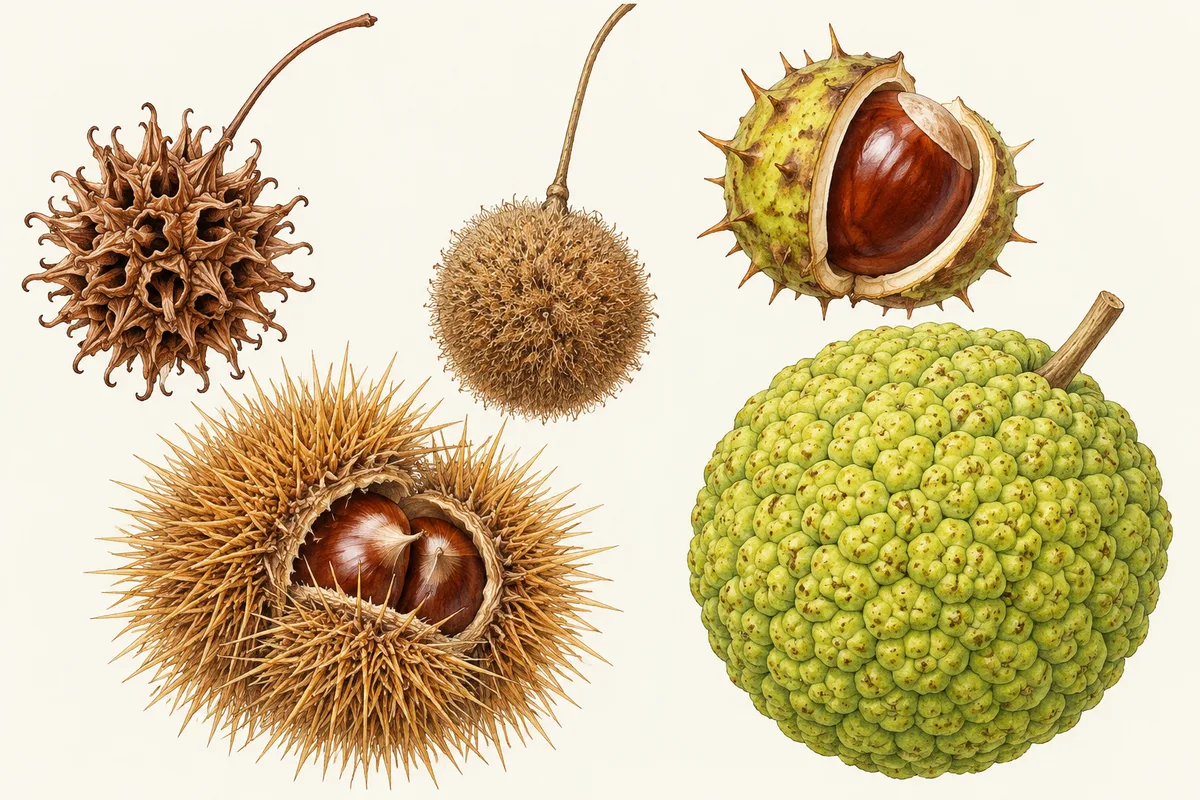
In short
A tree with spiky balls in the United States is usually a sweetgum: hard, brown "gumballs" 1 to 1.5 inches across, covered in beaked points, under star-shaped leaves. If a prickly husk splits to show a glossy brown seed, it is a horse chestnut or buckeye; a spiny bur holding 2 or 3 nuts means a chestnut; a soft, fuzzy ball means a sycamore.
- Sweetgum balls are woody and empty; buckeye, horse chestnut and chestnut husks hold seeds or nuts.
- Leaves settle it: star-shaped and alternate (sweetgum), hand-shaped and opposite (buckeye, horse chestnut), long and bristle-toothed (chestnut), broad and maple-like (sycamore).
- A green ball 3 to 6 inches across with a wrinkled, brain-like skin is an Osage orange, not a spiky ball.
Most trees with spiky balls in the United States belong to six species, and three checks sort them: the size and feel of the ball, whether it splits open around a nut or seed, and the leaves on the tree above it. Never eat a berry, nut or seed on the strength of a web page or an app; check with a local expert. This guide is for naming the tree, not for deciding what is safe to eat.
The six trees with spiky balls at a glance
| Tree | The ball | Size | When you see it | Leaves | Range |
|---|---|---|---|---|---|
| Sweetgum (Liquidambar styraciflua) | Hard, woody "gumball" of many capsules with beaked points | 1–1.5 in (USDA); 1–3 in (NC State) | Green in summer, brown September–November; hangs on through winter | Star-shaped, alternate | Connecticut south to central Florida and eastern Texas |
| Horse chestnut (Aesculus hippocastanum) | Prickly, leathery husk around large shiny brown seeds with a pale scar | 1–2 in | Fall | Opposite, hand-shaped, 5 to 7 leaflets | European; planted as a street and yard tree |
| Ohio buckeye (Aesculus glabra) | Warty or prickly leathery husk around 1 to 3 shiny brown seeds | Not given by NC State | Seeds mature in October | Opposite, hand-shaped, 5 to 7 leaflets | Ohio River valley, Great Plains, southern Appalachians |
| American chestnut (Castanea dentata) | Bur covered in sharp spines, opens around first frost | 2–2.5 in | Nuts drop September–October | Alternate, 4–9 in long, coarse bristle-tipped teeth | Eastern North America; now rare |
| Chinese chestnut (Castanea mollissima) | Spiny bur holding usually 2 to 3 nuts | 2–3 in | Ripens mid-September through October | Alternate, 5–8 in, fuzzy underneath | East Asia; widely planted |
| American sycamore (Platanus occidentalis) | Fuzzy ball on a 3–6 in stalk, not truly spiny | 0.5–1 in | Brown in fall, persists into early winter | Alternate, 3 to 5 lobes, 4–9 in wide | Southeastern Canada, central and eastern US |
| Osage orange (Maclura pomifera) | Wrinkled, yellow-green, brain-like ball; not spiny | 3–6 in | Ripens September–October | Alternate; stout thorns on sunlit shoots | Red River area of Oklahoma, Texas and Arkansas; planted as hedges nationwide |
Figures come from the USDA Forest Service Silvics of North America (sweetgum, Osage orange) and the NC State Extension Gardener Plant Toolbox (all others). Where the two disagree on sweetgum ball size, both ranges are shown.
Sweetgum: the most likely answer
If the ball is hard, brown, about the size of a ping-pong ball or a little smaller, and covered in sharp, beak-like points, you are almost certainly under a sweetgum. The USDA Forest Service describes the fruit as a head 1 to 1.5 inches across made of many small two-celled capsules. The heads are glossy green in summer and turn yellow, then brown, as they mature from September to November. Each capsule then opens and releases one or two small winged seeds, and empty heads often stay on the tree over winter.
The NC State Extension Plant Toolbox gives a larger range, 1 to 3 inches, and says the balls litter the ground from about December to April. It calls the fruit "the bane of some homeowners' existence".
Confirm with the leaves: glossy, star-shaped and alternate, turning red, purple, yellow or orange in fall. Some sweetgums, especially in the north of the range, also carry corky wings on their branches. Sweetgum grows wild from Connecticut south to central Florida and eastern Texas, and is common on river bottoms and in yards. Some cultivars, such as 'Rotundiloba', produce no balls at all.
Horse chestnut and buckeyes: a husk around shiny seeds
If the husk splits to reveal one to three large, glossy, chestnut-brown seeds, each with a pale round scar, the tree is a horse chestnut or a buckeye (genus Aesculus). The scar is the "buck's eye" that gives buckeyes their name.
- Horse chestnut is a European tree planted along streets and in yards. NC State describes its fruit as a prickly, leathery capsule 1 to 2 inches across. In spring it carries large upright clusters of creamy white flowers with a yellow throat and red speckles.
- Ohio buckeye is native from the Ohio River valley to the Great Plains and the southern Appalachians. Its capsule is warty or prickly, the seeds mature in October, and its spring flowers are greenish yellow. The flowers, bark and stems smell unpleasant when crushed, which is why it is also called fetid buckeye.
Both have opposite, palmately compound leaves: five to seven leaflets spread from one point like the fingers of a hand. No other tree on this list has opposite leaves, so one look at the twig settles it. NC State reports horse chestnut and Ohio buckeye as toxic to people, cats, dogs and horses; horse chestnut seeds are rated highly toxic.
Chestnuts: the sharpest burs
A chestnut bur is the spikiest of all: a ball of long, sharp spines that hurts to pick up. Inside are usually two or three nuts.
American chestnut was once a major tree of eastern forests, but chestnut blight, introduced in 1906, has made it nearly extinct in the wild. The NC State Plant Toolbox says it now survives mostly as sprouts from old stumps and roots, which may reach about 20 feet and bear a few burs before the blight kills them back. Its bur is 2 to 2.5 inches wide and opens around the first frost; the nuts drop in September and October. The leaves are 4 to 9 inches long with coarse teeth ending in a bristle, and are hairless.
Chinese chestnut is an East Asian species planted in yards and orchards; NC State notes that growers in the eastern part of North Carolina plant Asian and European chestnuts rather than the native one. NC State describes spiny burs 2 to 3 inches across, usually holding two or three nuts, ripening from mid-September through October. Its leaves are 5 to 8 inches long and soft and fuzzy underneath, and it resists chestnut blight. In the NC State profile the specific name mollissima refers to those soft, hairy twigs and leaf undersides.
Sycamore and Osage orange: balls that are not really spiky
American sycamore. People often call a sycamore ball spiky, but it is soft to the touch. The NC State profile describes a fuzzy ball 0.5 to 1 inch across, usually one per stalk, on a stalk 3 to 6 inches long. It turns brown in fall and persists into early winter, then breaks up into seeds carried off by downy tufts. Look up for the clincher: bark peeling in patches to show white to cream inner bark, and large leaves with 3 to 5 lobes, 4 to 9 inches wide.
Osage orange. A green ball the size of a softball, with a wrinkled, brain-like skin, is an Osage orange. The USDA Forest Service gives 3 to 6 inches across and a ripening time of September through October. When bruised, the fruit oozes a bitter milky juice that the Forest Service says may cause a skin rash. Branches in full sun carry sharp, stout thorns. Its native range is small, around the Red River of Oklahoma, Texas and Arkansas, but it was planted as a hedge in all 48 conterminous states.
How to tell them apart in three checks
- Squeeze it. Hard and woody with sharp points: sweetgum. Soft and fuzzy: sycamore. A thick, leathery husk: horse chestnut or buckeye. Needle-sharp spines that hurt: chestnut. Heavy, green and wrinkled: Osage orange.
- Open it. Empty and full of small holes: sweetgum. One to three large shiny seeds with a pale scar: horse chestnut or buckeye. Usually two or three nuts inside a spiny bur: chestnut.
- Read the leaves. Opposite and hand-shaped points to horse chestnut or buckeye. Alternate leaves narrow it to sweetgum (star-shaped), chestnut (long, with bristle-tipped teeth), sycamore (broad, with 3 to 5 lobes) or Osage orange (thorny shoots).
In winter, when the leaves are down, use the balls still hanging in the crown and the twigs: see winter tree identification. For acorns, samaras, pods and other fruit, the seeds and nuts guide covers the rest, and the red berries guide handles fleshy fruit.
When a photo helps
If you can't reach the leaves, a photo of the ball and a fallen leaf side by side usually gives a confident lead. Tree Identifier names a tree from one photo of a leaf, the fruit, the bark or the whole tree, and shows its common and scientific names. Sweetgum, horse chestnut and American sycamore are all in the app's Collection. Treat the result as a lead and check it against the three tests above, because the app does not show a confidence score or a list of look-alikes. Then ask follow-up questions in Tree Identifier's chat, such as how a horse chestnut differs from an Ohio buckeye. For the full field method, start with how to identify trees.
What a photo can't settle
- A photo of a fallen ball alone can't separate Ohio buckeye from yellow buckeye or other buckeye species; you need the leaves, the flowers and your location.
- Chestnut hybrids and planted Chinese chestnuts can look much like American chestnut. Telling them apart takes the leaf underside, the twigs and sometimes an expert.
- Planted trees break the range rule: horse chestnut, Chinese chestnut and Osage orange all grow far outside their native ranges.
Questions people ask
What tree drops spiky balls in the fall and winter?
Usually a sweetgum. Its spiky gumballs turn from green to brown as they mature in September to November, and many hang on the tree all winter. NC State Extension notes that they litter lawns and patios from about December to April, when most of them come down.
Is a sweetgum ball a seed?
No. It is a fruiting head made of many small capsules. Each capsule opens at its beaked tip and releases one or two small winged seeds that the wind carries off, so the brown ball on the ground is usually already empty.
Do sycamore trees have spiky balls?
Not really. A sycamore ball is 0.5 to 1 inch across, fuzzy rather than spiny, and hangs on a stalk 3 to 6 inches long. Late in the season it breaks apart into seeds with downy tufts. A sweetgum ball is hard and covered in sharp, beak-like points.
What is the difference between a buckeye and a horse chestnut?
Both have opposite, hand-shaped leaves and a leathery husk around shiny brown seeds. Horse chestnut is a planted European tree with a prickly husk 1 to 2 inches across and creamy white flowers. Ohio buckeye is native, its husk warty or only lightly prickly, its spring flowers greenish yellow.
Which chestnut tree has spiky balls?
All true chestnuts do. The nuts sit in a bur covered in long, sharp spines, 2 to 3 inches across. American chestnut is now rare because of chestnut blight, so a chestnut in a yard or orchard is often a planted Asian or European species such as Chinese chestnut, which resists the blight.
Sources
- Sweetgum (Liquidambar styraciflua), Silvics of North America — USDA Forest Service
- Liquidambar styraciflua (American sweetgum) — North Carolina Extension Gardener Plant Toolbox, NC State University
- Aesculus hippocastanum (common horsechestnut) — North Carolina Extension Gardener Plant Toolbox, NC State University
- Aesculus glabra (Ohio buckeye) — North Carolina Extension Gardener Plant Toolbox, NC State University
- Castanea dentata (American chestnut) — North Carolina Extension Gardener Plant Toolbox, NC State University
- Castanea mollissima (Chinese chestnut) — North Carolina Extension Gardener Plant Toolbox, NC State University
- Platanus occidentalis (American sycamore) — North Carolina Extension Gardener Plant Toolbox, NC State University
- Osage-Orange (Maclura pomifera), Silvics of North America — USDA Forest Service