Tree profile
Boxelder (Acer negundo): how to identify it
A maple with compound leaves. Check the leaf arrangement first, then the green, chalky twigs and the paired seeds, and you will never confuse it with poison ivy or ash.
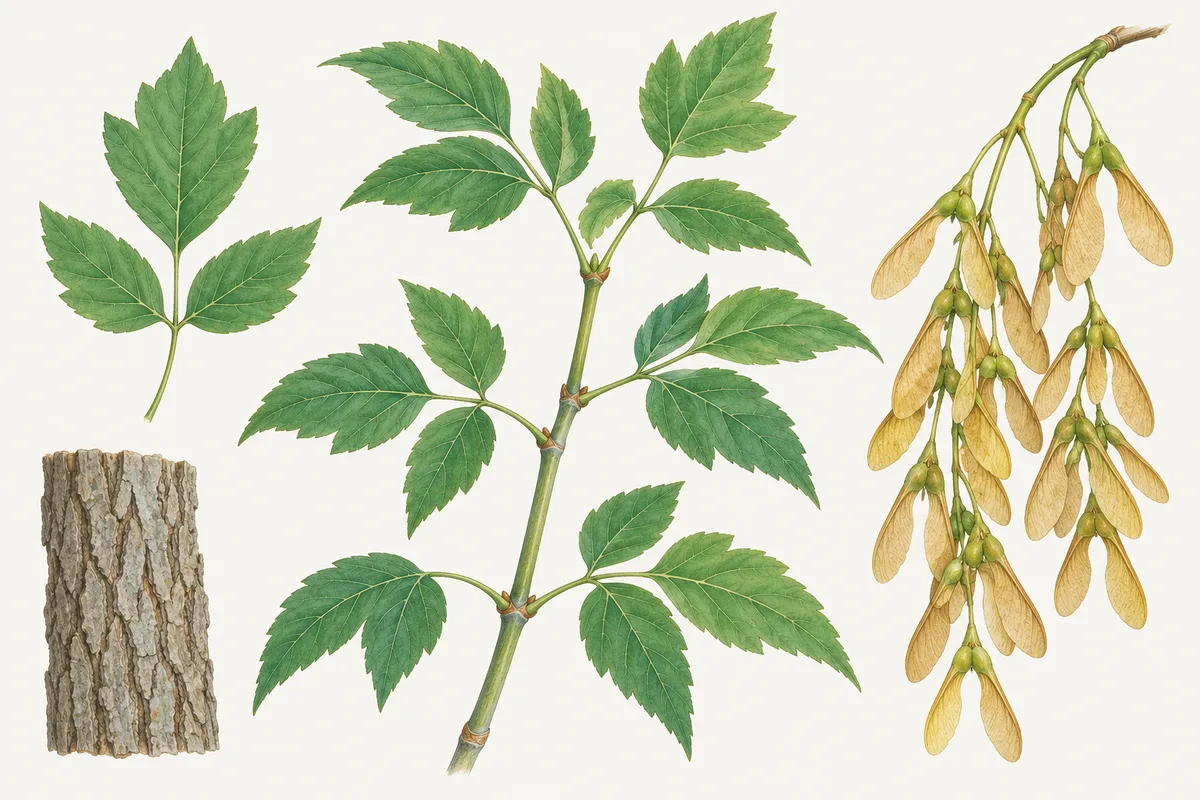
In short
Boxelder tree identification starts with the leaf: a maple whose leaves are compound, with 3 to 5 (sometimes 7) coarsely toothed or lobed leaflets, set in opposite pairs on the twig. Young twigs are green to purplish and often coated with a whitish, waxy bloom. Female trees carry paired, V-shaped winged seeds, 1 to 1 1/2 inches long, in drooping clusters that hang on through winter.
- Opposite leaves plus 3 to 7 leaflets mean boxelder; ash has 7 or more narrower leaflets and single-winged seeds.
- Poison ivy also has three leaflets, but its leaves alternate along a hairy vine or a low shrub: check the arrangement before you touch.
- In Canada the same tree is called Manitoba maple.
Field marks at a glance
- Scientific name
- Acer negundo
- Family
- Sapindaceae (soapberry family); the USDA Forest Service lists the older Aceraceae (maple family)
- Type
- Broadleaf, deciduous
- Leaves
- Opposite, pinnately compound, 6 to 8 inches long, with 3 to 5 leaflets (sometimes 7), each 2 to 4 inches; light green above, paler below. NRCan counts up to 9 on vigorous shoots.
- Leaflets
- Coarsely and irregularly toothed or somewhat lobed; the end leaflet often looks like a small maple leaf.
- Twigs and buds
- Green to purplish green, moderately stout, often with a whitish, waxy bloom. Buds white and hairy, side buds pressed to the twig. Narrow leaf scars meet in raised points around the twig.
- Seeds
- Paired samaras forming a V, 1 to 1 1/2 inches long, in drooping clusters on female trees only. Light tan when ripe in fall; they hang on through winter.
- Flowers
- Small, yellow-green, without petals, in drooping clusters; male and female on separate trees. Open March to May, with or before the leaves.
- Bark
- Thin, gray to light brown, with shallow interlacing ridges; warty on young trunks.
- Form and size
- Usually 30 to 60 ft, up to 75 ft; often several trunks, poor form and sprouts along the trunk. Averages about 60 years, rarely 100.
- Range and habitat
- The most widely distributed North American maple: Canada to Guatemala, in the US from New York to central Florida and west through the Plains. Stream banks, bottomlands, lakeshores and disturbed ground.
Boxelder (Acer negundo) is the maple that doesn't look like one. Its leaves are split into separate leaflets, so people take it for an ash, a weed tree or, when it is small, for poison ivy. It grows along streams, in bottomlands and on disturbed ground across most of North America, and in Canada it goes by the name Manitoba maple. Four checks, in this order, identify it.
How to identify a boxelder tree: four checks
1. Leaf arrangement: opposite. Look at where the leaf stalks join the twig. On boxelder they come off in pairs, directly across from each other. This one check rules out poison ivy, whose leaves alternate. Virginia Tech Dendrology's boxelder fact sheet describes the leaves as opposite and pinnately compound.
2. Count the leaflets: 3 to 5, sometimes 7. Each boxelder leaf carries 3 to 5 leaflets, sometimes 7, each 2 to 4 inches long, coarsely toothed or somewhat lobed. The end leaflet often looks like a small maple leaf, which is the clue to the tree's family. The Morton Arboretum gives the whole leaf as 6 to 8 inches long, light green in summer with very little fall color. Vigorous shoots can carry more: Natural Resources Canada counts 3 to 9 leaflets on leaves formed during the season, and only 3 on the leaves that open first in spring.
3. Twigs: green, often chalky. Boxelder twigs are green to purplish green and often coated with a whitish, waxy bloom that rubs off on your fingers. The buds are white and hairy. Virginia Tech notes another detail: the narrow leaf scars of each pair meet in raised points around the twig.
4. Seeds: V-shaped pairs on female trees. Boxelder is dioecious, with male and female flowers on separate trees. Females carry paired winged seeds that form a V, 1 to 1 1/2 inches long, hanging in drooping clusters; they ripen light tan in fall and stay on through winter. A tree with no seeds may simply be male.
When the leaves are out of reach or you are not sure about poison ivy, a photo of a leaf with its twig is enough for Tree Identifier to suggest a name. The app gives one answer with no look-alike list, so confirm it with checks 1 and 4.
Boxelder vs poison ivy
This is the comparison that matters most, because young boxelders and poison ivy both show three leaflets. North Carolina Extension's poison ivy profile lists Acer negundo as a plant poison ivy is often confused with, and states that all parts of poison ivy contain urushiol, an oil that causes significant, long-lasting skin irritation. Identify it by eye, before your hands get near it:
| Check | Boxelder | Poison ivy |
|---|---|---|
| Leaf arrangement | Opposite: two leaves across from each other | Alternate: one leaf per node, staggered |
| Leaflets | 3 on seedlings, 3 to 5 or 7 on older plants | Always 3; the middle leaflet is longer |
| Growth form | A woody stem that becomes a tree | A climbing vine with aerial rootlets, or a shrub to about 6 ft |
| Stem | Green to purplish, often with a whitish bloom | Older vines often covered in coarse brown hairs |
| Fruit | V-shaped winged pairs | Dull white berries about 1/4 inch, fall into winter |
| Fall color | Little change | Red or reddish yellow |
University of Georgia Extension's poison ivy article gives the same test in one line: boxelder leaves are arranged opposite each other on the stem, while the leaves alternate on poison ivy. It describes boxelder seedlings as young trees with three leaflets on a woody stem, and warns that poison ivy leaf shape and texture vary widely, so leaf shape alone isn't reliable.
Practical rules: look, don't touch, and use a stick to turn a leaf if you need to see the stem. Treat any vine climbing a trunk on dense, often hairy aerial rootlets as poison ivy, with or without leaves: North Carolina Extension notes that all parts of the plant contain urushiol. North Carolina Extension also warns never to burn poison ivy, because the smoke can be as toxic as touching the plant. If you develop a rash, see a doctor or pharmacist.
Boxelder vs ash
Boxelder and ash both have opposite, compound leaves, so this is the other common mix-up. Virginia Tech lists green ash among boxelder's look-alikes. Its green ash fact sheet gives the contrasts:
- Leaflets. Green ash has 7 to 9 lance-shaped, finely toothed leaflets on a leaf 6 to 9 inches long, never lobed. Boxelder has 3 to 5 (sometimes 7) coarse, often lobed leaflets.
- Seeds. Ash seeds are single, flattened wings. Boxelder's are paired and joined at the seed, forming a V.
- Twigs. Green ash twigs are gray to green-brown and stout, with the side bud sitting on top of a flat-topped leaf scar. Boxelder twigs are greener, often chalky, with white hairy buds.
- Bark. Mature ash has interlacing corky ridges in obvious diamonds; boxelder bark is thinner, with shallow ridges.
For white and black ash and the leaf-scar test, see the ash identification page. For how boxelder fits among sugar, red, silver and Norway maples, see the maple identification page.
Boxelder in winter
Without leaves, boxelder is still one of the easier trees to name. Look for the opposite twigs, green to purplish and often frosted with a waxy bloom, white hairy buds pressed close to the twig, and the narrow leaf scars that meet in raised points. On female trees, clusters of tan V-shaped seeds hang on all winter; the USDA Forest Service notes that they ripen from August to October and keep dispersing on the wind until spring. The tree often has several trunks, with sprouts along them. The method for other trees is in the winter tree identification guide.
Where boxelder grows, and its other names
The USDA Forest Service's Silvics of North America calls boxelder the most widely distributed of all the North American maples. It ranges from Canada to Guatemala; in the United States from New York to central Florida, west to southern Texas and northwest across the Plains, and it has naturalized in parts of New England, eastern Canada and the Pacific Northwest. It grows best in bottomland forests of the lower Ohio and Mississippi valleys, is most common on moist soils near streams, tolerates drought, and can survive flooding for as long as 30 days.
Its other names include ashleaf maple, boxelder maple, California boxelder and western boxelder. In Canada it is called Manitoba maple: Natural Resources Canada's Manitoba maple factsheet lists it under Acer negundo, with box-elder as a synonym and Érable à Giguère as the French name, and places it on lakeshores, stream banks, seasonally flooded and disturbed sites. If you are in Canada, look for it under Manitoba maple in the Canada tree identification guide.
The Morton Arboretum describes boxelder as a native tree that is rarely sold because it self-seeds aggressively, with weak wood prone to storm and ice damage. It also hosts the boxelder bug. The Forest Service reports that the bug's nymphs feed mainly on female trees and that the adults invade houses in large numbers when cold weather arrives, which is why many people first notice the tree in fall. If you want to keep track of which boxelders in a yard or park are female, Tree Identifier's Tree Map stores the location of each identified tree.
Look-alikes and how to tell them apart
Poison ivy (Toxicodendron radicans)
Poison ivy always has exactly three leaflets and its leaves alternate up the stem, one per node. It grows as a vine with hairy aerial rootlets or as a low shrub, and carries dull white berries. Boxelder leaves come in opposite pairs on a woody stem, and older plants grow 5 or 7 leaflets. Look, don't touch.
Green ash (Fraxinus pennsylvanica)
Also opposite and compound, but with 7 to 9 narrow, finely toothed leaflets that are never lobed, gray-brown twigs without a waxy bloom, and single-winged, paddle-shaped seeds instead of V-shaped pairs.
Poison oak (Toxicodendron pubescens)
A low, upright shrub about 3 feet tall in dry, sunny spots, with three leaflets that are always lobed, arranged alternately. Boxelder seedlings have opposite leaves. Avoid touching either until you have checked.
What a photo can't settle
- Boxelder leaflet shape varies a lot, even on one tree: Virginia Tech notes that the leaflets often resemble a classic maple leaf, and NRCan that the margins are irregular. A single leaflet in a photo can pass for a maple leaf, so photograph the whole compound leaf on its twig.
- Young boxelder seedlings with only three leaflets look much like poison ivy in a photo. The opposite-versus-alternate check needs the stem in view; if you can't see it, treat the plant as poison ivy and don't touch it.
- Boxelder is not in the app's 138-species Collection, and Tree Identifier gives one name per photo with no look-alike list. Confirm its answer with the leaf-arrangement and seed checks on this page.
Questions people ask
Is a box elder tree a maple?
Yes. Boxelder is Acer negundo, a true maple, even though its leaves are compound rather than lobed. Its opposite branching and paired, V-shaped winged seeds are maple traits. The USDA Forest Service calls it the most widely distributed of all North American maples and lists ashleaf maple among its other names.
How do you tell boxelder from poison ivy?
Look at how the leaves sit on the stem. Boxelder leaves come in opposite pairs; poison ivy leaves alternate, one per node. Poison ivy always has three leaflets and climbs on aerial rootlets or grows as a shrub. Boxelder grows as a woody tree, and older plants show 5 or 7 leaflets. Don't touch until you are sure.
How do you tell a box elder from an ash tree?
Count the leaflets and check the seeds. Boxelder has 3 to 5, sometimes 7, coarsely toothed or lobed leaflets and V-shaped paired seeds. Green ash has 7 to 9 narrower, finely toothed leaflets and single, paddle-shaped seeds. Boxelder twigs are green and often chalky; ash twigs are gray to brown.
What is a Manitoba maple?
The Canadian name for boxelder. Natural Resources Canada's factsheet lists Manitoba maple as Acer negundo, with box-elder as a synonym and Érable à Giguère as the French name. It is the same tree, with the same compound leaves, chalky green twigs and paired seeds.
Why does my boxelder have no seeds?
It is probably a male tree. Boxelder is dioecious: male and female flowers grow on separate trees, and the Morton Arboretum notes that the seeds appear on female trees only. A male tree still has the opposite, compound leaves and green twigs, so identify it from those.
Do boxelder trees attract boxelder bugs?
Yes. The USDA Forest Service names the boxelder bug as a common associate across most of the tree's range; its nymphs feed mainly on female trees, and the adults invade houses in large numbers when cold weather arrives. The Morton Arboretum also notes that the bugs often enter homes in fall.
How long do boxelder trees live?
Not long for a tree. The USDA Forest Service gives an average of about 60 years, rarely 100, and Natural Resources Canada also gives 60 years as a maximum. The wood is weak, and the Morton Arboretum describes boxelder as prone to storm and ice damage.
Sources
- Boxelder fact sheet — Virginia Tech Dendrology
- Boxelder (Acer negundo L.), Silvics of North America — USDA Forest Service
- Boxelder (Acer negundo) — The Morton Arboretum
- Manitoba maple — Natural Resources Canada, Trees, insects and diseases of Canada's forests
- Green ash fact sheet — Virginia Tech Dendrology
- Toxicodendron radicans (Eastern Poison Ivy) — North Carolina Extension Gardener Plant Toolbox
- Identifying poison ivy isn't as easy as 'Leaves of Three' — University of Georgia Cooperative Extension, Paulding County