Tree comparison
Spruce vs fir: how to tell them apart
Roll a needle, pull one off, then look up at the cones. Four checks separate every spruce from every fir, and the Douglas-fir test comes last.
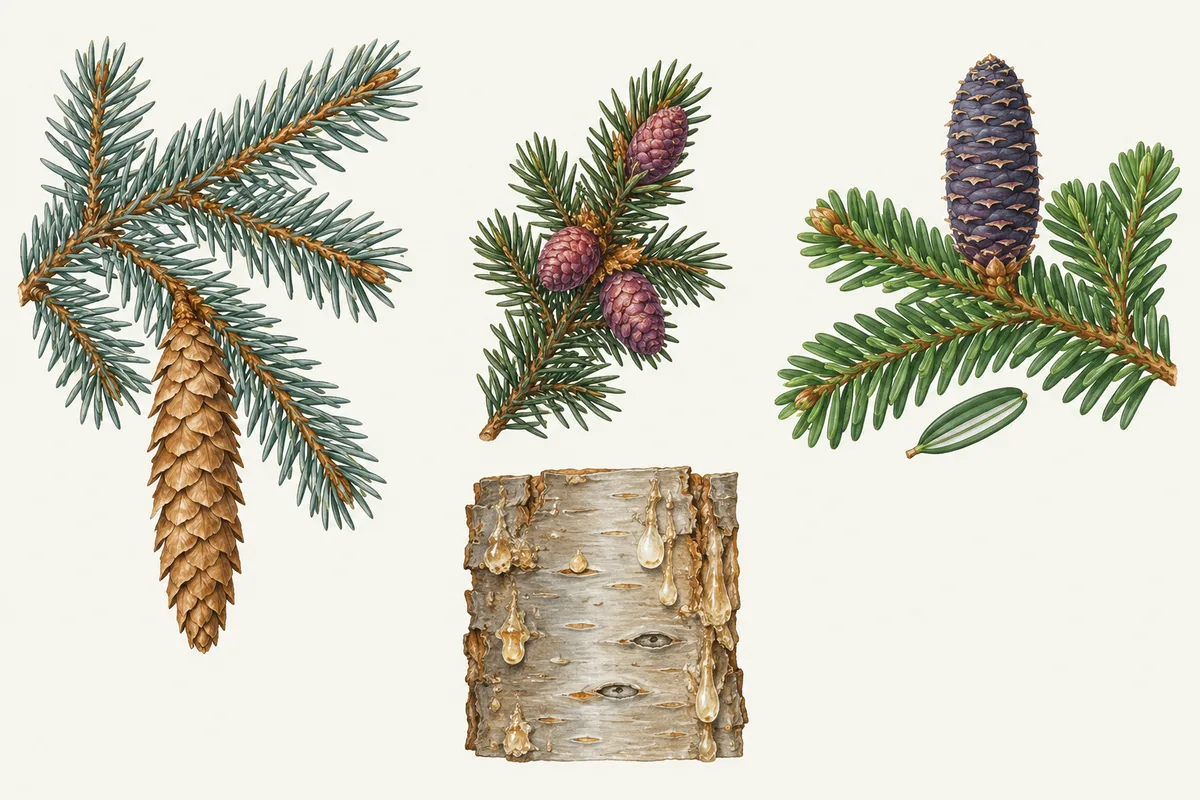
In short
Spruce vs fir comes down to the needle. A spruce needle is four-sided and rolls between your fingers, and pulling it off leaves a small woody peg on the twig. A fir needle is flat, will not roll and leaves a flat, round scar. Fir cones stand upright and fall apart on the branch; spruce cones hang down and often drop whole. Young fir bark carries raised resin blisters.
- Square needle that rolls and a woody peg left on the twig: spruce. Flat needle and a round, flat scar: fir.
- A whole cone on the ground under the tree rules out a true fir, because fir cones shed their scales on the branch.
- Douglas-fir is neither: its needles lack both the peg and the round base, and its hanging cones carry three-pointed bracts.
Field marks at a glance
- Scientific name
- Picea and Abies
- Family
- Pinaceae (pine family)
- Type
- Conifer, evergreen
- Needle shape
- Spruce: four-sided, square in cross-section, rolls easily between thumb and finger. Fir: flat, very hard to roll, tip rounded or notched.
- Needle attachment
- Spruce: each needle sits on a raised woody peg (sterigma) that stays on the twig, so a bare twig feels rough. Fir: the needle base leaves a flat, rounded scar, like a small suction cup.
- Needle underside
- Balsam fir: shiny dark green above, with two silvery-white bands of 10 to 12 lines of dots beneath. Spruces: four-sided needles, so no flat underside to carry two bands.
- Cones
- Spruce: cones hang down and often fall whole. Fir: cones stand upright on the upper branches and break apart in early fall, leaving a bare spike.
- Bark
- Fir: smooth, grayish, with raised resin blisters on young trunks, scaly and brownish with age. Spruce: thin, soon flaky or scaly, gray-brown to reddish brown.
- Smell
- Balsam fir: strong odor when crushed; Ohio State calls fir needles citrusy. White spruce: pungent, which some compare to cat urine; the Forest Service lists the names skunk spruce and cat spruce.
- Native species
- White spruce (Picea glauca), black spruce (Picea mariana) and balsam fir (Abies balsamea) across Canada and the northern US; Fraser fir native to the eastern United States.
- In the app's Collection
- Norway spruce, Colorado blue spruce, European silver fir and Douglas-fir.
Spruces (Picea) and firs (Abies) are both cone-shaped evergreens with single needles, and both grow across Canada and the northern United States. They are separate genera, and four tests in a fixed order tell them apart: the needle in your fingers, the twig under the needle, the cones and the bark. You can do the first two on a cut Christmas tree.
Spruce vs fir in four field tests
Do the tests in this order. Each one uses something you can touch or see from the ground.
1. Roll a needle. Pick one needle and roll it between your thumb and forefinger while squeezing it. University of Wisconsin–Madison Extension's guide to keying out Christmas trees puts it simply: flat needles are "exceedingly difficult to roll," while spruces have angled or rounded needles that roll easily. Virginia Tech describes the white spruce needle as square in cross-section, stiff, pointed but not sharp.
2. Pull a needle off and look at the twig. On a spruce, every needle sits on a short woody peg, which Virginia Tech calls a sterigma. Ohio State University Extension's fact sheet Is It Pine, Spruce, or Fir? explains that the pegs stay on the branch when the needles are shed, so a bare spruce twig feels rough. Fir needles lack pegs: the base of each one is expanded into a round disc, which Ohio State compares to a suction-cup-tipped dart, and it leaves a small circular scar on a smooth twig.
3. Look at the cones. Ohio State notes that spruce cones hang downward from the branch and often fall to the ground intact, while fir cones stay upright and crumble away from their central stalk; fir cones are seldom found whole on the ground. Natural Resources Canada's balsam fir factsheet describes erect, barrel-shaped cones 4 to 10 cm long that begin breaking apart in early September and leave the bare central axis on the tree for several years. A whole cone under the tree therefore did not come from a true fir.
4. Check the bark. Young fir bark is smooth with raised resin blisters, grayish at first, and with age it breaks into irregular brownish scales (NRCan). Spruce bark is thin and soon flaky or scaly: gray-brown on white spruce (Virginia Tech), reddish or grayish brown on black spruce (NRCan).
| Test | Spruce (Picea) | Fir (Abies) |
|---|---|---|
| Needle cross-section | Four-sided, rolls easily | Flat, won't roll |
| Needle feel | Stiff, pointed, often sharp | Soft, tip rounded or notched |
| Needle underside | No flat underside to carry bands | Two silvery-white bands (balsam fir) |
| What a pulled needle leaves | A woody peg; bare twig feels rough | A small circular scar; bare twig is smooth |
| Cones | Hang down, often fall whole | Stand upright near the top, crumble on the branch |
| Bark of a young tree | Thin, soon flaky or scaly | Smooth, resin blisters |
Fir tree identification by needles
Fir needles are single, flat and soft to the touch. On balsam fir, NRCan gives them 1.5 to 2.5 cm long with a rounded or notched tip, spread in two rows along the twig with the upper ones shorter. The top is shiny dark green; underneath, 10 to 12 lines of white dots form two silvery bands. Crushed, they give off a strong odor; Ohio State describes fir needles in general as citrusy when crushed. They are soft, never stiff and prickly like most spruce needles.
Two more fir clues sit at the twig tip: the buds are broadly egg-shaped, about 5 mm long and resinous, and the twigs are greenish gray and slightly hairy (NRCan). A fir needle pulled from the twig always comes away cleanly from its round base, which is the single most reliable fir tree identification test when there are no cones.
Spruce tree identification: white, black and Colorado spruce
Once the roll-and-pull test says spruce, the species usually comes from the twig, the smell and the cone.
White spruce (Picea glauca). Needles 1/3 to 3/4 inch, green to gray-green, on hairless twigs. Crush a few: Virginia Tech describes a pungent odor that some compare to cat urine, and the USDA Forest Service's Silvics of North America lists skunk spruce and cat spruce among its other names. Cones are cigar-shaped, 1 1/2 to 2 1/2 inches, with rounded scales. In the United States the Forest Service places it in Alaska, Minnesota, Wisconsin, Michigan, New York and Maine, with possible outliers in Montana, Wyoming and South Dakota; in Canada it ranges from Newfoundland and Labrador to the Yukon.
Black spruce (Picea mariana). Needles are short, 8 to 15 mm, straight, blunt-pointed and dull grayish green, and the twigs carry many short brownish hairs (NRCan's black spruce factsheet). The cones are the giveaway: open, almost round, and able to stay on the tree for up to 30 years, so an old black spruce is often crowded with gray cones near the top. In the southern part of its range it grows mostly on wet, poorly drained sites such as bogs.
Colorado blue spruce (Picea pungens). Wisconsin Extension notes its longer, very sharp needles, which make it hard to decorate as a Christmas tree. Ohio State's fact sheet names it alongside Norway spruce and white spruce, and the same peg and roll tests apply to all three.
Balsam fir and Fraser fir
Balsam fir (Abies balsamea) is the fir of the North. The Forest Service maps it from Newfoundland and Labrador west to northwestern Alberta, and in the United States from extreme northern Minnesota east through New York and central Pennsylvania into New England, with local stands in the mountains of Virginia and West Virginia. Mature trees stand 40 to 60 feet tall and 12 to 18 inches in diameter. The Forest Service gives a maximum age of about 200 years; NRCan says about 150.
In Canada, NRCan describes balsam fir as a tree of the northern forests of central and eastern Canada, and black spruce as transcontinental, extending south into the United States: these are two of the conifers Canadians meet first in the boreal forest. The Canada tree identification guide sorts them by region, with tamarack, the boreal conifer that drops its needles every autumn.
Fraser fir (Abies fraseri), native to the eastern United States according to Wisconsin Extension, is the other popular Christmas-tree fir. The Forest Service calls balsam fir closely related to Fraser fir, and the two share flat needles, upright cones and resin-blistered bark. Wisconsin Extension describes Fraser fir needles as flat, shiny dark green above and lighter below, more crowded on the twig than balsam's, with horizontal branches that give the tree a stiff look. On a tree lot, the label is usually the quickest way to tell them apart.
Douglas-fir: the look-alike that is neither
Douglas-fir (Pseudotsuga menziesii) carries "fir" in its name, which sends people to the wrong genus. Virginia Tech's Douglas-fir fact sheet gives the test in one line: its single needles "lack woody pegs or suction cups." They are 3/4 to 1 1/4 inches long, blunt-tipped and very fragrant. Two other marks settle it:
- Buds: long, sharp-pointed and red-brown, unlike a fir's round, resin-coated buds.
- Cones: 3 to 4 inches, hanging like a spruce's, with three-lobed bracts sticking out beyond the scales, which Virginia Tech compares to the back half of a mouse.
Hemlocks also have short, flat needles; they, and the pines, larches and cedars, are in the conifer identification key. For pines, whose needles come in bundles, see the pine page. If the tree has scales instead of needles, it belongs on the cedar page.
Spruce or fir in winter and from a distance
Because both keep their needles all year, spruce and fir are among the easiest trees to identify in winter; the winter tree identification guide covers the leafless broadleaves around them. From a distance, look at the top of the crown: upright fir cones, grayish brown when ripe (NRCan), stand on the uppermost branches until they break apart in early fall, while spruce cones hang down. Under the tree, whole cones mean spruce; loose scales and winged seeds mean fir. Spruces keep their needles for four to 10 years, Ohio State notes, so the woody pegs are easiest to see on older twig sections near the main stem.
If you can't reach a branch, a close photo of the needles and twig gives the best result. Tree Identifier names a tree from one photo, and its Collection includes Norway spruce, Colorado blue spruce and Douglas-fir. Tree Identifier's Tree Map keeps the location of each identified tree, which helps if you want to come back for the cones in late summer.
Look-alikes and how to tell them apart
Douglas-fir (Pseudotsuga menziesii)
Not a true fir. Its single, flat needles lack both a spruce's woody peg and a fir's suction-cup base, its buds are long, sharp and red-brown, and its hanging 3- to 4-inch cones carry three-lobed bracts sticking out between the scales.
Black spruce vs white spruce
Black spruce twigs carry many short brown hairs, its needles are 8 to 15 mm, and its small, almost round cones can stay on the tree for decades. White spruce twigs are hairless, its needles smell pungent when crushed, and its cones are cigar-shaped, 1 1/2 to 2 1/2 inches.
Fraser fir vs balsam fir
Both have flat needles, upright cones and resin-blistered bark, and the USDA Forest Service calls them closely related. Fraser fir is native to the eastern United States; its needles look more crowded on the twig and its horizontal branches give the tree a stiffer look.
What a photo can't settle
- A cut Christmas tree has no cones and little visible bark, so the needle and twig tests carry the whole decision. Photograph the underside of a branch close up so the needle bands and attachment show.
- Fir cones grow only near the top of the tree, and they break apart on the branch, so in a forest you may only find scattered scales on the ground.
- White spruce hybridizes with Engelmann, Sitka and black spruce where their ranges meet, the USDA Forest Service reports, so trees in those zones can show mixed traits.
- Tree Identifier gives one name from one photo, with no confidence score and no look-alike list; repeat the roll-and-pull test before settling between two spruces or two firs.
Questions people ask
How do you tell a spruce from a fir?
Roll a needle between your thumb and finger. A spruce needle is four-sided and rolls; a fir needle is flat and won't. Then pull one off: spruce leaves a woody peg on the twig, fir a flat round scar. If cones are in reach, spruce cones hang and fir cones stand upright.
How do you identify a fir tree by its needles?
Fir needles are single, flat and soft, with a rounded or notched tip. On balsam fir they are 1.5 to 2.5 cm long, shiny dark green above with two silvery-white bands beneath, and smell strongly when crushed. Pulled off, a fir needle leaves a flat, rounded scar, not a peg.
How do you identify spruce trees by needles?
Spruce needles are stiff, four-sided and roll easily between your fingers, and each one sits on a small woody peg that stays on the twig. Then sort the species: white spruce needles smell pungent when crushed, black spruce needles are short, 8 to 15 mm, on hairy twigs, and Colorado spruce needles are long and very sharp.
Is a Douglas-fir a spruce or a fir?
Neither. Douglas-fir has its own genus, Pseudotsuga. Virginia Tech notes that its needles lack both the woody pegs of spruce and the suction-cup bases of fir. Its cones hang like a spruce's but carry three-lobed bracts poking out between the scales, and its buds are long and sharp-pointed.
Is a Christmas tree a spruce or a fir?
Usually a fir. Wisconsin Extension notes that firs are more commonly used as Christmas trees than spruces and calls balsam fir the traditional holiday tree; Fraser fir is the other popular one. Spruces such as Colorado spruce turn up too, but their long, sharp needles make them hard to decorate.
What is the difference between balsam fir and spruce?
Balsam fir has flat, blunt needles with two white bands beneath, smooth gray bark with resin blisters and upright cones that fall apart on the tree. Spruces have stiff, four-sided needles on woody pegs, scaly bark and hanging cones. Crushed balsam fir needles smell strong; crushed white spruce smells pungent.
Sources
- Balsam Fir, Silvics of North America — USDA Forest Service
- White Spruce, Silvics of North America — USDA Forest Service
- Balsam fir (Abies balsamea) — Natural Resources Canada, Trees, insects and diseases of Canada's forests
- Black spruce (Picea mariana) — Natural Resources Canada, Trees, insects and diseases of Canada's forests
- White spruce fact sheet — Virginia Tech Dendrology
- Is It Pine, Spruce, or Fir? (Fact Sheet ANR-80, Curtis E. Young) — The Ohio State University Extension (CFAES)
- Douglas-fir fact sheet — Virginia Tech Dendrology
- Keying Out Christmas Trees (Bruce Spangenberg) — University of Wisconsin–Madison Division of Extension, Wisconsin Horticulture
Keep reading
- Field guideConifer identification: three questions about the needles, then the cone
- Tree profileCedar trees: how to identify red, white and true cedars
- Tree profilePines (Pinus): how to identify a pine tree
- Winter field guideWinter tree identification, from buds to bark
- Tree profileTamarack (Larix laricina): how to identify it