Tree profile
Birches (Betula): how to identify a birch tree
Bark color and how it peels, the shape of the leaf, and whether a scratched twig smells of wintergreen. Those three checks separate the common US birches.
In short
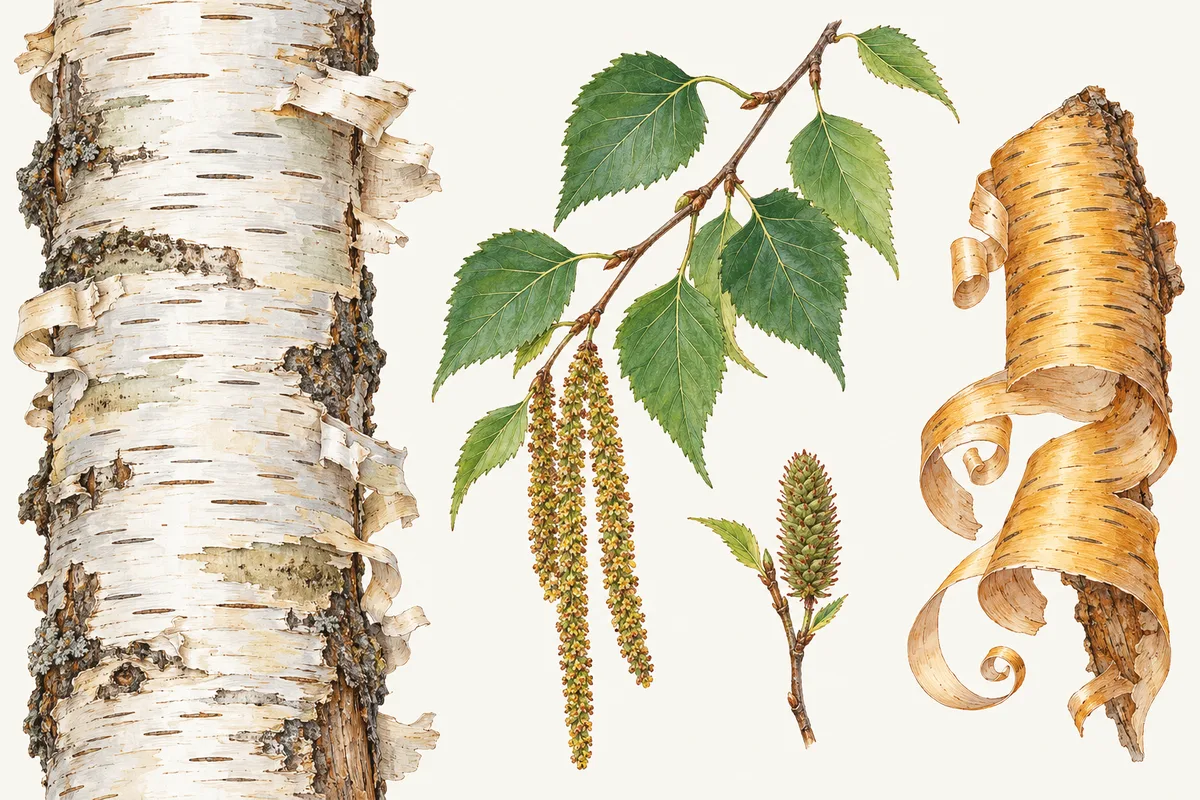
Birch tree identification starts with the bark: thin, marked with horizontal lines of lenticels, and on several species peeling in papery strips, chalky white on paper birch, salmon to cinnamon on river birch, shiny bronze on yellow birch. Then check the leaf, doubly toothed on most birches, and scratch a twig: black and yellow birch smell of wintergreen, paper and river birch do not.
- White bark that peels in sheets: paper birch. White bark that stays smooth, on a small multi-trunk tree: gray birch.
- Peeling salmon, orange and cream layers: river birch, the birch of the Southeast and a popular ornamental.
- Wintergreen smell from a broken twig: black (sweet) or yellow birch; tell them apart by the bark.
Field marks at a glance
- Scientific name
- Betula
- Family
- Betulaceae (birch family)
- Type
- Broadleaf, deciduous
- Leaves
- Alternate, simple, ovate to triangular, 1 1/2 to 6 inches depending on species, pinnately veined, with doubly toothed edges on most birches.
- Bark
- Thin, with horizontal lenticels. Paper birch: chalky to creamy white, peeling in strips. River birch: salmon to rust, peeling in several colors. Yellow birch: shiny bronze, curly strips. Black birch: dark, in scaly plates.
- Twig smell
- Scratch or break a twig: wintergreen in black (sweet) and yellow birch; no wintergreen in paper and river birch (Virginia Tech Dendrology).
- Fruit
- A small, cone-like catkin about 3/4 to 1 1/2 inches long that breaks apart to release tiny winged nutlets, mostly in fall and winter. River birch is the only spring-fruiting birch (USDA Forest Service).
- Catkins
- Male catkins are preformed: they are already on the twig, near its tip, before spring and lengthen in spring; female catkins stand upright.
- Buds
- No true end bud; side buds small and pointed, often two-toned green and brown. Older branches carry short spur shoots.
- Form
- Paper and river birch often grow several trunks; gray birch is small, rarely over 30 feet; black birch usually has a single straight trunk.
Birches (Betula) are the trees most people recognize by bark alone: thin, marked with horizontal lenticel lines and, on several species, peeling. But five birches are common in the eastern United States, a sixth is planted in yards, and the bark changes with age. Use three checks: bark, leaf, twig smell.
Bark, leaf and smell: the birch chart
Every row comes from the Virginia Tech Dendrology fact sheet linked in the first column.
| Birch | Bark on mature trees | Leaf | Scratched twig |
|---|---|---|---|
| Paper birch (B. papyrifera) | Chalky to creamy white, peeling in horizontal papery strips; orange inner bark | 3–5 in, ovate, rounded base, irregularly double teeth | No wintergreen |
| River birch (B. nigra) | Salmon to rust, peeling in papery scales of several colors, later coarse scales | 1 1/2–3 in, diamond-shaped, wedge base | No wintergreen |
| Yellow birch (B. alleghaniensis) | Shiny bronze, sometimes gray, peeling in thin curly strips; red-brown plates when old | 4–6 in, soft, double teeth | Wintergreen |
| Black or sweet birch (B. lenta) | Reddish brown to black, then gray to nearly black in large, thin, scaly plates | 2–4 in, heart-shaped base, sharp teeth | Wintergreen |
| Gray birch (B. populifolia) | Gray to chalky white, smooth, generally doesn't peel | 2–3 in, triangular, long drawn-out tip | No smell listed; twig rough with warty lenticels |
| European white birch (B. pendula) | White, mostly smooth, peels a little; thick, black, vertically furrowed at the base | 2–4 in, ovate to triangular, long tip | Not listed |
Start with the bark, but look at a trunk at least a few inches thick. On young stems most birches are reddish brown with pale lenticels, and the white, bronze or salmon color comes later.
The wintergreen test for black and yellow birch
Break or scratch a small twig and smell it. Virginia Tech notes a wintergreen smell for black (sweet) and yellow birch and its absence in paper and river birch. The USDA Forest Service's sweet birch silvics adds that the tree was at one time the only source of oil of wintergreen, and that the smell of crushed leaves and broken twigs gave it the name sweet.
The test is quick in winter too, when a twig is all you have. Once you smell wintergreen, the bark separates the two: yellow birch peels in shiny bronze curls, black birch does not peel and breaks into dark plates. The leaves agree: yellow birch leaves are 4 to 6 inches and soft, black birch leaves 2 to 4 inches with a heart-shaped base.
If you can't reach a twig, a photo of the bark or a leaf is enough to get a name from Tree Identifier. The app shows no confidence score and no list of look-alikes, so check the bark color and the smell before you trust it. Paper birch and European white birch are both in the app's 138-species Collection, which fills in as you identify trees.
White birches: paper, gray or European
Three white-barked birches cause most of the confusion.
Paper birch peels freely in horizontal sheets and shows orange inner bark where it peels. It grows to about 70 feet, often with several trunks. The Forest Service's Silvics of North America describes it as a northern tree whose range follows the northern limit of tree growth from Newfoundland and Labrador to Alaska, south into New England, the Great Lakes and the northern Rockies.
In Canada, paper birch often goes by the name white birch: Natural Resources Canada's white birch factsheet uses that name for Betula papyrifera, lists paper and canoe birch as synonyms, and says it grows across Canada. Yellow birch is Quebec's official tree, according to Canadian Heritage. The guide to tree identification in Canada shows where both fit among each region's trees.
Gray birch stays smooth and chalky and generally doesn't peel. It is small, rarely over 30 feet, usually with several trunks and drooping slender branches. Its leaves are triangular with a long, drawn-out tip, and its twigs feel rough because of warty, raised lenticels.
European white birch (Virginia Tech calls it European weeping birch) is the planted one. Look for distinctly drooping fine branches, white bark that peels only a little, and a base that turns thick and nearly black, split into narrow vertical furrows. It reaches up to 65 feet.
River birch, the yard birch of the South
River birch is the birch of the southeastern United States. The Forest Service's river birch silvics gives its main range as the southeastern quarter of the country, from eastern Texas and southeastern Iowa to Virginia and northern Florida, with scattered populations along rivers north to southern Minnesota and New England. It is the only birch whose range includes the southeastern coastal plain, and the only one that fruits in spring.
The bark is the giveaway: smooth and salmon to rust on young trees, then peeling in papery scales that show cream to orange-brown layers, and coarse scales on old trunks. The leaves are diamond-shaped with a wedge-shaped base and conspicuous double teeth, and the trunk generally divides low into several upright stems. The Forest Service notes that its beauty makes it an important ornamental, especially at the northern and western edges of its range, so a planted river birch in a yard tells you little about where it grows wild.
Birch vs beech
People confuse birch and beech because both have smooth, pale bark when young and simple, toothed leaves. Four checks settle it, from the American beech fact sheet and the birch sheets above:
- Bark: beech is smooth, thin and gray even on the largest trunks, and never peels. Birch bark carries horizontal lenticel lines and often peels or breaks into plates.
- Buds: beech buds are long (about 3/4 inch), slender and cigar-shaped, sticking out from the twig like thorns. Birch buds are short and there is no true end bud.
- Leaf veins: a beech leaf has 11 to 14 pairs of straight veins, each ending in one sharp tooth. Most birch leaves are doubly toothed.
- Fruit: beech bears triangular nuts in a spiny husk. Birch bears small cone-like catkins that crumble into winged nutlets.
The beech identification page covers American and European beech in detail, and the bark identification guide compares birch bark with other smooth and peeling barks.
Look-alikes and how to tell them apart
American beech (Fagus grandifolia)
Beech bark is smooth and gray and never peels; its leaves have 11 to 14 straight vein pairs, each ending in one sharp tooth, and its buds are long, slender and cigar-shaped, about 3/4 inch. Birch buds are short and birch bark has lenticel lines.
Hophornbeam (Ostrya virginiana)
Hophornbeam leaves look birch-like, but its bark breaks into small shreddy plates that brush off by hand, and its fruit hangs in hop-like clusters of inflated papery sacs, 1 1/2 to 2 1/2 inches long, that persist through winter.
American hornbeam (Carpinus caroliniana)
Hornbeam, also in the birch family, has similar doubly toothed leaves, but its smooth, blue-gray bark never peels and the trunk is fluted like flexed muscle. Its nutlets hang on 3-lobed leafy bracts, not in cone-like catkins.
What a photo can't settle
- Young paper, gray and European white birches all start with reddish-brown bark dotted with pale lenticels: the white color only develops with age, so a sapling photo can't settle which birch it is.
- Paper birch has six intergrading geographic varieties across North America (USDA Forest Service), so leaf and bark details vary from region to region.
- The wintergreen test needs a twig you can scratch; a photo can't carry a smell.
Questions people ask
How do you identify a birch tree by its bark?
Look for thin bark with horizontal lenticel lines, then the color. Chalky white and peeling in sheets is paper birch; white but smooth and non-peeling on a small tree is gray birch; salmon to cinnamon and shaggy is river birch; shiny bronze curls are yellow birch; dark, nearly black plates are black birch.
How do you identify a birch tree by its leaf?
Birch leaves are alternate and simple, with straight side veins and, on most species, double teeth. Shape narrows it down: triangular with a long drawn-out tip on gray birch, diamond-shaped with a wedge base on river birch, ovate with a rounded base on paper birch, heart-shaped base on black birch.
How do I identify a black birch tree?
Scratch a twig: black (sweet) birch smells strongly of wintergreen. The bark is reddish brown to black on young trees, with horizontal lenticels, and breaks into large, thin, scaly plates on old trunks. Leaves are 2 to 4 inches, sharply toothed, with a heart-shaped base. It usually grows a single straight trunk.
What is the difference between a birch and a beech tree?
Beech bark is smooth, solid gray and never peels; birch bark carries horizontal lenticels and often peels. Beech buds are long and cigar-shaped, birch buds short. Each beech leaf vein ends in one tooth; birch leaves are doubly toothed. Beech bears spiny husks, birch small cone-like catkins.
Which white birch is in my yard?
Compare paper birch with European white birch. European white birch has distinctly drooping branchlets and develops thick, nearly black bark with vertical furrows at the base; its white bark peels only a little. Paper birch peels freely in horizontal sheets, shows orange inner bark and has a pyramidal or irregular crown.
Sources
- Paper birch fact sheet — Virginia Tech Dendrology
- River birch fact sheet — Virginia Tech Dendrology
- Yellow birch fact sheet — Virginia Tech Dendrology
- Sweet birch fact sheet — Virginia Tech Dendrology
- Gray birch fact sheet — Virginia Tech Dendrology
- European weeping birch fact sheet — Virginia Tech Dendrology
- American beech fact sheet — Virginia Tech Dendrology
- River Birch (Betula nigra), Silvics of North America — USDA Forest Service