Field guide
How to identify trees for firewood
Name the tree before you cut it, read a dead trunk by its bark, twigs and split wood, and compare heat per cord from a published extension table.
In short
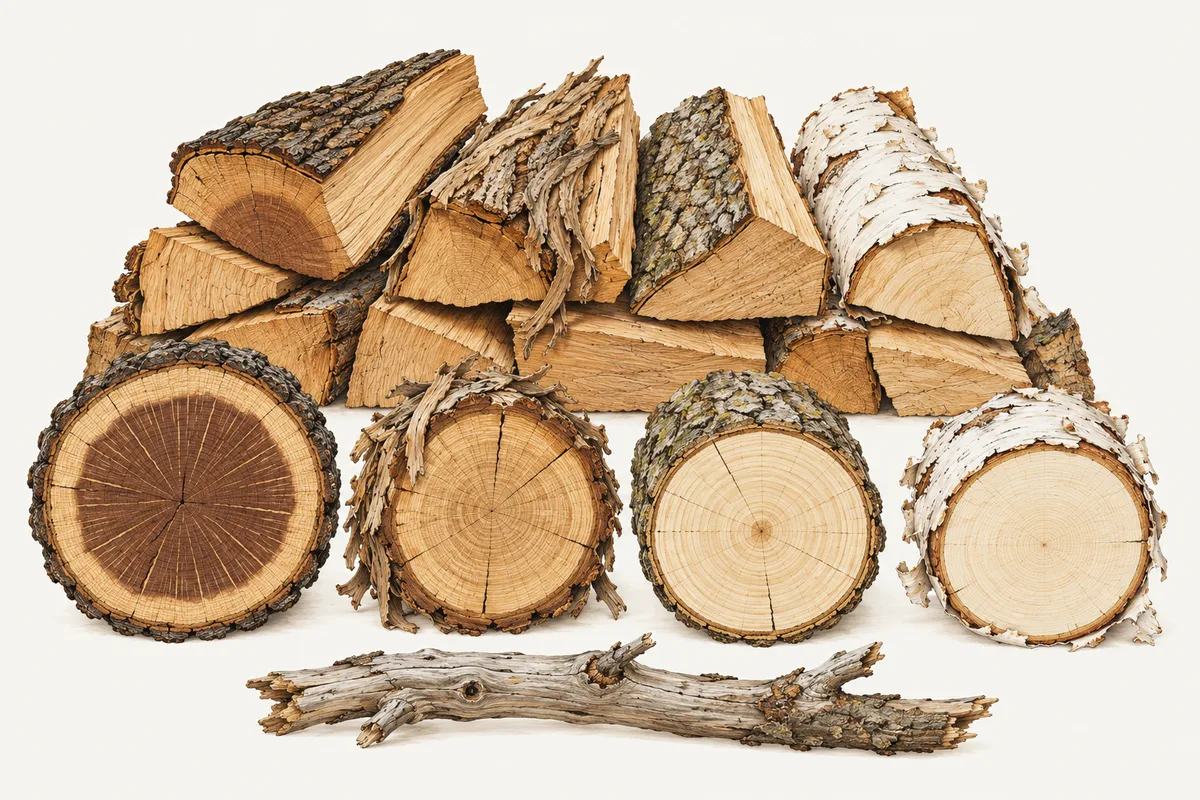
To identify trees for firewood, name the tree while it still stands: leaves in summer, buds and twigs in winter, bark all year. On a dead tree, read the bark pattern (shaggy plates on shagbark hickory, diamond ridges on white ash), then the split wood: oak shows broad rays and large pores. Dense woods give the most heat; Utah State lists white oak at 29.1 million BTU per dry cord, cottonwood at 15.8.
- Standing dead trees (snags) and hanging dead limbs (widowmakers) can fall without warning; take down a dead tree near people or buildings only with a certified arborist or professional.
- Dense hardwoods such as oak, black locust and hickory give the most heat per cord; cottonwood, willow and basswood give the least.
- Season wood until it is below 20 percent moisture, and burn it near where it was cut: pests such as emerald ash borer travel in firewood.
Firewood starts with a tree, and knowing which tree tells you how much heat the wood will give, how hard it will be to split, and whether it is worth cutting at all. Before anything else: standing dead trees and dead limbs, the ones loggers call snags and widowmakers, can fall without warning. Felling is work for trained people with the right gear, and a dead tree near people, houses, sheds or power lines should come down with a certified arborist or a professional logger, not a homeowner. Cut only on your own land or with the owner's permission.
Good firewood trees and how to recognize them
The quickest way to judge a firewood tree is its wood density: heavier wood holds more heat per cord. Utah State University Extension's Wood Heating table lists heat in million BTU per cord of air-dried wood. Here are the common eastern and midwestern trees from that table, with a field mark to find each one:
| Tree | How to spot it standing | Heat per dry cord (million BTU) | USU overall rating |
|---|---|---|---|
| Osage-orange | Round fruit 4 to 5 in across with a brain-like surface; orange-brown bark | 32.9 | Excellent |
| White oak | Rounded leaf lobes, pale gray scaly or blocky bark | 29.1 | Excellent |
| Black locust | Compound leaves with 7 to 19 small oval leaflets; thick bark like woven rope | 27.9 | Excellent |
| Honeylocust | Tiny leaflets, long twisted pods, clusters of branched thorns on the trunk | 26.7 | Excellent |
| Bur oak | Two deep middle sinuses nearly cut the leaf in half; fringed acorn cap | 26.2 | Excellent |
| Sugar maple and other hard maples | Opposite leaves with 5 lobes and smooth edges; furrowed bark with curling ridges | 25.5 | Excellent |
| Northern red oak | Bristle-tipped lobes, bark ridges like ski tracks | 24.6 | Excellent |
| White ash | Opposite compound leaves, diamond-pattern bark | 24.2 | Excellent |
| Black walnut | Compound leaves 12 to 24 in long; round green husk; ridged bark in a rough diamond pattern | 22.2 | Excellent |
| Birch | Bark with horizontal lines; paper birch peels in white papery strips | 20.8 | Fair |
| Cherry | Black cherry: nearly black bark in small upturned plates | 20.4 | Good |
| Silver maple | Opposite, deeply cut leaves, silvery white underneath | 19.0 | Fair |
| Willow | Narrow, finely toothed leaves, shiny above | 17.6 | Poor |
| Cottonwood | Triangular leaves on flattened stalks | 15.8 | Fair |
USU's table does not list hickory. Cornell Cooperative Extension's firewood table, which uses seasoned cords, puts hickory first at 27.7 million BTU per cord, with white oak at 25.7 and red or soft maple at 18.7. The two tables measure slightly differently, so compare species within one table rather than across them.
Safety before you cut: snags, widowmakers and permission
OSHA's logging eTool on felling hazards names the dangers that kill woodcutters:
- Snags: standing dead, broken or rotted trees in or near the felling area. OSHA's rule for loggers is to bring a snag down with a machine; otherwise it must be felled, or avoided by at least two tree lengths.
- Widowmakers: broken limbs hanging loose in the tree being cut or in trees nearby. They are knocked or pulled down by machine, and nobody works beneath them.
- Lodged trees: trees that have not reached the ground because they lean on another tree. OSHA calls them "death traps".
Texas A&M AgriLife's article on deciding when to remove a tree says dead or dying trees near homes, roads and power lines can be hazardous when structural defects could bring the tree or a large part of it down, that a doubtful tree "should be evaluated by a certified arborist", and that the "vast majority of tree removal is unsafe for the average person to attempt". Cornell's sheet adds that anyone felling trees needs a safe chainsaw, the right personal protective equipment and directional felling technique.
Two more rules: cut only where you own the land or the owner has said yes, and on public land, such as a national forest, check whether you need a firewood permit before you cut or collect.
Identifying a living tree before you cut
The easiest time to name a firewood tree is while it is alive. Flag the trees in summer, when the leaves do the work: opposite or alternate, simple or compound, lobed or toothed. White oak has rounded lobes, red oak bristle-tipped ones, maples opposite lobed leaves, ash opposite compound leaves, hickories and walnuts alternate compound leaves.
In winter, read the twigs and buds instead. Buds sit opposite or alternate just as the leaves did, so maples and ashes still stand out. Oaks carry a cluster of buds at the twig tip. The winter tree identification guide walks through buds, leaf scars and twigs.
Bark works all year, and it is the clue you will still have when the tree is dead:
- Shagbark hickory: smooth and gray when young, then breaking into long, wide plates that curve away from the trunk for a coarse, shaggy look. The hickory page covers the other hickories.
- White ash: ashy gray to brown, with interlacing corky ridges that form obvious diamonds, according to the Virginia Tech fact sheet; older trees may be scaly. More on the ash page.
- Black cherry: smooth with short horizontal lines when young, later nearly black and broken into small, upturned plates often compared to burnt cornflakes.
- Paper birch: chalky to creamy white, peeling in horizontal papery strips.
- White oak: whitish or ashy gray, scaly to blocky. Northern red oak develops wide, flat-topped ridges with shallow furrows. The oak page compares the groups.
How to identify dead trees for firewood
A tree that has had no green leaves for a full growing season is dead, by Texas A&M AgriLife's test. Without leaves, work from the outside in.
- Bark. Use the patterns above. As long as the bark is still on the trunk, a shaggy pattern still points to hickory and a diamond pattern to ash.
- Twigs and buds. Check whether the remaining twigs and buds are opposite or alternate, and look for clustered end buds (oaks). Virginia Tech notes that black cherry twigs have a pronounced bitter almond odor when scratched.
- Fruit on the ground. Old acorn caps, hickory husks, walnut shells and ash seeds may still lie under the tree.
- The end grain once it is cut. Michigan State University's extension bulletin Identifying Wood: A Guide and a Key explains what to look for on the cut end. Ring-porous woods, such as oak and elm, have much larger pores in the early part of each growth ring; diffuse-porous woods, such as maple and cottonwood, have pores of about the same size all through the ring. Rays, the lines running from the center toward the bark, are distinctive in oaks and beech, where they are quite broad.
- Color and smell. The same bulletin notes that only heartwood, the darker center of the trunk, has a characteristic color and odor, and that odor helps with a few woods, such as Douglas-fir, basswood and the cedars. A fresh cut, moistened, shows the smell best.
When the bark is gone and the wood is gray and weathered, even experts struggle. In that case, weigh it: density is what sets heat value, and Utah State lists a dry cord of white oak at 4,200 pounds against 2,272 pounds for cottonwood.
Woods people avoid burning, and why
Utah State's table gives the reasons some woods are rated low:
- Low heat: cottonwood is "one of our lightest woods", with about half the heat of Osage-orange by volume. Basswood (13.8) and willow (17.6, rated poor overall) are close behind.
- Sparks: woods that spark or pop "can throw embers out of an open fireplace and cause a fire danger". Conifers do it more because of their high resin content; spruce, white pine and tamarack are listed with many or moderate sparks.
- Poor coals and smell: boxelder and willow are rated poor for coals, and catalpa's fragrance is rated "Bad".
USU also warns that a "mixed hardwood" load may hold a lot of low-density wood such as cottonwood, which lowers its value.
Season it: why dry wood matters
Green firewood "may contain 50% or more water by weight", Utah State notes, and a fire must boil that water off before the wood burns, so green wood gives less heat and more smoke and creosote. EPA's Burn Wise program, now an archived record that EPA stopped updating in October 2025, still publishes best wood-burning practices: wood burns best below 20 percent moisture, a wood moisture meter checks it, and wood should season for at least six months, stored outdoors, off the ground, with only the top covered. Cornell's sheet advises planning 12 months of seasoning after the wood has been cut, split and stacked under cover. For anything about stoves, fireplaces or chimneys, follow the EPA Burn Wise pages and your appliance maker.
Don't move firewood
Firewood is one of the main ways tree pests travel. The USDA's emerald ash borer page explains that people spread the beetle over long distances by moving infested ash firewood, logs or nursery stock, and asks you to "buy only local firewood or certified heat-treated firewood". The beetle has killed or damaged tens of millions of ash trees in North America since it was found in Michigan in 2002. Gather or buy firewood near where you will burn it, and do not carry it to a cabin or campground in another region.
Where a photo app helps
When you are flagging trees in summer, a photo of the leaves or the bark is often enough for Tree Identifier, an iPhone app that uses a cloud AI model and needs an internet connection, to suggest the species with its key traits. If you allow location, its Tree Map pins the tree, so you can find it again in winter when the leaves are gone. Check the name against the bark and buds yourself, using the bark guide. Tree Identifier cannot tell you whether a dead tree is safe to cut, how rotten it is, or how dry your wood is; those calls belong to a professional and a moisture meter.
What a photo can't settle
- A photo can suggest which species a standing tree is, but it can't tell you whether a dead tree is safe to fell, how rotten the trunk is, or which way it will fall.
- No app can measure how dry a piece of firewood is; a wood moisture meter does that.
- A split log on its own is hard to name from a photo: wood identification relies on end grain, pores and rays seen up close, and some woods need a hand lens.
Questions people ask
How do you identify a dead tree for firewood?
Start with the bark pattern on the trunk: shaggy strips on shagbark hickory, diamond-shaped ridges on white ash, dark scaly plates on black cherry, white peeling bark on paper birch. Then check twigs for opposite or alternate buds, and look at the end of a cut or split piece: oak shows broad rays and large pores in each ring.
What is a widowmaker tree?
A widowmaker is a broken limb hanging loose in a tree, either the one being cut or a tree nearby. OSHA tells loggers to knock or pull it down with a machine and never to work beneath it. A standing dead tree, called a snag, is a related hazard that can fall without warning.
What are the best trees for firewood?
Dense hardwoods. In Utah State University Extension's table, Osage-orange gives 32.9 million BTU per dry cord, white oak 29.1, black locust 27.9 and honeylocust 26.7. Cornell's table puts hickory at 27.7 million BTU per seasoned cord. Cottonwood (15.8) and willow (17.6) sit near the bottom.
Is red oak or white oak better firewood?
Both are excellent, but white oak is denser. Utah State lists white oak at 29.1 million BTU per dry cord and northern red oak at 24.6, and rates both excellent overall with few sparks and excellent coals. To tell the trees apart, check the leaf lobes: rounded on white oak, bristle-tipped on red oak.
Is box elder good firewood?
It is a fair choice. Utah State's table gives boxelder 18.3 million BTU per dry cord, about 92 percent of green ash, and rates it difficult to split with poor coals. Cornell's table puts it at 17.9 million BTU per seasoned cord.
How long does firewood need to dry?
EPA's Burn Wise program advises seasoning wood for at least six months and burning it below 20 percent moisture, checked with a wood moisture meter. Cornell Cooperative Extension suggests planning 12 months for wood that has been cut, split and stacked under cover.
Sources
- Logging eTool: Felling Trees, Potential Hazards — Occupational Safety and Health Administration (OSHA)
- Deciding when to remove a tree — Texas A&M AgriLife Today (Paul Schattenberg)
- Wood Heating (Table 1: Firewood Facts) — Utah State University Extension (Michael Kuhns and Tom Schmidt)
- Estimating the Volume of Firewood in a Tree — Cornell University Cooperative Extension (Peter Smallidge)
- Identifying Wood: A Guide and a Key (Extension Bulletin E-746, archive copy) — Michigan State University Cooperative Extension Service (Eldon A. Behr)
- White ash fact sheet — Virginia Tech Dendrology
- Emerald Ash Borer — USDA Animal and Plant Health Inspection Service (APHIS)
- Best Wood-Burning Practices (Burn Wise) — U.S. Environmental Protection Agency
Keep reading
- Field guideTree bark identification: seven bark types and the trees that have them
- Winter field guideWinter tree identification, from buds to bark
- Tree profileHickory trees (Carya): how to identify them
- Tree profileAsh trees (Fraxinus): how to identify them
- Tree profileOak trees (Quercus): how to identify them