Tree profile
Willow trees (Salix): how to identify them
Long, narrow, finely toothed leaves, buds wrapped in a single cap-like scale, and a love of wet ground. Here is the order to check them in, and how to tell the common willows apart.
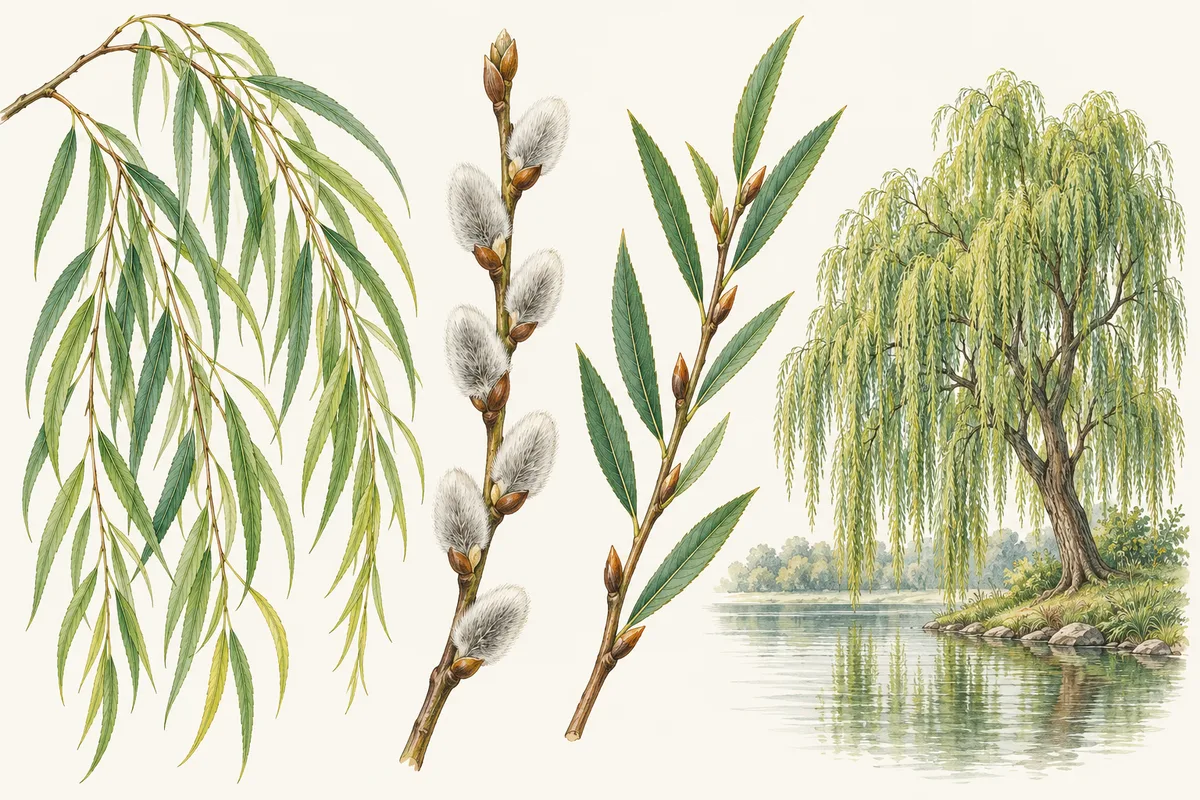
In short
Willow tree identification starts with the leaf: alternate, simple, long and narrow, usually 2 to 6 inches long with a finely toothed edge. Confirm with the bud, which is pressed flat against the twig and covered by a single cap-like scale, with no true end bud. Then read the form: hanging rope-like twigs mean weeping willow, a dark furrowed trunk by water means black willow.
- One bud scale, like a little hood, is the willow family's signature; poplars and cottonwoods have several scales per bud.
- Weeping willow is the one with branches sweeping to the ground; black willow is the common native tree willow of the East.
- Willow oak has willow-like leaves but each ends in a bristle tip, and it bears acorns.
Field marks at a glance
- Scientific name
- Salix
- Family
- Salicaceae (willow family)
- Type
- Broadleaf, deciduous
- Leaves
- Alternate, simple, narrow and lance-shaped on most tree willows, 2 to 6 inches long, with a finely toothed edge. The underside is paler: light green on black willow, nearly white and silky on white willow.
- Buds
- Small, pressed flat against the twig and covered by a single cap-like scale. There is no true end bud at the twig tip.
- Twigs
- Slender and flexible: orange-brown on black willow, golden yellow-brown on white willow, olive-green and hanging like rope on weeping willow, twisted on corkscrew willow.
- Flowers
- Catkins, male and female on separate trees, about 1 to 3 inches long, opening just before or with the leaves in spring. Pussy willow's silvery catkins appear in late winter.
- Fruit and seed
- Small capsules along the catkin that split open in late spring or summer and release tiny seeds covered in cottony hairs, carried by wind and water.
- Bark
- Black willow: brown to gray-black with thick, scaly ridges and deep furrows. Weeping and white willow: grayish brown, irregularly furrowed.
- Form and size
- Black willow can reach 140 ft on the best Mississippi Valley sites but is usually smaller, with a spreading, irregular crown. Weeping willow: round crown, 40 to 50 ft. White willow: up to 80 ft.
- Habitat
- Stream banks, floodplains, pond edges and wet ground. Black willow's seeds need very moist, nearly flooded bare soil to start.
Willows (Salix) are the trees of stream banks and pond edges, and most of them are easy to recognize as willows. Naming the species is harder. Check three things in this order: the leaf, the bud, then the form and bark. The catkins in spring help when you can reach them.
What to check first: narrow leaf, one-scale bud, wet ground
1. The leaf. Willow leaves are alternate and simple, and on the tree willows they are long and narrow. Black willow's are lance-shaped, 3 to 6 inches long, finely toothed, dark and shiny above and light green below, according to the Virginia Tech Dendrology fact sheet. Pick several leaves and look at the edge closely: a willow leaf has a fine, even row of small teeth. A smooth edge points away from willow.
2. The bud. This is the field mark that settles it, summer or winter. A willow bud is small, pressed flat against the twig and covered by a single bud scale, like a little hood, and there is no true end bud at the twig tip (Virginia Tech). Poplars and cottonwoods, in the same family, have buds with several scales. Oaks, including the willow oak, have a cluster of several buds at the tip.
3. The form and the place. Most willows grow on wet soil. The USDA Forest Service's Silvics of North America explains why for black willow: its seed must land on very moist, almost flooded bare soil within 12 to 24 hours or it loses viability, so wild willows line rivers, floodplains and pond margins. A weeping willow in a dry yard was planted.
In spring, look for catkins. Willows are dioecious: male and female catkins grow on separate trees and open just before or with the leaves. By late spring the female catkins split into small capsules that release seeds wrapped in cottony hairs.
If the tree hangs over water and you can't reach a twig, a photo of the whole tree or of a fallen leaf is enough to get a name from Tree Identifier. The app gives one answer, with no confidence score and no list of look-alikes, so confirm it with the bud test above.
Weeping, black, white, pussy and corkscrew willow compared
These are the willows most people meet in the United States. The figures come from Virginia Tech's fact sheets for weeping willow, black willow, white willow, pussy willow and corkscrew willow.
| Willow | Leaf | Leaf underside | Twigs | Form | Wild or planted |
|---|---|---|---|---|---|
| Weeping (Salix babylonica) | Very narrow, 3–6 in long, 3/8–1/2 in wide | Milky green | Olive-green to pale yellow-brown, hanging like rope | Round crown, 40–50 ft, branches sweeping the ground | Planted; may seed into the landscape |
| Black (S. nigra) | Lance-shaped, 3–6 in | Light green | Slender, orange-brown | Small to large tree, spreading irregular crown; dark, deeply furrowed bark | Native to the East |
| White (S. alba) | Lance-shaped to narrow oval, 2–4 in | Nearly white and silky | Very slender, golden yellow-brown | Upright, up to 80 ft, wide crown; trunk often splits low | Planted; may seed into the landscape |
| Pussy (S. discolor) | Elliptical to oblong, 2–4 in, weakly toothed | Pale, almost white | Green or red; buds purple-red | Multi-stemmed shrub or small tree to 30 ft | Native |
| Corkscrew (S. matsudana) | Lance-shaped, 3–5 in, often twisted | Nearly white | Twisted and contorted | Upright, rarely over 30–40 ft, round crown of twisted branches | Planted; not known to escape widely |
Two quick sorts cover most yards. Branches that hang straight down in long strands mean weeping willow. Branches that zigzag and curl mean corkscrew willow. Pussy willow is the one whose fuzzy, silvery-gray catkins, about an inch long, appear in late winter or very early spring.
Black willow, the native tree willow
The Forest Service calls black willow the largest of about 90 willow species native to North America and the only commercially important one; it is more distinctly a tree throughout its range than any other native willow. It grows from southern New Brunswick and central Maine west to southeastern Minnesota, south and west to the Rio Grande, and east along the Gulf Coast through the Florida panhandle and southern Georgia.
Black willow is short-lived and fast-growing. In the lower Mississippi Valley, 10-year-old trees average 49 feet, and the tallest trees reach 140 feet with trunks up to 48 inches across. Away from those bottomlands, and in the North, the trees are much smaller. The Forest Service calls it a very weak tree: almost all large trees have big broken limbs. Virginia Tech adds that crown gall, witches' brooms and sprouts along the trunk are common, which gives old black willows their ragged look.
Look for it on wet soils near streams, often in pure stands on floodplains, alongside cottonwood, sycamore, river birch and boxelder. The dark, thick-ridged bark is the best bark mark among the willows; Virginia Tech describes it as brown to gray-black with thick, scaly ridges and deep furrows.
Willows through the seasons
- Late winter: pussy willow catkins swell into silver-gray fuzz. Bare willow twigs show their color well: golden on white willow, orange-brown on black willow.
- Spring: catkins open just before or with the leaves. Black willow flowers from February in the South to late June at the northern edge of its range (USDA Forest Service).
- Late spring and summer: capsules split and release seeds wrapped in cottony hairs, which drift on wind and water. Black willow capsules open 45 to 60 days after pollination.
- Fall and winter: leaves drop; the single-scale buds, pressed against the twig, carry the identification. For more bare-twig methods, see winter tree identification.
Willows and their look-alikes
Willow oak is the classic willow mimic. Its leaves are 2 to 5 inches long and narrow like a willow's, but the edge is smooth and the tip ends in a small bristle, says the Virginia Tech willow oak fact sheet. It bears acorns 1/4 to 1/2 inch across, and its twig tips carry several small, sharp buds.
Poplars, cottonwoods and aspens belong to the willow family too, and they share the cottony seed and the riverbank habitat. Their leaves give them away: triangular on eastern cottonwood, round on aspens, on long flattened leaf stalks. Cottonwood buds are about 3/4 inch long with several brown, resinous scales. The poplar, cottonwood and aspen guide covers them in detail.
To get better at reading leaf edges and shapes on any tree, see how to identify trees by their leaves.
Willows in the app's Collection
Tree Identifier's Collection, the field-guide catalog that fills in as you identify, includes weeping willow (Salix babylonica) and white willow (Salix alba). Black willow and pussy willow are not in that catalog, though a photo of either still returns a name. If you want to find a particular willow again, for its catkins in late winter, the app's Tree Map keeps every located identification. For the full field method that works on any tree, see how to identify trees.
Look-alikes and how to tell them apart
Willow oak (Quercus phellos)
Willow oak leaves are 2 to 5 inches long and willow-shaped but have a smooth edge and a small bristle at the tip; willow leaves are finely toothed. Willow oak bears tiny acorns and has a cluster of several sharp end buds; a willow has no true end bud.
Eastern cottonwood and other poplars (Populus)
Poplars are in the same family, but their leaves are triangular to round, not long and narrow, on flattened leaf stalks. Their buds carry several scales, often resinous; a willow bud has one cap-like scale.
Corkscrew willow (Salix matsudana)
It is a willow, often mistaken for a sick or storm-damaged tree: its twigs and branches grow twisted and contorted, and its 3 to 5 inch leaves are often twisted too. The twigs do not hang in long straight strands like weeping willow's.
What a photo can't settle
- The USDA Forest Service counts about 90 willow species native to North America, many of them shrubs, and putative hybrids are hard to verify even for specialists. A photo gives a good genus answer; the species can need a botanist with catkins and a key.
- Male and female willows look the same except while flowering and setting seed, so a photo outside spring can't tell you whether a tree will shed cottony seed.
- Weeping forms and cultivars are planted far outside any natural range, so a range map can't rule a willow in or out.
Questions people ask
How do I identify a willow tree?
Look for alternate, long, narrow leaves with a finely toothed edge, usually 2 to 6 inches long. Then check a bud: on a willow it is pressed against the twig and covered by one cap-like scale, with no true end bud. Most willows grow near water, and all bear catkins in spring.
How do you tell different willow trees apart?
Use form and leaf underside. Weeping willow has rope-like twigs hanging to the ground. Black willow has a dark, deeply furrowed trunk and leaves light green beneath. White willow's leaves are nearly white and silky beneath and its twigs golden. Pussy willow is a shrub or small tree with silvery catkins in late winter.
Can you identify a willow tree by its bark?
Only partly. Black willow bark is brown to gray-black with thick, scaly ridges and deep furrows, darker than most willows. Weeping and white willow bark is grayish brown and irregularly furrowed, which looks like many other trees. Confirm with a bud or a leaf from the ground.
Is a weeping willow a native tree?
No. Virginia Tech lists weeping willow (Salix babylonica) as a planted tree that may seed into the landscape. The native tree willow of the eastern United States is black willow (Salix nigra), which grows wild from Maine and New Brunswick to Minnesota and south to Texas and Georgia.
What tree looks like a willow but is not?
Willow oak is the usual one: its leaves are willow-shaped but smooth-edged with a bristle tip, and it bears small acorns. Its twig tips carry a cluster of buds; a willow has no true end bud.
Sources
- Black willow (Salix nigra), Silvics of North America — USDA Forest Service
- Black willow fact sheet — Virginia Tech Dendrology
- Weeping willow (Salix babylonica) fact sheet — Virginia Tech Dendrology
- White willow (Salix alba) fact sheet — Virginia Tech Dendrology
- Pussy willow (Salix discolor) fact sheet — Virginia Tech Dendrology
- Corkscrew willow (Salix matsudana) fact sheet — Virginia Tech Dendrology
- Willow oak fact sheet — Virginia Tech Dendrology
- Eastern cottonwood fact sheet — Virginia Tech Dendrology