Tree comparison
Hornbeam vs beech: how to tell them apart
Both have oval, pointed leaves and grey bark, and both hold dead leaves through winter in a clipped hedge. Run a finger along the leaf edge first.
In short
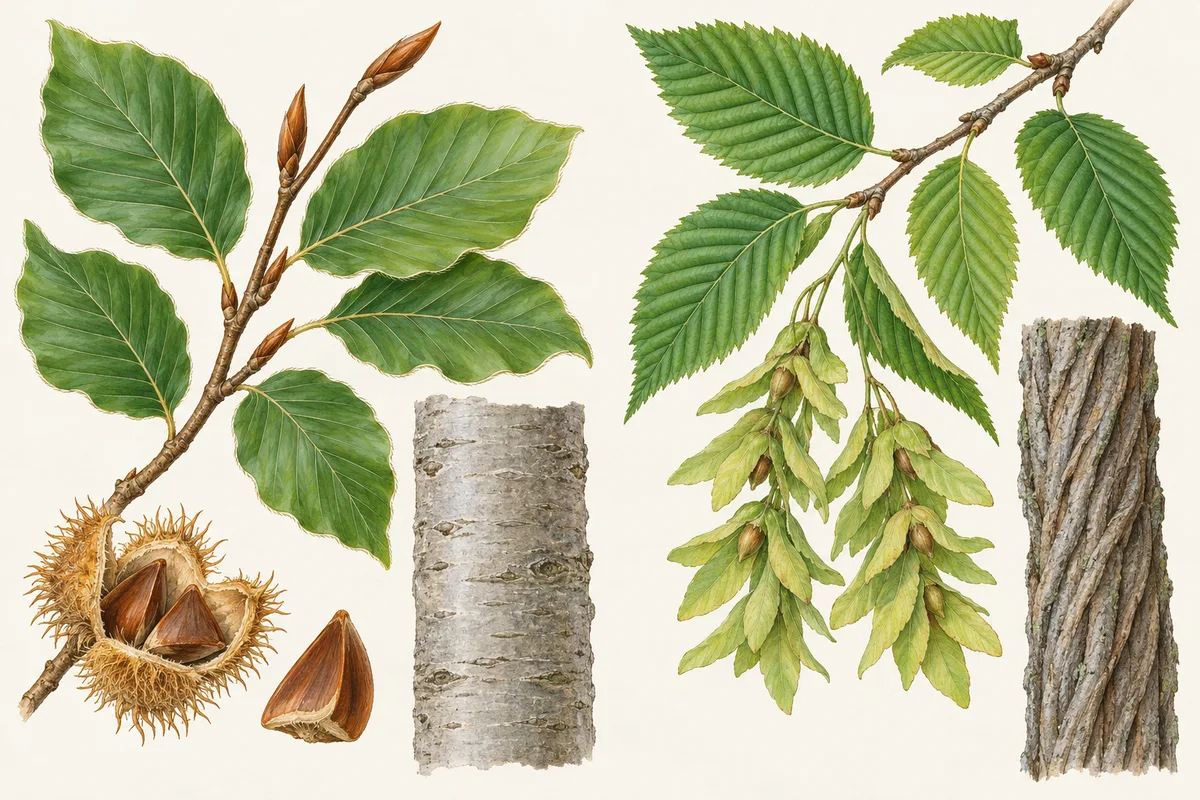
A hornbeam tree in the UK (Carpinus betulus) is told from beech by the leaf edge: hornbeam leaves have finely toothed edges and a pleated, deeply furrowed look; beech leaves have wavy edges fringed with small hairs. Hornbeam buds are short and pressed against the twig, beech buds long and torpedo-shaped. Hornbeam bark is grey with vertical markings and ridges; beech bark is smooth.
- Teeth mean hornbeam; a wavy edge with a fringe of fine hairs means beech.
- A brown hedge in January can be either: clipped beech and clipped hornbeam both keep most of their dead leaves through winter.
- In North America the pair is American hornbeam (musclewood, blue beech) and American beech; the same leaf-edge and bud tests apply.
Field marks at a glance
- Scientific name
- Carpinus betulus and Fagus sylvatica
- Family
- Betulaceae (hornbeam, birch family) and Fagaceae (beech, beech family)
- Type
- Broadleaf, deciduous
- Leaf edge
- Hornbeam: finely toothed. Beech: wavy, with a fringe of small hairs, clearest on young leaves.
- Leaf surface
- Hornbeam: smaller and more deeply furrowed than beech, with a pleated look. Beech: 4–9 cm (1.5–3.5 in), stalked, oval, pointed, silky-haired when young.
- Buds
- Hornbeam: similar to beech but shorter, slightly curved at the tip and pressed close to the twig. Beech: reddish-brown, long and torpedo-shaped, on short stalks.
- Bark and trunk
- Hornbeam: pale grey with vertical markings, often a short, twisted trunk that develops ridges with age. Beech: smooth, thin and grey, often with slight horizontal etchings.
- Fruit
- Hornbeam: papery, green winged fruits (samaras). Beech: triangular nuts in a prickly, four-lobed case, one or two per case (beechmast).
- Winter
- Both can keep dead leaves on the twigs through winter, especially when clipped as a hedge (marcescence).
- Size
- Hornbeam up to 30 m (100 ft), living more than 300 years. Beech more than 40 m (130 ft) (Woodland Trust).
- Native range in the UK
- Hornbeam: native to the south of the UK, naturally in oak woodland. Beech: truly native only to south-east England and south-east Wales, widely planted elsewhere.
- In the app's Collection
- Hornbeam (Carpinus betulus), European beech (Fagus sylvatica) and American beech (Fagus grandifolia) are in Tree Identifier's Collection; American hornbeam is not listed.
Hornbeam and beech are the pair British gardeners and walkers mix up most often. Both have oval leaves with a pointed tip, grey bark, and the habit of holding dead leaves through winter, especially in a clipped hedge. They are not closely related, though, and three checks separate them: the leaf edge, the bud and the trunk.
The leaf edge: teeth or hairs
This works from April to October and on most dry winter leaves too.
Hornbeam. The Woodland Trust describes the leaves as the same shape as beech, oval with pointed tips, but smaller and more deeply furrowed, with finely toothed edges and a pleated look. Run a fingertip along the edge and you feel the teeth.
Beech. The Woodland Trust's beech page gives leaves 4 to 9 cm (1.5 to 3.5 in) long, stalked, oval and pointed, with a wavy edge. Young leaves carry silky hairs and the edges are hairy; hold a fresh leaf against the light and the fringe shows. Mature leaves lose their hairs, so the wavy, untoothed outline is the steadier mark. In the Woodland Trust's own words, beech leaves have wavy edges with small hairs, as opposed to the serrated margins of hornbeam.
| Feature | Hornbeam (Carpinus betulus) | Beech (Fagus sylvatica) |
|---|---|---|
| Leaf edge | Finely toothed | Wavy, fringed with small hairs when young |
| Leaf surface | Deeply furrowed, pleated | Smoother; 4–9 cm long |
| Buds | Shorter, slightly curved, pressed to the twig | Long, torpedo-shaped, reddish-brown, on short stalks |
| Trunk | Pale grey, vertical markings, ridged with age, often twisted | Smooth, thin, grey, slight horizontal etchings |
| Fruit | Papery green winged fruits | Triangular nuts in a prickly four-lobed case |
| Height | Up to 30 m | More than 40 m |
| Family | Betulaceae (birch family) | Fagaceae (beech family) |
Buds and bark, the winter test
When the leaves are dry or gone, go to the twig. Beech buds are reddish-brown and torpedo-shaped, the Woodland Trust says, and form on short stalks, so they stand out from the twig like small cigars. Hornbeam buds are similar but shorter, slightly curved at the tip and pressed closely against the twig. If you can see the gap between bud and twig from a step away, it is probably beech.
The trunk helps on older trees. Beech bark is smooth, thin and grey, often with slight horizontal etchings. Hornbeam bark is pale grey with vertical markings; the trunk is often short and twisted and develops ridges as it ages. For the bark of other smooth-barked trees, see the guide to identifying trees by bark.
Beech or hornbeam hedge
This is the question most people actually have, usually in winter when the hedge is brown. Colour will not answer it. The Woodland Trust says clipped beech does not shed its leaves and makes a year-round dense screen, a trait called marcescence; it says the same of hornbeam hedges, which keep most of their leaves through winter.
To tell which hedge you have:
- Pick a leaf and check the edge. Small, regular teeth and a pleated surface mean hornbeam. A wavy edge without teeth means beech.
- Check a bud. Long, pointed and standing off the twig on a short stalk: beech. Shorter, slightly curved and lying flat: hornbeam.
- In spring, look at the new leaves. Fresh beech leaves show the hairy fringe and silky hairs clearly; fresh hornbeam leaves show the pleats.
Both make popular hedges. The Woodland Trust notes that beech usually grows on drier, free-draining soils; for advice on which to plant on your own ground, ask a local nursery or arborist.
American hornbeam and American beech
North American readers meet a parallel pair. American hornbeam (Carpinus caroliniana), which The Morton Arboretum also calls musclewood and blue beech, is a small tree, 6 to 9 m (20 to 30 ft) tall, native to the eastern half of the United States. Its blue-grey bark is fluted with long, sinewy ridges, and its leaves, 6 to 13 cm (2.5 to 5 in) long, are doubly serrated with pointed tips and open reddish-purple. Its light brown nutlets ripen in October, each under a three-lobed bract that hangs over them like an umbrella.
American beech (Fagus grandifolia) is a large tree, 15 to 21 m (50 to 70 ft) high and wide, with smooth, silvery-grey bark and leaves 5 to 13 cm (2 to 5 in) long with toothed edges. The Morton Arboretum describes its buds as over 2.5 cm (1 in) long, sharply pointed and smooth, and its three-sided nuts as enclosed in a prickly husk. Its dried leaves remain on the tree well into winter, like those of its European cousin.
The test is the same as in Britain: fluted, muscle-like trunk and small, doubly toothed leaves for hornbeam; smooth trunk and very long, sharp buds for beech. Our beech page covers American beech in more detail.
Where they grow, and using a photo
In Britain, the Woodland Trust lists hornbeam as native to the south of the UK, where it grows naturally in oak woodland and has long been coppiced and pollarded; its wood once made ox yokes, butchers' blocks and the cogs of windmills and water mills. Beech is considered truly native only to south-east England and south-east Wales, though it grows in woods and as single trees far beyond, usually on drier, free-draining soils. The Woodland Trust calls beech the queen of British trees, with oak as king; the English oak vs sessile oak page covers the oaks that hornbeam grows beneath.
A sharp photo of a leaf edge, or of a twig with its buds, is enough for Tree Identifier to suggest a name; European beech, American beech and hornbeam are all in the app's Collection. The app shows no confidence score and no list of look-alikes, so confirm the answer with the leaf-edge test. If you want to check a particular hedge, the app's Tree Expert can answer follow-up questions about what to look at next. The UK tree identification guide places both trees among the other common British species.
Look-alikes and how to tell them apart
Beech (Fagus sylvatica)
Feel the leaf edge: wavy, with a fringe of small hairs, not teeth. Look for long, reddish-brown, torpedo-shaped buds standing off the twig and a smooth, thin grey trunk without ridges.
Hornbeam (Carpinus betulus)
Leaves with finely toothed edges and a pleated, furrowed surface; short buds lying flat against the twig; a trunk that turns ridged and often twisted with age; papery winged fruits in autumn.
American hornbeam, musclewood (Carpinus caroliniana)
The North American hornbeam: blue-grey bark fluted with long, sinewy ridges, doubly serrated leaves 6–13 cm (2.5–5 in) long, and nutlets under a three-lobed bract. American beech has smooth bark, single teeth and buds over 2.5 cm.
What a photo can't settle
- A clipped hedge carries no flowers or fruit, and its leaves are small. A photo needs a sharp close-up of a leaf edge, or of a bud in winter, to separate the two.
- The fine hairs on a beech leaf edge are clearest on young leaves; the Woodland Trust says mature leaves lose their hairs. On a dry winter leaf, check the bud instead.
- Young beech and hornbeam saplings in a wood can both have thin grey bark; the ridged hornbeam trunk develops with age, so bark alone does not settle a young tree.
Questions people ask
How do you tell a beech hedge from a hornbeam hedge?
Not by colour: both keep brown leaves through winter when clipped. Take a leaf and look at the edge: finely toothed and pleated means hornbeam; wavy, with fine hairs on fresh leaves, means beech. In winter, check the buds: long, torpedo-shaped and standing out on beech; shorter and pressed to the twig on hornbeam.
Do hornbeam hedges keep their leaves in winter?
Mostly, yes. The Woodland Trust says a hornbeam hedge keeps its foliage through the year, with most leaves staying on through winter. Clipped beech does the same; the Woodland Trust calls the habit marcescence.
What does a hornbeam leaf look like?
Oval with a pointed tip, like a beech leaf, but smaller, with finely toothed edges and a deeply furrowed, pleated surface (Woodland Trust). American hornbeam's leaves are 6 to 13 cm long and doubly serrated, and open reddish-purple before turning dark green (Morton Arboretum).
Is hornbeam native to the UK?
Yes. The Woodland Trust lists hornbeam as native to the south of the UK, where it grows naturally in oak woodland and has often been coppiced or pollarded. Beech is considered truly native only in south-east England and south-east Wales, though it is planted far more widely.
Are hornbeam and beech related?
Not closely. Beech is in the beech family, Fagaceae, with oak and sweet chestnut, and its nuts sit in a prickly case. Hornbeam is in the birch family, Betulaceae, and its fruit is a small papery winged seed. The leaves look alike; the fruit does not.
Is blue beech a beech or a hornbeam?
A hornbeam. Blue beech and musclewood are other names The Morton Arboretum gives for American hornbeam, *Carpinus caroliniana*. Its blue-grey bark is fluted with long, sinewy ridges, its leaves are doubly serrated, and its nutlets hang under three-lobed bracts. American beech has smooth bark and spiny husks.
Sources
- Hornbeam (Carpinus betulus) — Woodland Trust
- Beech (Fagus sylvatica) — Woodland Trust
- American hornbeam (Carpinus caroliniana) — The Morton Arboretum
- American beech (Fagus grandifolia) — The Morton Arboretum
Keep reading
- Tree profileBeech (Fagus): how to identify a beech tree
- Field guideHow to identify trees by their leaves
- Field guideTree bark identification: seven bark types and the trees that have them
- Winter field guideWinter tree identification, from buds to bark
- Tree comparisonSessile oak vs English oak: how to tell them apart