Tree profile
Hawthorn (Crataegus): how to identify it
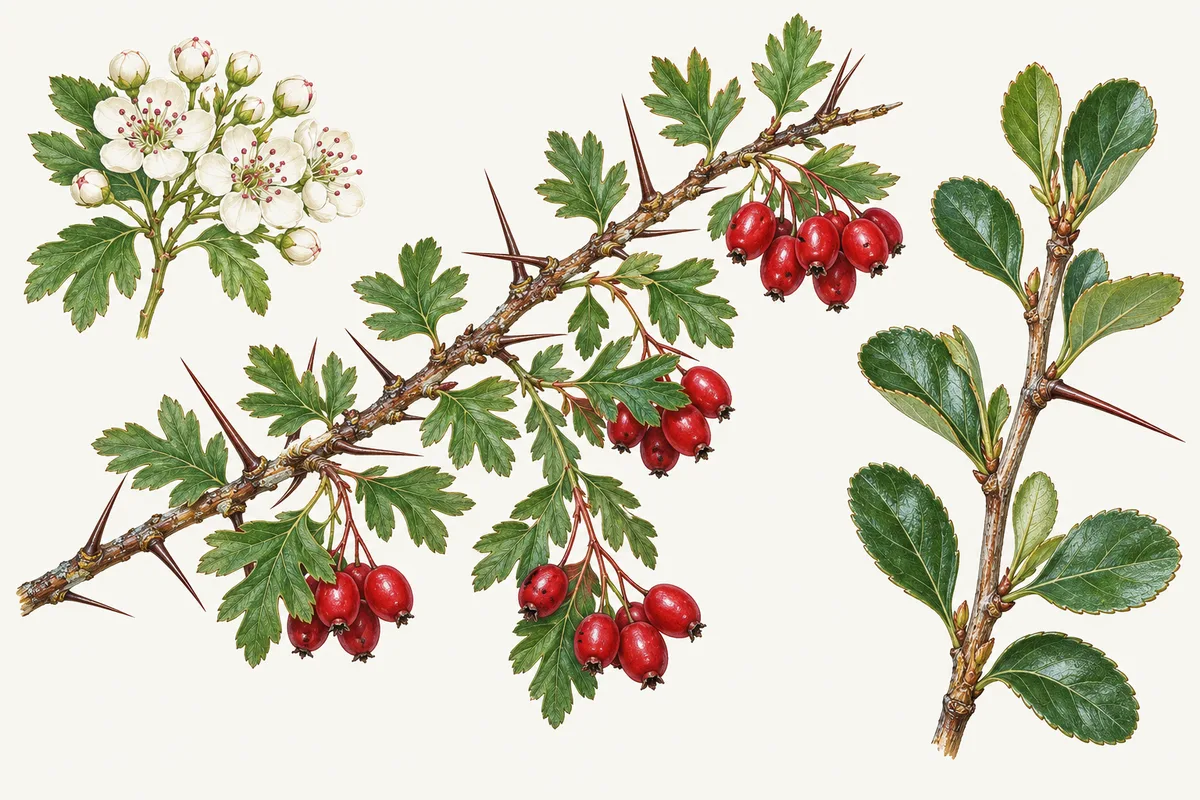
Stiff thorns on the twigs, small toothed leaves, flat clusters of five-petaled white flowers, then small red fruits called haws. Here is how to read each one, in America and in British and Irish hedges.
In short
Hawthorn tree identification starts with the twigs: most hawthorns carry stiff, straight thorns about 1 inch long. Then check the leaves, alternate, simple, toothed and often lobed, usually 2 to 4 inches long, and the fruit, small apple-like pomes about 1/4 inch across that ripen yellow to red in early fall. Flowers are white, five-petaled and clustered at the twig ends in mid to late spring.
- Thorns plus small white five-petaled flowers plus tiny red pomes: that combination puts a small tree in the genus Crataegus.
- North America has more than 200 hawthorn species and many hybrids, so naming the genus is easy and naming the species often is not.
- In the UK and Ireland, common hawthorn has deeply cut leaves and one seed per haw; Midland hawthorn has shallow lobes and two seeds.
Field marks at a glance
- Scientific name
- Crataegus spp. (common hawthorn is Crataegus monogyna)
- Family
- Rosaceae (rose family)
- Type
- Broadleaf, deciduous
- Thorns
- Most species carry obvious, stiff thorns about 1 inch long; cockspur hawthorn's reach 2 to 3 inches. Some planted cultivars are nearly thornless.
- Leaves
- Alternate and simple, usually 2 to 4 inches long, toothed and often lobed, sometimes unlobed; dark green above, paler below. Shape varies a lot between species.
- Flowers
- Small, white (occasionally pink), five petals, in flat-topped clusters near the twig ends, mid to late spring. Several American species smell unpleasant.
- Fruit (haws)
- Small pomes, usually about 1/4 inch across, ripening yellow to red in early fall; many species hold them into winter.
- Twigs and buds
- Slender, gray twigs; end buds usually dark, shiny red and round. Leaf scars show 3 bundle scars.
- Bark
- Smooth and gray-brown when young, later darker and scaly; rough and slightly shaggy on old cockspur and Washington hawthorns.
- Form and size
- Dense shrubs or small trees, generally up to 25 ft (about 8 m) in North America. Common hawthorn reaches about 15 m (50 ft) in the UK and Ireland.
- Range
- The genus is native across North America and widely planted. Common hawthorn is native to the UK and Ireland, where it dominates hedgerows.
Hawthorns (Crataegus) are the small thorny trees of field edges, old pastures, parks and hedgerows on both sides of the Atlantic. Never eat a berry, nut or seed on the strength of a web page or an app; check with a local expert. This page is about putting a name on the tree: the genus in four checks, the common American species, then common hawthorn in the UK and Ireland.
How to identify a hawthorn tree: four checks
1. The thorns. Run your eye along a twig. Most hawthorns carry obvious, stiff thorns about 1 inch long, set beside the leaves, according to the Virginia Tech Dendrology hawthorn fact sheet. Wear gloves: the Morton Arboretum lists "dangerous thorns" for its hawthorns.
2. The leaves. Hawthorn leaves are alternate and simple, usually 2 to 4 inches long, toothed along the edge and often lobed, though some species have unlobed leaves. Virginia Tech calls them "highly variable", which is the honest summary: leaf shape is the best clue to the species and the worst clue to the genus.
3. The flowers. In mid to late spring, hawthorns open clusters of small white flowers with five petals near the ends of the twigs. Several American species smell unpleasant up close; Morton describes cockspur, Washington and downy hawthorn flowers as "unpleasantly scented". Common hawthorn in Britain is described instead as highly scented.
4. The fruit. Hawthorn fruits are small pomes, the same fruit type as apples and pears, usually about 1/4 inch across, that ripen yellow to red in early fall. Many stay on the bare branches into winter, which is when hawthorns get noticed. Our guide to trees with red berries sets them against holly, dogwood, mountain-ash and crabapple.
In winter, add the buds and bark: the end buds are usually dark, shiny red and round on slender gray twigs, and the bark is smooth gray-brown on young stems, later darker and scaly. The winter tree identification guide covers reading buds and leaf scars.
When a hawthorn grows behind a fence or the fruit is out of reach, a single photo of a twig with leaves and haws is enough for Tree Identifier to suggest a name. The app shows no confidence score and no list of look-alikes, so confirm the thorns, flowers and fruit yourself, and ask the follow-up chat how a hawthorn differs from a crabapple if you are unsure.
Common hawthorns in the United States
North America is the center of hawthorn diversity: Virginia Tech notes that the USDA PLANTS Database lists 216 species, and that hybrids make the genus confusing even for botanists. These four are the ones you are most likely to meet in yards, parks and the woods of the eastern half of the country.
| Species | Leaves | Thorns | Fruit | Native range |
|---|---|---|---|---|
| Cockspur hawthorn (C. crus-galli) | 1–4 in, glossy dark green, rounded at the tip, narrow at the base, unlobed | 2–3 in, the longest of the group | Red, persisting into winter | Eastern and southeastern US, eastern Canada |
| Washington hawthorn (C. phaenopyrum) | 1–3 in, triangular, 3–5 lobes, toothed | Fairly thorny | Red, persisting into winter | Missouri to the East Coast, Michigan to Florida |
| Downy hawthorn (C. mollis) | 2–4 in, wide, doubly toothed, very hairy early in the season | 1–2 in, but not always as thorny | Red | Common through the Midwest |
| Green hawthorn (C. viridis) | Toothed, scarlet-red in fall | Up to 1.5 in; 'Winter King' has small, inconspicuous thorns | Orange-red, persisting into winter | Southeastern US, including the Maryland Coastal Plain |
Cockspur hawthorn is the easiest to name: the Morton Arboretum's cockspur profile gives thorns 2 to 3 inches long and glossy, unlobed leaves rounded at the tip and narrowed toward the base. It grows 20 to 30 feet tall and wide. A thornless variety (var. inermis) is widely planted, so a smooth-twigged tree with those leaves can still be a cockspur.
Washington hawthorn has small, triangular leaves with three to five toothed lobes, more like a tiny maple leaf than a typical hawthorn, and turns red to purple in fall, according to the Morton Arboretum. Its red fruits hang on into winter.
Downy hawthorn is a Midwest tree whose leaves are "very hairy early in the season" (Morton's downy hawthorn profile); rub a young leaf and it feels soft.
Green hawthorn is a southeastern native of lowlands, valleys and swamps. The University of Maryland Extension describes its planted cultivar 'Winter King' as tolerant of city conditions, with small, inconspicuous thorns, orange-red fruit that persists into winter, and, on mature trees, patches of gray outer bark that shed to show orange inner bark. That bark is a good winter mark for 'Winter King' along streets and in parking lots.
Common hawthorn in the UK and Ireland
In Britain and Ireland, "hawthorn" almost always means common hawthorn (Crataegus monogyna), the thorny tree that makes up much of the hedgerows that divide fields. The guide to identifying British trees covers the other hedgerow and woodland trees. The Woodland Trust lists its other names: May tree, whitethorn, quickthorn and one-seed hawthorn. Cut as a hedge it stays a dense shrub; left alone it grows into a small tree of about 15 m (50 ft) with brown-grey, knotted, fissured bark.
Four checks, in this order:
- Leaves: about 6 cm (2 1/2 in) long, with toothed lobes cut at least halfway to the midrib, so the leaf looks deeply lobed. They are often among the first leaves to open in spring.
- Flowers: white, occasionally pink, highly scented, five petals, in flat-topped clusters in May, which is where the name May tree comes from. Each flower has a single stigma.
- Haws: deep red, each with one seed. That single seed is the quickest test against Midland hawthorn.
- Winter twigs: slim, brown and thorny, with each spine growing from the same point as a bud.
Midland hawthorn (C. laevigata) is the look-alike. The Woodland Trust's Midland hawthorn page describes glossy, three-lobed leaves 2 to 6 cm long with shallow lobes cut less than halfway to the midrib, flowers with two stigmas from mid-April (one to two weeks before common hawthorn), and oval red haws with two seeds. It favors ancient woodland and clay hedgebanks and is most common in central and southern England, uncommon in Wales, Scotland, south-west England and East Anglia. The two species hybridize, so some hedge trees sit in between.
Common hawthorn in Ireland. University College Cork's Tree Explorers describes common hawthorn as native to Ireland, where its Irish name is sceach geal, "bright thorn". Its leaves have three to five deep, slightly toothed lobes; the white blossom comes around mid-May; the haws form in July and August and ripen deep red in autumn and early winter. Hawthorn hedges are a common feature of the Irish landscape: UCC dates hedge laying to the mid-seventeenth century in the Pale around Dublin, spreading across Ireland from the mid-eighteenth century, and calls the thorny hedge "stock-proof".
UCC also records hawthorn's place in Irish folklore. It is best known as a fairy tree, especially a lone hawthorn standing in a field, and many stories warn that harming one brings misfortune. It was thought bad luck to bring any part of the tree into the house. In 1999, storyteller Eddie Lenihan objected to cutting a lone hawthorn on the route of the Newmarket-on-Fergus bypass in County Clare, and the road was routed around it. A lone thorn in the middle of a field is therefore often a tree someone chose not to cut.
Hawthorn look-alikes and how to rule them out
Blackthorn (Prunus spinosa) shares British hedges with hawthorn and is just as spiny. The Woodland Trust gives the winter test: hawthorn spines come from the same point as a bud, while blackthorn has its buds on the spines.
Callery pear, including the wild offspring of the Bradford cultivar, forms thorny thickets along American roads and field edges. Its leaves are glossy and unlobed, and it blooms in a sheet of white very early in spring, before or with the leaves. Virginia Tech lists it among hawthorn's look-alikes; the Bradford pear profile covers it in detail.
Crabapples share the white spring flowers and small red fruit. Their fruit can be anywhere from 1/4 inch to 2 inches across, and many cultivars open pink or red. A tree with clusters of 1/4-inch red fruit and stiff 1-inch thorns is far more likely a hawthorn.
Seasons and where to look
- Spring: leaves first (common hawthorn is often one of the first trees in leaf), then flowers. In the eastern US most hawthorns bloom in late spring; Maryland's green hawthorn flowers in April. In Britain, Midland hawthorn blooms from mid-April and common hawthorn in May.
- Summer: haws form green, ripening through late summer.
- Fall: haws turn red; Washington and green hawthorn leaves turn red to scarlet, downy hawthorn's yellow-brown.
- Winter: red fruit on bare, thorny branches, red buds, and on 'Winter King', orange patches in gray bark.
The Woodland Trust says common hawthorn flowers and fruits best in full sun, which is why the most heavily flowered trees stand alone or on the sunny side of a hedge. In the US, downy hawthorn grows in a variety of habitats across the Midwest (Morton), and planted cultivars such as 'Winter King' turn up as street trees far from their native range, so a range map alone can't settle which species you have. If you want to come back to a particular tree when its haws ripen, Tree Identifier's Tree Map pins each located identification.
Look-alikes and how to tell them apart
Blackthorn (Prunus spinosa)
In winter, look at where the buds sit. Hawthorn spines grow from the same point as a bud; blackthorn carries its buds along the spines themselves, according to the Woodland Trust.
Midland hawthorn (Crataegus laevigata)
Count the seeds in a haw: two in Midland hawthorn, one in common hawthorn. Midland leaves are glossy, 2 to 6 cm long, with shallow lobes cut less than halfway to the midrib, and its flowers have two stigmas.
Callery pear, including wild Bradford pear offspring (Pyrus calleryana)
Wild Callery pears are thorny too, but their leaves are glossy and unlobed, and they bloom earlier, in a sheet of white before or with the leaves. Their fruit is a brown pome about 1/2 inch across, not a red haw.
Crabapple (Malus)
Crabapple fruit runs from 1/4 inch to 2 inches across, often larger than a haw, and many cultivars open from red buds into pink or red flowers. A tree with stiff 1-inch thorns and 1/4-inch red fruit in clusters is far more likely a hawthorn.
What a photo can't settle
- Virginia Tech notes that the USDA PLANTS Database lists 216 hawthorn species in North America and that hybridization makes the genus confusing. A photo can usually say hawthorn; naming the species often needs flowers, fruit, thorns and leaves from the same tree, and sometimes a specialist.
- Common and Midland hawthorn hybridize in Britain (Woodland Trust), so a hedge tree with in-between leaves and one or two seeds per haw may not belong cleanly to either.
- Hedgerow hawthorns are cut back every year, so many never flower or fruit at hedge height; check the twigs and leaves, or find an uncut tree nearby.
Questions people ask
What does a hawthorn tree look like?
A dense shrub or small tree, usually under 25 feet in North America, with stiff thorns about 1 inch long on the twigs. Leaves are small, toothed and often lobed. In late spring it carries flat clusters of small white five-petaled flowers, followed by small red fruits about 1/4 inch across.
How do I identify a hawthorn tree in the UK?
Common hawthorn is the thorny tree of British hedgerows. Its leaves are about 6 cm long with toothed lobes cut at least halfway to the midrib, it flowers white in May (hence May tree), and each deep red haw holds a single seed. A haw with two seeds points to Midland hawthorn.
What is the hawthorn tree in Ireland called?
In Irish it is sceach geal, meaning bright thorn, and the word sceach appears in place names such as Ballinaskeagh, the townland of the hawthorns. University College Cork describes it as native to Ireland and a common feature of Irish hedges, where its thorns keep cattle and sheep in.
Why is hawthorn called a fairy tree in Ireland?
University College Cork says hawthorn is best known in Ireland as a fairy tree, especially a lone one in a field, and that many stories warn harming it brings misfortune. In 1999 a bypass near Newmarket-on-Fergus in County Clare was routed around a lone hawthorn after storyteller Eddie Lenihan objected to cutting it.
How do you tell hawthorn from blackthorn?
In winter, hawthorn spines grow from the same point as the buds, while blackthorn has buds along its spines. In spring, common hawthorn flowers in May once the leaves are out; its fruit is a red haw. Check the twig first, since it works with no leaves or flowers.
Are hawthorn trees poisonous?
This page does not judge edibility or toxicity. The thorns are the hazard every source agrees on: the Morton Arboretum lists dangerous thorns as a planting consideration for cockspur and Washington hawthorn. For anything about eating haws, or a child or pet that has, ask a local expert or poison control.
Sources
- Hawthorn (Crataegus spp.) fact sheet — Virginia Tech Dendrology
- Cockspur hawthorn (Crataegus crus-galli) — The Morton Arboretum
- Washington hawthorn (Crataegus phaenopyrum) — The Morton Arboretum
- Downy hawthorn (Crataegus mollis) — The Morton Arboretum
- Green Hawthorn — University of Maryland Extension
- Hawthorn (Crataegus monogyna) — Woodland Trust
- Midland Hawthorn (Crataegus laevigata) — Woodland Trust
- Crataegus monogyna (Tree Explorers) — University College Cork
Keep reading
- Clue guideWhich tree has red berries? Sort it by leaf and season
- Clue guideWhich tree has white flowers? Start with the month
- Invasive tree profileBradford pear and Callery pear (Pyrus calleryana): how to identify them
- Winter field guideWinter tree identification, from buds to bark
- Tree profileRowan tree (mountain ash): how to identify it