Field guide
How to identify a dead tree's species
A dead tree has lost its leaves, but its branching, buds, bark, crown shape, fallen fruit and wood still say what it was. Read them in that order.
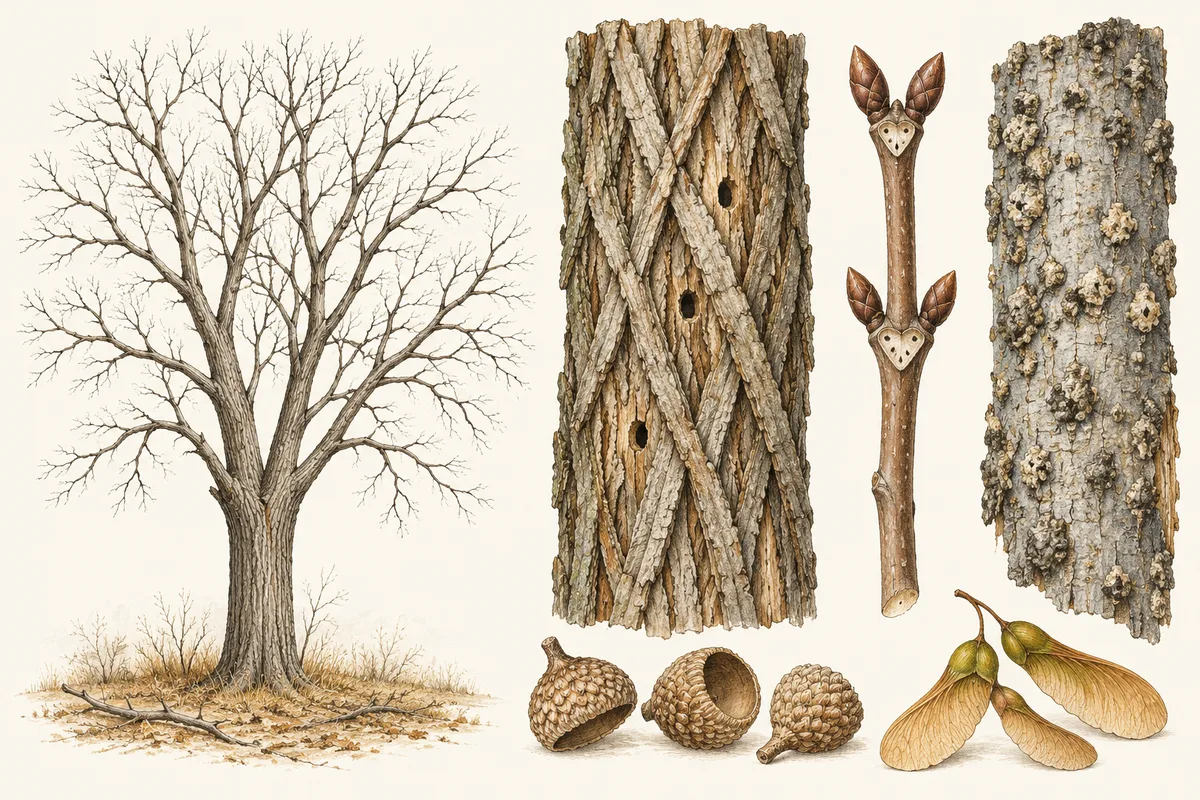
In short
To identify a dead tree, meaning to name what species it was, read the clues that outlast the leaves. Check whether twigs and buds sit opposite (maple, ash, dogwood, horse chestnut) or alternate. Read the bark: diamond-shaped ridges on white ash, corky warts on hackberry. Look for fruit, cones or old leaves underneath. If the bark has fallen off, the end grain of a cut branch still separates oak from maple.
- Branching outlives the leaves: opposite twigs in eastern North America point to maple, ash, dogwood, horse chestnut or a shrub such as elderberry.
- Bark is the best single clue on a dead trunk while it stays attached: diamonds on white ash, warts on hackberry, long curling plates on shagbark hickory.
- Ash and elm are the trees most often found dead in eastern towns: emerald ash borer leaves D-shaped exit holes, Dutch elm disease kills elms with a vase-shaped crown.
- A standing dead tree can drop limbs or fall without warning: look from a distance and leave removal near people, roads or wires to a certified arborist.
A tree that has died can still be named. The leaves are gone, but the tree's architecture is not: the way twigs and buds are arranged, the pattern of the bark, the shape of the crown, the fruit lying underneath and the wood inside all stay in place for months or years. This guide is about naming the species, not diagnosing why it died. One rule before you start: a standing dead tree can shed limbs or fall without warning, so look from a distance, never climb it, and leave removal near people, roads or wires to a certified arborist.
Read the clues in the order they disappear
A dead tree loses its clues in a predictable order. Start with the ones that fade first and work toward the ones that last.
- Leaves and fruit underneath. For the first season, the ground under a dead tree often holds its last crop: acorn caps, hickory husks, walnut shells, ash seeds, maple keys, pine or spruce cones. A few trees, such as young beech, hold dead leaves on their twigs through winter, which the University of New Hampshire Extension calls marcescent leaves. A dead leaf, even a brown one, still shows its shape and its edge.
- Twigs and buds. Buds formed the summer before the tree died stay on the twigs. The UNH Extension guide Mind Your B's to Identify Winter Trees starts with the branching: twigs are either opposite or alternate, and the opposite group in New England is short: maple, ash, horse chestnut, dogwood, plus shrubs such as viburnums and elderberry. Bud shape narrows it further. Shagbark hickory has a relatively large, stout bud, and a black birch twig, broken, smells strongly of wintergreen.
- Bark. Bark stays on the trunk for years on many trees and is the best single clue on a dead trunk. It loosens and falls in sheets as the wood underneath decays.
- Crown shape. The silhouette of the dead branches stays readable until the limbs break up.
- The wood. Once the bark is gone, only the wood is left. It still identifies many trees, but it needs a clean cut and a close look.
If you have a recent photo of the tree in leaf, from a phone, a real-estate listing or a street-view image, check it first: a picture of the living leaves settles more than any clue on the dead tree.
Bark patterns that last after death
Bark is where most dead trees are named. A few patterns are distinctive enough to work alone:
- White ash: ashy gray to brown, with interlacing corky ridges forming obvious diamonds, according to the Virginia Tech white ash fact sheet; older trees may be scaly. The same sheet describes the leaf scars as round at the bottom and notched at the top, with a bud sitting in the notch, a detail you can still see on dead twigs.
- Hackberry: smooth and gray-brown when young, soon breaking into corky individual warts that later run together into rough, irregular ridges, per the Virginia Tech hackberry fact sheet. Its twigs are slender and zigzag.
- Shagbark hickory: develops its shaggy plates as it matures, UNH Extension notes. The long plates curving away from the trunk survive well on a dead tree.
- Red oak: UNH notes that its fissures often show red coloring.
- Black gum: mature trees have very deep fissures, per UNH.
When bark starts to slough off, look at the pieces on the ground as well as the trunk: the outer surface of a fallen slab still shows the pattern, and its thickness and color add a clue.
Ash and elm: the trees most often found dead
In eastern and midwestern towns, two groups of trees account for a large share of the dead trees people ask about, because each has been hit by an introduced pest or disease.
Ash. USDA APHIS says the emerald ash borer has caused the death and decline of tens of millions of ash trees in North America since it was first found in southeast Michigan in 2002, with infestations detected in 38 states and the District of Columbia (as of the page read on 2026-10-21). A dead ash is named by its opposite branching, diamond-ridged bark and notched leaf scars. APHIS lists the beetle's signs: D-shaped exit holes in the bark, S-shaped tunnels under it, vertical bark cracks, bark stripped by woodpeckers looking for larvae, dead branches near the top and excessive branching on the trunk. Those marks point to ash borer, which attacks ash, so they also support the species call. The ash page covers the living tree.
Elm. The USDA Forest Service's silvics manual for American elm describes its characteristic vaselike crown, and notes that open-grown trees usually fork near the ground into wide arching crowns. It also says that scores of dead elms in forests, shelterbelts and towns are testimony to Dutch elm disease. The Morton Arboretum's Dutch elm disease page says highly susceptible elms may die in the year of infection, rates American elm as extremely susceptible, and rates lacebark and Siberian elm as highly resistant. Brown streaks under the bark of affected branches are further evidence, but only a laboratory test confirms the disease.
So a dead tree with a tall vase shape, alternate branching and ring-porous wood in a town that once had elm-lined streets is very likely an American elm.
Crown shape and branching from a distance
Before walking up to a dead tree, step back and look at the whole silhouette against the sky. Opposite branching often shows from the ground as paired limbs. The vase shape of American elm, the narrow oblong crown and straight trunk that Virginia Tech describes for white ash in good sites, and the zigzag twigs of hackberry are all visible without touching the tree. Compare the dead tree with living ones nearby, too: a dead tree in a row or a woodlot is often the same species as its neighbors. The winter tree identification guide has a twig key for 12 common eastern trees that works just as well on a dead tree with its twigs intact.
When only the wood is left
An old snag with no bark and no twigs still has wood, and the cut end of a fallen branch or a fresh cut on the trunk carries most of the information. Michigan State University's extension bulletin Identifying Wood: A Guide and a Key recommends a 10x hand lens and a sharp pocket knife, and explains what to check:
- Pores. Hardwoods have pores; conifers do not. In ring-porous woods, such as oak, elm, ash and hickory, the pores at the start of each growth ring are much larger than the rest. In diffuse-porous woods, such as maple and cottonwood, they are about the same size through the ring.
- Rays. The lines running from the center toward the bark are broad and distinct in oaks and beech.
- Heartwood color and smell. Only heartwood, the darker center, has a characteristic color and odor; the bulletin notes that no other American wood has the color of eastern redcedar, and that odor helps with Douglas-fir, basswood and the cedars, sometimes only after a fresh cut is moistened.
- Resin canals. Pines show tiny resin openings scattered along the growth ring, often visible to the eye.
Weathered gray wood shows none of this until you cut below the surface. If the tree has already been cut down, the tree stump guide walks through reading a stump, including the sprouts many hardwoods send up after cutting. If you plan to burn the wood, the firewood guide compares heat values by species.
Confirm the tree is really dead
Name the species first, then be careful about calling the tree dead. Many healthy trees look dead from November to April. Texas A&M Forest Service staff forester Gretchen Riley, quoted by Texas A&M AgriLife, uses a plain rule: a tree is dead if it has had no green leaves for a full growing season. The same article says dead or dying trees in natural areas are not usually dangerous, but those near homes, roads and power lines can be hazardous when they have structural defects, and that a doubtful tree should be evaluated by a certified arborist. Knowing the species helps that conversation: it tells the arborist whether ash borer or elm disease is likely, and which nearby trees of the same kind are at risk.
Where a photo app helps
Tree Identifier, an iPhone app that uses a cloud AI model and needs an internet connection, identifies trees from one photo, and a photo of the bark or of a dead leaf from the ground is often enough for it to suggest a species with its key traits. Ask the follow-up chat under the result what else to check, such as the bud arrangement. If you allow location, the Tree Map pins the tree so you can find it again in spring and compare it with living neighbors. Check the name yourself against the bark, buds and wood described above. Tree Identifier cannot tell you whether a dead tree is safe, what killed it, or whether it will fall; those calls belong to a certified arborist.
What a photo can't settle
- A photo can suggest which species a dead tree was when bark, buds or fruit are visible; it can't say whether the tree is safe, how rotten the trunk is, or why it died.
- Only a laboratory test confirms Dutch elm disease, and a photo cannot confirm emerald ash borer; those calls belong to an arborist or your state's extension or forestry office.
- A snag with no bark and no twigs is hard to name from a photo: the wood's pores and rays have to be seen up close on a fresh cut.
Questions people ask
Can you identify a tree after it dies?
Usually, yes. The branching pattern, buds, bark, crown shape and fallen fruit stay readable for a long time after death. The hardest case is an old snag that has lost its bark and twigs; then only the wood is left, and its pores, rays and heartwood color need a fresh cut and often a hand lens.
How do I know if a tree is dead and not just dormant?
Texas A&M Forest Service staff forester Gretchen Riley gives a simple rule: a tree is dead if it has had no green leaves for a full growing season. A bare tree in winter is not dead. If you are unsure about a tree near a house, road or power line, have a certified arborist look at it.
What does a dead ash tree look like?
An ash killed by emerald ash borer keeps its opposite branching and its bark of interlacing ridges forming diamonds. USDA APHIS lists D-shaped exit holes, S-shaped tunnels under the bark, vertical bark cracks, strips of bark removed by woodpeckers and dead branches near the top as signs of the beetle.
How can I tell if a dead tree was an elm?
Look at the shape first: the USDA Forest Service describes American elm's vaselike crown, and open-grown trees often fork low into wide arching limbs. Then check the wood of a cut branch: Michigan State's key shows elm as ring-porous, with the late part of each ring in wavy bands of small pores.
Is a dead tree safe to stand under?
Not reliably. Texas A&M AgriLife notes that dead trees near homes, roads and power lines can be hazardous when they have structural defects. Look from a distance, do not climb it or stand under hanging limbs, and leave pruning or removal to a certified arborist.
Sources
- Deciding when to remove a tree — Texas A&M AgriLife Today (Paul Schattenberg)
- Mind Your B's to Identify Winter Trees — University of New Hampshire Extension (Emma Tutein)
- White ash fact sheet — Virginia Tech Dendrology
- Hackberry fact sheet — Virginia Tech Dendrology
- Emerald Ash Borer — USDA Animal and Plant Health Inspection Service (APHIS)
- Dutch elm disease — The Morton Arboretum
- American Elm (Silvics of North America) — USDA Forest Service
- Identifying Wood: A Guide and a Key (Extension Bulletin E-746, archive copy) — Michigan State University Cooperative Extension Service (Eldon A. Behr)