Field guide
How to identify a tree by its stump
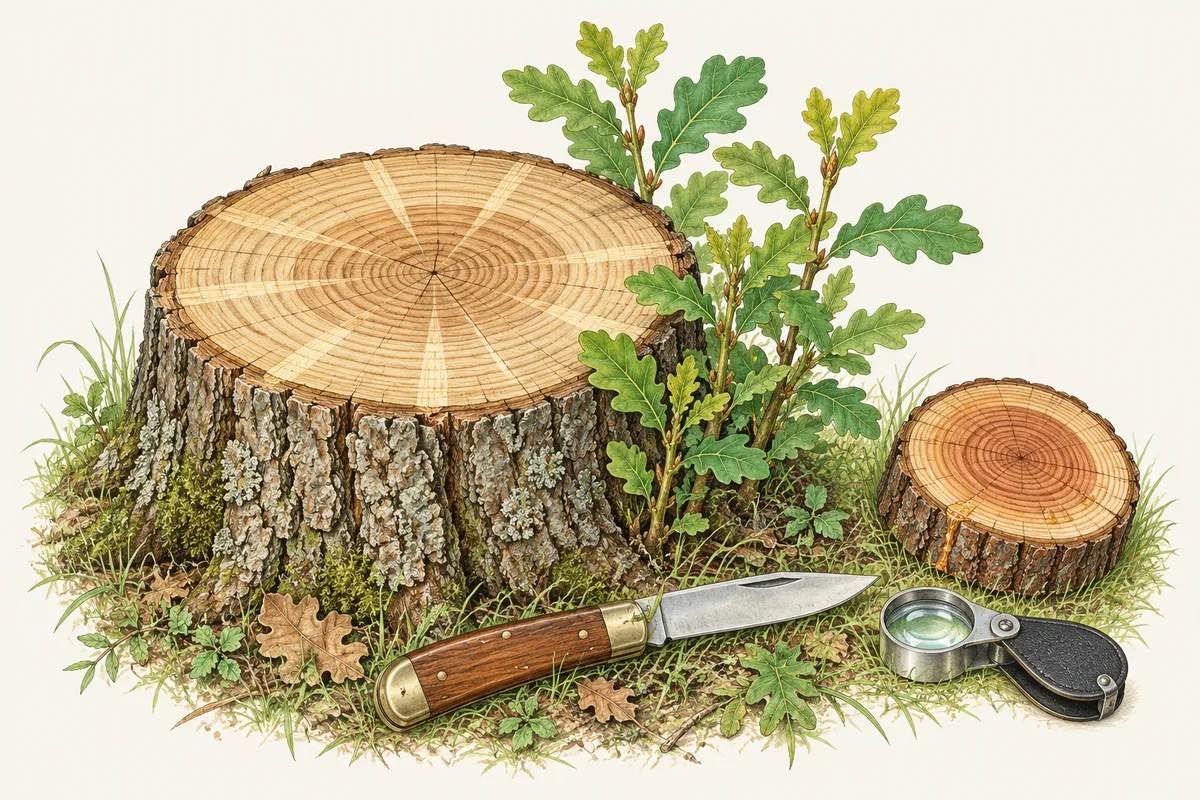
A stump keeps more of the tree than it looks. Check for sprouts first, then the bark on the sides, then the cut face with a sharp knife and a hand lens.
In short
Tree stump identification starts with sprouts: oak, ash, maple, cottonwood, willow and many other hardwoods send up shoots after cutting, and their leaves name the tree. Next read any bark left on the sides. Then pare a clean patch of the cut face: large pores at the start of each ring mean oak, ash, elm or hickory, even-sized pores mean maple, and no pores means a conifer.
- Sprouts are the fastest answer: their leaves name the stump. Most pines, junipers and cypresses do not resprout, so a conifer stump stays bare.
- On the cut face, ring-porous wood (oak, ash, elm, hickory) shows a band of large pores at the start of each ring; diffuse-porous wood (maple, cottonwood, birch) does not.
- Broad rays running from the center toward the bark point to oak or beech; tiny resin dots scattered in the rings point to a pine.
- Each growth ring is one year in temperate trees, so a ring count on the stump gives the tree's age at that height.
A tree stump holds more of the tree than it seems to: sprouts that will grow real leaves, a ring of bark on the sides, and a cut face that shows the structure of the wood. Most stumps can be named with three checks in the right order, a sharp pocket knife and, for the hardest cases, an inexpensive hand lens. Work through the checks below before the stump weathers gray, because a fresh cut shows far more than an old one.
Three checks, in order: sprouts, bark, cut face
- Look for sprouts. Many hardwoods send up new shoots from the stump or the roots after the tree is cut. Their leaves are the easiest clue of all: compare them with any leaf guide, or photograph them.
- Read the bark on the sides. Even after the trunk is gone, a band of bark stays on the stump. The pattern is the same one the tree had: diamond-shaped corky ridges on white ash, shaggy plates on shagbark hickory, red-tinged fissures on red oak.
- Read the cut face. With a sharp knife, pare a thin slice off a small patch of the top to get a clean surface across the grain, then look at the pores, the rays, the heartwood color and the smell. Michigan State University's extension bulletin Identifying Wood: A Guide and a Key says a 10x hand lens and a sharp pocket knife are of great help, and that many of the wood's structural differences appear most clearly on the end grain.
Add a fourth, informal check: look around. Logs and branches from the felled tree, leaves raked into a pile, cones or nuts on the ground and the neighboring trees often settle it faster than the stump itself.
Sprouts and root suckers: the leaves that name a stump
University of Arizona Cooperative Extension's cut stump publication explains that when the top of a tree is removed, many trees and shrubs produce new shoots from buds at or below ground level, called stump sprouts, which grow back vigorously on the energy stored in the roots. Its list of stump-sprouting trees includes oak, ash, aspen, cottonwood, maple and box elder, sycamore and willow. The same publication notes that most pines, junipers and cypresses do not resprout, with alligator juniper as one exception. So a conifer stump usually stays bare, and a bare stump with resin in the wood is probably a conifer.
Two trees deserve a closer look:
- Tree-of-heaven. Penn State Extension's tree-of-heaven page says a cut or injured tree may send up dozens of stump and root sprouts, and that established trees send up root suckers as far as 50 feet from the parent. The sprouts are easy to name: long compound leaves with smooth-edged leaflets, one or two glandular teeth at the base of each leaflet, and a strong, offensive odor when crushed. Sumac, black walnut and hickory, the look-alikes, have toothed leaflets.
- American elm. The USDA Forest Service's silvics manual notes that small American elm trees produce vigorous stump sprouts.
Compare leaves from several sprouts rather than one. The guide to young trees and saplings covers the look-alikes that trouble people most: black walnut, tree-of-heaven and sumac, ash, maple and boxelder.
What the cut face tells you
The table below follows Michigan State's key for the woods most often found as stumps in North American yards and woodlots. Look at a freshly pared patch, not the weathered surface.
| What you see on the cut face | Likely tree |
|---|---|
| No pores; resin canals visible as tiny light or dark dots along the rings | Pine (numerous in southern pines, less distinct in white pine) |
| No pores; purplish to rose-brown heartwood with a cedar-chest smell | Eastern redcedar |
| No pores; orange-red cast, very hard latewood, distinct smell when moistened | Douglas-fir |
| Large pores at the start of each ring; broad, distinct rays; red-brown heartwood, pores open | Red oak group |
| Large pores at the start of each ring; broad rays; yellowish heartwood, early pores plugged | White oak group |
| Ring-porous; purplish brown to chocolate heartwood with a distinct smell | Black walnut |
| Ring-porous; very hard and heavy; pores not in a continuous row | Hickory or pecan |
| Ring-porous; late part of each ring in wavy bands of small pores | Elm |
| Ring-porous; continuous band of early pores, then poreless areas with isolated pores | Ash |
| Diffuse-porous; broad rays easily seen on the cut face | Beech |
| Diffuse-porous; narrow rays, light tan wood | Maple |
| Diffuse-porous; rays visible to the eye; medium to deep reddish brown | Black cherry |
| Diffuse-porous; sapwood creamy, heartwood green or yellowish green | Yellow-poplar (tulip tree) |
| Diffuse-porous; grayish, pores barely visible, sometimes an unpleasant smell when wet | Cottonwood |
Three notes from the same bulletin make the table easier to use. Ring-porous means the pores at the start of each growth ring are markedly larger than those later in the ring; diffuse-porous means they are about the same size throughout. Rays are the lines running outward from the center to the bark, and they are distinctive in oaks and beech, where they are quite broad. And only heartwood, the darker center, has a characteristic color and smell; sapwood has neither, and odors such as those of Douglas-fir, basswood and the cedars may only show on a fresh cut that has been moistened.
Bark left on the stump
The bark on the sides of a stump is often the quickest confirmation of what the cut face suggests. Virginia Tech's white ash fact sheet describes ash bark as ashy gray to brown, with interlacing corky ridges forming obvious diamonds. The University of New Hampshire Extension's guide Mind Your B's notes that red oak bark often shows red coloring in its fissures, that mature black gum has very deep fissures, and that shagbark hickory develops its shaggy plates as it matures. The bark identification guide walks through bark patterns tree by tree.
Bark on a stump changes as it dries and decays. It can darken, crack and lift away from the wood, so judge the pattern rather than the exact color, and look for a piece that is still tight to the wood.
Counting the rings for age
Once the stump has a name, its rings give its age. Michigan State's bulletin notes that all temperate-zone trees have growth rings and that each ring indicates one year's growth; most tropical woods do not show true rings. Count from the center to the bark on a clean, freshly cut or sanded patch. The count gives the age at the height of the cut, so a stump cut close to the ground comes nearest the full age. For a tree that is still standing, the tree age calculator estimates age from the trunk's girth and a growth factor for the species, which is another reason to know the species first.
Where a photo app helps
For a stump, Tree Identifier, an iPhone app that uses a cloud AI model and needs an internet connection, works best on the parts that look like a living tree: a photo of the sprouts' leaves or of the bark on the side is usually more useful than a photo of the weathered top. It returns a common and scientific name with key traits, and the follow-up chat under the result can answer questions such as whether that species is known to resprout. Check its suggestion against the cut face, using the table above. Tree Identifier can't tell you what is decaying a stump, whether a mushroom on it is toxic, or how far its roots run; for those, ask a certified arborist or your county extension office.
What a photo can't settle
- A photo of a weathered stump top rarely names the species: pores and rays have to be seen on a fresh, clean cut, often with a 10x hand lens.
- Sapwood, the pale outer band, has no characteristic color or smell, so a stump with only sapwood left is harder to name than one with heartwood.
- A photo app can't say whether a stump will resprout, how deep its roots run or what is decaying it; a certified arborist or your extension office can.
Questions people ask
Can you identify a tree from just the stump?
Often, yes. Sprouts growing from the stump or its roots carry leaves that name the tree. Without sprouts, bark left on the sides and the cut face do the work: pores, rays, heartwood color and smell separate oak from maple, walnut from cherry and pine from spruce. Old, weathered stumps are the hardest, because the surface turns gray.
How can I tell if a stump is oak?
Pare a clean patch on the cut face. Oak is ring-porous, with a band of large pores at the start of each ring, and its rays are broad and easy to see. Michigan State's key separates the two oak groups: red oak heartwood has a red-brown cast with open pores, white oak a yellowish cast with the early pores plugged.
Will the stump grow back?
It depends on the species. University of Arizona Extension lists oak, ash, aspen, cottonwood, maple and box elder, sycamore and willow among stump-sprouting trees, and notes that most pines, junipers and cypresses do not resprout. Tree-of-heaven can send up dozens of stump and root sprouts after cutting, Penn State Extension says.
How do I tell the age of a tree from its stump?
Count the growth rings on a clean cut face, from the center out. Michigan State's bulletin notes that each ring indicates one year's growth in temperate trees. The count gives the age at the height of the cut, so a low stump comes closest. For a standing tree, the tree age calculator gives an estimate from the trunk's girth.
What is the mushroom growing on my stump?
This guide covers naming the tree, not fungi. Many fungi grow on stumps, and some are toxic. Never eat a mushroom, berry, nut or seed on the strength of a web page or an app; check with a local expert, such as a mycological society or your extension office.
Sources
- Identifying Wood: A Guide and a Key (Extension Bulletin E-746, archive copy) — Michigan State University Cooperative Extension Service (Eldon A. Behr)
- Cut Stump Application of Herbicides to Manage Woody Vegetation (AZ1401) — University of Arizona Cooperative Extension (Jeff Schalau)
- Tree-of-Heaven — Penn State Extension (David R. Jackson, Art Gover, Sarah Wurzbacher)
- American Elm (Silvics of North America) — USDA Forest Service
- White ash fact sheet — Virginia Tech Dendrology
- Mind Your B's to Identify Winter Trees — University of New Hampshire Extension (Emma Tutein)