Prairie provinces field guide
Trees of Manitoba and Saskatchewan, zone by zone
Both provinces run from grassland in the south through aspen parkland to boreal forest and taiga in the north. Each band has a short list of trees, and most of them are easy to learn.
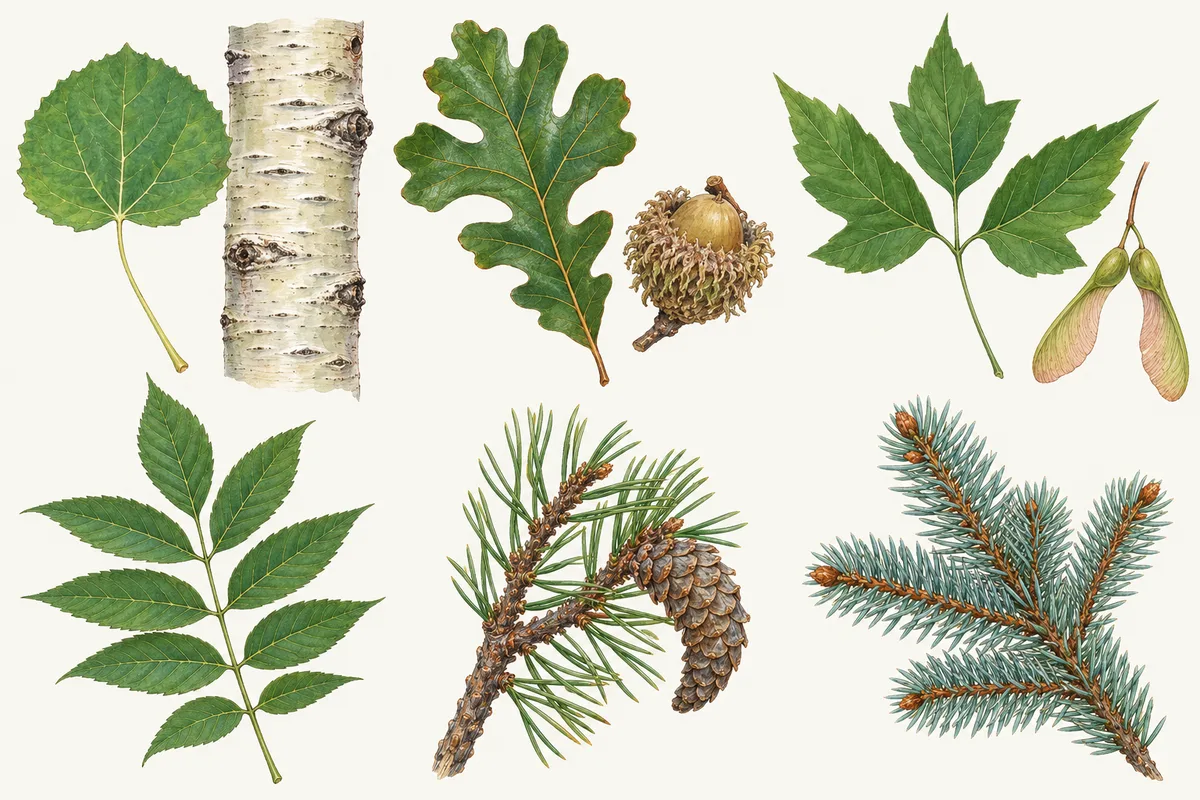
In short
Manitoba and Saskatchewan tree identification starts with the zone you stand in. In the boreal forest, learn white spruce (Manitoba's tree), black spruce, jack pine, tamarack, balsam fir, white birch (Saskatchewan's tree), trembling aspen and balsam poplar. In the aspen parkland, aspen groves. In prairie river valleys, bur oak, green ash, Manitoba maple and American elm.
- Forests cover about 26.3 million hectares of Manitoba's 54.8 million hectare land base, according to the Province of Manitoba.
- White spruce is Manitoba's provincial tree; white birch, with its papery white bark, has been Saskatchewan's since 1988.
- In the south, trees follow water: aspen bluffs on moist north-facing slopes and in hollows, and bur oak, green ash and Manitoba maple along river valleys.
Manitoba and Saskatchewan look like flat farmland from the highway, but both provinces reach far north into forest, and their trees change from south to north in clear bands. This guide follows those bands, from the prairie river valleys to the boreal forest, with the trees most worth learning in each and one clue that settles each tree. Measurements are from Natural Resources Canada's (NRCan) tree factsheets unless another source is named. Never eat a berry, nut, seed or pod on the strength of a web page or an app; check with a local expert.
The Prairie provinces' trees at a glance
The Encyclopedia of Saskatchewan's ecozones and ecoregions entry (Diane Secoy, University of Regina) divides Saskatchewan into four ecozones: the Taiga Shield in the far north, the Boreal Shield, the Boreal Plain and the Prairie. The Province of Manitoba describes its Northeast Region as boreal forest "transitioning to taiga in the far north". Find your band, then use the table.
| Tree | Where you meet it | The feature that settles it |
|---|---|---|
| White spruce | Boreal uplands, Manitoba's tree | Stiff blue-green needles 15–22 mm, pungent when crushed, hairless twig |
| Black spruce | Bogs, fens, Shield country | Short dull needles 8–15 mm, round cones massed at the top |
| Jack pine | Sand and rock | Two needles per bundle, 2–4 cm; curved cones that stay shut |
| Tamarack | Bogs and muskeg | Soft needles in tufts of 15–60 that drop in autumn |
| Balsam fir | Moist boreal mixedwoods | Flat needles 15–25 mm, resin blisters on young bark |
| White birch | Throughout, Saskatchewan's tree | Creamy-white bark peeling in sheets |
| Trembling aspen | Parkland groves and boreal | Round leaves 3–7 cm that flutter on flat stalks |
| Balsam poplar | River valleys, moist ground | Sticky, fragrant buds; leaves stained brown beneath |
| Bur oak | Southern river valleys and ridges | Acorn cup with a fringe of long scales |
| Green ash | River valleys | Opposite compound leaves, usually 7 leaflets |
| Manitoba maple | River banks, towns | Opposite compound leaves of 3–9 leaflets, winged keys |
| American elm | Wet river flats | Alternate leaves 10–15 cm with 15–20 veins per side, vase-shaped crown |
The boreal forest: spruce, pine, fir, birch and aspen
North of the parkland lies the boreal forest. The Province of Manitoba's forestry page says forests cover about 26.3 million hectares of the province's 54.8 million hectare land base, and describes the boreal forest as "black spruce in the lowland bogs and fens, and jack pine, poplar and white spruce on the uplands." The Encyclopedia of Saskatchewan lists white and black spruce, jack pine, aspen, white birch and balsam poplar on the Boreal Plain, and dense black spruce, with birch, poplar, jack pine and tamarack, on the Boreal Shield.
- White spruce (Picea glauca), Manitoba's tree: stiff, straight needles 15 to 22 mm, green to bluish-green, on hairless twigs, "unpleasantly pungent when crushed" in NRCan's words. Cones are slender, cylindrical and 3 to 6 cm long. NRCan gives its range as throughout Canada except the Pacific coast.
- Black spruce (Picea mariana): shorter needles, 8 to 15 mm, dull greyish-green, on twigs with many short brownish hairs. Its small cones, almost round when open, crowd the top of the tree and can stay on for up to 30 years. On wet ground it grows a narrow, spire-like crown. The spruce vs fir guide helps when spruce and balsam fir grow together.
- Jack pine (Pinus banksiana): stiff, slightly twisted needles in pairs, 2 to 4 cm, and curved, lopsided cones 3 to 7 cm that point forward along the branch. NRCan says they usually stay closed on the tree for 10 to 20 years until heat from a wildfire opens them. It calls jack pine the most widely distributed pine in Canada, on coarse sands, shallow soils and rock.
- Tamarack (Larix laricina): a conifer that drops its needles, which grow in tufts of 15 to 60 on short shoots. NRCan places it on cold, wet sites such as sphagnum bogs and muskeg, often with black spruce.
- Balsam fir (Abies balsamea): flat needles 15 to 25 mm with white lines beneath and a strong smell when crushed, resin blisters on smooth young bark, and upright cones that break apart in autumn.
- White birch (Betula papyrifera): bark dark red on young stems, turning bright creamy white and shedding in large sheets; leaves 5 to 10 cm with double-toothed edges.
- Trembling aspen (Populus tremuloides): broadly oval to nearly round leaves 3 to 7 cm with 20 to 30 fine teeth per side, on flattened stalks usually longer than the blade, so the crown shivers in any wind. Bark is pale green to almost white and smooth. NRCan says it grows throughout the forested areas of Canada.
- Balsam poplar (Populus balsamifera): leaves 7 to 12 cm with a long, drawn-out tip, silvery green beneath and usually stained with brownish resin blotches; very resinous, fragrant buds up to 25 mm long. The poplar guide sorts the aspens, poplars and cottonwoods.
In southeastern Manitoba, add red pine (Pinus resinosa): long needles in pairs, 10 to 16 cm, that snap cleanly when bent, and reddish, platy bark. NRCan gives its range as southeastern Manitoba to Newfoundland.
Aspen parkland and the prairie river valleys
South of the boreal forest lies the aspen parkland, a band of grassland, aspen groves and wetlands. The Encyclopedia of Saskatchewan places the aspen groves on "the moister north-facing slopes and low-lying depressions", and describes the Boreal Transition as a deciduous boreal forest with a higher share of trembling aspen. Farther south, on the open prairie, trees grow mainly along streams and sloughs.
The river valleys are where the broadleaf variety is. The Province of Manitoba's regions page names "burr oak, Manitoba maple, and green ash on ridges and along the banks of the Saskatchewan River" in its Northwest Region, and the Encyclopedia of Saskatchewan adds American elm and green ash in lowlands near water on the Boreal Plain.
- Bur oak (Quercus macrocarpa): leaves 15 to 30 cm, often with a broad, toothed upper part above two deep notches; acorns 20 to 30 mm in a large cup that covers half or more of the nut, fringed with long-pointed scales; branchlets often with corky ridges. NRCan's range runs from southern Saskatchewan east to New Brunswick, on bottomlands, grasslands and shallow soils.
- Green ash (Fraxinus pennsylvanica): opposite, compound leaves of 5 to 9, usually 7, leaflets 10 to 15 cm long, and bark in narrow ridges that form a diamond pattern. NRCan calls green ash the common ash form in the Prairie provinces and says the species is confined to river valleys there.
- Manitoba maple (Acer negundo), box-elder in the US: opposite, compound leaves of 3 to 9 leaflets and paired keys with incurved wings in drooping clusters. NRCan lists lakeshores, stream banks, seasonally flooded and disturbed sites. The boxelder page has more.
- American elm (Ulmus americana), white elm in NRCan's factsheets: alternate leaves 10 to 15 cm, rough above, with 15 to 20 veins per side; a buttressed trunk and a graceful vase- or umbrella-shaped crown with drooping branch tips. It favours wet sites and alluvial flats.
- Choke cherry (Prunus virginiana): a small tree to 9 m with sharply toothed leaves 5 to 10 cm, flowers in dense cylindrical clusters 8 to 15 cm long, and fruit 8 to 10 mm that varies from yellow to crimson to black. NRCan notes a very strong bitter almond odour from bruised twigs. It is transcontinental except for coastal British Columbia.
On the farms, NRCan notes that balsam poplar is frequently planted in rural areas for shelterbelts and windbreaks, so a poplar by a farmyard may not be wild.
The Cypress Hills and the far north
Two areas break the pattern. The Cypress Upland in southwestern Saskatchewan is an unglaciated plateau whose higher elevations, the Encyclopedia of Saskatchewan says, support a forest associated with the montane forests farther west: lodgepole pine, white spruce and aspen. Lodgepole pine also carries its needles in pairs; the Alberta tree guide covers it in its home range.
In the far north, the Taiga Shield carries lichen woodlands on higher ground and bogs in the lowlands; the jack pine, black spruce and tamarack clues above carry you that far north.
Provincial trees, free guides and a photo app
- Manitoba: white spruce. Canadian Heritage's Manitoba page describes it as "capable of surviving in virtually every climatic and environmental region of Manitoba" and widely grown as a Christmas tree.
- Saskatchewan: white birch, adopted as a provincial symbol in 1988. Canadian Heritage's Saskatchewan page calls it easily recognized by its papery white bark and found throughout the province.
The Canada tree identification guide lists every other provincial tree. For measurements and range maps of every species on this page, NRCan's free factsheets (read on 21 October 2026) are the standard reference for both provinces: each gives leaves or needles, buds, twigs, cones or fruit, bark, size, habitat and range.
When a spruce is too tall to reach or a river-valley tree has dropped its leaves, Tree Identifier names a tree from one photo of a needle spray, a leaf, the bark or the fruit. Ask its follow-up chat a question such as "is this green ash or Manitoba maple?"; it shows no confidence score and no look-alike list, so check the result against the leaf arrangement and the one feature in the table above. The app's Collection includes white birch and American elm, and its Tree Map keeps each find you locate, useful for a bur oak you want to check again when its acorns drop.
What a photo can't settle
- Shelterbelts, farmyards and city streets on the Prairies are full of planted trees, including poplars bred for shelterbelts and non-native species, which a native-tree list will not cover.
- NRCan notes that trembling aspen leaves on fast-growing shoots can be heart-shaped and larger or smaller than the usual round ones, so one leaf photo from a sucker may not match a guide.
- Green ash and white elm are both common in river valleys and both have toothed leaves; a photo of a single leaf from the ground can mislead, so check whether leaves are opposite (ash) or alternate (elm).
Questions people ask
What are the most common trees in Manitoba?
In the boreal forest that covers most of the province's forest land, the Province of Manitoba names black spruce in lowland bogs and fens and jack pine, poplar and white spruce on the uplands. In the south, trembling aspen dominates the parkland groves, with bur oak, green ash and Manitoba maple along rivers.
What is Manitoba's provincial tree?
The white spruce (Picea glauca). Canadian Heritage describes it as able to survive in virtually every climatic and environmental region of Manitoba. Look for stiff blue-green needles 15 to 22 mm long that smell unpleasant when crushed, on hairless twigs, and slender cones 3 to 6 cm long.
What is Saskatchewan's provincial tree?
The white birch (Betula papyrifera), adopted in 1988. Canadian Heritage says it is found throughout the province and is easily recognized by its papery white bark, which First Nations communities used for canoes, baskets and utensils. Its leaves are 5 to 10 cm with double-toothed edges.
What trees grow in southern Saskatchewan?
Few, and mostly near water. The Encyclopedia of Saskatchewan describes aspen bluffs dotting the grasslands and aspen groves on moister north-facing slopes and hollows in the parkland. Trees and shrubs follow stream courses and permanent sloughs, and the Cypress Hills carry lodgepole pine, white spruce and aspen.
Is a Manitoba maple a real maple?
Yes. Manitoba maple (Acer negundo), also called box-elder, is a maple with compound leaves of 3 to 9 leaflets, which makes it look like an ash. Its paired, winged keys in drooping clusters give it away as a maple.
Sources
- Ecozones and ecoregions (The Encyclopedia of Saskatchewan) — Canadian Plains Research Center, University of Regina
- Forestry — Province of Manitoba, Natural Resources and Indigenous Futures
- Parks and regional services: regions — Province of Manitoba (gov.mb.ca)
- Trees, insects and diseases of Canada's forests: tree factsheets — Natural Resources Canada, Canadian Forest Service
- Manitoba: provincial symbols — Canadian Heritage, Government of Canada
- Saskatchewan: provincial symbols — Canadian Heritage, Government of Canada
Keep reading
- Alberta field guideAlberta trees, natural region by natural region
- Canada field guideTree identification in Canada, region by region
- Tree profileBoxelder (Acer negundo): how to identify it
- Tree profilePoplars, cottonwoods and aspens (Populus): how to identify them
- Tree comparisonSpruce vs fir: how to tell them apart